A usable ginger supplement specification connects six decisions: ingredient form, marker compounds, assay basis, amount per serving, dosage form, and quality requirements. Together, these determine what a supplier should quote and what the finished product must deliver.
Start with the product requirement:
Your requirement | Your first specification decision |
|---|---|
| A whole-botanical product | Specify Zingiber officinale rhizome powder and its quality attributes |
| A defined gingerol amount per serving | Specify the measured gingerols, concentration, and reporting basis |
| A gingerol-and-shogaol profile | Define the individual compounds and how any combined total is calculated |
| Ginger aroma or a volatile fraction | Specify the volatile profile rather than relying on a gingerol percentage |
| A low-mass capsule, gummy, or liquid serving | Calculate the ingredient requirement, then assess format feasibility |
1. Select the Ginger Preparation
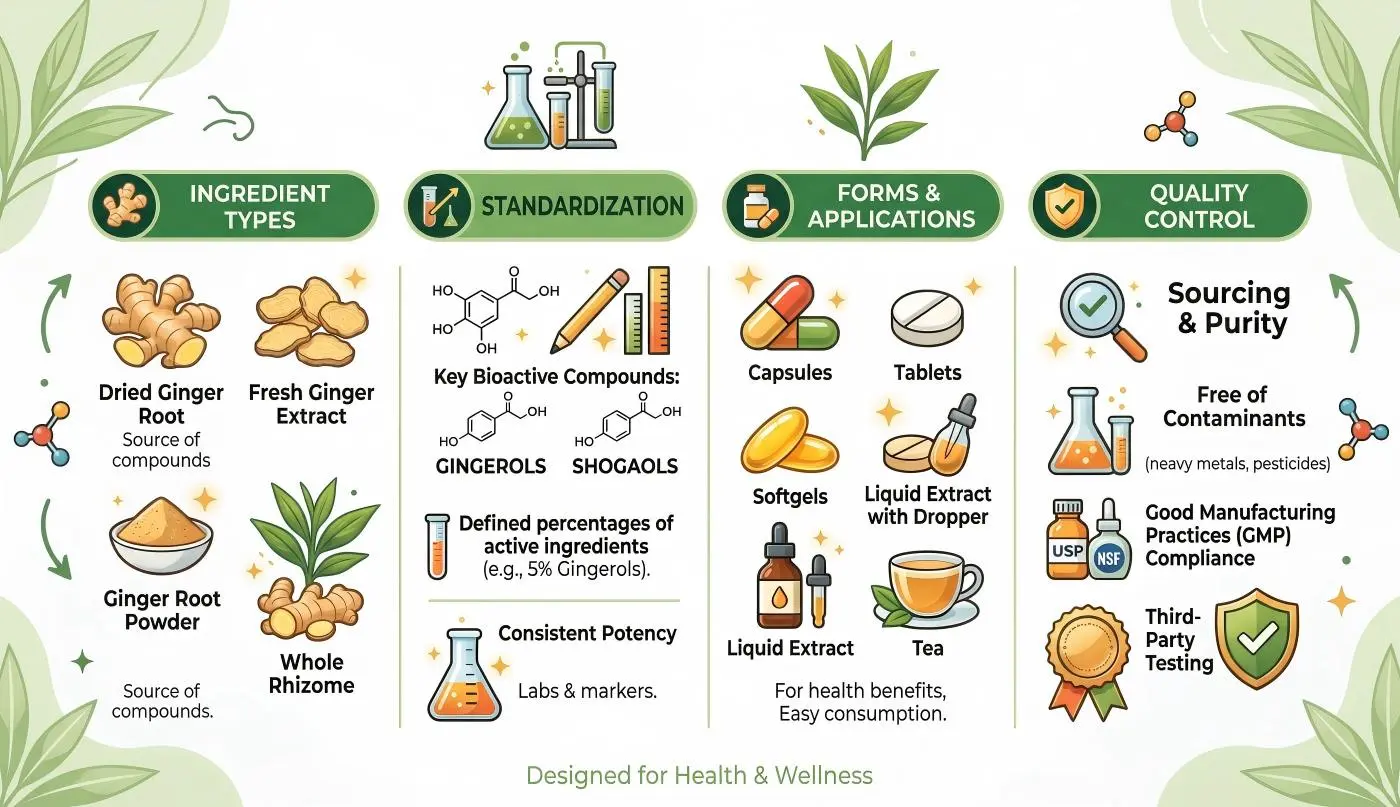
Ginger powder, dry extract, oleoresin, and volatile oil have different compositions and handling requirements. The botanical name alone does not define the material being purchased.
Ingredient form | What to establish | Main sourcing questions |
|---|---|---|
| Rhizome powder | Botanical identity, plant part, particle size, moisture, and relevant contaminant limits | Is a marker assay needed? Does the required mass fit the serving? |
| Dry extract | Extraction information, carriers, physical properties, and marker results | Is the material standardized, or described only by an extract ratio? |
| Standardized extract | Named markers, concentration limits, method, and assay basis | Which compounds are measured, and does the percentage apply to the supplied ingredient? |
| Oleoresin | Pungent-constituent profile, composition, physical form, and handling requirements | Is the material compatible with the proposed fill or formulation? |
| Volatile oil | Volatile profile, identity, purity, and intended function | Does the product need aroma-related constituents or a nonvolatile marker specification? |
For a powder-based product, assess replacement with an extract as a formula change: ingredient mass, composition, processing behavior, and product description may all need revision. For a marker-led product, compare quantified constituents rather than ingredient names.
Processing can change the marker profile
Gingerols can dehydrate to form shogaols during processing, including drying and heat exposure. The resulting distribution depends on the preparation and processing conditions. Request analytical data for the purchased material rather than inferring its composition from “fresh ginger,” “dried ginger,” or an extraction-process name.[1][2]
2. Define the Marker Specification and Extract Ratio
A statement such as “ginger extract 5%” is incomplete. The specification needs to identify what the percentage measures.
Supplier wording | Information required for comparison |
|---|---|
| 5% total gingerols | The gingerols included in the sum, their individual results where required, and the calculation rule |
| 5% 6-gingerol | Confirmation that the result applies to 6-gingerol alone |
| 5% gingerols + shogaols | Each included compound and whether the percentage is a combined total |
| 5:1 ginger extract | The starting-material-to-extract relationship, its calculation basis, and whether it describes native extract or commercial material containing carriers |
An extract ratio describes a material relationship; it does not establish gingerol content. Compare ratios only after clarifying their definitions, then use batch assay results to compare marker concentrations.
For each candidate ingredient, request:
- Named analytes and the definition of any reported total.
- Assay units, such as % w/w or mg/g.
- Reporting basis: as-is, dry basis, or another stated basis.
- Specification limits and actual batch results.
- Analytical method reference.
- Carrier or excipient composition.
These fields provide a common basis for supplier comparison before price or ingredient weight is evaluated.
3. Calculate the Ingredient Amount per Serving
When the marker percentage applies to the supplied ingredient on the formulation basis:
Ingredient amount per serving (mg) = target marker amount (mg) ÷ marker fraction
Convert the percentage to a decimal: 5% becomes 0.05.
Illustrative marker concentration | Ingredient amount per serving | Calculated marker amount |
|---|---|---|
| 5% | 500 mg | 25 mg |
| 10% | 250 mg | 25 mg |
| 20% | 125 mg | 25 mg |
The 25 mg target is hypothetical. These calculations do not establish an appropriate consumer intake or clinical equivalence between preparations.
Before finalizing the formula, reconcile the assay with the material being weighed:
- For a dry-basis result, confirm the laboratory’s basis definition and corresponding correction data.
- For a native-extract result, establish the concentration in the commercial ingredient after carriers or excipients are included.
- For a combined marker result, check that the formula target uses the same compound definition.
Record ingredient mass and marker mass as separate fields. A higher concentration reduces the calculated ingredient mass needed for the same marker target, but selection still depends on composition, processing performance, and the finished format.
4. Check Dosage-Form Feasibility Before Purchasing the Ingredient
The calculated ingredient amount becomes an input to format development. Assess it alongside excipients, serving count, manufacturing conditions, and packaging.
Format | Feasibility questions |
|---|---|
| Capsules | Does the blend fit the proposed capsule size and count? Are bulk density, flow, blend uniformity, and filling performance acceptable? |
| Tablets | Are compression behavior and disintegration suitable? Can the specified markers be measured in the tablet matrix? |
| Gummies | Can the serving accommodate the ingredient mass? Are pungency, distribution, processing exposure, and storage performance acceptable? |
| Softgels | Is the ingredient compatible with the fill and shell? Can the laboratory recover and measure the markers from the fill matrix? |
| Drink mixes | Are dispersion, flavor, appearance, sedimentation, and moisture protection acceptable? |
| Liquids | Can the selected system maintain its physical, microbiological, and marker specifications in the proposed package? |
Provide the manufacturer with the ingredient specification, calculated amount per serving, carrier composition, proposed serving configuration, and packaging concept. Request a feasibility assessment before committing to a production quantity.
Extraction and carrier information to obtain
Assess extraction processes by the material they produce, not by labels such as “premium” or “solvent-free.” Request the extraction solvents or process information available, declared carriers and their proportions, relevant residue controls, physical properties, and storage instructions.
Use this information to resolve practical questions: whether the material can be blended or filled, whether it disperses as required, and which process-related tests belong in the quality specification.
5. Establish the COA and Supplier Document Package
A batch-specific Certificate of Analysis should link the supplied material to agreed limits and reported results. Supporting documents complete the review where information is not shown on the COA.
Review area | Information to obtain |
|---|---|
| Traceability | Ingredient name, supplier, lot identifier, specification version, and relevant manufacturing or testing dates |
| Identity | Zingiber officinale, rhizome, preparation type, and an identity method appropriate to the material |
| Marker assay | Analytes, totals definition, method, units, reporting basis, limits, and batch results |
| Physical attributes | Relevant moisture or loss-on-drying result, particle size, density, appearance, and other process-critical attributes |
| Contaminants | Agreed elemental impurity, pesticide, and microbiological criteria based on material risks and market requirements |
| Process residues | Solvent or other process-related controls relevant to the manufacturing route |
| Composition | Carrier and excipient declaration, with proportions or ranges needed for formulation |
| Handling | Packaging, storage conditions, and retest or shelf-life information |
| Supporting records | Specification sheet, method information, relevant declarations, and available stability documentation |
For contaminant testing, request the actual panel, limits, methods, and results. A statement such as “heavy metals tested” does not identify which elements were measured or whether the specification meets the intended market’s requirements.
For laboratory method evaluation, NIST’s RM 8666 ginger extract reference material provides characterized ginger constituents and reference values for selected elemental contaminants. It supports measurement assessment rather than qualifying a supplier’s commercial batch.[4]
6. Define Testing for the Ingredient and Finished Matrix
Testing should answer a specific question at each stage.
Stage | Primary control question |
|---|---|
| Incoming ingredient | Does the received lot meet the approved identity, composition, and quality specification? |
| In-process | Are the selected blend or process attributes within the agreed operating criteria? |
| Finished-product release | Does the completed dosage form meet its release specification? |
| Stability | Do the selected attributes remain within acceptance criteria over the proposed shelf life? |
Specify the finished-product testing scope during development. The analytical laboratory needs the actual matrix, target concentrations, analytes, and acceptance criteria to assess sample preparation, recovery, interference, and reporting capability.
How to use AOAC SMPR 2017.012
AOAC SMPR 2017.012 provides performance requirements for selected nonvolatile ginger constituents. Within its scope, required analytes are 6-, 8-, and 10-gingerols and 6-shogaol. Required matrices include rhizome powder, rhizome dry extract, and tablets or capsules containing powder or dry extract; soft extract, tincture, and softgel matrices are optional.[3]
Use the framework to discuss method performance with the laboratory. Ask for suitability evidence covering the claimed analytes and the actual formulation, especially where the matrix differs from those already demonstrated. Referencing an SMPR is neither product certification nor proof that a particular procedure works for every dosage form.
7. Plan Stability With the Commercial Package
Set the target shelf life and packaging concept before agreeing on the stability protocol. The plan should identify:
- The finished formula and package configuration.
- Intended storage and distribution conditions.
- Marker assay and other critical quality attributes.
- Relevant physical and microbiological tests.
- Test intervals, methods, and acceptance criteria.
- The evidence required to support the proposed shelf life.
Select accelerated and real-time conditions for the actual product and market. Ingredient storage information is useful background, but finished-product shelf life requires evidence relevant to the formula and package being sold.
8. Review Evidence, Safety, and Claims Against the Actual Product
When assessing a proposed claim, compare the studied preparation with the formula being developed: ingredient type, composition, amount, population, and measured outcomes. A marker specification characterizes composition; it does not establish that results from another ginger preparation apply to the finished product.
NCCIH describes potentially helpful effects for some uses, including pregnancy-associated nausea and menstrual cramps, while reporting uncertain or unsupportive evidence for others. Its summary also identifies possible oral side effects, including abdominal discomfort, heartburn, diarrhea, and mouth or throat irritation, and advises healthcare consultation for people taking medicines and for use during pregnancy.[5]
Translate this into a product-specific review of the intended users, serving, warnings, evidence, and market requirements. Keep decisions about consumer use separate from arithmetic marker calculations.
Review marketing across labels, product pages, social media, and directions for use. FDA’s June 2024 warning letter to Natural Ginger, Corp/Jonaus Corp cited online disease-related claims as evidence of intended drug uses. Adding “support” or a disclaimer does not by itself resolve a claim’s regulatory status.[6]
9. Prepare a Quote-Ready Manufacturing Brief
A useful RFQ separates confirmed requirements from decisions the supplier or manufacturer needs to help resolve.
RFQ field | Information to provide |
|---|---|
| Project and market | Project name, target countries, proposed product category, and intended users |
| Ingredient | Botanical identity, rhizome, and required preparation type |
| Composition | Extract ratio if relevant, extraction information, carriers, and excipients |
| Marker specification | Analytes, concentration limits, method, and reporting basis |
| Serving target | Ingredient mg and marker mg per serving, recorded separately |
| Format | Dosage form, units per serving, and servings per pack |
| Quality and testing | Identity, assay, physical attributes, contaminants, residues, and finished-product testing scope |
| Packaging and stability | Package concept, storage conditions, and target shelf life |
| Commercial scope | Estimated initial quantity, forecast if available, and target launch schedule |
| Open decisions | Feasibility, samples, documentation, testing, or formulation questions requiring a response |
Turn an incomplete request into an actionable brief
An initial request might read:
Ginger extract, 5%, 500 mg per capsule.
A more useful technical brief separates the known requirement from the open questions:
Ingredient: Zingiber officinale rhizome dry extract.
Proposed amount: 500 mg per capsule, subject to feasibility review.
Marker definition: supplier to confirm whether the quoted 5% refers to total gingerols or a named compound.
Required documents: batch COA, assay method and reporting basis, carrier composition, and ingredient specification.
Market, quality limits, packaging, and shelf-life requirements: to be supplied before quotation approval.
For a KS Nutripharma project discussion, submit the brief with any existing specification or COA. Request confirmation of ingredient options, dosage-form feasibility, testing responsibilities, documentation, MOQ, lead time, and quotation scope.
References
- Sang S, Snook HD, Tareq FS, Fasina Y. Precision Research on Ginger: The Type of Ginger Matters. Journal of Agricultural and Food Chemistry. 2020;68(32):8517–8523. PubMed
- Impact of Thermal Processing on the Composition of Secondary Metabolites of Ginger Rhizome—A Review. Foods. 2022;11(21):3484. Full text
- AOAC INTERNATIONAL. AOAC SMPR® 2017.012: Standard Method Performance Requirements for Quantitation of Select Nonvolatile Ginger Constituents. AOAC PDF
- National Institute of Standards and Technology. A New Control for Measuring Active Compounds and Contaminants in Ginger Root. NIST
- National Center for Complementary and Integrative Health. Ginger: Usefulness and Safety. NCCIH
- U.S. Food and Drug Administration. Natural Ginger, Corp/Jonaus Corp — Warning Letter, June 25, 2024. FDA