Editorial note: This article is written for supplement brands, procurement teams, and product developers. Traditional uses and research findings are presented for formulation and educational context and should not be treated as approved health claims. Finished-product claims and market access requirements must be reviewed for the target jurisdiction.
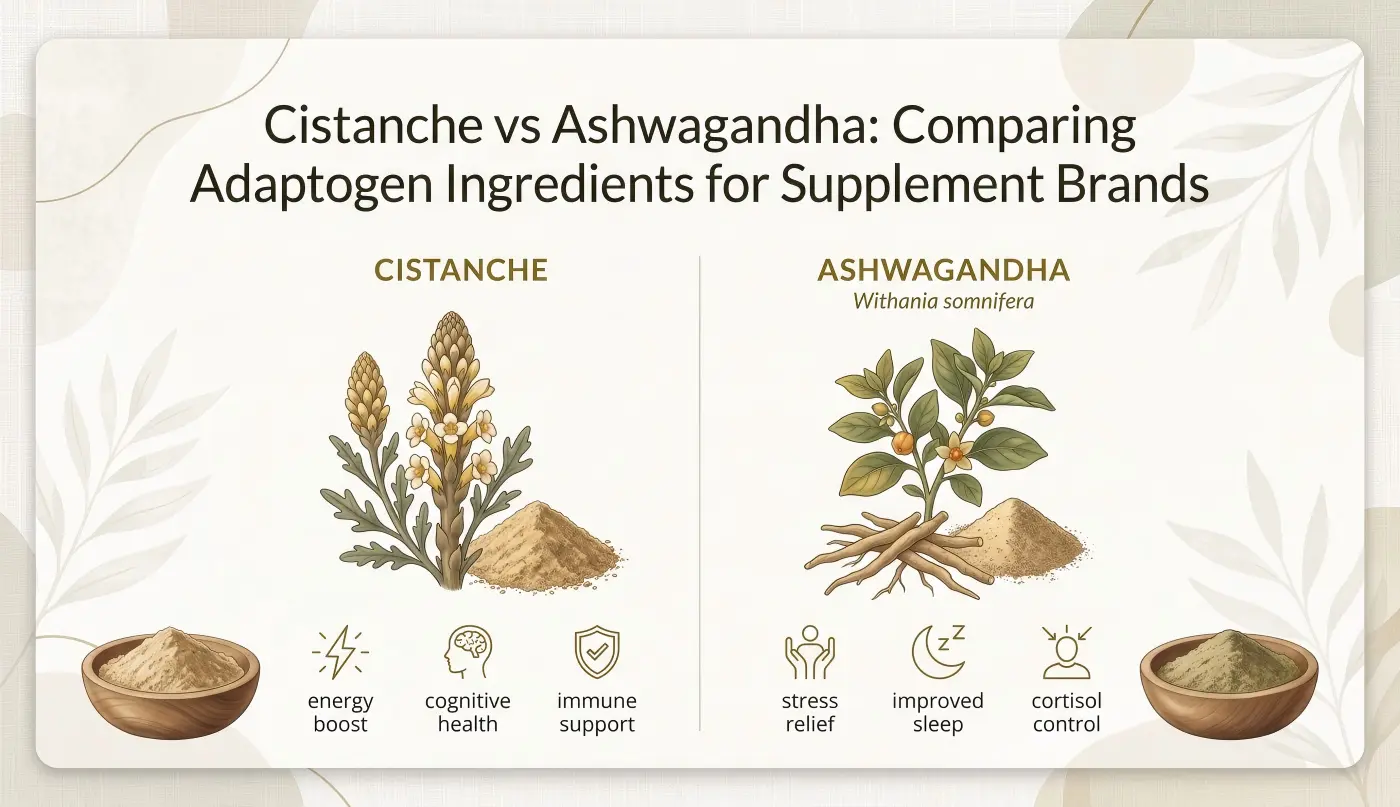
When supplement brands evaluate Cistanche vs. Ashwagandha for their next formulation, the decision extends far beyond comparing two botanical names on an ingredient list. These ingredients occupy different positions in the adaptogen and vitality landscape: Cistanche, traditionally known as “desert ginseng,” carries a deep-rooted legacy in Traditional Chinese Medicine (TCM) for vitality and men’s wellness [1], while Ashwagandha has a substantially larger human clinical literature for stress-related outcomes than Cistanche, although the evidence varies by extract, dose, study design, and outcome [2]. For brands seeking a reliable Cistanche supplement manufacturer or Ashwagandha supplier, understanding their distinct botanical identities, phytochemical markers, and formulation roles is essential to making a procurement decision that aligns with product positioning, regulatory requirements, and target consumer needs.
Cistanche vs Ashwagandha: Quick Comparison
| Procurement / Formulation Factor | Cistanche | Ashwagandha |
| Botanical source | Cistanche spp. (primarily C. tubulosa, C. deserticola) | Withania somnifera (L.) Dunal |
| Traditional use | Traditional Chinese Medicine — kidney yang tonic, vitality, healthy aging | Ayurveda — Rasayana (rejuvenative), stress resilience, sleep support |
| Common supplement positioning | Men’s wellness, vitality, healthy aging, traditional botanical formulas | Stress support, relaxation, sleep, daily resilience, adaptogen formulas |
| Key compounds | Phenylethanoid glycosides (PhGs): echinacoside, acteoside (verbascoside), cistanosides | Withanolides (steroidal lactones): withaferin A, withanone, withanosides |
| Common standardization | Echinacoside / acteoside / total PhGs by HPLC | Total withanolides (typically 2.5–10%) by HPLC |
| Ingredient story | Traditional Chinese botanical / vitality / “desert ginseng” | Ayurvedic adaptogen / stress resilience / “Indian ginseng” |
| Formula role | Core or complementary botanical for vitality positioning | Core adaptogenic ingredient for stress/resilience positioning |
| Main procurement concern | Species selection (C. tubulosa vs C. deserticola) + marker standardization | Extract type (root-only vs root+leaf) + withanolide specification |
| Typical formulation direction | Men’s wellness / vitality / healthy-aging formulas | Stress / sleep / daily resilience / sports recovery formulas |
| Best starting point | When botanical vitality or TCM positioning is central | When stress/adaptogen positioning is central |
Core takeaway: Cistanche and Ashwagandha should not be treated as interchangeable “adaptogens.” They have different botanical identities, phytochemical markers, traditional-use contexts, and formulation positioning. The better ingredient depends on the product concept and the specification you need to deliver it.
Are Cistanche and Ashwagandha Both Adaptogens?
What Is an Adaptogen?
The term “adaptogen” emerged from Soviet-era pharmacological research in the mid-20th century, describing botanicals that produce a “nonspecific increase in resistance against diverse stressors” while maintaining normal physiological function [3]. However, this concept represents a systems-level interpretation of complex physiological responses that does not map neatly onto Western regulatory frameworks. The European Food Safety Authority (EFSA) does not recognize “adaptogen” as a valid health claim category for dietary supplements, and the U.S. FDA has not established a formal regulatory definition [4]. In supplement marketing, “adaptogen” remains a widely used positioning term, but brands must ensure that any structure/function claims comply with regional regulatory requirements and do not imply disease treatment or prevention.
Where Cistanche Fits
Cistanche is classified in the Chinese Pharmacopoeia (ChP) as a kidney yang-tonifying herb with traditional indications for kidney deficiency, impotence, female infertility, and senile constipation [5]. Modern research has identified phenylethanoid glycosides (PhGs), particularly echinacoside and acteoside, as major marker compounds used to characterize Cistanche extracts [6]. While Cistanche is sometimes marketed within the adaptogen category, brands should avoid automatically treating it as equivalent to clinically established “adaptogen” botanicals. Its positioning is more accurately rooted in traditional vitality and men’s wellness applications.
Where Ashwagandha Fits
Ashwagandha (Withania somnifera) has the strongest clinical evidence base among botanicals commonly labeled as adaptogens. Multiple randomized controlled trials (RCTs) and systematic reviews have demonstrated its effects on perceived stress, cortisol levels, anxiety scores, and sleep quality [2,7]. A 2023 systematic review in Nutrients analyzing cortisol outcomes across stressed human subjects found consistent evidence for Ashwagandha’s modulatory effects on the hypothalamic-pituitary-adrenal (HPA) axis [8]. This makes Ashwagandha the more typical choice when formulating for stress-resilience or adaptogen-oriented product positioning.
How to Interpret the Evidence
For procurement and product-development decisions, evidence should be interpreted in a hierarchy:
| Evidence Level | Role in Procurement Decisions |
| Traditional use | Useful for understanding historical positioning and botanical story, but not equivalent to clinical efficacy |
| Preclinical research | Useful for identifying mechanisms and research directions, but findings from cell or animal models cannot be assumed to translate directly to finished-product outcomes |
| Human clinical evidence | More relevant to product positioning, but results depend on the specific extract, dose, population, duration, and study design |
| Product-specific evidence | The strongest basis for comparing a commercial ingredient with a published study is a close match in species, plant part, extraction method, marker specification, dose, and quality controls |
Key procurement principle: Not all Cistanche extracts are equivalent, and not all Ashwagandha extracts are equivalent. A clinically studied extract should not be treated as interchangeable with a generic extract simply because the botanical name is the same.
Cistanche vs. Ashwagandha: Botanical and Phytochemical Differences
Cistanche
The genus Cistanche (Orobanchaceae) comprises holographic parasitic plants native to arid and semi-arid regions of northwestern China, Mongolia, and Central Asia. Two species dominate commercial supply:
- Cistanche deserticolaC. Ma: Historically the standard source in TCM, primarily hosted by Haloxylon ammodendronin Inner Mongolia. Listed as endangered in China since 1984 due to overharvesting [9].
- Cistanche tubulosa(Schenk) R. Wight: Widely cultivated in Xinjiang (Hetian region), hosted by Tamarix Now the primary commercial source for standardized extracts due to cultivation scalability and higher echinacoside content [5,10].
Both species are listed under the Herba Cistanche monograph in the Chinese Pharmacopoeia 2020 edition, but they exhibit meaningfully different phytochemical profiles. C. tubulosa typically contains significantly higher echinacoside levels — the ChP stipulates that the combined content of echinacoside and verbascoside (acteoside) must be >=1.5% in C. tubulosa versus >=0.30% in C. deserticola [5,10].
The primary bioactive fraction comprises phenylethanoid glycosides (PhGs), including:
| Compound | Role / Properties |
| Echinacoside | Dominant marker compound with documented neuroprotective, antioxidant, and anti-inflammatory activity [6,11] |
| Acteoside (Verbascoside) | Secondary marker with hepatoprotective and anti-apoptotic properties [12] |
| Cistanosides A–F, Tubulosides A–D | Additional PhGs contributing to the total glycoside profile [13] |
Ashwagandha
Withania somnifera (Solanaceae) is a small shrub native to India, the Middle East, and parts of Africa. The root has been the traditional medicinal part in Ayurveda, though modern extracts may incorporate leaf material.
Critical procurement distinction — Root-only vs. Root-and-Leaf Extracts:
| Extract Type | Plant Part | Typical Withanolide Content | Clinical Focus |
| KSM-66 | Root only | ~5% withanolides | Stress resilience, physical performance, cortisol support — largest RCT database [14] |
| Sensoril | Root + Leaf | ~10% withanolides | Cognitive function, sleep quality — higher withanolide concentration but fewer published RCTs [14] |
| Generic root extract | Root only | 2.5–5% withanolides | Variable; depends on extraction method and standardization |
The leaves contain comparatively higher levels of withanone and withaferin A, compounds studied for cytoprotective and neuroprotective effects [15]. However, root-only extracts align more closely with traditional Ayurvedic practice and have the most extensive published clinical evidence. A higher total-withanolide percentage does not automatically indicate a superior extract — source material, plant part, extraction process, and the specific withanolide profile must all be considered [14].
Cistanche vs. Ashwagandha: Which Active Compounds Matter?
| Ingredients | Cistanche | Ashwagandha |
| Primary botanical markers | Echinacoside | Total withanolides |
| Secondary important markers | Acteoside (verbascoside), total PhGs | Withaferin A, withanone (depending on extract type) |
| Standardization approach | Marker-specific HPLC assay (echinacoside + acteoside) | Total withanolides by HPLC / defined extract specification |
| Analytical priority | HPLC/validated assay per Chinese Pharmacopoeia | HPLC/validated assay (USP or in-house) |
| Extract ratio alone sufficient? | No — ratio does not establish active-compound content | No — ratio does not establish withanolide content or clinical equivalence |
Why Extract Ratio Alone Does Not Define Potency
Extract ratio (e.g., 10:1, 20:1) describes the concentration of the extract relative to the starting botanical material by weight. It does not independently establish:
- Active-compound content (echinacoside or withanolide percentage)
- Clinical equivalence to studied extracts
- Batch-to-batch consistency of bioactive markers
- Product potency or efficacy
For B2B procurement, marker-based standardization is the only reliable specification approach. A “20:1 Cistanche extract” without echinacoside quantification provides no verifiable potency data. Similarly, an Ashwagandha extract labeled “15:1” without withanolide percentage cannot be compared to clinically studied standardized extracts [16].
Which Ingredient Fits Different Supplement Product Concepts?
| Product Concept | Starting Ingredient | Strategic Rationale |
| Daily stress support / cortisol management | Ashwagandha | Strongest RCT evidence for stress biomarkers and HPA axis modulation [2,8] |
| Relaxation / sleep-oriented formula | Ashwagandha | Systematic review evidence for sleep quality improvement [7] |
| Men’s wellness / vitality | Cistanche | Traditional TCM kidney yang positioning; phenylethanoid glycosides studied for reproductive function [17] |
| Healthy-aging botanical formula | Cistanche | “Desert ginseng” longevity narrative; antioxidant and neuroprotective PhG research [6] |
| Stress + resilience (adaptogen positioning) | Ashwagandha | Most established adaptogen clinical evidence base |
| Men’s wellness + vitality | Cistanche | Better category alignment with TCM vitality positioning |
| Premium multi-botanical formula | Cistanche + Ashwagandha | Different functional roles — vitality + resilience |
| Broad daily wellness formula | Either | Depends on primary product concept and target demographic |
Regulatory disclaimer: These positioning categories describe traditional use and emerging research contexts. They do not constitute approved health claims in any jurisdiction. All finished-product claims must be reviewed against FDA, EFSA, or applicable national regulations.
When Should Brands Choose Cistanche?
Men’s Wellness and Vitality
Cistanche’s traditional classification as a kidney yang tonic in TCM aligns directly with men’s wellness positioning. Phenylethanoid glycosides from C. tubulosa have been studied for their effects on testicular steroidogenesis via the CYP450-3beta-HSD pathway in preclinical models [17]. For brands targeting the men’s health category with a traditional botanical narrative, Cistanche offers a differentiated ingredient story compared to more common testosterone-support botanicals.
Healthy Aging and Longevity
The “desert ginseng” moniker positions Cistanche within the healthy-aging category. Preclinical research has investigated Cistanche phenylethanoid glycosides in antioxidant and neuroprotective models [11,18]. These findings may support research-oriented formulation narratives, but they should not be presented as established human anti-aging efficacy.
Traditional Botanical Positioning
For brands seeking TCM authenticity or differentiation in the botanical supplement market, Cistanche offers a less commoditized ingredient story than Ashwagandha. With fewer products on shelf compared to Ashwagandha, Cistanche can provide premium positioning and reduced competitive density.
When Should Brands Choose Ashwagandha?
Stress Support and Cortisol Management
Ashwagandha has the most robust clinical evidence for stress-related outcomes. A 2022 systematic review and meta-analysis of RCTs in Phytotherapy Research found beneficial effects on anxiety and stress management [2]. A 2023 systematic review in Nutrients specifically examining cortisol levels in stressed subjects concluded that Ashwagandha supplementation produced consistent reductions in this primary stress hormone [8].
Relaxation and Sleep Quality
A 2021 systematic review and meta-analysis in PLOS ONE examining Ashwagandha’s effect on sleep found evidence for improved sleep quality, particularly in subjects with pre-existing sleep disturbances [7]. This makes Ashwagandha a strong candidate for sleep-support and relaxation-oriented formulas.
Adaptogen-Oriented Formulas
For brands using an adaptogen-oriented product concept, Ashwagandha has a substantially larger human clinical literature than Cistanche, particularly for stress-related outcomes. Any finished-product claims still need to be reviewed for the target market and the specific extract used [19].
Ashwagandha Safety and Regulatory Considerations for Brands
Ashwagandha safety should be evaluated at the level of the specific preparation, plant part, dose, target population, and target market. Public-health sources note that short-term use has been studied more extensively than long-term use, while reported considerations include gastrointestinal symptoms, drowsiness, possible effects on thyroid function, rare reports of liver injury, and potential interactions with medicines. Pregnancy and breastfeeding also require particular caution.
For product-development teams, this means safety review should not stop at confirming a botanical identity or a withanolide percentage.
Before Commercialization, Verify:
| Verification Item | Description |
| Plant part | Root-only versus root + leaf |
| Extract identity | Exact botanical and extraction specification |
| Marker specification | Total withanolides and any additional marker requirements |
| Dose | Finished-product serving level and intended duration of use |
| Target population | Including any populations requiring additional safety review |
| Safety documentation | Available toxicology, adverse-event, and supplier documentation as applicable |
| Drug-interaction considerations | Assessed for the intended product and target population |
| Contaminant testing | Heavy metals, pesticides, microbiology, residual solvents, and other market-specific requirements |
| Stability | Finished-product stability under the intended packaging and storage conditions |
| Claim language | Reviewed against the regulations of the target market |
B2B formulation principle: Ingredient compatibility is a formulation question; safety and drug-interaction considerations are separate questions and should be reviewed independently.
How Should Supplement Brands Specify Cistanche Extract?
Botanical Species
Specify either C. tubulosa or C. deserticola on the specification sheet and COA. While both are valid under the ChP Herba Cistanche monograph, their marker compound ratios differ:
| Species | Key Characteristics |
| C. tubulosa | Higher echinacoside content; primary commercial cultivation source |
| C. deserticola | Lower echinacoside but contains unique 2’-acetylacteoside; historically prized in TCM [10] |
Plant Part
The dried fleshy stem with scale leaves is the official medicinal part per ChP 2020 [5]. Non-traditional parts (flowers, lignified stems) contain different chemical profiles and should not be used interchangeably.
Extract Ratio
If listed, verify that it is secondary to marker specification. Ratio alone is insufficient for potency verification.
Marker Specifications
| Marker | Typical Range | Analytical Method |
| Total Phenylethanoid Glycosides (PhGs) | 10–50% | HPLC |
| Echinacoside | 5–30% | HPLC (ChP method) |
| Acteoside (Verbascoside) | 2–15% | HPLC |
Analytical and Contaminant Testing
| Test Category | Details |
| HPLC assay | Validated method for echinacoside and acteoside quantification |
| Heavy metals | Lead, cadmium, mercury, arsenic (USP <232> or equivalent) |
| Pesticide residues | Per target market requirements (EU Regulation 396/2005, US EPA tolerances) |
| Microbiology | Total aerobic count, yeast/mold, E. coli, Salmonella (USP <2021>) |
| Residual solvents | If solvent extraction is used |
How Should Supplement Brands Specify Ashwagandha Extract?
Root vs. Root + Leaf
This is the most consequential specification decision for Ashwagandha procurement:
| Extract Type | Characteristics |
| Root-only extracts (e.g., KSM-66) | Align with traditional Ayurvedic use; largest published RCT base; typically standardized to ~5% withanolides [14] |
| Root + leaf extracts (e.g., Sensoril) | Higher withanolide concentration (~10%); broader phytochemical profile including leaf-specific withanone; fewer published RCTs [14] |
Brands must match the extract type to their clinical evidence requirements and positioning narrative.
Total Withanolides
Standardization typically ranges from 2.5% (basic root powder) to 35% (concentrated extracts like Shoden). The clinically studied range for most RCTs is 5–10% withanolides at doses of 300–600 mg/day [2,8].
Withanolide Profile
Beyond total percentage, consider the specific withanolide composition:
| Compound | Research Focus |
| Withaferin A | Studied for anti-inflammatory and cytoprotective effects |
| Withanone | Abundant in leaf material; neuroprotective research |
| Withanoside IV/V | Traditional marker compounds |
Extraction Method and Solvents
Water-based extraction (traditional) vs. hydroalcoholic extraction affects the final withanolide profile and solvent residue status. Verify extraction solvent on COA for regulatory compliance.
Analytical Testing
| Test Category | Details |
| Withanolide content | HPLC with validated reference standards |
| Heavy metals, pesticides, microbiology | Per market requirements |
| Withaferin A levels | Some markets require monitoring due to cytotoxicity concerns at high concentrations |
What Should Buyers Check on the COA?
| COA Item | Cistanche Verification | Ashwagandha Verification |
| Botanical identity | Species (C. tubulosa or C. deserticola); plant part | Species (Withania somnifera); plant part (root vs. root+leaf) |
| Extract ratio | Verify if present; do not rely on as potency proof | Verify if present; do not rely on as potency proof |
| Marker assay | Echinacoside % + Acteoside % by HPLC | Total withanolides % by HPLC; specify withaferin A if required |
| Analytical method | HPLC with validated reference standards | HPLC with validated reference standards |
| Microbiology | USP <2021> or equivalent | USP <2021> or equivalent |
| Heavy metals | Lead, cadmium, mercury, arsenic | Lead, cadmium, mercury, arsenic |
| Pesticide residues | Per target market (EU 396/2005, US EPA) | Per target market; India-origin material requires special attention |
| Residual solvents | If applicable | If applicable (ethanol, methanol, acetone) |
| Batch number & manufacturing date | Required for traceability | Required for traceability |
| Third-party lab accreditation | ISO 17025 or equivalent | ISO 17025 or equivalent |
Critical EEAT principle: A COA should confirm more than one number. Single-metric specifications (e.g., only “total withanolides” without plant-part identification) create procurement risk. Comprehensive COA documentation demonstrates supplier quality maturity and reduces finished-product liability exposure.
Cistanche vs Ashwagandha for Different Dosage Forms
Capsules
| Ingredient | Formulation Notes |
| Cistanche | Moderate active loading; typical dose 500–1,000 mg of standardized extract per serving. Powdered extract flows well; minimal excipient requirements. |
| Ashwagandha | Standardized root extracts at 300–600 mg fit easily in size 00 or 0 capsules. Root powder requires higher fill weight. Bitter taste is masked by capsule shell. |
Tablets
| Ingredient | Formulation Notes |
| Cistanche | Extract density and compressibility vary by specification. High-PhG extracts may require additional binders or flow agents. |
| Ashwagandha | Root extracts generally compress well. Bitterness requires taste-masking if chewable or orodispersible formats are considered. |
Gummies
| Ingredient | Formulation Notes |
| Cistanche | Earthy, slightly bitter taste requires flavor engineering. Lower consumer familiarity may necessitate stronger flavor masking than Ashwagandha. |
| Ashwagandha | Strong bitter/astringent taste is the primary formulation challenge. Proprietary extracts (KSM-66, Sensoril) often have reduced off-notes compared to generic powders. |
Powders
| Ingredient | Formulation Notes |
| Cistanche | Brown-yellow powdered extract; particle size and dispersibility affect mixability in beverage applications. Bulk density varies by extraction method. |
| Ashwagandha | Root powder is fibrous and poorly soluble; standardized extracts offer better dispersibility. pH stability should be verified for RTD beverage applications. |
Should You Combine Cistanche and Ashwagandha in One Formula?
Why Brands May Combine Them
Rather than competing for the same functional role, Cistanche and Ashwagandha can occupy complementary positions in a multi-botanical formula:
- Cistanche-> Vitality / Men’s wellness / TCM botanical positioning
- Ashwagandha-> Stress resilience / Cortisol management / Adaptogen positioning
A combined formula can target: “Men’s vitality + stress resilience” or “Daily wellness + adaptogenic support.” This dual positioning appeals to consumers seeking comprehensive men’s health or active-lifestyle products.
Formulation Considerations
| Factor | Check Point |
| Serving size | Combined botanical load may exceed single-capsule capacity; consider split servings or tablets |
| Total botanical load | Ensure marker doses (echinacoside + withanolides) remain clinically relevant per serving |
| Capsule capacity | Size 00 capsule holds ~750 mg; size 000 holds ~1,000 mg — calculate total fill weight |
| Ingredient compatibility | Compatibility should be assessed at the formulation level, while safety and drug-interaction considerations for each botanical must be reviewed separately for the target population and market. |
| Cost per serving | Cistanche standardized extracts typically command higher raw-material cost than generic Ashwagandha; budget accordingly |
| Regulatory claims | Structure/function claims must not imply disease treatment; review combined claim language for compliance |
Avoid “More Ingredients = Better Formula”
A combination should solve a defined formulation problem rather than simply increase the ingredient count. If the target consumer is a stressed professional seeking sleep support, Ashwagandha alone may be more appropriate than a complex blend. If the target is an aging male seeking vitality and stress management, the combination may add justified value.
How to Choose the Right Botanical for Your Formula: 5-Question Framework
Question 1: What is the primary product positioning?
| Positioning | Recommended Starting Ingredient |
| Stress / resilience / sleep | Ashwagandha |
| Men’s vitality / TCM wellness / healthy aging | Cistanche |
Question 2: Which botanical story fits the brand narrative?
| Brand Narrative | Recommended Ingredient |
| Ayurvedic adaptogen / Indian traditional medicine | Ashwagandha |
| Traditional Chinese Medicine / desert ginseng | Cistanche |
Question 3: Which active marker will define your specification?
| Ingredient | Marker Specification |
| Cistanche | Echinacoside + acteoside (PhGs) by HPLC |
| Ashwagandha | Total withanolides by HPLC; specify root-only or root+leaf |
Question 4: What dosage form are you developing?
Capsule, tablet, gummy, powder, or RTD — each presents different formulation constraints for bitterness, solubility, and active loading.
Question 5: What regulatory market are you targeting?
| Market | Key Regulatory Considerations |
| US (FDA) | Structure/function claims permitted; avoid disease claims; New Dietary Ingredient (NDI) status verified for novel extracts |
| EU (EFSA) | No approved adaptogen health claims; careful claim wording required; Ashwagandha regulatory status can differ across European markets, and some national authorities have raised safety or risk-management concerns. Verify the status and permitted use in each target country before commercialization [20]. |
| UK, Australia, Canada | Each has distinct botanical regulations; verify permitted claims and Novel Food status |
From Ingredient Selection to Finished Supplement
At KS Nutripharma, we guide brands through the complete OEM workflow from botanical selection to commercial manufacturing:
| Step | Action |
| 1. Define Product Positioning | Clarify target consumer, primary benefit territory, and competitive differentiation |
| 2. Select Cistanche, Ashwagandha, or Both | Match ingredient to positioning using the framework above |
| 3. Lock Ingredient Specifications | Species, plant part, marker compounds, analytical methods, and COA requirements |
| 4. Develop the Formula | Active doses, excipient system, compatibility testing, and stability protocols |
| 5. Select Dosage Form | Capsule, tablet, gummy, or powder — optimized for active loading and consumer experience |
| 6. Validate QC Documentation | Third-party COA review, heavy metal and pesticide verification, batch traceability |
| 7. Move to Commercial Manufacturing | GMP-compliant production with full documentation for market registration |
Need a Cistanche-based men’s wellness formula? Contact KS Nutripharma at https://kssupplements.com/cistanche-supplement-manufacturer/ for specification development and private-label manufacturing.
Need a multi-botanical formula combining Cistanche with Ashwagandha? Our formulation team can design a compliant, evidence-aligned product for your target market. Visit https://kssupplements.com/ashwagandha-supplements/ to explore Ashwagandha manufacturing options.
FAQ
Is Cistanche better than Ashwagandha?
Neither is universally “better.” The optimal ingredient depends on product positioning: Cistanche is commonly considered for vitality and TCM-oriented formulations; Ashwagandha has a larger human clinical literature for stress-related outcomes and is more commonly positioned in stress-resilience formulas.
Can Cistanche and Ashwagandha be taken together?
They may be considered together when the product concept calls for complementary positioning, but compatibility and safety should be assessed at the formulation level. Dose, serving size, target population, and potential interactions should be reviewed before commercialization.
What is the difference between Cistanche and Ashwagandha?
Botanically, they belong to different families (Orobanchaceae vs. Solanaceae) and different traditional medicine systems (TCM vs. Ayurveda). Phytochemically, Cistanche is defined by phenylethanoid glycosides (echinacoside, acteoside); Ashwagandha by withanolides. Positionally, Cistanche aligns with vitality/men’s wellness; Ashwagandha with stress/adaptogen support.
Which is better for men’s wellness supplements?
Cistanche offers stronger traditional and category alignment for men’s vitality positioning due to its TCM kidney yang tonic classification and emerging research on reproductive function [17]. Ashwagandha also has men’s health RCTs but is more broadly positioned [19].
Is Ashwagandha a better adaptogen than Cistanche?
Ashwagandha has the larger published RCT database for stress-related outcomes and is more commonly positioned within the adaptogen category. However, “adaptogen” is not a formally regulated classification, and EFSA does not recognize it for health claims [4].
What are the active compounds in Cistanche?
Phenylethanoid glycosides (PhGs), primarily echinacoside and acteoside (verbascoside), are the major active constituents [6].
What are the active compounds in Ashwagandha?
Withanolides, a group of steroidal lactones including withaferin A, withanone, and withanosides, are the primary markers [2].
Should Ashwagandha be standardized to withanolides?
Yes. Total withanolides by HPLC is the industry standard for potency verification. Root-only vs. root+leaf specification should also be defined.
Should Cistanche be standardized to echinacoside?
Yes. Echinacoside is the primary marker compound. The Chinese Pharmacopoeia requires combined echinacoside + verbascoside quantification [5].
Is a higher extract ratio better?
No. Extract ratio (e.g., 10:1, 20:1) describes concentration relative to starting material but does not establish active-compound content, clinical equivalence, or batch-to-batch potency [16].
What should supplement brands check on a Cistanche or Ashwagandha COA?
Botanical identity, plant part, marker assay results (echinacoside/PhGs or withanolides), analytical method, heavy metals, pesticides, microbiology, residual solvents, and third-party lab accreditation.
Can a manufacturer develop private-label Cistanche supplements?
Yes. KS Nutripharma provides private-label and contract manufacturing services for Cistanche-based formulas, including specification development, formulation, and GMP production.
Conclusion
Cistanche and Ashwagandha serve distinct but equally valuable roles in the supplement formulation landscape. Cistanche brings a TCM-rooted vitality narrative anchored by phenylethanoid glycoside research, making it ideal for men’s wellness and healthy-aging positioning. Ashwagandha offers the most extensive clinical evidence base for stress resilience and cortisol management, making it a commonly selected botanical for relaxation, sleep, and daily-resilience product concepts.
The procurement decision should never be reduced to “which is stronger?” Instead, brands must ask: Which botanical identity, marker specification, traditional narrative, and clinical evidence profile best serves the target consumer and product concept?
For brands ready to move from ingredient comparison to finished-product development, KS Nutripharma provides end-to-end formulation, specification locking, and GMP manufacturing services. Whether you need a standalone Cistanche vitality formula, an Ashwagandha stress-resilience product, or a strategic combination of both, our team ensures your specification meets both scientific rigor and regulatory compliance standards.
Ready to formulate? Contact KS Nutripharma at https://kssupplements.com/cistanche-supplement-manufacturer/ to discuss your Cistanche or Ashwagandha supplement project.
References
[1] Wang T, Zhang XY, Xie WY. Cistanche deserticola Y. C. Ma, “Desert Ginseng”: a review. Am J Chin Med. 2012;40(6):1123–1141. https://doi.org/10.1142/S0192415X12500839
[2] Akhgarjand C, Asoudeh F, Bagheri A, et al. Does Ashwagandha supplementation have a beneficial effect on the management of anxiety and stress? A systematic review and meta-analysis of randomized controlled trials. Phytother Res. 2022;36(11):4115–4124. https://doi.org/10.1002/ptr.7598
[3] Panossian A, Wikman G. Effects of adaptogens on the central nervous system and the molecular mechanisms associated with their stress—protective activity. Pharmaceuticals. 2010;3(1):188–224. https://doi.org/10.3390/ph3010188
[4] EFSA Panel on Dietetic Products, Nutrition and Allergies. Scientific opinion on the substantiation of health claims related to various botanicals and adaptogenic effects. EFSA Journal. 2011;9(6):2282. https://efsa.onlinelibrary.wiley.com/doi/10.2903/j.efsa.2011.2282
[5] Chinese Pharmacopoeia Commission. Chinese Pharmacopoeia (2020 Edition, Vol. I). Beijing: China Medical Science and Technology Press; 2020. Herba Cistanche monograph.
[6] Li Y, He Y, Zhang K, et al. Cistanches Herba: chemical constituents, pharmacological effects, and clinical implications. J Ethnopharmacol. 2023;302:115893. https://doi.org/10.1016/j.jep.2022.115893
[7] Cheah KL, Norhayati MN, Husniati Yaacob L, Abdul Rahman R. Effect of Ashwagandha (Withania somnifera) extract on sleep: A systematic review and meta-analysis. PLOS ONE. 2021;16(9):e0257843. https://doi.org/10.1371/journal.pone.0257843
[8] Della Porta M, Maier JA, Cazzola R. Effects of Withania somnifera on cortisol levels in stressed human subjects: A systematic review. Nutrients. 2023;15(24):5015. https://doi.org/10.3390/nu15245015
[9] State Forestry Administration of China. China Plant Red Data Book: Rare and Endangered Plants (Vol. 1). Beijing: Science Press; 1992. Cistanche deserticola listing.
[10] Li X, Mao Q, Yang Q, et al. Quality analysis report of Cistanche tubulosa and Cistanche deserticola. Molecular & Cellular Biomechanics. 2025;22(1):633. https://doi.org/10.62617/mcb633
[11] Chen Y, Wang Y, Zhang J, et al. Echinacoside promotes bone regeneration by increasing OPG/RANKL ratio in MC3T3-E1 cells. Fitoterapia. 2012;83(8):1443–1450. https://doi.org/10.1016/j.fitote.2012.08.013
[12] Pu XP, Song ZH, Li YX, et al. Acteoside from Cistanche salsa inhibits apoptosis in 1-methyl-4-phenylpyridinium ion-induced cerebellar granule neurons. Planta Med. 2003;69(1):65–66. https://doi.org/10.1055/s-2003-37027
[13] Tu PF, Song ZH, Shi HM, Zhao YY. Phenylethanoid glycosides from Cistanche tubulosa. Phytochemistry. 1997;46(7):1127–1131. https://doi.org/10.1016/S0031-9422(97)00523-4
[14] Deshpande A, Irani N, Balkrishnan R, Benny IR. A randomized, double blind, placebo controlled study to evaluate the effects of ashwagandha (Withania somnifera) extract on sleep quality in healthy adults. Sleep Med. 2020;72:28–36. https://doi.org/10.1016/j.sleep.2020.03.012
[15] Gao S, Liu J, Li L. Withanone and withaferin A: two important withanolides from Withania somnifera with diverse pharmacological properties. Molecules. 2022;27(18):5973. https://doi.org/10.3390/molecules27185973
[16] U.S. Pharmacopeia. USP-NF: Dietary Supplements — General Chapter <2251> Botanical Extracts. Rockville, MD: United States Pharmacopeial Convention; 2024.
[17] Wang Q, Dong J, Lu W, Tu P. Phenylethanol glycosides from Cistanche tubulosa regulate testicular steroids via CYP450-3beta-HSD pathway. J Ethnopharmacol. 2016;186:183–191. https://doi.org/10.1016/j.jep.2016.03.064
[18] Xiong Q, Kadota S, Tani T, Namba T. Antioxidative effects of phenylethanoid glycosides from Cistanche deserticola. Planta Med. 1996;62(3):243–245. https://doi.org/10.1055/s-2006-957860
[19] Lopresti AL, Smith SJ, Malvi H, Kodgule R. An investigation into the stress-relieving and pharmacological actions of an ashwagandha (Withania somnifera) extract: a randomized, double-blind, placebo-controlled study. Medicine. 2019;98(37):e17186. https://doi.org/10.1097/MD.0000000000017186
[20] European Food Safety Authority (EFSA). Compendium of botanicals reported to contain naturally occurring substances of possible concern for human health when used in food and food supplements. EFSA Journal. 2023;21(3):e07892. https://doi.org/10.2903/j.efsa.2023.7892