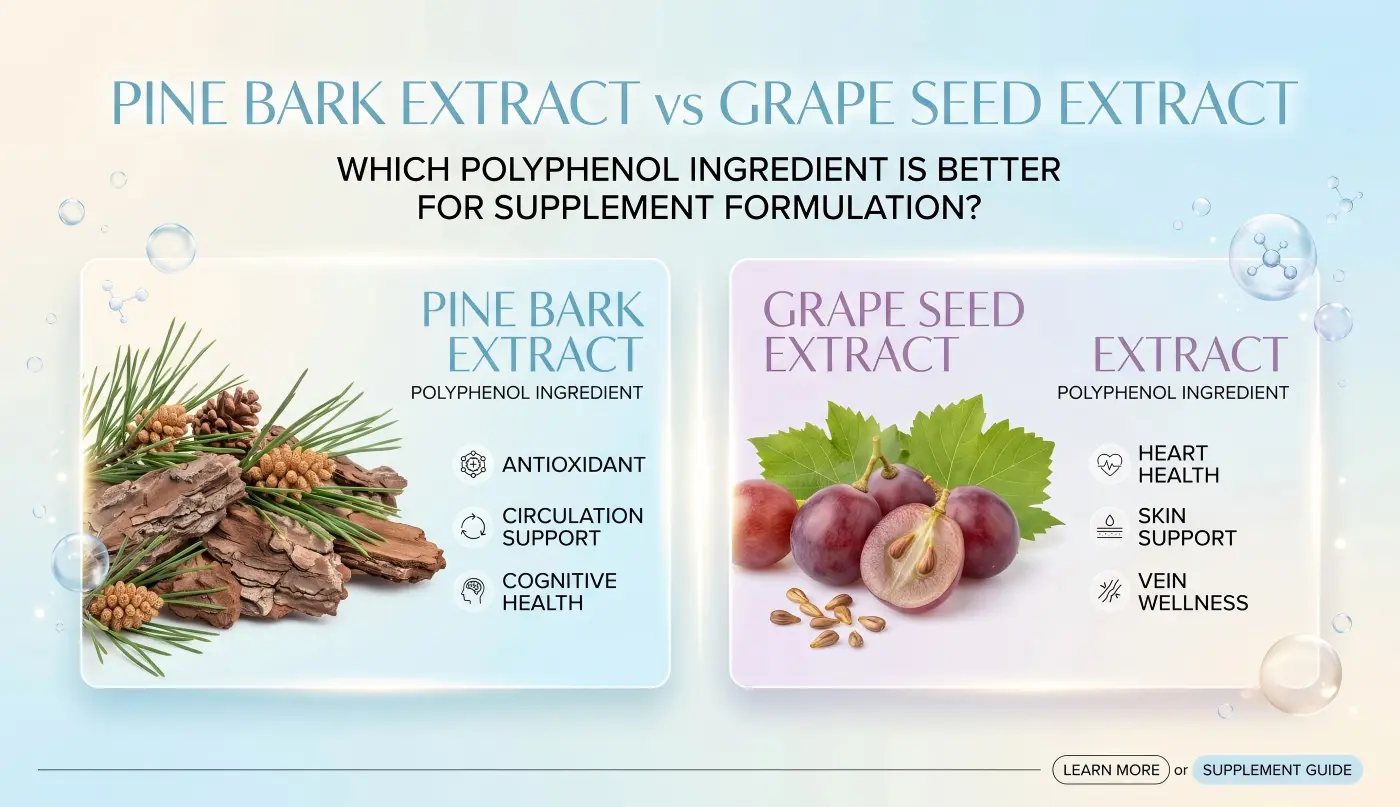
A B2B Ingredient Selection Guide for Nutraceutical Brands & Product Developers
KS Nutripharma® | Science-Driven Nutraceutical Contract Manufacturer
Written by KS Nutripharma Formulation Team | Reviewed by KS Nutripharma Director of R&D, PhD (Food Science)
Disclaimer: For B2B ingredient education, procurement, and product-development guidance only. Not intended to diagnose, treat, cure, or prevent any disease. Final product claims must comply with regulations in each target market, including FDA, EU, UK, and other applicable authorities. Pycnogenol® is a registered trademark of its respective owner. Evidence associated with a branded extract does not automatically transfer to every commercial pine bark or grape seed grade.
Why Brands Compare Pine Bark Extract and Grape Seed Extract
When procurement and R&D teams evaluate Pine Bark Extract vs Grape Seed Extract, the decision is commercial: which polyphenol ingredient better supports SKU positioning, cost per finished serving, claim-safe storytelling, dosage form, and a reorderable specification?
Demand continues to rise across antioxidant support, healthy aging, cardiovascular wellness, beauty-from-within, and circulation-adjacent assortments. OPC-rich botanical extracts remain high-priority shortlist ingredients in premium and mid-tier pipelines – especially pine bark extract and grape seed extract.
Both contain proanthocyanidins (OPCs), flavonoids, and broader polyphenol fractions.[1] They are not interchangeable commodities. Botanical source differences drive molecular profile, standardization practice, sensory behavior, formulation economics, and brand positioning.
Ingredients | Botanical Source |
|---|---|
| Pine Bark Extract | Maritime pine bark (Pinus pinaster and qualified Pinus pathways) |
| Grape Seed Extract | Grape seeds (Vitis vinifera) |
For finished-goods manufacturing pathways, see our pine bark extract manufacturer page.
Quick Comparison: Pine Bark Extract vs. Grape Seed Extract
Features | Pine Bark Extract | Grape Seed Extract |
|---|---|---|
| Botanical Source | Maritime pine bark | Grape seeds |
| Key Actives | Oligomeric procyanidins, catechin units, taxifolin, phenolic acids | Monomeric / oligomeric flavan-3-ols, catechin, epicatechin, gallate derivatives |
| Main Standardization | Often OPC / procyanidin bands around 65%-95% (method-dependent) | Often high OPC / PAC grades around 90%-95% (method-dependent) |
| Primary Positioning | Circulation, skin, healthy aging, premium antioxidant | Antioxidant, cardiovascular wellness, beauty support |
| Evidence Landscape | Stronger branded-ingredient clinical history (esp. Pycnogenol® literature) | Growing human + antioxidant research base |
| Color / Sensory | Light brown, mild woody | Light reddish-brown, more astringent/bitter |
| Common Formats | Capsules, tablets, gummies | Capsules, tablets, powders, drink mixes |
| Typical Brand Fit | Premium/specialty wellness | Mass-premium antioxidant & value stacks |
| Cost Architecture | Often higher ingredient cost; premium retail positioning | Often lower cost per serving at high OPC loading |
Procurement takeaway: Do not compare these extracts on “OPC %” alone. Compare molecular profile + assay method + finished-product fit + cost per serving + documentation readiness.
OPC Structure & Molecular Profile: Why Extracts Are Not Interchangeable
OPCs (oligomeric proanthocyanidins) are flavonoid polymers used for free-radical scavenging capacity positioning and batch potency control when locked to a validated assay.[1] For buyers, OPC is both a marketing marker and a QC marker – poorly defined “95% OPC” quotes create procurement risk.
Pine Bark Extract – Molecular Emphasis
Peer-reviewed descriptions of standardized French maritime pine bark extract report a procyanidin-rich complex – commonly discussed in the approximately 65%-75% procyanidin range for branded Pycnogenol® material – built from catechin/epicatechin subunits of varying chain lengths, together with monomeric polyphenols, phenolic/cinnamic acids, and related constituents such as taxifolin.[2][3][4]
Focus Marker | R&D Relevance |
|---|---|
| Oligomeric procyanidins | Core standardization/potency narrative |
| Catechin units | Building blocks of the procyanidin profile |
| Taxifolin | Differentiating low-MW flavonoid often discussed in pine bark PK work |
| Phenolic acids | Companion phenolics that diversify the extract fingerprint |
Grape Seed Extract – Molecular Emphasis
Grape seed preparations are rich sources of monomeric and oligomeric flavan-3-ols / proanthocyanidins (PACs), including catechin, epicatechin, and often galloylated derivatives, with commercial materials commonly emphasizing high OPC / polyphenol concentration.[5][6][7]
Focus Marker | R&D Relevance |
|---|---|
| Monomeric flavan-3-ols | High-potency antioxidant positioning |
| Catechin/epicatechin | Core flavanol identity markers |
| Gallate derivatives | Profile difference vs many pine bark pathways |
| Oligomeric PACs | High OPC loading options for cost-efficient SKUs |
Critical Buyer Rule
Two extracts may both report “95% OPC,” but their molecular distribution and analytical methods may differ.
Confirm whether the COA reports OPCs, procyanidins, PACs, or total polyphenols – and whether the method is UV colorimetric, HPLC, or another pathway. “OPC” on two COAs is not automatically the same analytical or commercial substance.[1][2][5]
Pine Bark Extract: Ingredient Profile & Formulation Advantages
Pine bark extract is typically derived from maritime pine (Pinus pinaster) bark, with some programs using other qualified Pinus pathways. Pharmacokinetic reviews note that low-molecular-weight constituents (e.g., catechin, phenolic acids, taxifolin) and gut-microbial metabolites of procyanidins can appear in systemic circulation after oral intake of standardized maritime pine bark extract – useful for bioavailability storytelling, not as a finished-product claim.[4]
Application | Positioning Adjacency | Typical Companions |
|---|---|---|
| Cardiovascular wellness | Circulation / vessel wellness / healthy aging | CoQ10, omega systems |
| Beauty-from-within | Skin elasticity / collagen-protection adjacency | Collagen, vitamin C, HA |
| Premium healthy aging | Longevity / multi-polyphenol platforms | Resveratrol, CoQ10, astaxanthin, NMN* |
Restricted actives should be scoped only where your selling market allows.
Brand takeaway: Prefer pine bark when the SKU needs premium perception, skin/circulation adjacency, and a differentiated botanical story – not the lowest cost-per-OPC.
Grape Seed Extract: Ingredient Profile & Formulation Advantages
Grape seed extract is produced from Vitis vinifera seeds and is widely used as a standardized polyphenol ingredient in private-label and mass-premium catalogs.[5][6] For antioxidant-oriented OEM pathways, see our antioxidant supplement manufacturing capabilities.
Application | Buyer Advantage | Typical Companions |
|---|---|---|
| Antioxidant supplements | High OPC options, clear antioxidant story, cost efficiency | Vitamin C, acerola, green tea |
| Cardiovascular wellness | Broad familiarity, stack flexibility | CoQ10, omega, magnesium |
| Beauty & skin | Recognizable botanical without maritime-pine cost structure | Collagen, ceramides, biotin |
Brand takeaway: Prefer grape seed when the brief prioritizes high OPC concentration, antioxidant clarity, and cost-efficient formulation.
Scientific Evidence Comparison: Pine Bark Extract vs. Grape Seed Extract
Clinical studies have investigated both ingredient classes, but the commercial evidence story differs. Evidence varies by extract specification, study design, and whether a branded, composition-locked material was used. Research suggests useful adjacency for formulation positioning – not automatic disease or therapeutic claims.
Evidence Area | Pine Bark Extract | Grape Seed Extract |
|---|---|---|
| Human Clinical Research | Stronger branded-ingredient history; a 2024 review discusses 39 randomized double-blind placebo-controlled trials of French maritime pine bark extract across multiple wellness domains[3] | Growing evidence base; reviews summarize flavonoid research history and human vascular / antioxidant-related investigations for characterized grape seed preparations[5][7] |
| Research focus often discussed | Circulation / endothelial function adjacency, skin, cognition, sports, women’s wellness (as investigated in branded-extract literature)[3] | Antioxidant markers, vascular wellness adjacency, inflammation-pathway research in characterized preparations[5][6][7] |
| Evidence type | Human trials + mechanistic / PK studies[3][4] | Human studies + antioxidant / in vivo research + composition characterization work[5][6][7] |
| Commercial caution | Pycnogenol® evidence is not equal to all pine bark extracts | OPC percentage is not identical activity across grades and methods |
| Claim / market caution | Non-branded pathways need separate claim scoping | High OPC headlines still require method + market compliance review |
EU-facing programs should review EFSA guidance on scientific requirements for health claims related to antioxidants, oxidative damage, and cardiovascular health before locking front-of-pack language.[8] Structure/function or claim pathways differ by market; a PubMed abstract is not an authorized claim.
Which Ingredient Fits Which Product Category?
Category | Recommended Winner | Why |
|---|---|---|
| Beauty supplements | Pine Bark Extract | Premium positioning, stronger beauty-from-within adjacency |
| Antioxidant supplements | Grape Seed Extract | High OPC loading, efficient cost architecture |
| Cardiovascular Wellness | Tier-dependent | Premium -> pine bark; mass/value -> grape seed |
| Healthy Aging | Combination | Complementary polyphenol profiles |
| Sports/recovery adjacency | Secondary fit | Prefer grape seed for cost-efficient antioxidant support; pine bark for premium wellness lines |
Beauty formula example
Ingredients | Role |
|---|---|
| Pine Bark Extract (OPC-locked) | Premium polyphenol botanicals |
| Marine Collagen Peptides | Beauty Protein Base |
| Hyaluronic Acid | Moisture/skin matrix adjacency |
| Vitamin C | Antioxidant synergy narrative |
Advanced polyphenol combination example
Ingredients | Function |
|---|---|
| Pine Bark Extract | Diversified OPC / polyphenol source |
| Grape Seed Extract | High polyphenol concentration |
| Resveratrol | Longevity adjacency |
| Vitamin C | Antioxidant synergy |
| CoQ10 | Cellular energy / cardiovascular adjacency |
Formulation Economics: Cost Per Serving Considerations
Compare cost per finished serving, not raw material price per kilogram alone. Add capsule/gummy/powder conversion cost, sensory engineering, documentation, and expected retail tier.
Scenario | Ingredient Logic | Economics Signal | Retail Fit |
|---|---|---|---|
| Premium beauty formula | Pine bark at a meaningful botanical dose next to collagen / HA | Higher ingredient cost band | Supports premium AOV / specialty positioning |
| Antioxidant mass formula | Grape seed with higher OPC loading as hero or co-hero | Lower cost per serving at high OPC concentration | Supports Amazon / DTC value-premium twins |
| Healthy aging combo | Pine bark + grape seed (plus optional resveratrol / CoQ10) | Mid-to-high cost per serving, stronger differentiation | Premium multi-polyphenol platforms |
- Lock target retail price and serving format first.
- Convert ingredient $/kg into $/serving at the intended label amount.
- Add sensory / encapsulation cost (especially gummies and drinks).
- Add assay/documentation burden if using a branded or dual-sourced pathway.
- Confirm whether premium story margin covers pine bark’s higher band – or whether grape seed wins on serving economics.
How to Evaluate OPC Extract Specifications Before Purchase
Buyer Specification Checklist Before RFQ
Pine Bark Extract
Area | Spec Items to Lock |
|---|---|
| Botanical | Pinus pinaster (or qualified Pinus pathway), plant part = bark, origin documentation |
| Extract | DER ratio, extraction solvent, OPC / procyanidin definition, assay method, acceptance criteria |
| Physical | Appearance, mesh/particle size, loss on drying, flow suitability for format |
| Testing | Assay, HPLC fingerprint (as scoped), heavy metals, microbiology, pesticides, residual solvents |
Grape Seed Extract
Area | Spec Items to Lock |
|---|---|
| Botanical | Vitis vinifera, seed origin/pathway, identity method |
| Extract | OPC / PAC assay, total polyphenols, solvent pathway, DER (if claimed) |
| Physical | Color, mesh, moisture, sensory notes for gummy/powder risk |
| Testing | Assay, heavy metals, microbiology, pesticide panel, residual solvents |
Every-Batch COA Expectations
Identity, assay vs locked spec, heavy metals, microbiology, pesticides, residual solvents (as applicable), appearance / LOD as scoped.
For U.S.-facing dietary supplement manufacturing, FDA’s 21 CFR Part 111 establishes CGMP expectations for identity, purity, strength, composition, and contamination-control specifications.[9]
Common Procurement Mistakes When Selecting OPC Ingredients
Mistake 1: Only Comparing OPC Percentage
95% OPC is not the same ingredient. Molecular distribution, botanical source, and assay definition can differ even when headline percentages match.[1][2][5]
Mistake 2: Ignoring Assay Method
UV colorimetric and HPLC pathways can produce non-comparable numbers. Lock method + acceptance criteria before awarding a supplier.
Mistake 3: Choosing the Ingredient Before the Dosage Form
Gummies and flavored powders often require taste masking, color control, and sometimes lower realistic botanical doses. Capsules tolerate high-potency OPC extracts more cleanly.
Mistake 4: Ignoring Supply Consistency
Request change-control rules, dual-sourcing options, and batch-to-batch consistency evidence – not only a first-lot COA.
Mistake 5: Overloading the Formula
Too many antioxidants dilute positioning, inflate capsule count, and weaken the hero story. One clear commercial job beats a crowded polyphenol cocktail.
Dosage Forms & Delivery Reality
Format | Pine Bark Fit | Grape Seed Fit | Watch-outs |
|---|---|---|---|
| Capsules | Excellent premium hero | Excellent | Capsule count in multi-ingredient stacks |
| Tablets | Strong | Strong at scale | Compression / coating with polyphenol blends |
| Gummies | Needs sensory engineering | Stronger masking needs | Bitterness, astringency, color stability |
| Powders / drinks | Premium blends | Excellent antioxidant drinks | Flavor and solubility |
Polyphenol extracts can oxidize, shift color, and lose assay activity under poor handling – plan oxygen/light/moisture control and finished-product stability scoping early.
Decision Tree: How to Choose Between Pine Bark and Grape Seed
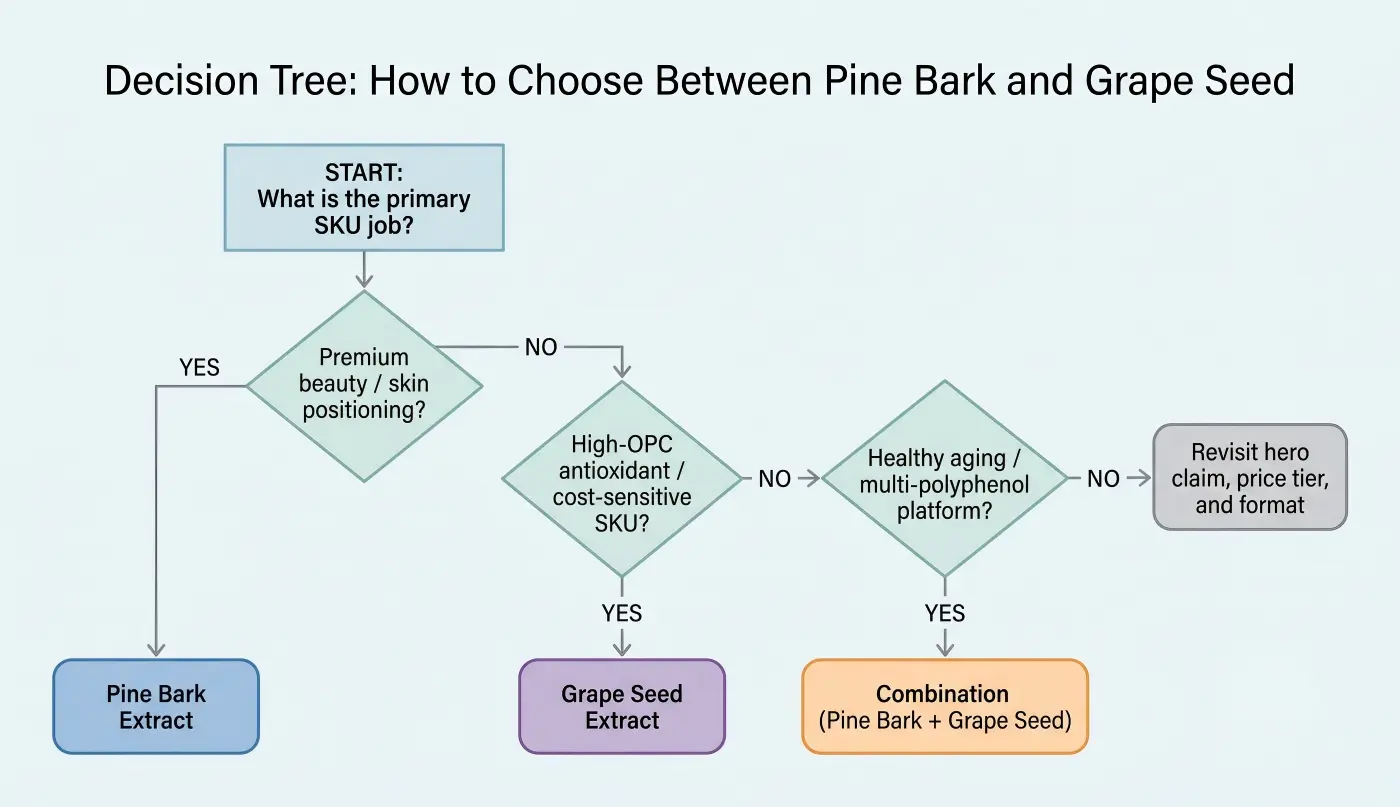
Your Product Goal | Recommended Ingredients |
|---|---|
| Premium beauty supplement | Pine Bark Extract |
| High OPC antioxidant product | Grape Seed Extract |
| Healthy aging formula | Both / combination |
| Cost-sensitive formula | Grape Seed Extract |
| Luxury wellness brand | Pine Bark Extract |
| Multi-polyphenol formula | Combination |
Practical sequence: Define hero claim and price tier -> choose pine, grape seed, or combination -> lock botanical identity + assay method -> confirm dosage-form sensory feasibility -> request COA/spec/sample -> align OEM/ODM MOQ and docs before artwork lock.
Why Work With KS Nutripharma®
KS Nutripharma® supports standardized botanical extracts and finished supplement manufacturing for global brands: custom formulation; OEM/ODM/private label across capsules, tablets, powders, and gummies; assay/HPLC pathway support as scoped; microbial and heavy metals testing; and project-scoped stability evaluation.
19+ years | 500+ brand projects | 60+ export markets | 81,000+ m2 cGMP footprint | multi-format production lines
FAQ
Is Pine Bark Extract better than Grape Seed Extract?
Neither is universally better. Selection depends on formulation goals, brand positioning, target price tier, dosage form, and cost per finished serving.
Are Pine Bark Extract and Grape Seed Extract the same?
No. Both contain OPCs / proanthocyanidins, but molecular distribution, companion phenolics, sensory behavior, and commercial positioning differ.[1][2][5]
Can brands combine Pine Bark and Grape Seed Extract?
Yes – especially for premium multi-polyphenol / healthy aging platforms. Avoid overloading if the brief is a simple antioxidant hero.
Which ingredient is more suitable for beauty supplements?
Pine bark extract is often selected for premium beauty-from-within products. Grape seed remains a strong supporting antioxidant botanical in mid-tier beauty formulas.
What OPC percentage should brands request?
It depends on application and method. Branded maritime pine bark literature commonly discusses approximately 65%-75% procyanidins for Pycnogenol®-type materials;[2][4] commercial grape seed programs often quote high OPC bands (including about 90%-95%). Always lock assay method and marker definition.
What should a buyer check on the COA?
Assay vs locked specification, identity, heavy metals, microbiology, pesticides, residual solvents (as applicable), and origin / Non-GMO statements required by your brand or retailer.[9]
Develop Your Next OPC Polyphenol Supplement
Share your target category, preferred ingredient (pine bark, grape seed, or combination), OPC / polyphenol specification band, dosage form, packaging, and volume. KS Nutripharma returns feasibility guidance, documentation scope, MOQ direction, and next steps – from sample/COA review to commercial OEM/ODM production.
Develop Your OPC Supplement – Request OEM Feasibility
KS Nutripharma manufactures for business clients only.
References
- Chen Y, et al. Oligomeric Proanthocyanidins: An Updated Review of Their Natural Sources, Synthesis, and Potentials. Int J Mol Sci. 2023. https://pmc.ncbi.nlm.nih.gov/articles/PMC10215713/
- D’Andrea G. Pycnogenol: a blend of procyanidins with multifaceted therapeutic applications? Fitoterapia. 2010. https://pubmed.ncbi.nlm.nih.gov/20598812/
- Weichmann F, Rohdewald P. Pycnogenol® French maritime pine bark extract in randomized, double-blind, placebo-controlled human clinical studies. Front Pharmacol. 2024. https://pubmed.ncbi.nlm.nih.gov/38757130/
- Weichmann F, Rohdewald P. Review of the pharmacokinetics of French maritime pine bark extract (Pycnogenol®) in humans. Front Nutr. 2024. https://www.frontiersin.org/journals/nutrition/articles/10.3389/fnut.2024.1389422/full | https://pubmed.ncbi.nlm.nih.gov/38757126/
- Weseler AR, Bast A. Masquelier’s grape seed extract: from basic flavonoid research to a well-characterized food supplement with health benefits. Nutr J. 2017. https://pubmed.ncbi.nlm.nih.gov/28103873/
- Unusan N. Blessings in disguise: Bio-functional benefits of grape seed extracts. Food Res Int. 2015. https://www.sciencedirect.com/science/article/abs/pii/S0963996915301605
- Rodriguez-Perez C, et al. Grape Seeds Proanthocyanidins: An Overview of In Vivo Bioactivity in Animal Models. Nutrients. 2019. https://pmc.ncbi.nlm.nih.gov/articles/PMC6835351/
- EFSA NDA Panel. Guidance for the scientific requirements for health claims related to antioxidants, oxidative damage and cardiovascular health (Revision 1). EFSA Journal. 2018;16(1):5136. https://doi.org/10.2903/j.efsa.2018.5136 | https://efsa.onlinelibrary.wiley.com/doi/10.2903/j.efsa.2018.5136
- U.S. Food and Drug Administration. 21 CFR Part 111 – Current Good Manufacturing Practice in Manufacturing, Packaging, Labeling, or Holding Operations for Dietary Supplements. https://www.law.cornell.edu/cfr/text/21/part-111 | Section 111.70: https://www.law.cornell.edu/cfr/text/21/111.70