Introduction:
Why Understanding Saffron Actives Matters for Supplement Brands
Procurement teams and product developers evaluating saffron (Crocus sativus L.) extract supplements usually ask the same commercial questions:
- Why do different saffron extracts vary so widely in price?
- Why do some suppliers emphasize crocin, while others highlight safranal?
- Which compound should be used as a standardization marker?
- Which specification best fits mood-oriented, sleep, gummy, or beverage positioning?
These are not academic details. They determine label substantiation, batch consistency, cost of goods, and how confidently a brand can defend its ingredient story.
Common Questions from Product Developers
- Which marker is most relevant in mood-oriented saffron formulations?
- Which assay should appear on the Certificate of Analysis (COA)?
- How do crocin and safranal affect formulation and stability decisions?
- Why can two “saffron extracts” look similar on a sales sheet but perform differently in finished goods?
Why Saffron Is Becoming a Premium Ingredient?
Saffron has moved from culinary spice into a commercially active botanical for emotional-wellness and premium botanical formulas. Several market and consumer signals explain the shift:
Market signals
- According to Grand View Research, the global depression & mood segment of brain-health supplements was valued at about USD 2.03 billion in 2024 and is projected to reach about USD 4.48 billion by 2030 (CAGR ~14.3%, 2025–2030).
- The broader brain-health supplements market was estimated at about USD 10.95 billion in 2024, with projected growth to about USD 23.52 billion by 2030 (CAGR ~13.7%).
- The global saffron market was estimated at about USD 482.4 million in 2025, projected to reach about USD 883.8 million by 2033 (CAGR ~7.9%, 2026–2033), with nutraceutical and extract applications cited among growth drivers.
Consumer and NPD signals
- Innova Market Insights has reported that, across surveyed markets, meaningful shares of consumers took steps to support mental/emotional wellbeing through diet changes and supplements (about one-quarter reported taking supplements in the cited survey wave).
- FMCG Gurus emotional-wellness and adaptogen trend reports describe rising consumer intent to manage stress and mood through food, drink, and supplements, with growing preference for natural and clean-label approaches.[27][28]
Why buyers pay for standardization
At the same time, professional buyers increasingly require:
- Transparent assays (method stated on COA)
- Clinically discussed extract profiles where available
- Authenticity controls (saffron is a high-adulteration-risk botanical)
- Dosage-form stability evidence—not only raw-material assay claims
For private-label and OEM programs, standardization is no longer optional. It is the difference between a commodity botanical and a defensible functional ingredient.
What Are the Main Active Compounds in Saffron?
Overview of Saffron Phytochemistry
Dried saffron stigmas contain a distinctive phytochemical profile. The constituents most frequently discussed in quality control and research include:[1][2][3]
| Constituent groups | Role in saffron | Relevance to supplements |
| Crocins (crocetin glycosides) | Deep red/yellow color | Common HPLC standardization marker |
| Crocetin | Related carotenoid aglycone/metabolite | Discussed in mechanistic research |
| Safranal | Characteristic aroma | Increasingly used as a secondary marker |
| Picrocrocin | Bitter taste precursors | Authenticity and quality assessment |
| Flavonoids and other carotenoids | Minor phytochemicals | Contribute to full-spectrum profile |
PubChem and NCBI taxonomy resources confirm Crocus sativus as the botanical source of saffron and document the chemical identity of its major constituents.[4][5][6]
Why Crocin and Safranal Receive the Most Attention
Crocin and safranal receive the most commercial attention because they are:
- Frequently used as quality markers on extract COAs
- Associated with biological activity in preclinical and clinical research contexts
- Central to extract standardization conversations between suppliers and brands
- Linked to sensory identity—color (crocin) and aroma (safranal)
ISO 3632 remains the international reference framework for saffron spice quality grading using UV-Vis absorbance related to crocin, picrocrocin, and safranal.[7][8] For nutraceutical-grade extracts, many laboratories additionally rely on HPLC/UHPLC methods because they provide greater compound specificity.[9][10][11]
Crocin vs. Safranal vs. Picrocrocin
Procurement teams increasingly search for all three markers together. Understanding the triad improves both QC and storytelling.
| Compound | Primary sensory / QC role | Typical commercial use | Notes for buyers |
| Crocin | Color | Most common assay marker | Start here for most SKUs |
| Safranal | Aroma | Premium / dual-marker specs | Confirm HPLC vs UV-Vis method |
| Picrocrocin | Bitterness / authenticity | Authenticity and full-spectrum QC | Often under-declared on retail labels |
Buyer takeaway: Crocin supports routine standardization; safranal supports premium differentiation; picrocrocin strengthens authenticity arguments—especially important because saffron is among the most adulteration-prone botanicals in global trade.[10][29]
What Is Crocin?
Chemical Structure and Characteristics
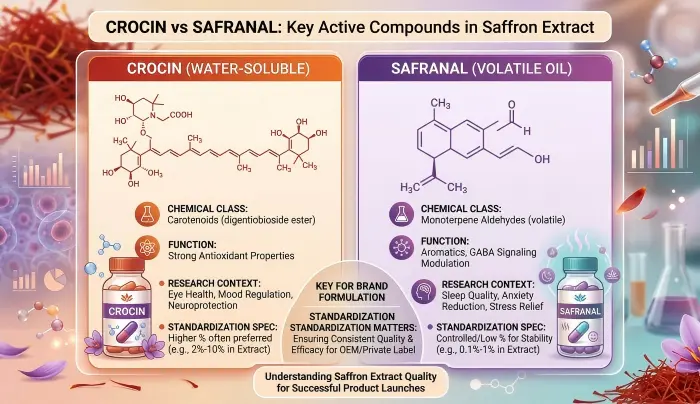
Crocins are water-soluble carotenoid glycosides formed when crocetin is esterified with one or more sugar moieties. They are the primary pigments responsible for saffron’s deep red color and strong yellow tint in aqueous systems.[1][2][3]
Key formulation-relevant characteristics:
- Compound class: carotenoid glycosides
- Solubility: water-soluble (advantageous for beverages and some gummy systems)
- Sensory role: color contribution
- Commercial role: most common assay marker on saffron extract COAs
PubChem provides verifiable structure and identifier data for crocin (CID 5281233).
Natural Occurrence in Saffron Stigmas
Major crocin isomers
Commercial and research literature commonly discusses several crocetin esters, including trans-4-GG crocin and related glycosides. Isomer distribution matters because UV methods and HPLC response factors can differ across species.[9][11]
Factors affecting concentration
- Cultivar / botanical genetics
- Geographic origin and climate
- Harvest timing
- Drying temperature and duration
- Storage conditions (light, oxygen, humidity, temperature)
Biological Properties Investigated in Research
Peer-reviewed research has investigated crocin and saffron extracts in areas such as antioxidant activity, emotional well-being / mood-related outcomes (often studied with whole standardized extracts), neuroprotective mechanisms in experimental models, and eye-health research contexts.
These are research investigation areas—not disease-treatment claims for finished dietary supplements.[13][14][15]
What Is Safranal?
Chemical Characteristics
Safranal (2,6,6-trimethyl-1,3-cyclohexadiene-1-carboxaldehyde) is a volatile aromatic monoterpene aldehyde and a major contributor to saffron’s characteristic aroma.[1][2][3][6]
Key formulation-relevant characteristics:
- Compound class: volatile terpene aldehyde
- Behavior: lipophilic and volatile
- Sensory role: aroma
- Stability: more heat- and process-sensitive than crocin in many systems
PubChem CID 61041 provides authoritative chemical identity data.
Formation During Processing
Safranal is largely generated during post-harvest processing rather than existing at high levels in fresh stigmas. Formation pathways commonly described include picrocrocin degradation, drying conditions, and storage/aging of dried saffron.[2][3]
Potential Biological Activities
Research has investigated safranal and saffron aroma-related fractions in relaxation support, sleep-quality research settings, emotional-balance / stress-perception outcomes (often within whole-extract studies), and antioxidant models. Finished-product claims should remain within compliant wellness language and be supported by appropriate evidence for the specific extract and dose used.[13][16]
Crocin vs. Safranal: Key Differences
| Attribute | Crocin | Safranal |
| Compound class | Carotenoid glycoside(s) | Volatile monoterpene aldehyde |
| Solubility | Water-soluble | Lipophilic / volatile |
| Primary role in saffron | Color | Aroma |
| Stability (general) | Moderate | Lower (volatility + heat sensitivity) |
| Sensitivity to heat | Moderate | High |
| Standardization use | Very common | Increasing (often secondary marker) |
| Typical product focus | Mood-oriented formulas, antioxidant positioning, color-linked QC | Relaxation storytelling, sensory profile, premium differentiation |
| Analytical caution | Assay method (HPLC vs UV) affects reported % | ISO UV-Vis may overestimate vs HPLC |
Practical takeaway: Request crocin first for comparability; add safranal for premium differentiation—and always ask whether the percentage is by HPLC or ISO UV-Vis.[9][10][11]
Which Marker Is Most Relevant in Mood-Oriented Saffron Formulations?
Current Scientific Understanding
Human clinical research on saffron and mood-related outcomes has primarily evaluated standardized whole extracts, not isolated single compounds alone. Systematic reviews and meta-analyses of randomized trials report that saffron supplementation has been associated with improvements in self-reported depressive and anxiety symptoms in studied populations, while also noting heterogeneity, publication-bias concerns, and the need for further high-quality trials.[13][14][15][17]
Important evidence boundary:
Clinical studies primarily investigated saffron extracts in populations with mild-to-moderate mood symptoms, often under medical supervision or within controlled research settings. These findings should not be extrapolated into disease-treatment claims for dietary supplements.
The most evidence-aligned interpretation for brand education is:
Observed wellness outcomes associated with saffron are likely driven by multiple bioactive compounds and synergistic interactions, not by a single “magic marker.”
Proposed Mechanisms Associated With Crocin
Mechanistic and clinical adjunct research has explored pathways potentially involving neurotransmitter modulation, oxidative stress pathways, and neuroprotective mechanisms in experimental models. One randomized pilot trial evaluated crocin as an adjunct in a clinical depression research setting; such disease-context studies inform scientific understanding but should not be translated into consumer disease claims.
Proposed Mechanisms Associated With Safranal
Proposed research directions include relaxation-related pathways, sleep-related mechanisms, and sensory–mood interactions linked to aroma chemistry. These remain areas of ongoing investigation.
Why Synergy May Matter More Than a Single Marker
Whole-extract effects may depend on crocin/crocetin esters, safranal, picrocrocin, and minor phytochemicals. A COA that lists only one marker can be useful—but it does not automatically prove full extract quality.
Safety and Dosage Considerations
Safety communication is essential for YMYL trust and buyer confidence.
Human study doses commonly investigated
Across many mood-oriented and related wellness trials of standardized saffron extracts, investigated doses commonly fall around 20–30 mg/day, with 28–30 mg/day frequently cited in commercial and clinical discussions of standardized extracts. Exact dose must match the specific extract identity used in supporting evidence.[13][16][19]
General safety context
Consult authoritative public resources when building label warnings and education pages:
- NIH Office of Dietary Supplements (ODS): https://ods.od.nih.gov/
- National Center for Complementary and Integrative Health (NCCIH): https://www.nccih.nih.gov/
High-dose and special-population cautions (brand/QA checklist)
- Pregnancy/lactation: Use caution; therapeutic or high-dose use requires medical guidance and market-specific labeling review. Culinary amounts are not equivalent to concentrated extract doses.
- Drug interactions: Evaluate potential interactions in formula risk assessment, especially with sedatives or other mood-active ingredients.
- Sedative combinations: Sleep formulas combining saffron with melatonin, ashwagandha, or other calming botanicals need careful dose design and compliant claim language.
- Adulteration-related safety: Economic adulteration of saffron can introduce undeclared dyes or foreign plant material; authenticity testing is a safety control, not only a quality control.
This section is educational for product developers and is not a substitute for toxicology review, GRAS/NDI assessment (where applicable), or local regulatory counsel.
Regulatory Considerations for Saffron Claims
Claim language is where many saffron launches create YMYL and compliance risk.
United States — FDA/DSHEA framework
Under the U.S. dietary supplement framework administered by FDA, brands generally use structure/function language rather than disease claims.
| Avoid (disease claims risk) | Prefer (structure/function framing — counsel review required) |
| Treat depression | Supports emotional well-being |
| Cures anxiety | Helps promote a positive mood |
| Antidepressant alternative | Supports calm and emotional balance |
Always ensure claim substantiation matches the specific extract, dose, and population studied. See FDA dietary supplement resources: https://www.fda.gov/food/dietary-supplements
European Union — EFSA/health-claims register
In the EU, nutrition and health claims are regulated under Regulation (EC) No 1924/2006. Brands should check the EU Register of Nutrition and Health Claims before making mood-related statements:
https://food.ec.europa.eu/food-safety/labelling-and-nutrition/nutrition-and-health-claims/eu-register-health-claims_en
Practical note for saffron: EFSA has evaluated at least one proprietary saffron-extract mood claim application and concluded that the evidence was insufficient to establish a cause-and-effect relationship for the proposed claim; related authorization was refused.[30][31] Many botanical Article 13 claims also remain in complex “on-hold” policy contexts. EU-facing labels therefore typically require careful local regulatory strategy and should not assume U.S. structure/function language is transferable.
Buyer implication
The same extract may be commercially viable in multiple regions, but claim language, dossier expectations, and allowed wording can differ substantially. Ask your OEM partner for market-specific claim-support packages—not one global slogan.
Why Standardization Matters in Saffron Extract Manufacturing
Challenges of Non-Standardized Saffron
Without defined assays, brands face large batch variability, inconsistent sensory/color outcomes, difficult label substantiation, and higher adulteration exposure.
The ABC-AHP-NCNPR Botanical Adulterants Prevention Program (BAPP) has published a dedicated bulletin on adulteration of saffron and saffron extracts, documenting known adulterants and analytical approaches used by industry and laboratories.
American Botanical Council / BAPP resources: https://www.herbalgram.org/
USP also supports botanical quality and adulteration-prevention education for dietary ingredients:
https://www.usp.org/dietary-supplements-herbal-medicines
Common Standardization Specifications
| Specification example | Typical use case |
| Crocin ≥2% | Entry-level Amazon / multi-ingredient formulas |
| Crocin ≥3% | Mid-tier private-label capsules and tablets |
| Crocin ≥5% | Premium mood / wellness positioning |
| Dual-standardized (crocin + safranal) | Premium emotional wellness and sensory differentiation |
| Triple-marker / full-spectrum + clinical dossier | Highest EEAT / clinical positioning |
Exact assay percentages must always be interpreted with the analytical method stated (HPLC vs. UV-Vis).
Analytical Methods Used
HPLC / UHPLC-DAD (preferred for extract assays)
Enables more specific quantification of crocetin esters, picrocrocin, and safranal than bulk UV absorbance alone.[9][10][11]
UV-Vis spectrophotometry
Rapid and widely used for spice grading at wavelengths historically linked to picrocrocin (~257 nm), safranal (~330 nm), and crocin (~440 nm).[7][8]
ISO 3632 methods
- ISO 3632-1:2025— Specifications: https://www.iso.org/standard/86798.html
- ISO 3632-2:2010— Test methods: https://www.iso.org/standard/44526.html
Buyer tip: Ask every supplier: “Is the % crocin / % safranal on your COA by HPLC or by ISO UV-Vis?”
Factors Affecting Crocin and Safranal Levels
Agricultural Factors
Origin, cultivar genetics, and climate/harvest-year conditions.
Processing Factors
| Factor | Potential impact |
| Drying temperature | Affects safranal formation and pigment retention |
| Storage conditions | Heat, humidity, and time alter assays |
| Oxygen exposure | Increases oxidation risk for carotenoid pigments |
| Light exposure | Accelerates color degradation |
Manufacturing Factors
Extraction solvent, concentration/drying technology, encapsulation (especially for volatile safranal and color protection), carrier selection, and residual moisture control.
Formulation Implications for Supplement Brands
Ingredient Selection Considerations
- What compounds are standardized, and at what minimum levels?
- Which analytical methods are used (HPLC chromatograms available)?
- Are accelerated and real-time stability studies available?
- Is third-party verification or identity testing provided?
- How is adulteration risk controlled?
Dosage Form Compatibility
| Dosage form | Crocin considerations | Safranal considerations |
| Capsules | Generally favorable; manage oxidation/moisture | Protect from heat during blending |
| Tablets | Watch compression heat and color fading | Volatility loss risk during processing |
| Gummies | Color retention; pH/water-activity control | Flavor masking + cook-cycle loss |
| Stick powders | Solubility and color bloom in water | Aroma loss on open exposure |
| Functional beverages | Water solubility is an advantage | Needs encapsulation / flavor-system support |
Stability Challenges
- Crocin: color degradation; oxidation risk
- Safranal: volatility loss; high heat sensitivity
OEM Buying Guide: Which Specification Fits Your Brand?
This is the decision section most private-label buyers need.
Entry-Level Amazon Products
Recommended starting point: Crocin ≥2% (HPLC preferred)
Best for:
- Capsules and simple tablets
- Multi-ingredient mood-oriented SKUs
- Competitive pricing with clear consumer communication
Documentation minimum: COA with method stated, heavy metals, microbiology, identity testing.
Mid-Premium Brands
Recommended starting points:
- Crocin ≥3%
- Safranal declared (even if secondary)
- HPLC assay chromatograms available
Best for women’s mood, emotional wellness DTC, and higher AOV Amazon brands that need stronger EEAT.
Premium Clinical Positioning
Recommended starting point:
- Crocin + safranal (+ picrocrocin where commercially available)
- Clinical dossier or extract-matched published evidence pathway
- Stability data for the intended dosage form
- Third-party verification/authenticity screening summary
Decision Matrix
| Brand type | Recommended marker strategy | Priority documentation |
| Amazon brand | Crocin | COA + contaminants + competitive cost |
| Women’s mood brand | Dual marker (crocin + safranal) | HPLC + claim-support memo |
| Gummies | Crocin + process/stability focus | Gummy cook-cycle retention data |
| Functional beverage | Crocin + encapsulation strategy | Light/oxygen shelf-life validation |
| Premium clinical brand | Triple marker / full spectrum | Clinical dossier + third-party verification |
Crocin vs. Safranal: Which Specification Should Supplement Brands Choose?
For Amazon brands
Prioritize crocin-standardized extracts and clear communication. Consistency and reviews usually outperform complex marker stories.
For premium emotional wellness brands
Prioritize multi-marker extracts and clinical substantiation pathways.
For gummies
Prioritize stability under cook cycles, flavor masking, and color retention.
For functional beverages
Prioritize water solubility, shelf-life validation, and encapsulation technologies.
How to Compare Two Supplier COAs
Identical label language can hide materially different quality.
| Parameter | Supplier A | Supplier B |
| Crocin | 3% (UV-Vis / ISO-style) | 3% (HPLC) |
| Safranal | Not declared | 0.2% (HPLC) |
| Picrocrocin/authenticity markers | Not provided | Screened |
| HPLC chromatograms | No | Yes |
| Stability data (extract/dosage form) | No | Yes |
| Heavy metals + residual solvents | Partial | Complete |
| Adulteration screening summary | No | Yes |
Interpretation: Supplier B may justify a higher cost despite “identical” headline crocin percentage, because method transparency, secondary markers, and documentation reduce reformulation, recall, and claim-support risk.
How to Evaluate a Saffron Extract COA (step-by-step)
- Confirm botanical identity (Crocus sativus, plant part: stigma).
- Confirm assay markers and analytical method(HPLC vs UV-Vis).
- Request chromatograms for declared markers.
- Review moisture, heavy metals, microbiology, and residual solvents.
- Ask for adulteration / authenticity screening (BAPP-aware methods).
- Match the extract to dosage-form stability evidence.
- Confirm whether claim-support materials match the same extract identity and dose.
Questions Every Buyer Should Ask OEM Manufacturers
- Can you provide HPLC chromatograms for the declared markers?
- Can you guarantee batch-to-batch variation limits for crocin (and safranal, if dual-standardized)?
- Do you have gummy, beverage, or capsule stability data for this extract?
- Can you customize crocin/safranal ratios for our brand positioning?
- Can you support dossier preparation and market-specific claim language review?
- What adulteration controls are used for saffron incoming materials?
- Is the quoted assay by HPLC or ISO UV-Vis?
Emerging Trends in Saffron Ingredient Development
Multi-Marker Standardization
Growing interest in crocin + safranal dual standards, crocin + picrocrocin authenticity pairing, and full-spectrum / fingerprint-style extracts.
Clinically Positioned Saffron Ingredients
Increasing demand across emotional wellness, women’s wellness, sleep support, and beauty-from-within concepts.
Example Saffron Formulations for OEM Brands
Illustrative concept formulas only. Final doses, excipients, and claims require technical and regulatory review.
Formula 1 — Emotional Wellness Gummies
- Standardized saffron extract (crocin-standardized; dual-marker optional)
- L-Theanine
- Vitamin B6
Formula 2 — Women’s Mood Support Capsules
- Saffron extract
- Magnesium
- Lemon balm
- Vitamin D3
Formula 3 — Sleep & Relaxation Formula
- Saffron extract
- Ashwagandha
- Melatonin (where legally permitted)
- Chamomile extract
Frequently Asked Questions
Is crocin the main active ingredient in saffron?
Crocin is one of the main quality and research-relevant constituents, especially for color and many commercial assays. Saffron’s overall profile is better described as multi-constituent (crocins, safranal, picrocrocin, and related compounds).[1][2][13]
What does safranal do in saffron extract?
Safranal is the principal aroma compound and an increasingly used secondary standardization marker. Research has explored relaxation- and sleep-related contexts; commercial claims should remain evidence-matched and compliant.[2][3][16]
Which compound should be standardized?
For most private-label launches, start with crocin standardization and add safranal for premium positioning. Method transparency matters as much as the percentage.[7][9][11]
Why do saffron extracts have different prices?
Price differences usually reflect raw-material grade, assay level, analytical method, dual-marker requirements, origin traceability, clinical documentation, adulteration controls, and finished-form stability support.
Does higher crocin content mean better efficacy?
Not automatically. Clinical relevance depends on extract identity, dose, study evidence, and full phytochemical context. A higher UV-Vis number is not the same as a higher HPLC-verified material.[9][10][13]
Are crocin and safranal stable in gummies?
They can be formulated successfully, but both face process and shelf-life challenges. Require dosage-form stability data before scaling.
Is saffron a high adulteration-risk ingredient?
Yes. Independent industry and scientific sources, including the ABC-AHP-NCNPR BAPP saffron bulletin, document multiple adulteration patterns for saffron stigmas and extracts. Authentication belongs in every serious sourcing SOP.
Can I claim that saffron treats depression?
No. Disease-treatment claims are not appropriate for dietary supplements under U.S. DSHEA-style frameworks. Use compliant structure/function language and market-specific regulatory review. EU health-claim authorization for mood statements should not be assumed.[22][30][31]
OEM Development Support
KS Nutripharma supports saffron OEM/ODM programs with:
- Customized crocin specifications
- Dual-marker standardization options
- Capsule, gummy, powder, and beverage formulation support
- Stability testing support
- Regulatory documentation packages
- Private-label product development from concept to scale-up
CTA: Request a saffron specification sheet or discuss your formulation requirements with our R&D team.
Conclusion
Crocin and Safranal Both Play Important Roles in Saffron Extract Quality
Crocin primarily contributes to: color characteristics, antioxidant research interest, and routine standardization.
Safranal primarily contributes to: aroma profile, relaxation-oriented storytelling, and premium multi-marker differentiation.
Picrocrocin strengthens authenticity assessment and full-spectrum quality narratives.
Neither single marker tells the full quality story. The strongest OEM specifications combine transparent assays, appropriate analytical methods, authenticity controls, dosage-form stability evidence, and market-compliant claim language.
For supplement brands, the winning question is no longer only “What is your crocin percent?”
It is: “Which markers, by which method, for which dosage form—and with what evidence?”
References
- Aissa R, Ibourki M, Ait Bouzid H, et al. Phytochemistry, quality control and medicinal uses of saffron (Crocus sativus): an updated review. J Med Life. 2023. PMID: 37675158. https://pubmed.ncbi.nlm.nih.gov/37675158/ · PMC: https://pmc.ncbi.nlm.nih.gov/articles/PMC10478662/
- Moratalla-López N, Bagur MJ, Lorenzo C, Martínez-Navarro ME, Salinas MR, Alonso GL. Bioactivity and bioavailability of the major metabolites of Crocus sativus flower. Molecules. 2019;24(15):2827. doi:10.3390/molecules24152827. PMID: 31382514. https://pubmed.ncbi.nlm.nih.gov/31382514/ · PMC: https://pmc.ncbi.nlm.nih.gov/articles/PMC6696486/
- Butnariu M, Quispe C, Herrera-Bravo J, et al. The pharmacological activities of Crocus sativus: a review based on the mechanisms and therapeutic opportunities of its phytoconstituents. Oxid Med Cell Longev. 2022;2022:8214821. doi:10.1155/2022/8214821. PMID: 35198096. https://pubmed.ncbi.nlm.nih.gov/35198096/ · PMC: https://pmc.ncbi.nlm.nih.gov/articles/PMC8860555/
- National Center for Biotechnology Information (NCBI). Taxonomy Browser: Crocus sativus(Taxonomy ID: 82528). https://www.ncbi.nlm.nih.gov/Taxonomy/Browser/wwwtax.cgi?id=82528 · PubChem Taxonomy: https://pubchem.ncbi.nlm.nih.gov/taxonomy/82528
- National Center for Biotechnology Information (NCBI). PubChem Compound Summary for CID 5281233, Crocin. https://pubchem.ncbi.nlm.nih.gov/compound/5281233
- National Center for Biotechnology Information (NCBI). PubChem Compound Summary for CID 61041, Safranal. https://pubchem.ncbi.nlm.nih.gov/compound/61041
- International Organization for Standardization. ISO 3632-1:2025. Spices — Saffron (Crocus sativus) — Part 1: Specification. https://www.iso.org/standard/86798.html
- International Organization for Standardization. ISO 3632-2:2010. Spices — Saffron (Crocus sativus) — Part 2: Test methods. https://www.iso.org/standard/44526.html
- García-Rodríguez MV, López-Córcoles H, Alonso GL, Pappas CS, Polissiou MG, Tarantilis PA. Comparative evaluation of an ISO 3632 method and an HPLC-DAD method for safranal quantity determination in saffron. Food Chem. 2017;221:838-843. doi:10.1016/j.foodchem.2016.11.089. PMID: 27979282. https://pubmed.ncbi.nlm.nih.gov/27979282/
- Moras B, Loffredo L, Rey S. Quality assessment of saffron (Crocus sativus) extracts via UHPLC-DAD-MS analysis and detection of adulteration using gardenia fruit extract (Gardenia jasminoidesEllis). Food Chem. 2018;257:325-332. doi:10.1016/j.foodchem.2018.03.025. https://doi.org/10.1016/j.foodchem.2018.03.025
- García-Rodríguez MV, Serrano-Díaz J, Tarantilis PA, López-Córcoles H, Carmona M, Alonso GL. Determination of saffron quality by high-performance liquid chromatography. J Agric Food Chem. 2014;62(32):8068-8074. doi:10.1021/jf5019356. PMID: 25014747. https://pubmed.ncbi.nlm.nih.gov/25014747/
- Bergomi A, Comite V, Santagostini L, Guglielmi V, Fermo P. Determination of saffron quality through a multi-analytical approach. Foods. 2022;11(20):3227. doi:10.3390/foods11203227. PMID: 37430976. https://pubmed.ncbi.nlm.nih.gov/37430976/ · PMC: https://pmc.ncbi.nlm.nih.gov/articles/PMC9601413/
- Marx W, Lane M, Rocks T, et al. Effect of saffron supplementation on symptoms of depression and anxiety: a systematic review and meta-analysis. Nutr Rev. 2019;77(8):557-571. doi:10.1093/nutrit/nuz023. PMID: 31159588. https://pubmed.ncbi.nlm.nih.gov/31159588/
- Khaksarian M, et al. The efficacy of Crocus sativus(saffron) versus placebo and fluoxetine in treating depression: a systematic review and meta-analysis. Psychol Res Behav Manag. 2019;12:297-305. PMID: 31118846. https://pubmed.ncbi.nlm.nih.gov/31118846/ · PMC: https://pmc.ncbi.nlm.nih.gov/articles/PMC6503633/
- Hausenblas HA, Saha D, Dubyak PJ, Anton SD. Saffron (Crocus sativus) and major depressive disorder: a meta-analysis of randomized clinical trials. J Integr Med. 2013;11(6):377-383. PMID: 24299602. https://pubmed.ncbi.nlm.nih.gov/24299602/
- Lopresti AL, Smith SJ, Metse AP, Foster J, Drummond PD. Effects of saffron on sleep quality in healthy adults with self-reported poor sleep: a randomized, double-blind, placebo-controlled trial. J Clin Sleep Med. 2020;16(6):937-947. PMID: 32056539. https://pubmed.ncbi.nlm.nih.gov/32056539/
- Tóth B, et al. The efficacy of saffron in the treatment of mild to moderate depression: a meta-analysis. Planta Med. 2019;85(1):24-31. PMID: 30060266. https://pubmed.ncbi.nlm.nih.gov/30060266/
- Talaei A, et al. Crocin, the main active saffron constituent, as an adjunctive treatment in major depressive disorder: a randomized, double-blind, placebo-controlled, pilot clinical trial. J Affect Disord. 2015;174:51-56. PMID: 25484177. https://pubmed.ncbi.nlm.nih.gov/25484177/
- Kell G, Rao A, Beccaria G, Clayton P, Inarejos-García AM, Prodanov M. affron®, a novel saffron extract (Crocus sativus), improves mood in healthy adults over 4 weeks in a double-blind, parallel, randomized, placebo-controlled clinical trial. Complement Ther Med. 2017;33:58-64. PMID: 28735826. https://pubmed.ncbi.nlm.nih.gov/28735826/
- National Institutes of Health, Office of Dietary Supplements (ODS). https://ods.od.nih.gov/
- National Center for Complementary and Integrative Health (NCCIH). https://www.nccih.nih.gov/
- S. Food and Drug Administration (FDA). Dietary Supplements. https://www.fda.gov/food/dietary-supplements
- Grand View Research. Depression & Mood — Brain health supplements market outlook. https://www.grandviewresearch.com/horizon/statistics/brain-health-supplements-market/application/depression-mood/global
- Grand View Research. Brain Health Supplements Market Size | Industry Report, 2030. https://www.grandviewresearch.com/industry-analysis/brain-health-supplements-market
- Grand View Research. Saffron Market Size, Share & Growth | Industry Report, 2033. https://www.grandviewresearch.com/industry-analysis/saffron-market
- Innova Market Insights. Mental and emotional wellbeing: Targeting the ‘feel good’ factor and specific mood needs. https://www.innovamarketinsights.com/trends/mental-and-emotional-wellbeing-targeting-the-feel-good-factor-and-specific-mood-needs/
- FMCG Gurus. Emotional Well-being in 2024: Key Success Strategies (Global Report). https://fmcggurus.com/reports/fmcg-gurus-emotional-well-being-in-2024-key-success-strategies-global-report/
- FMCG Gurus. Unlocking Natural Resilience: The Global Surge of Adaptogens in Wellness (2024). https://fmcggurus.com/reports/fmcg-gurus-unlocking-natural-resilience-the-global-surge-of-adaptogens-in-wellness-trend-report-2024/
- Girme A, Mirgal A, Darji B, Gafner S, Hingorani L. Adulteration of saffron and saffron extracts. Botanical Adulterants Prevention Bulletin. Austin, TX: ABC-AHP-NCNPR Botanical Adulterants Prevention Program; 2022. https://www.herbalgram.org/news/press-releases/2022/bulletin-on-saffron-published-by-botanical-adulterants-prevention-program/ · Bulletin PDF index via ABC/BAPP: https://www.herbalgram.org/
- EFSA NDA Panel. Affron® and increase in positive mood: evaluation of a health claim pursuant to Article 13(5) of Regulation (EC) No 1924/2006. EFSA Journal. 2021. doi:10.2903/j.efsa.2021.6669. https://efsa.onlinelibrary.wiley.com/doi/10.2903/j.efsa.2021.6669
- European Commission. EU Register of Nutrition and Health Claims. https://food.ec.europa.eu/food-safety/labelling-and-nutrition/nutrition-and-health-claims/eu-register-health-claims_en · See also Commission Regulation refusing certain health claims, including Affron® mood claim context: https://eur-lex.europa.eu/legal-content/EN/TXT/?uri=CELEX%3A32023R1141
- American Botanical Council (ABC). https://www.herbalgram.org/
- United States Pharmacopeia (USP). Dietary Supplements / Herbal Medicines resources, including botanical adulteration prevention education. https://www.usp.org/dietary-supplements-herbal-medicines
Document prepared for B2B saffron OEM / private-label education. Verify all assay claims against current supplier COAs and local regulatory guidance before publication or product launch. Replace named-reviewer placeholders with real, verifiable credentials before live EEAT publication.