Table of Contents
- Quick Answer
- Section 1: Introduction
- Section 2: Why Lion’s Mane Became a Nootropic Superstar
- Section 3: Understanding Lion’s Mane Bioactive Compounds
- Section 4: What Are Hericenones?
- Section 5: What Are Erinacines?
- Section 6: Hericenones vs Erinacines Comparison
- Section 7: Does Lion’s Mane Really Increase NGF?
- Section 8: How Extraction Influences Active Compounds
- Section 9: Which Ingredient Should Brands Choose?
- Section 10: Quality Specification
- Section 11: Future Research Directions
- Section 12: FAQ
- Section 13: How We Help Supplement Brands
- References
Disclaimer: This article is intended for educational and B2B formulation purposes only. It does not constitute medical advice. Health-related claims about dietary supplements must comply with local regulations. The evidence summarized below reflects the current state of peer-reviewed research, which remains preliminary for many outcomes.
Quick Answer
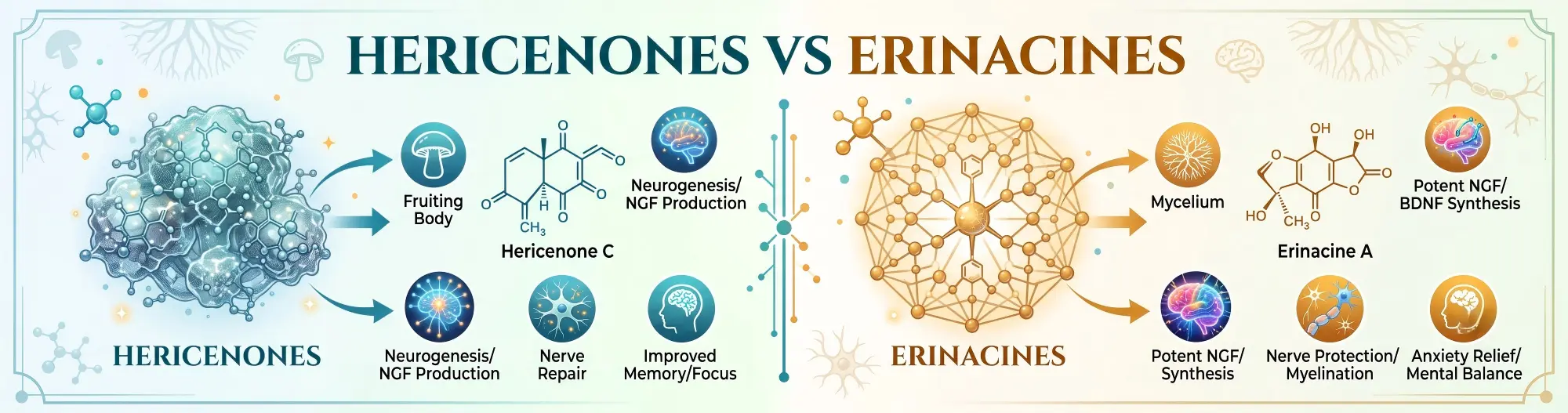
Hericenones and erinacines are two distinct neuroactive compound classes naturally produced by Lion’s Mane (Hericium erinaceus).Hericenones are found primarily in the fruiting body, while erinacines are produced in liquid-fermented mycelium. Both have demonstrated nerve growth factor (NGF)-stimulating activity in laboratory studies, but erinacines currently have stronger preclinical evidence for blood-brain barrier penetration and central nervous system activity. Human evidence for either compound remains limited, and no published study has directly measured NGF levels in human blood or cerebrospinal fluid following supplementation.
Section 1: Introduction
Choosing the wrong Lion’s Mane raw material can fundamentally change the bioactive profile of your finished product.
Two supplements may both claim “Lion’s Mane Extract,” yet contain completely different neuroactive compounds depending on whether they are manufactured from fruiting bodies or liquid-fermented mycelium. This is not a marketing distinction—it is a chemical one.
If you have ever compared Lion’s Mane supplements, you have likely noticed a frustrating pattern: some users report noticeable cognitive benefits, while others feel nothing at all. The reason for this disparity is not merely placebo effect or dosage variation. It comes down to chemistry.
Not all Lion’s Mane (Hericium erinaceus) products contain the same bioactive profile. The mushroom produces two distinct classes of neurotrophic compounds—hericenones and erinacines—and their distribution depends entirely on which part of the fungus is used, how it is cultivated, and how it is extracted. For supplement brands and OEM partners, understanding this distinction is critical to building formulations that align with both the science and consumer expectations.
Section 2: Why Lion’s Mane Became a Nootropic Superstar
The global brain-health supplement market has grown rapidly, driven by aging populations and demand for natural nootropics. Lion’s Mane occupies a unique position in this space because its proposed mechanism is not merely antioxidant or metabolic—it is neurotrophic. Unlike stimulants that temporarily enhance alertness, Lion’s Mane is studied for its potential to influence Nerve Growth Factor (NGF), a protein essential for the survival and differentiation of neurons.
This NGF-centric narrative has made Lion’s Mane one of the most discussed functional mushrooms on platforms like Reddit, Amazon, and Quora. However, the discussion often misses a crucial nuance: NGF stimulation in a petri dish does not automatically translate to cognitive enhancement in humans. The specific compounds responsible, their bioavailability, and their ability to reach the central nervous system all matter.
Section 3: Understanding Lion’s Mane Bioactive Compounds
Lion’s Mane contains three major categories of bioactive constituents relevant to human health:
| Compound Class | Primary Source | Key Mechanism | Solubility |
| Beta-glucans | Fruiting body & mycelium | Immunomodulation | Water-soluble |
| Hericenones | Fruiting body only | NGF synthesis stimulation | Alcohol-soluble |
| Erinacines | Liquid-fermented mycelium only | NGF synthesis + BBB penetration | Alcohol-soluble |
Table 1: Major bioactive compound classes in Lion’s Mane
Beta-glucans are well-established immunomodulators and are often used as a marker for mushroom extract quality. However, they are not the primary drivers of the neurotrophic effects that distinguish Lion’s Mane from other medicinal mushrooms. That distinction belongs to the terpenoid compounds: hericenones and erinacines.
Bioactive Distribution by Source and Extraction Method
| Compound | Fruiting Body | Mycelium (Liquid) | Hot Water Extract | Ethanol Extract | Dual Extract |
| Beta-glucans | High | Moderate | High | Low | Moderate |
| Hericenones | High | Very Low / None | Low | High | Moderate–High |
| Erinacines | None | High | Low | High | N/A* |
Table 2: Compound distribution by source and extraction method. *Dual extraction of fruiting body alone will not yield erinacines, as they are mycelium-specific.
This distribution has direct implications for procurement. A product using only hot water extraction and claiming significant hericenone or erinacine content warrants scrutiny, as both compound classes are alcohol-soluble and require ethanol or similar solvents for effective recovery.
Section 4: What Are Hericenones?
Discovery and Chemistry
Hericenones were first isolated and characterized by Kawagishi et al. in 1991 from the fruiting bodies of Hericium erinaceum [7]. The original research identified hericenones C, D, and E as active stimulators of NGF synthesis. Since then, the hericenone family has expanded to include variants A through H, along with related chroman derivatives such as hericenones F, G, and H.
Source and Production
Hericenones are found exclusively in the fruiting body of Lion’s Mane. They are not produced by the mycelial stage under standard liquid fermentation conditions. This means any fruiting-body extract standardized for hericenones is relying on the mushroom’s above-ground, spore-producing structure.
Manufacturing Considerations
From a manufacturing perspective, hericenone-rich extracts are typically produced from mature fruiting bodies using dual extraction (hot water followed by ethanol) to recover both polysaccharides and lipophilic aromatic compounds. The maturity of the fruiting body, drying conditions, and extraction solvent ratio can significantly influence hericenone yield.
Because hericenones are alcohol-soluble, hot water extraction alone will not capture them in meaningful quantities. A properly manufactured fruiting-body extract for cognitive positioning should specify both its beta-glucan content (from the water phase) and its hericenone profile (from the ethanol phase), verified by HPLC.
Mechanism of Action
In vitro studies demonstrate that hericenones can stimulate NGF synthesis in cultured astrocytoma cells [7]. This has made them the poster compounds for “whole mushroom” brain-health positioning. Fruiting-body extracts also enjoy strong consumer acceptance, particularly among buyers seeking organic, whole-food-based supplements.
Limitations
The primary limitation of hericenones is bioavailability. While they demonstrate NGF-stimulating activity in cell culture, direct evidence that they cross the blood-brain barrier (BBB) in mammals remains limited. Most of the human clinical data on fruiting-body extracts (such as Mori et al., 2009 [1]) show cognitive benefits, but researchers have not directly measured hericenone concentrations in human cerebrospinal fluid or brain tissue.
Section 5: What Are Erinacines?
Discovery and Chemistry
Erinacines belong to the cyathane diterpenoid family. They were first discovered by Kawagishi et al. in 1994 from the cultured mycelia of Hericium erinaceum [8]. The initial report described erinacines A, B, and C as “strong stimulators of nerve growth factor (NGF)-synthesis.” The family has since grown to include erinacines A through K, along with erinacines P–S, each with subtle structural variations that influence their pharmacological activity.
Source and Production
Unlike hericenones, erinacines are produced by the mycelium—the root-like network of fungal hyphae. Crucially, they are most abundant under liquid submerged fermentation conditions, not in the fruiting body. This makes erinacine-rich extracts a specialty of mycelium-based manufacturing, requiring controlled bioreactor cultivation rather than traditional mushroom farming.
Fermentation Engineering
The production of erinacines is significantly more complex than fruiting-body cultivation. Key process parameters include: carbon source optimization (glucose, maltose), dissolved oxygen (DO) control, pH regulation, harvest timing (peak secondary metabolite phase), and erinacine yield standardization [14].
Substrate composition and tissue type directly influence erinacine biosynthesis and gene expression. Recent research confirms that optimizing these fermentation parameters is essential for consistent erinacine A output. This engineering complexity is why erinacine-standardized ingredients command a premium over conventional fruiting-body powders.
The Blood-Brain Barrier Advantage
The most clinically significant distinction of erinacines is their apparent ability to cross the blood-brain barrier. Animal pharmacokinetic studies have demonstrated that erinacine A and its analogs can be detected in brain tissue following oral administration [10]. In one study, erinacine S showed measurable brain distribution after systemic administration, with researchers noting its ability to reach the central nervous system.
This BBB permeability is the central reason erinacines have generated intense research interest for neurodegenerative conditions. If a compound can both stimulate NGF and reach the brain, its theoretical therapeutic potential increases substantially.
Neuroprotective Evidence
Preclinical research has shown that erinacine A-enriched mycelium can ameliorate Alzheimer’s disease-related pathologies in transgenic mouse models, reduce neuroinflammation, and support hippocampal neurogenesis [6]. A pilot double-blind placebo-controlled study further suggested that erinacine A-enriched mycelia may help prevent early Alzheimer’s disease progression in human subjects, though the authors emphasized the need for larger trials.
Section 6: Hericenones vs. Erinacines: Side-by-Side Comparison
Scientific Comparison
| Features | Hericenones | Erinacines |
| Chemical Class | Benzyl-substituted aromatic compounds / chromans | Cyathane diterpenoids |
| Primary Source | Fruiting body only | Liquid-fermented mycelium only |
| NGF Stimulation | Demonstrated in vitro | Demonstrated in vitro and in vivo |
| BBB Penetration | Evidence limited | Animal evidence positive |
| Commercial Availability | High (standardized fruiting-body extracts) | Limited (requires specialized fermentation) |
| Best Application | General wellness, mass-market cognitive support | Premium nootropics, clinical innovation |
Table 3: Scientific comparison of hericenones and erinacines
Commercial Comparison
| Item | Fruiting Body (Hericenones) | Mycelium (Erinacines) |
| Raw Material Cost | Lower | Higher |
| Organic Availability | Excellent | Limited |
| Supply Stability | High | Medium |
| Consumer Recognition | Very High | Moderate |
| Manufacturing Complexity | Low–Moderate | High |
| Premium Positioning | Moderate | Excellent |
| Analytical Standardization | HPLC for hericenones | HPLC for erinacine A |
Table 4: Commercial comparison of fruiting body and mycelium sources
Application Guidance for Brands
| Target Market | Recommended Ingredient Strategy |
| General Brain Health / Amazon Mass Market | Standardized fruiting-body extract (beta-glucans + hericenones) |
| Premium Nootropic Positioning | Liquid-fermented mycelium extract (erinacine-rich) |
| Next-Generation Clinical Formulations | Dual-source strategy: fruiting-body extract + erinacine-standardized mycelium |
Table 5: Application guidance by target market
The dual-source approach is gaining traction among advanced formulators. By combining the consumer familiarity of fruiting-body extracts with the neurotrophic potential of erinacines, brands can create differentiated products that address both the “whole mushroom” consumer preference and the mechanistic demand for BBB-permeable neurotrophic compounds.
Section 7: Does Lion’s Mane Really Increase NGF?
This is where scientific rigor becomes essential—especially under YMYL (Your Money Your Life) standards for health content.
In Vitro Evidence: Strong
Both hericenones and erinacines have demonstrated NGF-stimulating activity in cultured cell lines, including 1321N1 human astrocytoma cells [7][8]. This is well-established in the primary literature.
Animal Evidence: Promising
Rodent studies consistently show that Lion’s Mane extracts—and particularly erinacine-enriched mycelium—can increase NGF levels in the hippocampus and support neurogenesis. One study found that Hericium erinaceus improved recognition memory and induced hippocampal and cerebellar neurogenesis in aging mice [5].
Human Evidence: Preliminary but Directional
The human clinical trial data remain limited in scale but are encouraging:
- Mori et al. (2009) [1]:A double-blind, placebo-controlled trial in 50–80-year-old Japanese adults with mild cognitive impairment (MCI) found that daily intake of 3 g of Lion’s Mane fruiting-body powder significantly improved cognitive function scores versus placebo at 8, 12, and 16 weeks. Notably, the benefits declined within 4 weeks of discontinuation.
- Saitsu et al. (2019) [11]:A study on healthy adults aged 50–80 years reported improvements in cognitive function measures after 12 weeks of Lion’s Mane supplementation.
- Docherty et al. (2023) [12]:A pilot study in healthy young adults (18–45 years) found that 1.8 g/day of a Lion’s Mane extract improved Stroop task reaction time acutely (60 minutes post-dose) and showed a trend toward reduced subjective stress after 28 days. However, most other cognitive measures did not reach significance, and the authors explicitly urged caution in interpreting the results.
Critical Limitation:No published human study has directly measured serum or cerebrospinal fluid NGF levels following Lion’s Mane supplementation. The link between observed cognitive effects and NGF stimulation in humans remains indirect and theoretical.
EEAT / YMYL Compliance Note: Current evidence is promising but preliminary. Lion’s Mane should not be positioned as a treatment for cognitive disease, and all marketing claims should be reviewed for regulatory compliance in your target market.
Section 8: How Extraction Influences Active Compounds
The extraction method is not merely a processing detail—it determines which compound classes are present in the final product.
| Extraction Method | Primary Compounds Recovered | Limitations |
| Hot Water Only | Beta-glucans, polysaccharides | Will not capture hericenones or erinacines meaningfully |
| Ethanol Only | Hericenones (from FB), erinacines (from mycelium) | Low beta-glucan recovery |
| Dual Extraction (Fruiting Body) | Beta-glucans + hericenones | Still no erinacines—requires mycelium source |
| Dual Source + Dual Extraction | Beta-glucans + hericenones + erinacines | Highest complexity and cost |
Table 6: Extraction methods and compound recovery
This is a critical point for procurement teams: dual extraction of fruiting body alone will still not yield erinacines. To capture both hericenones and erinacines in a single formula, you need a dual-source approach (fruiting body + mycelium), not merely a dual-extraction process applied to fruiting body only.
Section 9: Which Ingredient Should Supplement Brands Choose?
The answer depends on your brand positioning, target consumer, and regulatory environment.
Formulation Matrix by Brand Position
| Brand Positions | Ingredients | Suggested Dose | Delivery Format | Rationale |
| Amazon / Mass Market | Fruiting Body Extract | 500–1,000 mg/day | Capsule, powder | Consumer familiarity, cost efficiency, organic cert available |
| Healthy Aging | Fruit Body + Phosphatidylserine | 600 mg/day | Capsule | Synergistic positioning for senior cognitive support |
| Functional Coffee | Fruiting Body Extract | 300 mg/serving | Coffee, stick pack | Neutral flavor, good solubility with proper extraction |
| Gummies | Fruiting Body Extract | 200–400 mg/day | Gummy | Lower dose tolerance, palatability focus |
| Premium Nootropic | Erinacine-Rich Mycelium | 500 mg/day | Capsule | BBB penetration story, clinical-channel positioning |
| Innovation / Clinical | Dual-Source (FB + Mycelium) | 800 mg/day | Capsule, sachet | Full-spectrum NGF positioning, maximum differentiation |
Table 7: Formulation matrix by brand position
Option 1: Fruiting Body Extract
- Best for: Amazon, mass-market DTC, organic positioning
- Rationale: Consumer familiarity, strong supply chain, organic certification available, established beta-glucan standardization
- Limitation: Lower erinacine content; BBB penetration of active compounds not established
Option 2: Liquid-Fermented Mycelium
- Best for: Premium nootropic brands, clinical-channel products, innovation-focused positioning
- Rationale: Erinacine-rich; animal data support CNS penetration; differentiated mechanism
- Limitation: Higher production cost; requires rigorous fermentation control; consumer education needed
Option 3: Dual-Ingredient Strategy
- Best for:Next-generation cognitive health formulations
- Rationale:Combines the consumer trust of fruiting-body extracts with the mechanistic advantages of erinacines. A dual-source product can be positioned as “full spectrum” while delivering both hericenones and erinacines in standardized ratios.
- Formulation Example:Fruiting-body extract (20–30% beta-glucans, hericenones present) + erinacine-standardized mycelium extract (erinacine A > 0.5% by HPLC).
Section 10: Quality Specification—What Brands Should Ask Suppliers
Before committing to a Lion’s Mane raw material, procurement teams should verify the following parameters on every Certificate of Analysis (COA):
| Parameter | Recommendation | Why It Matters |
| Beta-glucans | ≥20% (if immunomodulatory positioning) | Primary quality marker for mushroom extracts; verified by enzymatic method or HPLC |
| Hericenones | Declare if standardized; HPLC preferred | Ensures neurotrophic compound presence in fruiting-body extracts |
| Erinacine A | Declare if standardized; HPLC required | Critical for mycelium extracts; verify liquid fermentation origin (not MOG) |
| Heavy Metals | ≤10 ppm total; Pb ≤2 ppm; As ≤1 ppm; Cd ≤1 ppm; Hg ≤0.1 ppm | USP / EU safety compliance |
| Microbiology | TPC <10,000 cfu/g; E. coli negative; Salmonella negative/25g | USP / EP microbiological standards |
| Pesticides | Multi-residue screen | Required for organic and conventional botanicals |
| Species Identification | DNA barcoding confirmation | Prevents adulteration with other Hericium species |
| Extraction Method | Declared on COA (water, ethanol, or dual) | Determines compound profile accuracy |
| COA Availability | Every batch, third-party ISO-accredited lab | Ensures consistency and traceability |
Table 8: Quality specifications for Lion’s Mane procurement
Section 11: Future Research Directions
The neurotrophic potential of Lion’s Mane is actively being explored across several high-value therapeutic areas:
- Mild Cognitive Impairment (MCI): Following Mori et al. (2009) [1], larger RCTs are needed to confirm whether Lion’s Mane can delay MCI progression.
- Alzheimer’s Disease Support: Preclinical data suggest erinacine A may reduce amyloid-beta burden and tau pathology in transgenic models [6].
- Neuroregeneration: Animal studies indicate that Lion’s Mane may accelerate peripheral nerve regeneration and enhance hippocampal neurogenesis [5].
- Mood and Stress: Early trials suggest anxiolytic and antidepressant-like effects, possibly mediated by BDNF/PI3K/Akt signaling modulation, though human data are sparse.
From a manufacturing perspective, the most significant near-term opportunity is analytical standardization. As Friedman (2015) noted in a comprehensive chemical analysis of Lion’s Mane, commercial products show enormous variability in active compound content [2]. Brands that invest in HPLC-standardized hericenone and erinacine testing—and can verify those claims with certificates of analysis—will establish a clear competitive advantage in an increasingly educated market.
Section 12: Frequently Asked Questions
Section 13: How We Help Supplement Brands Develop Advanced Lion’s Mane Formulas
Instead of sourcing generic Lion’s Mane powder, many brands are now looking for differentiated formulations with standardized bioactive compounds, transparent analytical testing, and application-specific delivery systems.
Our formulation team supports:
- Fruiting body extract formulations with verified hericenone and beta-glucan content
- Liquid-fermented mycelium ingredients with erinacine A standardization
- Dual-source Lion’s Mane concepts combining fruiting body + mycelium
- Multiple delivery formats: capsules, powders, gummies, stick packs, and mushroom coffee
- Custom specification development: beta-glucan, hericenone, and erinacine A targets
- OEM, ODM, and private label manufacturing with batch COAs and third-party verification
Whether you are developing an Amazon bestseller or a premium nootropic line, selecting the appropriate Lion’s Mane raw material is one of the most important formulation decisions your brand will make.
→ Explore our Lion’s Mane OEM Manufacturing Solutions
References
The following sources are peer-reviewed publications, institutional repositories, or authoritative scientific databases. URLs are provided for independent verification.
[1]Mori, K., Inatomi, S., Ouchi, K., Azumi, Y., & Tuchida, T. (2009). Improving effects of the mushroom Yamabushitake (Hericium erinaceus) on mild cognitive impairment: a double-blind placebo-controlled clinical trial. Phytotherapy Research, 23(3), 367–372. https://onlinelibrary.wiley.com/doi/abs/10.1002/ptr.2634
[2]Friedman, M. (2015). Chemistry, nutrition, and health-promoting properties of Hericium erinaceus (Lion’s Mane) mushroom fruiting bodies and mycelia and their bioactive compounds. Journal of Agricultural and Food Chemistry, 63(32), 7108–7123. https://pubs.acs.org/doi/abs/10.1021/acs.jafc.5b02914
[3]Kodani, S., et al. (2024). Uncovering Hericenones from the Fruiting Bodies of Hericium erinaceus through Interdisciplinary Collaboration. Journal of Natural Products. https://pubs.acs.org/doi/abs/10.1021/acs.jnatprod.4c01018
[4]Contato, A. G., & Conte-Junior, C. A. (2025). Lion’s Mane Mushroom (Hericium erinaceus): A Neuroprotective Fungus with Antioxidant, Anti-Inflammatory, and Antimicrobial Potential—A Narrative Review. Nutrients, 17(8), 1307. https://pmc.ncbi.nlm.nih.gov/articles/PMC12030463/
[5]Brandalise, F., et al. (2017). Dietary Supplementation of Hericium erinaceus Increases Mossy Fiber-CA3 Hippocampal Neurotransmission and Recognition Memory in Wild-Type Mice. Evidence-Based Complementary and Alternative Medicine, 2017, 3864340. https://onlinelibrary.wiley.com/doi/10.1155/2017/3864340
[6]Li, I. C., et al. (2020). Prevention of Early Alzheimer’s Disease by Erinacine A-Enriched Hericium erinaceus Mycelia Pilot Double-Blind Placebo-Controlled Study. Frontiers in Aging Neuroscience, 12, 155. https://doi.org/10.3389/fnagi.2020.00155
[7]Kawagishi, H., Ando, M., Sakamoto, H., Yoshida, S., Ojima, F., Ishiguro, Y., Ukai, N., & Furukawa, S. (1991). Hericenones C, D and E, stimulators of nerve growth factor (NGF)-synthesis, from the mushroom Hericium erinaceum. Tetrahedron Letters, 32(35), 4561–4564. https://pubs.acs.org/doi/10.1021/acsomega.3c07792
[8]Kawagishi, H., Shimada, A., Shirai, R., Okamoto, K., Ojima, F., Sakamoto, H., Ishiguro, Y., & Furukawa, S. (1994). Erinacines A, B and C, strong stimulators of nerve growth factor (NGF)-synthesis, from the mycelia of Hericium erinaceum. Tetrahedron Letters, 35(10), 1569–1572. https://pubs.acs.org/doi/abs/10.1021/acs.jnatprod.4c01018
[9]Ma, B. J., Shen, J. W., Yu, H. Y., Ruan, Y., Wu, T. T., & Zhao, X. (2010). Hericenones and erinacines: stimulators of nerve growth factor (NGF) biosynthesis in Hericium erinaceus. Mycology, 1(2), 92–98. https://pubs.acs.org/doi/10.1021/acsomega.3c07792
[10]Hu, J. H., Li, I. C., Lin, T. W., Chen, W. P., Lee, L. Y., Chen, C. C., & Kuo, C. F. (2019). Absolute Bioavailability, Tissue Distribution, and Excretion of Erinacine S in Hericium erinaceus Mycelia. Molecules, 24(8), 1624. https://pdfs.semanticscholar.org/f9b0/babc91f2f4928eaf6d1ed5e01369b833f9ef.pdf
[11]Saitsu, Y., Nishide, A., Kikushima, K., Shimizu, K., & Ohnuki, K. (2019). Improvement of cognitive functions by oral intake of Hericium erinaceus. Biomedical Research, 40(4), 125–131. https://doi.org/10.2220/biomedres.40.125
[12]Docherty, S., Doughty, F. L., & Smith, E. F. (2023). The Acute and Chronic Effects of Lion’s Mane Mushroom Supplementation on Cognitive Function, Stress and Mood in Young Adults: A Double-Blind, Parallel Groups, Pilot Study. Nutrients, 15(22), 4842. https://doi.org/10.3390/nu15224842
[13]Li, I. C., et al. (2020). Erinacine A-enriched mycelia and Alzheimer’s prevention. Frontiers in Aging Neuroscience, 12, 155. https://link.springer.com/chapter/10.1007/978-981-95-2774-8_11
[14]Springer (2025). Influences of substrate and tissue type on erinacine production and biosynthetic gene expression in Hericium erinaceus. Fungal Biology and Biotechnology, 2025. https://link.springer.com/article/10.1186/s40694-025-00194-9
[15]Mycogenius (2026). Hericenones and erinacines explained: compound comparison, extraction requirements, and quality evaluation. https://mycogenius.com/blogs/articles/hericenones-and-erinacines
[16]Nutraceuticals Group (2023). Lion’s Mane Mushroom Fruiting Body Extract 10% Polysaccharides 3% Hericenones Specification Sheet. https://nutraceuticalsgroup.com/document/nigeher025228-mnspec.pdf