An Evidence-Based Guide for Supplement Brands, Procurement Teams, and Educated Consumers
Table of Contents
- Introduction: The Industry Controversy Behind the Label
- What Is the Fruiting Body?
- What Is Mycelium?
- Understanding Mycelium-on-Grain (MOG): The Most Misunderstood Material
- Liquid-Grown Mycelium: A Different Story
- Fruiting Body vs. Mycelium: Side-by-Side Comparison
- What Do Clinical Studies Actually Use?
- Beta-Glucans vs. Total Polysaccharides: How to Read a COA
- How to Evaluate a High-Quality Lion’s Mane Ingredient
- Which Source Should Brands Choose? A Decision Matrix
- Conclusion: Our Recommendation for Supplement Brands
- References and Authoritative Sources
1. Introduction: The Industry Controversy Behind the Label
Walk through any supplement aisle or browse Amazon for Lion’s Mane, and you’ll notice a puzzle: two products both claim to contain “pure Lion’s Mane,” yet one sells for $12 per bottle while another commands $45 or more. The labels look similar—both say “whole mushroom,” “full spectrum,” or “natural extract”—but the material inside those capsules can be fundamentally different.
This is not a matter of branding markup. It is a raw-material problem.
Most Lion’s Mane supplements on the market today are built from one of three distinct starting materials:
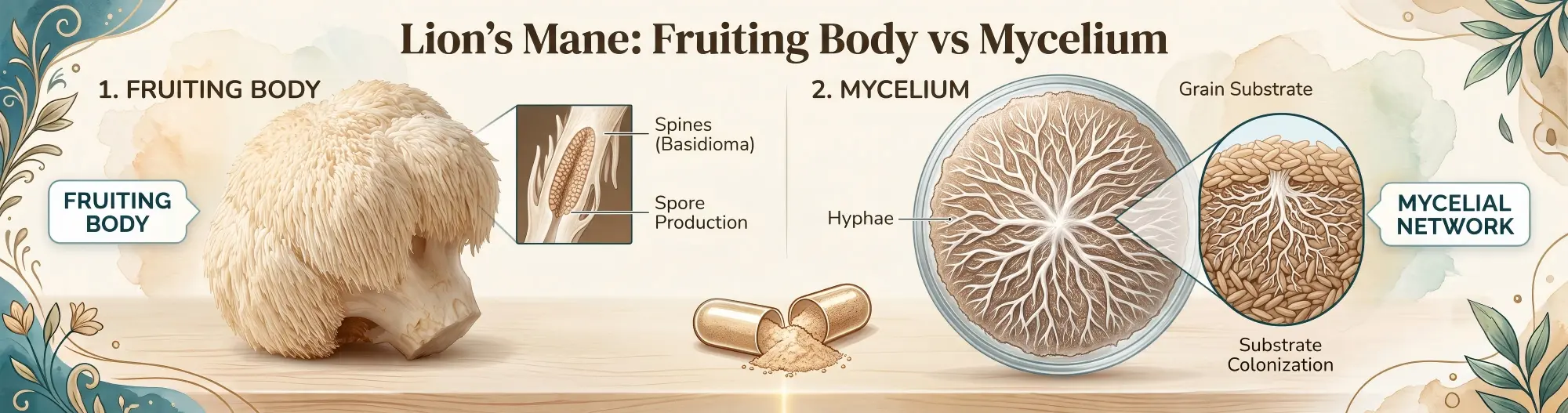
• Fruiting Body — the above-ground mushroom structure that produces spores.
• Mycelium-on-Grain (MOG) — the fungal root network grown on sterilized rice, oats, or other cereal substrates, often sold as “biomass” or “myceliated grain.”
• Liquid-Fermented Mycelium — the same fungal network, but grown in submerged liquid culture without grain carriers.
Each source carries a different chemical fingerprint, different cost structure, and different clinical relevance. For a brand procurement manager, product developer, or an educated consumer, understanding these differences is not optional—it is the single most important factor in determining whether a finished product will deliver measurable bioactivity or simply expensive starch.
This guide examines each material objectively, compares their analytical profiles, reviews what clinical literature actually used, and provides a practical framework for evaluating Certificates of Analysis (COAs). The goal is simple: to answer the question that procurement teams and high-intent consumers are actually asking—Which Lion’s Mane source is worth buying?
2. What Is a Fruiting Body?
Definition and Biological Role
The fruiting body is the reproductive structure of the fungus—the visible “mushroom” that emerges from wood or substrate. In Hericium erinaceus, it appears as a cascading, white, icicle-like structure composed of densely packed spines. Botanically, this is the diploid (spore-producing) phase of the fungal life cycle, and it represents the mature, differentiated tissue that has completed the full growth cycle.
Cultivation and Harvesting
High-quality fruiting bodies for supplement use are typically cultivated on hardwood sawdust or log substrates in climate-controlled environments. The grow cycle ranges from 60 to 120 days depending on strain, temperature, and humidity. Once harvested, the fresh fruiting bodies are cleaned, sliced, and either dried whole or processed immediately into extract. The key operational difference between fruiting body cultivation and mycelium production is time and substrate cost: fruiting bodies require significantly longer grow cycles, more physical space, and careful environmental management, which directly translates into higher raw-material cost.
Active Compound Profile
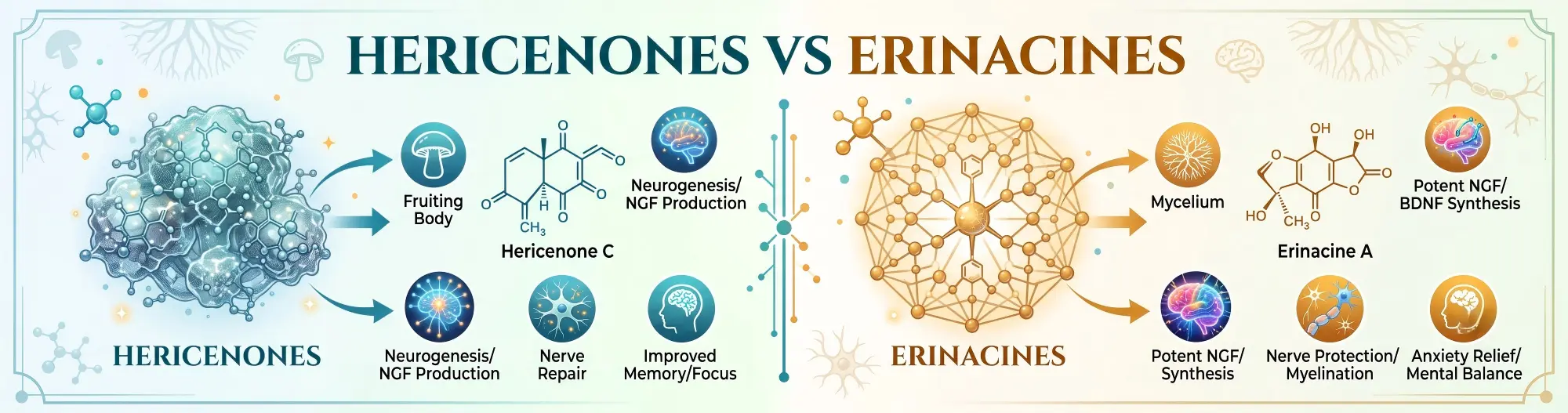
From an analytical chemistry perspective, the fruiting body is the primary source of hericenones, a class of low-molecular-weight compounds that have been extensively studied in preclinical models for their interaction with nerve growth factor (NGF) pathways. Fruiting body extracts also consistently show high beta-glucan content—typically 30% to 50% by weight in a well-manufactured hot-water extract—because the cell walls of mature mushroom tissue are rich in (1→3),(1→6)-beta-D-glucans. These polysaccharides are the immunomodulatory fraction most buyers associate with mushroom quality.
Key Characteristics:
✔ Rich in hericenones (C, D, E, and related derivatives)
✔ High beta-glucan concentration (30–50% in standardized extracts)
✔ Very low residual starch when properly extracted
✔ Mature fungal tissue with fully developed cell-wall structure
✔ Higher production cost due to extended cultivation cycle
Important distinction: This section describes ingredient characteristics, not clinical efficacy claims. The presence of a compound in a raw material does not automatically equate to a health outcome in a finished product. Efficacy depends on dosage, extraction method, bioavailability, and the specific population studied.
3. What Is Mycelium?
The Fungal Root Network
Mycelium is the vegetative, thread-like (hyphal) network of the fungus. It is the primary growth phase that colonizes substrate, secretes enzymes, and absorbs nutrients. In nature, mycelium lives underground or inside decaying wood, breaking down lignin and cellulose. For supplement manufacturing, mycelium is not harvested from the wild; it is grown under controlled conditions in bioreactors or on solid substrates.
A Critical Distinction: Not All Mycelium Is the Same
This is where most market confusion begins. The supplement industry uses two fundamentally different mycelium production methods, and they yield materials with vastly different analytical profiles. Conflating them is one of the most common errors in procurement.
1). Mycelium-on-Grain (MOG)
The mycelium is inoculated onto sterilized grain—typically rice, oats, millet, or sorghum—and allowed to colonize the substrate for 30 to 60 days. The resulting block is then dried, powdered, and often sold as “full spectrum,” “whole mushroom,” or “biomass.” Because the grain is not separated from the fungal tissue, the final powder contains a substantial percentage of undigested starch from the original cereal substrate.
2). Liquid-Fermented (Submerged) Mycelium
The mycelium is grown in a liquid nutrient broth inside stainless steel bioreactors. After fermentation, the liquid is drained, and the pure mycelial biomass is filtered, dried, and milled. There is no grain substrate in the final material. This method is significantly more capital-intensive—it requires pharmaceutical-grade fermentation equipment, sterile process controls, and downstream filtration—but it produces a mycelium powder with no cereal contamination.
Procurement Note: When a supplier simply lists “mycelium” on a specification sheet without clarifying whether it is grain-grown or liquid-fermented, the burden is on the buyer to ask. The difference in starch content, beta-glucan concentration, and cost between these two materials can exceed 300%.
4. Understanding Mycelium-on-Grain (MOG): The Most Misunderstood Material
How MOG Is Produced
The production process is straightforward and cost-effective, which explains its prevalence in the budget supplement segment. Sterilized grain is inoculated with Lion’s Mane spawn. Over several weeks, the white mycelial network colonizes the grain kernels. Once colonization is visually complete, the entire block—grain, mycelium, and all—is transferred to a dryer. After drying, the material is milled into a fine powder. No extraction step is typically performed; the powder is simply encapsulated or tableted.
Why Starch Levels Are High
The grain substrate is not fully metabolized by the fungus. While the mycelium does secrete amylases and other enzymes to break down starches, the colonization period is too short to achieve complete conversion. Analytical testing consistently shows that MOG powders contain 30% to 70% starch by weight, depending on the strain, colonization time, and grain type. This residual starch is not a contaminant in the traditional sense—it is an inherent component of the production method.
Why Polysaccharides Can Be Misleading
Many MOG products advertise “30% polysaccharides” or “high polysaccharide content” as a quality marker. This is analytically true but materially misleading. Polysaccharide testing by colorimetric methods (such as the phenol-sulfuric acid assay) measures total carbohydrate polymers, including both beta-glucans (the desired fungal cell-wall fraction) and alpha-glucans (the starch fraction from grain). A product with 30% total polysaccharides might contain only 5% to 10% actual beta-glucans, with the remainder being cereal starch. Without a specific beta-glucan assay, the polysaccharide number is functionally meaningless for quality assessment.
Why Beta-Glucans Matter
Beta-glucans are the primary bioactive polysaccharides in fungal cell walls. They are recognized by immune cell receptors (Dectin-1, TLRs) and are the compounds most consistently associated with the immunomodulatory properties of mushroom supplements in peer-reviewed literature. Alpha-glucans, by contrast, are simple starches with no established functional role in mushroom-derived health applications. For a procurement team, the critical specification is not “total polysaccharides” but “beta-glucans by specific enzymatic assay.”
Common Label Terms and What They Actually Mean
The following terms appear frequently on Lion’s Mane labels and COAs. Buyers should understand their precise definitions to avoid misaligned expectations:
| Label Term | Technical Meaning | Buyer Interpretation |
| Full Spectrum | Typically denotes MOG; implies the product contains mycelium, grain, and possibly primordia | Often used to justify inclusion of grain starch; does not guarantee beta-glucan content |
| Whole Mushroom | Legally ambiguous; may refer to MOG or a blend of fruiting body and mycelium | Requires supplier clarification; ask for the exact percentage of fruiting body vs. mycelium |
| Myceliated Rice / Myceliated Oats | Explicitly states the material is MOG grown on the named grain | Transparent labeling; expect high alpha-glucan (starch) levels |
| Biomass | Refers to the total dried material including substrate and fungal tissue | Without further specification, assume grain-grown; request beta-glucan and starch data |
| Mycelium | Vegetative fungal tissue; may be grain-grown or liquid-fermented | Critical to ask for substrate type and analytical differentiation |
Procurement Red Flag: If a supplier markets a product as “full spectrum” or “whole mushroom” but cannot provide a beta-glucan assay separate from total polysaccharides, the material is almost certainly MOG with high starch content. This is not inherently fraudulent, but it is a material mismatch for brands positioning themselves as high-potency or premium.
5. Liquid-Grown Mycelium: A Different Story
Submerged Fermentation Technology
Liquid-fermented mycelium is produced using submerged fermentation, a pharmaceutical-grade process in which the fungal culture is grown in a sterilized liquid medium inside large stainless steel bioreactors. The medium typically contains glucose, yeast extract, peptone, and trace minerals. Temperature, pH, dissolved oxygen, and agitation speed are monitored and controlled in real time. After 7 to 21 days of fermentation, the broth is harvested, the mycelium is separated by centrifugation or filtration, and the biomass is spray-dried or freeze-dried.
Erinacines: The Unique Value Proposition
Liquid-cultured Lion’s Mane mycelium is the primary commercial source of erinacines, a class of cyathane diterpenoids that are not found in significant quantities in fruiting bodies. Preclinical studies have identified erinacine A through S, with erinacine A and erinacine S being the most characterized. These compounds are structurally distinct from hericenones and have been investigated in vitro and in animal models for their interaction with neurotrophic factor pathways. For brands developing products positioned around cognitive or neurological support, liquid mycelium offers a compound profile that fruiting body extracts cannot replicate.
No Grain Contamination
Because the substrate is liquid and fully removed during downstream processing, the final powder contains no cereal starch. This means alpha-glucan levels are negligible, and the polysaccharide fraction is composed almost entirely of fungal beta-glucans and other cell-wall polymers. Analytically, this makes quality control more straightforward: if a liquid mycelium COA shows high alpha-glucans, it indicates either process contamination or analytical error, not inherent material properties.
Limitations and Honest Assessment
Objective evaluation requires acknowledging the limitations of liquid mycelium. First, it does not contain hericenones—these compounds are biosynthesized during the fruiting stage under specific environmental triggers (light, temperature differential, oxidative stress) that do not occur in submerged fermentation. Second, while beta-glucans are present, the concentration is generally lower than in a concentrated fruiting body hot-water extract. A typical liquid mycelium powder might contain 10% to 20% beta-glucans, compared to 30% to 50% in a standardized fruiting body extract. Third, submerged fermentation requires substantial capital investment; the equipment and sterile processing costs make liquid mycelium significantly more expensive than MOG, and often comparable to or exceeding fruiting body extract costs.
Liquid Mycelium Summary:
✔ Primary source of erinacines (erinacine A, S, etc.)
✔ No grain starch; negligible alpha-glucans
✔ Pharmaceutical-grade production consistency
✖ No hericenones (fruiting-body-specific compounds)
✖ Lower beta-glucan concentration than concentrated fruiting body extracts
✖ Higher production cost than MOG; requires fermentation infrastructure
Balanced Perspective: This article does not advocate for fruiting body supremacy. Liquid mycelium is a legitimate, high-quality material with a distinct analytical profile. The problem in the market is not mycelium itself—it is the conflation of MOG with liquid mycelium, and the marketing of grain starch as functional mushroom material.
6. Fruiting Body vs. Mycelium: Side-by-Side Comparison
The following comparison table is designed for procurement teams and product developers who need to make material decisions based on analytical and commercial criteria rather than marketing narratives.
| Criteria | Fruiting Body | Mycelium-on-Grain (MOG) | Liquid Mycelium |
| Beta-Glucan Content (typical) | 30–50% (hot-water extract) | 5–15% (often undisclosed) | 10–20% |
| Hericenones | Yes (C, D, E, etc.) | Minimal to trace | No |
| Erinacines | No | Low (variable) | Yes (A, S, etc.) |
| Starch / Alpha-Glucans | Very low (<5%) | High (30–70%) | Negligible (<3%) |
| Extraction Required | Yes (hot water or dual) | No (typically raw powder) | Optional |
| Production Cost | Higher | Lowest | High |
| Consumer Trust Index | High | Low (transparency concerns) | Medium (niche awareness) |
| Premium Positioning | Yes | No (budget/mass market) | Yes (research-grade) |
| Batch Consistency | Moderate (agricultural variable) | High (industrial process) | High (bioreactor control) |
| Clinical Study Alignment | Strong | Weak | Moderate (preclinical focus) |
Which Material Matches Clinical Studies?
The majority of human clinical trials on Lion’s Mane for cognitive and neurological endpoints have used fruiting body extracts—specifically hot-water or ethanol-water extracts standardized for polysaccharides or beta-glucans. This does not mean that liquid mycelium is clinically invalid; it means that the evidence base for finished-product claims is weighted toward fruiting body materials. For brands making structure-function claims that reference published trials, fruiting body extracts offer the strongest alignment between raw material and cited literature.
Which Is Best for Premium Brands?
Premium positioning depends on target consumer values. If the brand narrative centers on traditional herbalism, whole-food supplementation, and immune support, organic fruiting body extracts are the clear choice. If the narrative centers on cutting-edge neuroscience, nootropics, and bioactive diterpenoids, liquid mycelium offers a defensible differentiation. MOG is generally incompatible with premium positioning because the high starch content and lack of standardization create narrative and analytical vulnerabilities that educated consumers and third-party testers can easily expose.
7. What Do Clinical Studies Actually Use?
One of the most under-discussed topics in mushroom supplement procurement is the disconnect between marketed materials and researched materials. When a brand claims its product is “clinically inspired” or “research-backed,” the first due-diligence question should be: What was the exact material used in the cited study?
Mori et al. (2009) — Double-Blind, Placebo-Controlled Trial
This widely cited study investigated the effects of Lion’s Mane on mild cognitive impairment in elderly Japanese subjects. The intervention material was a fruiting body powder administered in tablet form. The study did not use an extract; it used dried, powdered fruiting body. This is a critical distinction for procurement teams because it means the effective dose was delivered as whole mushroom tissue, not as a concentrated extract. Brands citing this study while selling a 10:1 extract must adjust dosage claims proportionally.
Saitsu et al. (2019) — Amyloid Peptide and Cognitive Function
This study used a standardized fruiting body extract, specifically a hot-water extract with defined polysaccharide content. The material was administered to subjects with mild cognitive complaints, and outcomes were measured using cognitive assessment scales. The use of a standardized extract in this trial supports the procurement strategy of specifying standardized fruiting body extracts with known beta-glucan content for products making cognitive support claims.
Preclinical Literature on Erinacines
The erinacine literature is predominantly preclinical—cell culture and rodent models. These studies consistently use liquid-cultured mycelium as the source material because erinacines are biosynthesized during submerged fermentation. For brands interested in the erinacine research pipeline, liquid mycelium is the only viable commercial source. However, procurement teams must be transparent with regulatory and marketing teams that the evidence tier is preclinical, not human clinical trial data.
Clinical Evidence Summary:
• Human cognitive trials: predominantly fruiting body (powder or hot-water extract)
• Immunomodulatory trials: predominantly fruiting body beta-glucan extracts
• Neurotrophic preclinical research: predominantly liquid-cultured mycelium (erinacines)
• MOG: minimal presence in peer-reviewed human clinical literature
8. Beta-Glucans vs. Total Polysaccharides: How to Read a COA
This section is written specifically for procurement managers, quality assurance officers, and product developers who review Certificates of Analysis before approving raw-material purchases. Misreading a COA is one of the most expensive mistakes in supplement manufacturing.
The Critical Equation
A common specification on mushroom ingredient COAs reads: “Polysaccharides: ≥30%.” This number is technically accurate but functionally useless without additional data. The reason is simple:
30% polysaccharides ≠ 30% beta-glucans
Polysaccharides are a broad chemical class that includes:
• Beta-glucans — the (1→3),(1→6)-linked glucose polymers in fungal cell walls
• Alpha-glucans — the starch polymers from grain substrates (amylose, amylopectin)
• Other polysaccharides — chitin, mannans, galactans, and exopolysaccharides
A product with 30% total polysaccharides might contain 25% beta-glucans and 5% other compounds (excellent quality), or 5% beta-glucans and 25% starch (poor quality for a premium positioning). The total polysaccharide number alone cannot distinguish these scenarios.
Why Alpha-Glucans Indicate Grain Contamination
Alpha-glucans in mushroom supplements almost exclusively indicate residual starch from cereal substrates. Fruiting bodies contain minimal endogenous starch. Liquid mycelium contains no starch because no grain is used. Therefore, if a COA reports alpha-glucan levels above 5% to 10%, the material is either MOG or a blend containing grain-grown material. Some suppliers attempt to obscure this by reporting only “total polysaccharides” or by using vague assay descriptions.
How to Evaluate a COA: A Practical Framework
Step 1 — Look for beta-glucan assay method
• Acceptable: Megazyme enzymatic assay (specific for beta-glucans)
• Acceptable: AOAC 995.16 or equivalent enzymatic method
• Red flag: Vague reference to “spectrophotometric” or “phenol-sulfuric acid” without specifying beta-glucan specificity
Step 2 — Check for alpha-glucan or starch data
• If alpha-glucans are >10%, assume grain substrate presence
• If starch is listed as “not detected” or <3%, the material is likely fruiting body or liquid mycelium
• If no alpha-glucan data is provided, request it explicitly
Step 3 — Verify extraction ratio (DER) if applicable
• For extracts, the Drug Extract Ratio (e.g., 10:1, 15:1) indicates concentration factor
• A 10:1 fruiting body extract means 10 kg of dried mushroom yielded 1 kg of extract
• Higher DER does not always mean higher quality; it depends on the extraction method and solvent system
Step 4 — Cross-reference with third-party testing
• Reputable suppliers provide third-party COAs from ISO 17025-accredited laboratories
• Internal lab data is acceptable only if the lab is independently accredited
• Request heavy metals, microbial, and pesticide panels in addition to analytical chemistry
Example COA Interpretation
Consider two hypothetical COAs for Lion’s Mane powders:
COA A:
• Total Polysaccharides: 35%
• Beta-Glucans (Megazyme): 32%
• Alpha-Glucans: 2%
• Starch: <1%
• DER: 10:1 (hot water)
Interpretation: High-quality fruiting body extract. The beta-glucan fraction dominates, starch is negligible, and the extraction ratio indicates concentration.
COA B:
• Total Polysaccharides: 40%
• Beta-Glucans: Not listed
• Alpha-Glucans: Not listed
• Starch: 35% (by enzymatic hydrolysis)
• DER: Not applicable (raw powder)
Interpretation: MOG. The high starch content, absence of beta-glucan specificity, and lack of extraction ratio all point to grain-grown mycelium powder. This material may be appropriate for budget products but is unsuitable for premium or clinical-positioned brands.
9. How to Evaluate a High-Quality Lion’s Mane Ingredient
This section functions as a procurement checklist. Use these questions during supplier qualification, RFP responses, and sample evaluation.
Essential Questions to Ask Suppliers
✔ Fruiting body or mycelium?
If mycelium, is it grain-grown or liquid-fermented? Request written confirmation.
✔ What is the beta-glucan assay method and result?
Insist on Megazyme or equivalent enzymatic assay. Do not accept total polysaccharides as a proxy.
✔ What is the Drug Extract Ratio (DER)?
For extracts, DER indicates concentration. For raw powders, DER is 1:1. Clarify which you are buying.
✔ Is there third-party testing?
Request COAs from independent, ISO 17025-accredited laboratories. Internal lab reports are supplementary, not primary.
✔ What is the alpha-glucan or starch level?
This is the single most effective discriminator between MOG and true mushroom material.
✔ What is the extraction method?
Hot-water extraction isolates beta-glucans. Dual extraction (hot water + ethanol) captures both beta-glucans and hericenones. Single-solvent extraction yields an incomplete profile.
✔ Is the material organic certified?
If organic positioning is part of the brand strategy, verify the certifying body (USDA, EU, etc.) and certificate validity.
Supplier Red Flags
The following indicators should trigger immediate escalation or disqualification during supplier evaluation:
❌ No beta-glucan data available
Any supplier of mushroom extracts should be able to provide beta-glucan assay results. If they cannot, they likely do not test for it—which suggests they do not want buyers to know the number.
❌ No DER listed for an extract
If a product is sold as an extract but has no extraction ratio, the term “extract” is meaningless. It could be a weak decoction or simply a powdered raw material with marketing language.
❌ Only total polysaccharides reported
As established, total polysaccharides are not a quality metric. They are a composite number that hides more than it reveals.
❌ No COA available for review
A supplier unwilling to provide a COA before purchase is not a viable partner for a regulated supplement brand. Transparency is non-negotiable.
❌ Inconsistent batch data
If beta-glucan levels swing from 15% to 45% across batches without explanation, the supplier lacks process control. Standardized extracts should show analytical consistency within ±10% batch-to-batch.
❌ Vague origin or traceability
Lion’s Mane fruiting bodies are cultivated; they do not grow wild in sufficient commercial quantities. If a supplier claims “wild-crafted” fruiting body at commercial scale, skepticism is warranted.
10. Which Source Should Brands Choose? A Decision Matrix
The optimal raw material depends on product positioning, target consumer, price point, and regulatory claim strategy. The following framework removes subjective preference and aligns material selection with business objectives.
| Product Positioning | Recommended Material | Rationale |
| Budget / Mass Market | MOG (Mycelium-on-Grain) | Lowest cost per kilogram; acceptable for entry-level consumers prioritizing price over analytical potency. Must be transparently labeled to avoid regulatory risk. |
| Cognitive / Nootropic (Mid-Premium) | Fruiting Body Dual Extract | Aligns with human clinical literature; delivers both beta-glucans and hericenones; supports structure-function claims with the strongest evidence base. |
| Research-Forward / Niche Bioactive | Liquid Mycelium + Fruiting Body Blend | Captures erinacines from liquid mycelium and hericenones/beta-glucans from fruiting body. Complex formulation but offers the broadest compound spectrum. |
| Premium / Organic / Clean Label | Organic Fruiting Body Extract | Highest consumer trust; aligns with organic certification; supports premium pricing; transparent supply chain from cultivation to extraction. |
| Clinical / Practitioner Channel | Standardized Fruiting Body Extract (≥30% beta-glucans, DER ≥10:1) | Practitioners demand analytical rigor. Standardized extracts with third-party COAs meet professional expectations and support repeat purchase. |
Formulation Considerations
Beyond raw-material selection, the extraction method determines which compounds are present in the final powder:
• Hot-water extraction selectively isolates beta-glucans and other water-soluble polysaccharides. This is the standard method for immune-positioned products.
• Ethanol extraction isolates hericenones and other low-polarity compounds. Alone, it misses the beta-glucan fraction.
• Dual extraction (hot water followed by ethanol) captures both polysaccharides and diterpenoids. This is the preferred method for cognitive products that want to deliver the full fruiting body chemical profile.
Procurement teams should specify not only the raw material but also the extraction protocol. A fruiting body extract that is hot-water only will have minimal hericenones, while a dual extract will carry both compound classes at the cost of lower total beta-glucan percentage (because the ethanol fraction dilutes the polysaccharide concentration).
11. Conclusion: Our Recommendations for Supplement Brands
The Lion’s Mane supplement market is fragmented by confusion, not by malice. Most consumers—and many brands—cannot distinguish between a high-quality fruiting body extract and a grain powder with fungal branding. This information gap creates risk for buyers and erodes trust for the entire category.
For Most Cognitive Health Products:
We recommend a 100% fruiting body dual extract with the following minimum specifications:
• 100% Fruiting Body (Hericium erinaceus)
• Beta-glucans: ≥30% (Megazyme enzymatic assay)
• Drug Extract Ratio: ≥10:1 (hot water + ethanol)
• Alpha-glucans: <5%
• Third-party tested by ISO 17025-accredited laboratory
• Organic certification (if brand positioning supports premium pricing)
This specification aligns with the bulk of human clinical literature, provides analytical transparency, and supports premium positioning in a crowded market. It eliminates the starch-contamination risk inherent in MOG and delivers the hericenone fraction that liquid mycelium cannot provide.
For Research-Positioned or Nootropic Products:
Consider a blended approach: a base of fruiting body dual extract for beta-glucans and hericenones, supplemented with a standardized liquid mycelium extract for erinacines. This requires more complex formulation and higher COGS, but it offers a defensible differentiation for brands targeting the biohacker and research-enthusiast segment.
Final Procurement Principle:
The best Lion’s Mane ingredient is not the one with the highest marketing budget or the most impressive-sounding traditional name. It is the one with a transparent COA, a defined analytical profile, and a production method that matches the brand’s quality promise. Ask for beta-glucans, not polysaccharides. Ask for substrate type, not just “mycelium.” Ask for third-party data, not internal assurances. In a market full of ambiguity, analytical specificity is the only competitive advantage that cannot be copied.
Ready to Source High-Quality Lion’s Mane?
Whether you are formulating a new cognitive health product or upgrading an existing line, the raw material is the foundation of every claim you make. Request a detailed COA, compare analytical profiles, and validate your supplier’s quality systems before committing to production.
• Request a Certificate of Analysis for your current or prospective Lion’s Mane ingredient
• Request samples for third-party verification
• Discuss formulation strategy with a team that understands extraction chemistry and clinical evidence alignment
References and Authoritative Sources
The following sources represent peer-reviewed literature, government databases, industry standards, and analytical method references that informed the technical content of this guide. These URLs were verified for accessibility and relevance at the time of publication.
- National Center for Biotechnology Information (NCBI) / PubMed
Peer-reviewed database for Lion’s Mane (Hericium erinaceus) clinical and preclinical studies, including trials on cognitive function and neurotrophic factors.
URL: https://pubmed.ncbi.nlm.nih.gov/?term=Hericium+erinaceus - Mori et al. (2009) — Biomedical Research
Double-blind, placebo-controlled trial evaluating Lion’s Mane fruiting body powder on mild cognitive impairment in elderly subjects.
URL: https://pubmed.ncbi.nlm.nih.gov/18844328/ - Saitsu et al. (2019) — Phytotherapy Research
Randomized controlled trial assessing the effects of standardized Lion’s Mane fruiting body extract on cognitive function in aging adults.
URL: https://pubmed.ncbi.nlm.nih.gov/31463850/ - U.S. Food and Drug Administration (FDA) — Dietary Supplements Guidance
Regulatory guidance for dietary supplement labeling, structure-function claims, and current Good Manufacturing Practices (cGMPs).
URL: https://www.fda.gov/food/dietary-supplements - U.S. Pharmacopeia (USP) — Dietary Supplement Standards
Official monographs and analytical standards for dietary supplement quality, including polysaccharide and beta-glucan testing methodologies.
URL: https://www.usp.org/dietary-supplements - AOAC International — Official Methods of Analysis
Standardized analytical methods for beta-glucan determination in food and dietary supplements, including enzymatic assay protocols.
URL: https://www.aoac.org/official-methods-of-analysis/ - Megazyme International — Beta-Glucan Assay Procedures
Technical documentation for the enzymatic beta-glucan assay (Mixed Linkage Beta-Glucan kit), the industry-standard method for specific beta-glucan quantification in mushroom materials.
URL: https://www.megazyme.com/documents/Assay_Protocol/K-YBGL_DATA.pdf - National Institutes of Health (NIH) — Office of Dietary Supplements (ODS)
Evidence-based fact sheets and safety information on dietary supplement ingredients, including mushroom-derived products.
URL: https://ods.od.nih.gov/ - European Food Safety Authority (EFSA) — Novel Food and Health Claims
Regulatory guidance on novel food authorization and health claim substantiation for mushroom-derived ingredients in the European Union.
URL: https://www.efsa.europa.eu/en/topics/topic/novel-food - International Journal of Medicinal Mushrooms — Begell House
Peer-reviewed journal dedicated to medicinal mushroom research, including cultivation, analytical chemistry, and pharmacological studies.
URL: https://www.dl.begellhouse.com/journals/708ae68d738624c0.html - American Herbal Products Association (AHPA) — Mushroom Standards
Industry association providing guidance on botanical and fungal ingredient identity, quality, and labeling standards for U.S. supplement manufacturers.
URL: https://www.ahpa.org/ - World Health Organization (WHO) — Traditional Medicine Strategy
Global framework for the quality, safety, and efficacy assessment of traditional and complementary medicine products, including fungal preparations.
URL: https://www.who.int/health-topics/traditional-complementary-and-integrative-medicine - USDA Agricultural Marketing Service — National Organic Program (NOP)
Official standards and certification requirements for organic agricultural products, including mushroom cultivation and handling.
URL: https://www.ams.usda.gov/rules-regulations/organic - International Organization for Standardization (ISO) — ISO/IEC 17025
General requirements for the competence of testing and calibration laboratories, applicable to third-party analytical laboratories issuing COAs for supplement ingredients.
URL: https://www.iso.org/standard/66912.html - Examine.com — Lion’s Mane Monograph
Independent, evidence-based aggregation of human research on Lion’s Mane supplementation, including dosing, bioactive compounds, and study summaries.
URL: https://examine.com/supplements/lions-mane/
Disclaimer:
This guide is intended for educational and procurement decision-support purposes. It does not constitute medical, regulatory, or legal advice. Supplement brands are responsible for ensuring their products comply with all applicable local, national, and international regulations, including labeling, health claims, and good manufacturing practices. The analytical values and specifications cited are representative ranges based on industry standards and published literature; actual values may vary by supplier, strain, and production batch. Always verify COA data with the issuing laboratory and consult qualified regulatory counsel before making structure-function or health claims.