
Why KS Nutripharma®
Reliable Supply Chain & Certified Manufacturing
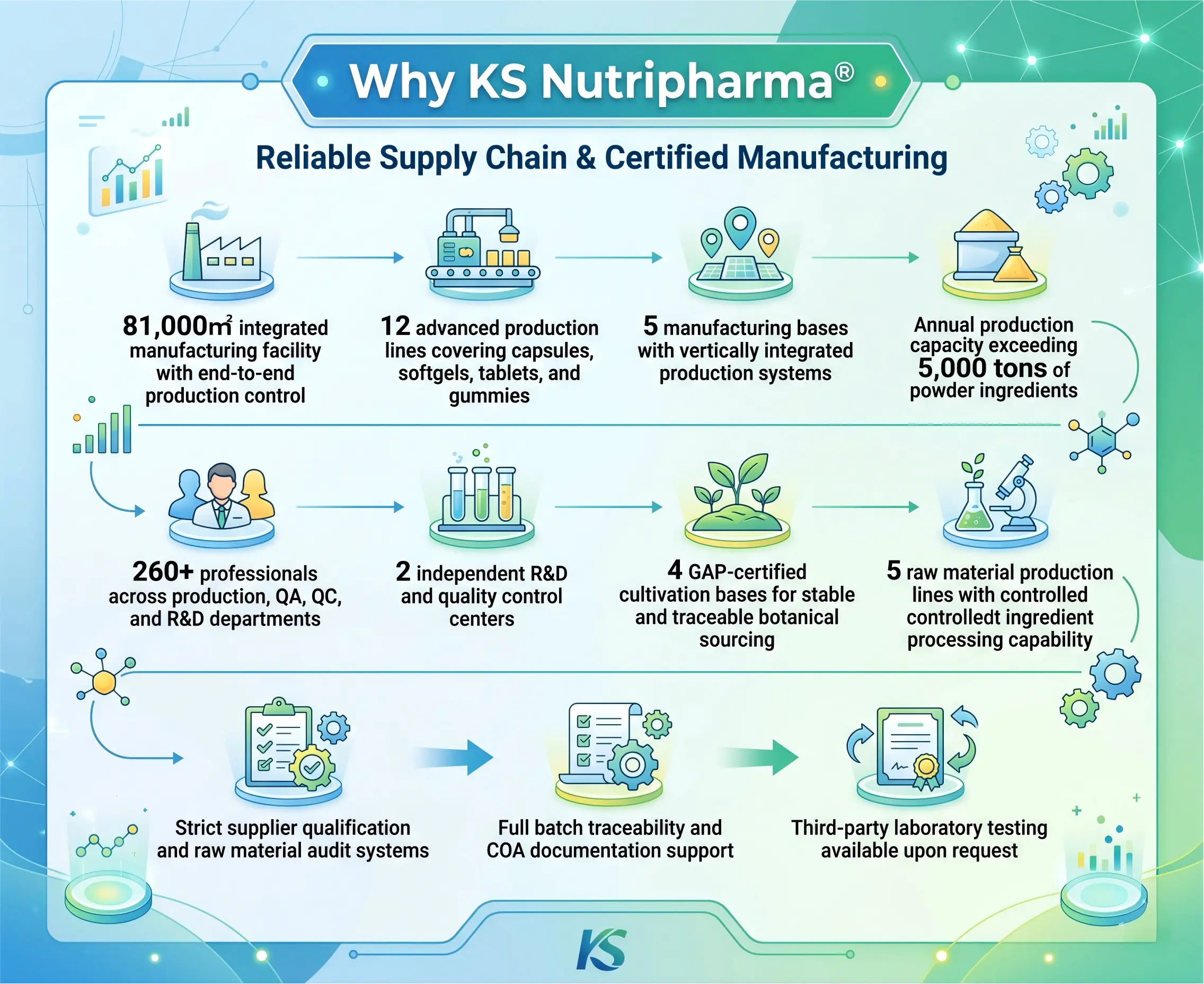
- 81,000㎡ integrated manufacturing facility with end-to-end production control
- 12 advanced production lines covering capsules, softgels, tablets, and gummies
- 5 manufacturing bases with vertically integrated production systems
- Annual production capacity exceeding 5,000 tons of powder ingredients
- 260+ professionals across production, QA, QC, and R&D departments
- 2 independent R&D and quality control centers
- 4 GAP-certified cultivation bases for stable and traceable botanical sourcing
- 5 raw material production lines with controlled ingredient processing capability
- Strict supplier qualification and raw material audit systems
- Full batch traceability and COA documentation support
- Third-party laboratory testing available upon request
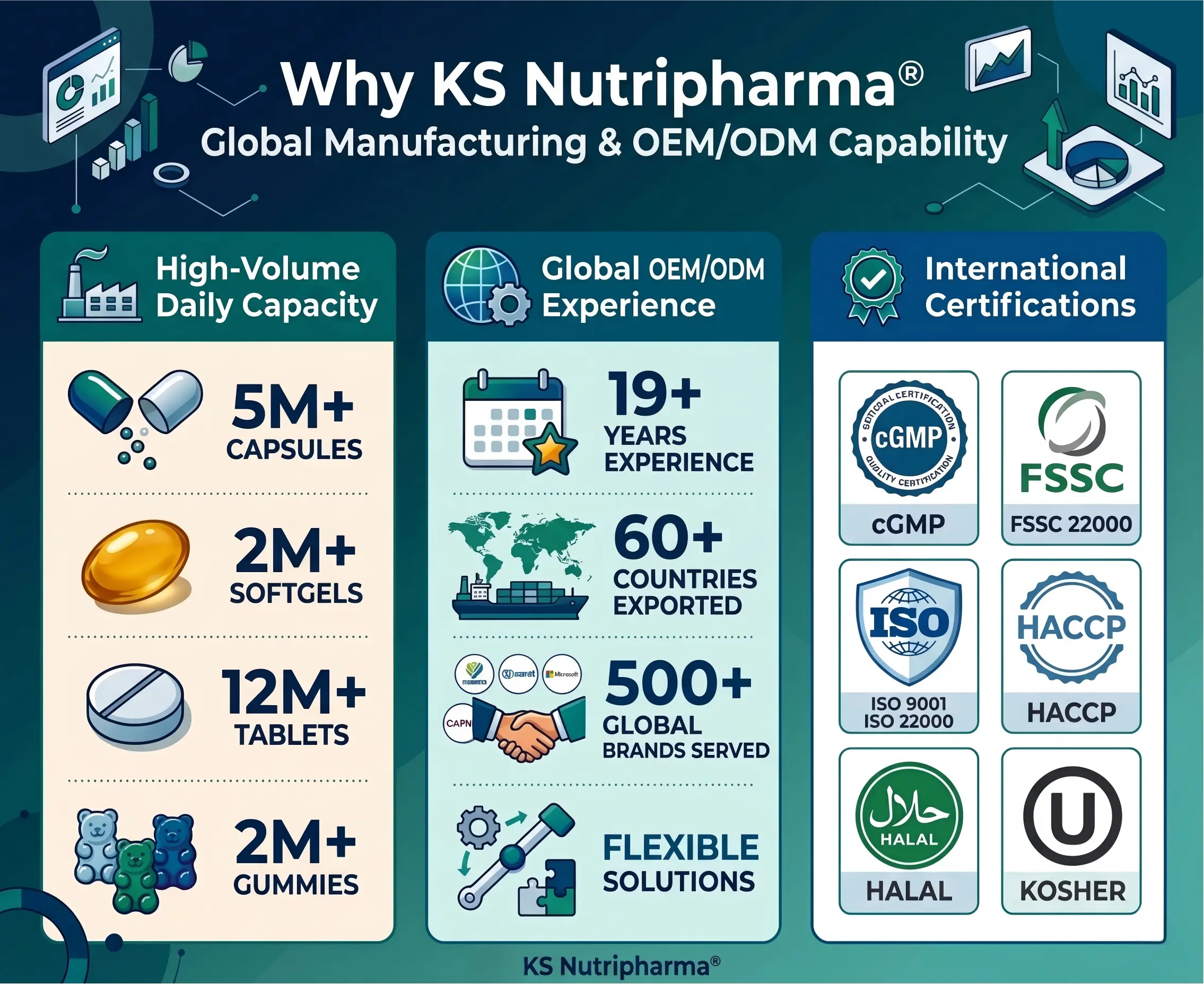
High-Volume Daily Production Capacity
- 5,000,000+ capsules per day
- 2,000,000+ softgels per day
- 12,000,000+ tablets per day
- 2,000,000+ gummies per day
Global OEM/ODM Commercialization Capability
- 19+ years of supplement manufacturing experience
- Exported to 60+ countries
- Serving 500+ global supplement brands
- Flexible OEM/ODM and private-label solutions
- Low MOQ to large-scale commercial production
- Multi-market regulatory documentation support
- Packaging and labeling coordination support
- Long-term supply-chain planning capability
International Certification Systems
Certified under: cGMP/ISO 22000/ ISO 9001/HACCP/FSSC 22000/HALAL/KOSHER
Deep Hydration & Barrier Repair Supplement OEM/ODM Solutions
Modern skin hydration supplements are evolving beyond simple “moisturizing” concepts toward clinically positioned barrier-support systems designed to address chronic dehydration, transepidermal water loss (TEWL), environmental stress exposure, and long-term skin resilience.
Across Reddit skincare communities, Quora discussions, and beauty supplement reviews, consumers repeatedly report several unresolved frustrations:
- skin remains dehydrated despite expensive topical skincare
- dry skin rapidly returns after stopping products
- indoor air conditioning and screen-heavy lifestyles worsen dehydration
- seasonal climate changes trigger barrier instability
- makeup adherence declines due to dehydrated skin texture
- sensitive skin worsens after overuse of exfoliating acids or retinol
- consumers want “inside-out hydration” instead of temporary surface moisturization
For supplement brands, these consumer pain points create additional commercial challenges:
- hydration claims often lack visible consumer-perceived results
- hyaluronic acid products become commoditized quickly
- moisture-sensitive formulas face shelf-life instability
- powders and gummies frequently absorb humidity during transport
- hydration products struggle to differentiate in saturated beauty markets
- low-grade HA raw materials create inconsistent user experiences
KS Nutripharma develops hydration supplement systems focused on formulation engineering, active stability, barrier-repair architecture, and scalable manufacturing reproducibility for global beauty and wellness brands. Our hydration OEM systems support:
- oral beauty hydration supplements
- hyaluronic acid capsule manufacturing
- ceramide beauty powders
- beauty hydration stick packs
- RTD beauty beverages
- hydration gummies
- skin barrier support complexes
- clinical-style inside-out beauty positioning
1. Skin Hydration Market Segmentation System
The hydration supplement category is becoming increasingly specialized as consumers move away from generic collagen-only positioning and seek targeted barrier repair, moisture retention, and environmental resilience support.
Positioned for consumers experiencing mild dehydration from lifestyle and environmental exposure.
Common consumer triggers:
- office air conditioning
- high screen exposure
- low water intake
- frequent travel
- urban pollution environments
Focused on consumers with compromised skin barriers caused by:
- over-exfoliation
- retinol adaptation
- sensitive skin recovery
- seasonal irritation
- post-procedure skincare recovery
Targeted toward regions with:
- cold winter dryness
- desert climates
- high-altitude dehydration
- tropical humidity imbalance
- frequent seasonal transitions
Designed for:
- luxury beauty supplement positioning
- dermatologist-inspired product lines
- clinical beauty retail channels
- influencer-driven inside-out beauty brands
Fast-growing category combining:
- hydration support
- electrolytes
- skin-focused antioxidants
- low-sugar beauty beverage positioning
Hydration supplements often fail commercially because brands underestimate the gap between “ingredient listing” and “consumer-perceived hydration improvement.”
Key commercial risks include:
- hydration claims without visible consumer feedback
- formulas overloaded with trendy ingredients but poor synergy
- insufficient ceramide dosage
- HA molecular-weight mismatch
- poor taste masking in beauty beverages
- unstable powders under humid logistics conditions
Our formulation systems prioritize measurable hydration positioning rather than trend-based ingredient stacking.
2. Functional Ingredient System Architecture
Skin hydration supplementation is not a single-ingredient function. It is a multi-layer biological support system designed to regulate water retention, lipid barrier integrity, and environmental stress response.
Modern hydration formulas require structured functional architecture rather than trend-based ingredient stacking.
This layer supports skin hydration capacity and water-binding behavior.
Core Functional Ingredients
- Sodium Hyaluronate (multi-molecular weight systems)
- Tremella Fuciformis Polysaccharides
- Natural moisturizing factors (NMF-support systems)
Functional Role
- Supports dermal and epidermal moisture retention capacity
- Enhances water-binding performance at cellular level
- Improves hydration availability under environmental stress conditions
This system supports skin barrier integrity and reduces transepidermal water loss (TEWL).
Core Functional Ingredients
- Ceramide complexes (plant-derived / bio-identical systems)
- Phospholipids
- Omega lipid matrices (linoleic acid support systems)
Functional Role
- Supports lipid matrix reconstruction
- Reduces moisture evaporation rate
- Strengthens barrier resilience under external stress exposure
Hydration degradation is often accelerated by oxidative stress and environmental exposure.
Core Functional Ingredients
- Astaxanthin
- Polyphenol complexes (grape seed, green tea extracts)
- Vitamin E derivatives (tocotrienols)
Functional Role
- Supports cellular oxidative stress balance
- Protects lipid and moisture systems from degradation
- Enhances long-term skin resilience under urban and UV exposure conditions
This layer improves cross-functional interaction between hydration, barrier, and stress-response systems.
Core Components
- Electrolyte mineral systems (magnesium, potassium)
- Botanical hydration cofactors
- Adaptogenic support compounds (functional positioning dependent)
Functional Role
- Supports intracellular hydration balance
- Enhances systemic hydration efficiency
- Stabilizes multi-ingredient hydration performance pathways
Effective hydration supplementation is not determined by single active concentration, but by system-level synergy between:
- water retention pathways
- lipid barrier reinforcement
- oxidative stress protection
- hydration signaling balance
Extended Functional Ingredient Library
Modern hydration supplement systems require a broader and more clinically relevant ingredient architecture beyond hyaluronic acid and ceramide systems.
Based on global formulation trends in beauty-from-within, dermatological nutraceuticals, and consumer hydration demand patterns, advanced systems integrate additional functional actives targeting intracellular hydration, mitochondrial protection, glycation stress reduction, and long-term skin resilience.
This system focuses on improving hydration efficiency at the cellular level rather than surface moisture retention alone.
Key Functional Ingredients
- Taurine (osmotic balance & cellular hydration support)
- Betaine (trimethylglycine hydration stabilization)
- Glycerophosphocholine (cell membrane hydration support)
- Coconut-derived electrolytic osmolytes
Functional Role
- Supports intracellular water retention efficiency
- Enhances osmotic balance under dehydration stress
- Improves systemic hydration utilization rate
A rapidly growing category in premium beauty supplements focused on oxidative aging pathways and cellular stress protection.
Key Functional Ingredients
- Ergothioneine
- Coenzyme Q10 (ubiquinone / ubiquinol systems)
- PQQ (Pyrroloquinoline Quinone)
- Alpha-lipoic acid (mitochondrial antioxidant support)
Functional Role
- Protects skin cells from oxidative hydration degradation
- Supports mitochondrial energy metabolism in skin cells
- Reduces stress-induced hydration breakdown
- Enhances long-term skin vitality and resilience positioning
Hydration loss is strongly linked to glycation-related collagen stiffening and structural degradation.
Key Functional Ingredients
- Carnosine
- Benfotiamine
- Resveratrol
- Aminoguanidine-inspired botanical analogs
Functional Role
- Reduces glycation-induced skin rigidity
- Supports collagen flexibility and moisture binding capacity
- Improves long-term skin texture quality
- Enhances hydration retention in aging skin structures
Emerging hydration category linking gut-skin interaction with moisture balance and barrier function.
Key Functional Ingredients
- Postbiotics (heat-treated probiotic metabolites)
- Probiotic lysates
- Inulin / prebiotic fibers
- Short-chain fatty acid precursors
Functional Role
- Supports inflammatory balance affecting skin hydration
- Enhances barrier recovery through gut-skin axis modulation
- Improves long-term skin sensitivity reduction
Designed for clean-label, vegan, and natural beauty supplement positioning.
Key Functional Ingredients
- Snow mushroom (Tremella fuciformis – polysaccharide refinement systems)
- Aloe vera bioactive fractions
- Sea buckthorn oil (omega-rich lipid hydration support)
- Polyglutamic acid (PGA – high water-binding capacity polymer)
Functional Role
- Enhances surface hydration retention capacity
- Supports plant-based moisture binding systems
- Provides clean-label hydration positioning advantage
- Improves consumer perception of “natural hydration efficacy”
Modern hydration loss is strongly correlated with stress, cortisol imbalance, and sleep disruption.
Key Functional Ingredients
- L-theanine
- Magnesium glycinate
- Ashwagandha (Withania somnifera extract)
- Lemon balm extract
Functional Role
- Reduces stress-induced skin dehydration pathways
- Supports sleep-related skin regeneration cycles
- Improves hydration stability under lifestyle stress conditions
Advanced hydration supplementation is no longer defined by single-active positioning (such as HA concentration).
Instead, it is defined by multi-layer physiological system integration:
- cellular hydration regulation
- lipid barrier reinforcement
- oxidative stress protection
- glycation control mechanisms
- microbiome modulation
- stress-response hydration stability
Commercial Insight
Brands that only rely on hyaluronic acid/collagen/ceramides are increasingly facing commoditization pressure in global markets.
Brands that integrate multi-system hydration architecture are better positioned for:
- premium pricing
- repeat purchase stability
- clinical-style positioning
- retail differentiation
- long-term brand defensibility
3. Hydration Performance & Consumer Perception Engineering System
Hydration supplements fail commercially not because of ingredient insufficiency, but because of the gap between biological activity and consumer-perceived results.
Across skincare communities, consumer feedback consistently shows:
- “No visible improvement”
- “Works only temporarily”
- “Feels like placebo hydration”
- “Skin still feels dry after use”
- “No difference vs skincare alone”
This indicates that hydration success is defined by perception stability, not ingredient presence.
Biological Hydration Effect
Refers to internal physiological changes such as:
- improved moisture retention
- barrier lipid support
- hydration pathway activation
Consumer-Perceived Hydration Effect
Refers to observable outcomes such as:
- reduced skin tightness
- improved skin softness perception
- makeup adherence improvement
- reduction in dryness recurrence frequency
Many hydration supplements underperform because they rely on ingredient intensity instead of system behavior.
Common failure patterns include:
- high-dose HA with no barrier synergy
- lack of lipid reinforcement systems
- poor hydration persistence over time
- inconsistent daily compliance behavior
- no sensory-linked reinforcement signals
Long-term hydration performance depends on system persistence rather than peak effect.
Key determinants include:
- duration of hydration retention signal
- consistency of daily user experience
- reduction in dryness recurrence cycles
- stability of perceived skin improvement over time
Consumer behavior directly impacts hydration outcomes.
Even scientifically strong formulas fail if:
- usage is inconsistent
- sensory experience is unpleasant
- product format is inconvenient
- daily integration is low
Therefore, hydration effectiveness is partially a behavioral engineering outcome.
Successful hydration supplements are designed to support perceptible outcomes including:
- smoother skin surface perception
- reduced dryness visibility
- improved skin radiance perception
- enhanced makeup compatibility
These outcomes drive repeat purchase behavior more than ingredient awareness.
Core Principle
Hydration performance is not defined by what is inside the formula, but by what the consumer consistently perceives over time.
4. Dosage Form & Delivery System Engineering
Hydration supplements require precise dosage form engineering to ensure ingredient stability, consumer usability, and real-world commercial performance.
Each dosage form creates unique technical constraints and commercial risks.
Capsules provide the highest stability for moisture-sensitive ingredients.
Advantages
- high protection against oxidation
- precise dosage control
- suitable for lipid-based systems (ceramides, phospholipids)
- strong shelf-life stability
Engineering Requirements
- controlled powder flow behavior
- humidity-resistant capsule shells
- active compatibility balancing
- oxygen exposure control
Powder formats are widely used for beauty hydration systems due to flexibility and scalability.
Advantages
- fast consumer adoption
- easy e-commerce distribution
- flexible ingredient combination systems
Key Engineering Challenges
- moisture absorption sensitivity
- powder aggregation under humidity
- flowability inconsistency
- dissolution variability in real use conditions
Effervescent formats are used for premium hydration beverage experiences.
Advantages
- strong sensory activation
- fast dissolution perception
- high consumer engagement
Technical Risks
- premature reaction under humidity exposure
- instability in packaging systems
- degradation of active ingredients under moisture stress
Ready-to-drink hydration beverages require advanced formulation stability.
Engineering Requirements
- suspension stability control
- prevention of ingredient sedimentation
- pH and flavor system compatibility
- preservative system balancing
Common Stability Issues
- layering or separation during storage
- HA sedimentation at the bottom
- flavor drift over time
- viscosity inconsistency
Hydration gummies are a high-demand but technically complex delivery format.
Advantages
- strong consumer appeal
- high repeat purchase potential
- easy positioning for beauty brands
Key Engineering Constraints
- water activity control
- heat sensitivity during transport
- texture stability over shelf life
- active ingredient degradation risk
Dosage form selection directly determines:
- stability performance
- consumer compliance
- sensory acceptance
- repeat purchase behavior
- logistics survivability
Therefore, dosage form is not a packaging decision, but a core formulation engineering parameter.
High-performance hydration supplements require alignment across:
- ingredient architecture (what it does)
- consumer perception system (what is felt)
- dosage form engineering (how it is delivered)
Only when these three layers are aligned can a hydration product achieve scalable commercial success.
5. REGULATORY & GLOBAL COMPLIANCE FRAMEWORK
Skin hydration supplements operate in one of the most regulation-sensitive categories within nutraceuticals and beauty-from-within products.
Commercial success in global markets depends not only on formulation quality, but on whether products can legally enter and sustain distribution across multiple regulatory environments.
KS Nutripharma operates under a fully certified global compliance framework designed to support multi-market product deployment and retail acceptance.
Our facilities are compliant with internationally recognized standards, including:
- cGMP (Current Good Manufacturing Practice)
- HACCP (Hazard Analysis and Critical Control Points)
- ISO 9001 Quality Management System
- ISO 22000 Food Safety Management System
- FSSC 22000 Global Food Safety Certification
- FDA Registered Manufacturing Facility
- Kosher Certified Production System
- Halal Certified Manufacturing System
These certifications are not symbolic credentials.
They function as market entry enablers, allowing brands to:
- enter US retail and Amazon regulated categories
- access EU and Middle East distribution channels
- pass retailer onboarding audits (Walmart, CVS, pharmacy chains)
- support cross-border e-commerce expansion
- reduce regulatory rejection risk during listing approval
Hydration supplement brands frequently fail due to:
- unsupported structure/function claims
- ingredient mislabeling across regions
- non-compliant botanical positioning
- inconsistent allergen declarations
- documentation gaps during retail audits
Our compliance system ensures:
- market-specific labeling adaptation
- claim structure alignment with regional regulations
- full ingredient traceability documentation
- export-ready regulatory dossier preparation
Core Principle
Compliance is not a legal requirement only — it is a market access engineering system.
6. Hydration Manufacturing Stability & Process Engineering System
Hydration supplements are among the most stability-sensitive categories in nutraceutical manufacturing due to their sensitivity to moisture, heat, and ingredient interaction dynamics.
Unlike standard supplements, hydration products require environmental-controlled manufacturing logic.
Production systems are designed with:
- low-humidity manufacturing zones
- temperature-controlled processing environments
- moisture isolation handling systems
- oxygen exposure minimization protocols
We engineer production systems around measurable stability benchmarks:
- active ingredient retention ≥ 90%
- batch-to-batch variation ≤ ±5%
- dissolution consistency ≥ 95%
- moisture activity control within defined thresholds
- sensory stability across shelf-life duration
Hydration ingredients such as hyaluronic acid, ceramides, and polysaccharides require:
- anti-caking system integration
- controlled blending sequences
- encapsulation protection strategies
- humidity-controlled packaging transfer
We specifically mitigate:
- powder clumping after production
- gummy texture degradation during transport
- RTD sedimentation after storage
- capsule instability under humidity exposure
- flavor and odor drift over time
Core Principle
Manufacturing is not production output — it is stability reproduction at scale.
7. MOQ Flexibility & Commercial Scaling Pathway System
Hydration supplement brands rarely scale in a linear way. Most successful brands evolve through staged validation cycles driven by e-commerce performance, influencer validation, and retail onboarding.
Our MOQ system is designed to support this commercial evolution.
Designed for early-stage brands and concept validation.
Used for:
- influencer sampling campaigns
- sensory validation testing
- hydration performance feedback loops
- packaging compatibility testing
- market positioning validation
Designed for active market entry.
Supports:
- Amazon and Shopify launches
- TikTok and DTC scaling campaigns
- regional distributor onboarding
- early retail negotiations
Designed for established brands and multi-market expansion.
Enables:
- continuous global supply chains
- multi-country retail distribution
- long-term forecasting stability
- SKU portfolio expansion
This structure reduces brand risk by allowing:
- controlled capital deployment
- iterative product optimization
- data-driven formula refinement
- minimized inventory exposure
Core Principle
MOQ is not a production limit — it is a brand growth engineering framework.
8. Project Timeline & Commercial Delivery System
In the global hydration supplement industry, delivery reliability is a critical factor that directly impacts brand launch success, retail onboarding schedules, and marketing campaign execution.
Unlike standard manufacturing timelines, hydration supplement development requires synchronized coordination between formulation engineering, stability validation, packaging compatibility, and regulatory preparation.
KS Nutripharma operates a structured project execution system designed to ensure predictable, transparent, and scalable product delivery.
This phase includes:
- market positioning analysis
- ingredient system design
- dosage form selection
- compliance feasibility review
- initial formulation framework development
Deliverable: validated product concept and technical direction
This phase includes:
- laboratory prototype formulation
- hydration system performance testing
- sensory evaluation (taste, texture, solubility)
- initial stability screening
- ingredient compatibility validation
Deliverable: functional prototype samples
This phase includes:
- accelerated stability testing under humidity and temperature stress
- packaging compatibility verification
- dissolution and texture consistency testing
- active ingredient retention analysis
- transport simulation testing
Deliverable: production-ready validated formulation
This phase includes:
- full-scale manufacturing scheduling
- GMP production execution
- batch quality control testing
- regulatory documentation preparation
- export compliance validation
Deliverable: ready-for-market finished goods
Hydration supplement projects often involve multi-department coordination, including:
- formulation R&D
- packaging engineering
- compliance documentation
- supply chain sourcing
- production scheduling
To ensure predictable delivery, all workflows operate under synchronized project tracking systems.
We actively mitigate common OEM delivery risks such as:
- raw material delay fluctuations
- packaging supply chain disruption
- stability test rework cycles
- regulatory documentation delays
- production scheduling conflicts
Through:
- pre-qualified supplier systems
- parallel workflow execution
- contingency production planning
- batch buffer scheduling
Reliable project timelines enable brands to:
- align product launch with marketing campaigns
- meet Amazon and retail listing deadlines
- synchronize influencer marketing schedules
- reduce inventory and launch risk exposure
- accelerate time-to-market for seasonal products
Core Principle
In hydration supplement manufacturing, delivery time is not a production metric — it is a commercial execution reliability system that determines brand launch success.
9. End-to-End Supply Chain Orchestration System
Hydration supplements rely on a highly sensitive supply chain structure due to the variability of bioactive raw materials, moisture-sensitive ingredients, and packaging-dependent stability requirements.
Unlike standard nutraceutical categories, hydration formulations require synchronized control across ingredient sourcing, supplier redundancy, logistics engineering, and packaging optimization.
KS Nutripharma operates a fully integrated supply chain orchestration system designed to ensure consistency, continuity, and scalability across global markets.
Every hydration formula begins with a structured raw material qualification process rather than simple ingredient procurement.
Core Selection Criteria
We evaluate raw materials based on:
- functional performance consistency (hydration efficacy stability)
- molecular integrity (HA molecular weight distribution accuracy)
- lipid oxidation resistance (ceramide stability behavior)
- moisture sensitivity profile
- batch reproducibility across suppliers
- regulatory compliance compatibility (US/EU/MEA standards)
Ingredient Categories Covered
We manage full-spectrum sourcing for:
- hyaluronic acid (multi-molecular weight systems)
- ceramide complexes (plant-based & bio-identical systems)
- polysaccharide hydration systems (tremella, botanical fibers)
- electrolyte mineral systems
- antioxidant stabilization systems
To eliminate single-point failure risk, we operate a multi-tier supplier structure.
Primary Suppliers
- validated GMP-certified ingredient manufacturers
- long-term strategic raw material partners
- high-consistency production facilities
Secondary Backup Suppliers
- pre-qualified alternative sourcing partners
- regional redundancy suppliers (US / EU / Asia)
- emergency substitution-ready vendors
Strategic Reserve Suppliers
- innovation-stage ingredient providers
- specialty bioactive manufacturers
- seasonal or volatility-hedge suppliers
Commercial Advantage
This structure ensures:
- continuous production even during supply disruption
- reduced dependency on single-origin raw materials
- pricing stability across market fluctuations
- uninterrupted global order fulfillment
Hydration ingredients are highly sensitive to global volatility.
We actively manage risk factors including:
- HA raw material price fluctuation
- ceramide sourcing instability
- botanical extract seasonal variability
- geopolitical logistics disruption
- regulatory reclassification risks
Risk mitigation strategies include:
- dual-sourcing for critical actives
- inventory buffering systems
- forward procurement planning
- multi-region sourcing diversification
Hydration supplements require controlled logistics due to moisture sensitivity and temperature exposure risk.
Logistics Engineering Focus Areas
- humidity-controlled transportation pathways
- temperature-stable freight routing
- anti-condensation packaging strategy
- e-commerce fulfillment adaptation (Amazon / Shopify / 3PL systems)
Transport Risk Control
We simulate and manage:
- ocean freight humidity exposure
- air freight temperature fluctuations
- warehouse storage cycling conditions
- last-mile delivery stress factors
Packaging is not treated as a downstream component, but as part of the supply chain engineering system.
Packaging Optimization Objectives
- moisture barrier performance alignment with formula sensitivity
- lightweight shipping optimization for cost efficiency
- e-commerce durability (drop, vibration, compression resistance)
- retail shelf stability performance
- sustainability compliance alignment
Packaging Formats Supported
- stick packs (high-moisture protection powders)
- HDPE / PET bottles (capsule & tablet systems)
- aluminum sachets (effervescent systems)
- air-tight RTD beverage containers
- high-barrier gummy packaging systems
We support brands in aligning supply chain output with real market demand signals.
Demand Integration Inputs
- Amazon sales velocity data
- DTC conversion performance
- influencer campaign spikes
- retail reorder cycles
- seasonal demand forecasting
Inventory Optimization Strategy
- flexible production batch planning
- rolling forecast supply adjustment
- safety stock calibration per SKU
- multi-market allocation balancing
Core Commercial Value
This system enables brands to:
- avoid stockout during viral growth cycles
- reduce overstock risk during slow cycles
- stabilize cash flow through controlled production
- maintain consistent global product availability
Core Principle
Supply chain in hydration supplements is not procurement — it is a risk-controlled commercial continuity system that determines brand survival and scalability.
10. Advanced R&D Innovation & Formulation Engineering System
Hydration supplement development is not a linear formulation process. It is a multi-variable engineering system combining bioactive interaction modeling, stability prediction, sensory optimization, and commercial viability forecasting.
Most OEM manufacturers operate at the ingredient mixing level. KS Nutripharma operates at the formulation system engineering level.
We design hydration systems based on biological and functional layering:
- Hydration delivery pathways (HA molecular architecture)
- Lipid barrier reinforcement systems (ceramide-phospholipid synergy)
- Oxidative stress buffering systems (antioxidant stabilization)
- Electrolyte hydration modulation systems
Before production, formulations undergo predictive simulation including:
- moisture exposure behavior modeling
- ingredient interaction degradation mapping
- sensory evolution forecasting
- shelf-life performance simulation
Each formula is engineered for potential conversion across:
- capsules
- powders
- gummies
- RTD beverages
- effervescent systems
without structural loss of functional integrity.
Core Principle
R&D is not product creation — it is predictive commercial performance engineering.
11. Intellectual Property Protection & Confidential Manufacturing System
In the global hydration supplement market, formulation replication is one of the highest commercial risks, especially for successful influencer-driven or Amazon-best-selling products.
KS Nutripharma implements structured IP protection systems to safeguard brand differentiation and long-term commercial exclusivity.
We implement:
- NDA-based formulation access control
- segmented production documentation systems
- restricted supplier visibility protocols
- controlled internal knowledge separation
We protect client formulations through:
- ingredient ratio encryption systems
- proprietary blending sequence protection
- process parameter confidentiality control
- batch-level traceability restriction
This system ensures:
- reduced risk of market imitation
- protection of brand premium positioning
- longer product lifecycle sustainability
- increased investor and distributor confidence
Core Principle
In hydration supplements, IP protection is not legal documentation — it is market survival infrastructure.
12. Product Lifecycle Optimization & Commercial Extension System
Hydration supplement products do not succeed in a single launch cycle. Long-term performance depends on continuous optimization across formulation, sensory experience, cost structure, and market positioning.
We continuously refine:
- taste masking systems
- texture consistency
- odor reduction strategies
- aftertaste elimination systems
Based on real-world data:
- Amazon review analysis
- DTC return feedback
- influencer campaign performance
- repeat purchase behavior tracking
We optimize:
- raw material efficiency
- packaging cost reduction
- logistics weight optimization
- large-scale manufacturing economics
We support:
- flavor extensions
- sugar-free / clean label upgrades
- regional adaptation formulas
- premium vs mass-tier product segmentation
Core Principle
A hydration product is not a fixed SKU — it is a continuously evolving commercial asset.
13. Technical Support, Root Cause Analysis (RCA) & After-Sales Engineering System
Hydration supplements are highly sensitive to environmental and handling conditions, making post-production technical support a critical part of commercial success.
- 24-hour technical response support
- 72-hour structured root cause analysis (RCA)
- batch-level issue tracking system
- corrective action implementation (CAPA)
We systematically analyze:
- humidity exposure during logistics
- packaging integrity failure
- ingredient interaction instability
- storage condition deviations
- consumer handling variability
Based on RCA findings, we implement:
- formulation adjustment recommendations
- packaging material upgrades
- moisture control system improvements
- production parameter recalibration
Core Principle
After-sales support is not service — it is continuous product stability engineering.
14. Quality Assurance & Multi-Layer Testing System
Hydration supplements require a multi-dimensional quality system that goes beyond standard nutraceutical testing protocols.
We conduct full-spectrum validation for:
- hyaluronic acid concentration consistency
- ceramide potency verification
- antioxidant activity stability
- electrolyte composition accuracy
Each batch undergoes:
- heavy metal screening
- microbial contamination testing
- allergen verification analysis
- residual solvent evaluation
We simulate real-world conditions including:
- high humidity exposure cycles
- temperature fluctuation stress testing
- long-term shelf-life simulation
- dissolution performance consistency testing
Core Principle
Quality assurance is not inspection — it is predictive failure prevention engineering.
15. Scientific Positioning & Evidence-Based Formulation System
The hydration supplement category is shifting from cosmetic beauty positioning to science-driven functional wellness systems.
Brands that fail to adapt lose differentiation quickly in saturated markets.
Focused on:
- skin barrier reinforcement
- lipid matrix restoration
- moisture loss reduction systems
Focused on:
- systemic hydration support
- cellular water retention pathways
- long-term hydration stability
Targeting:
- urban pollution exposure
- blue light stress
- climate variability adaptation
- lifestyle dehydration effects
Core Principle
Scientific positioning is not marketing — it is consumer trust architecture.
16. Packaging Engineering & Real-World Stability Simulation System
In hydration supplement manufacturing, packaging is not a visual branding element — it is a critical engineering system that determines product stability, active ingredient integrity, and real-world consumer experience.
Hydration formulations are highly sensitive to moisture, oxygen exposure, temperature fluctuation, and mechanical stress during global distribution. Without engineered packaging systems, even scientifically strong formulations can fail in commercial environments.
KS Nutripharma integrates packaging development directly into formulation engineering to ensure full lifecycle product stability from production to end-user consumption.
Hydration supplements are among the most moisture-sensitive nutraceutical categories.
We design packaging systems with controlled moisture ingress protection based on formulation sensitivity levels.
High-Sensitivity Protection Systems
Applied to:
- hyaluronic acid powders
- effervescent tablets
- probiotic-hydration blends
- hygroscopic botanical extracts
Technical protections include:
- multi-layer aluminum barrier structures
- desiccant integration systems
- humidity-sealed closure systems
- oxygen reduction headspace control
Applied to:
- capsules
- standard hydration powders
- ceramide blends
Includes:
- HDPE high-barrier bottles
- induction seal technology
controlled moisture permeability layers
Unlike traditional retail logistics, hydration supplements sold via e-commerce platforms are exposed to highly variable conditions including warehouse cycling, last-mile delivery stress, and uncontrolled temperature environments.
We simulate real-world distribution conditions including:
- high-temperature warehouse exposure (Amazon FBA simulation)
- repeated humidity cycling
- vibration and compression stress during transit
- long-duration storage degradation testing
Packaging is engineered in parallel with formulation development, not after production.
We validate:
- interaction between packaging polymers and active ingredients
- moisture transfer rate vs ingredient sensitivity
- oxygen permeability vs oxidation-prone actives (ceramides, lipids)
- flavor and odor retention stability in beverage systems
Each dosage form requires specialized packaging architecture:
Powder Systems
- anti-caking moisture barrier containers
- stick pack aluminum laminated sachets
- reseal integrity systems
Gummies
- humidity-resistant blister or jar systems
- anti-sticking inner coatings
- temperature deformation resistance design
RTD Beverages
- oxygen-controlled bottling systems
- UV-protective packaging layers
- sedimentation-compatible container geometry
We ensure packaging meets requirements for:
- US retail distribution standards (Walmart, CVS, Target)
- EU regulatory packaging safety compliance
- Amazon FBA storage durability standards
- pharmacy and beauty retail shelf stability expectations
Core Principle
Packaging is not a branding layer — it is a stability preservation and distribution engineering system that determines whether a hydration product survives real-world logistics conditions.
17. Sustainability, ESG Compliance & Responsible Supply Chain System
Modern hydration supplement brands are increasingly evaluated not only on product performance, but also on environmental responsibility, ethical sourcing, and supply chain transparency.
Sustainability in this context is not marketing positioning — it is a measurable supply chain governance system that affects retailer approval, distributor onboarding, and global market scalability.
1. Clean Label Formulation Governance System
We support formulation strategies aligned with global clean-label expectations:
- non-GMO ingredient sourcing frameworks
- plant-based hydration system integration
- reduced synthetic additive dependency
- transparent ingredient disclosure architecture
- allergen-aware formulation design
This ensures compatibility with:
- US natural supplement market
- EU clean-label regulatory expectations
- premium retail positioning standards
2. Responsible Raw Material Sourcing System
We implement structured sourcing governance across all key hydration actives.
Key Focus Areas
- traceable hyaluronic acid sourcing chains
- certified ceramide plant-origin verification systems
- sustainable botanical extract procurement
- long-term supplier environmental compliance alignment
Each supplier is evaluated based on:
- environmental compliance documentation
- labor and ethical sourcing standards
- production sustainability metrics
- batch consistency under sustainable harvesting conditions
3. Supply Chain Transparency & Traceability System
We provide full lifecycle traceability across:
- raw material origin documentation
- batch-level production tracking
- ingredient transformation records
- export compliance documentation
This system supports:
- retailer audit readiness
- regulatory inspection transparency
- brand-level ESG reporting requirements
4. Sustainable Packaging Engineering Integration
Sustainability is integrated into packaging design without compromising stability performance.
Sustainable Packaging Strategies
- recyclable mono-material packaging structures
- reduced plastic usage optimization
- lightweight shipping design to reduce carbon footprint
- material efficiency optimization in large-scale production
5. ESG Compliance Commercial Value System
Strong sustainability systems directly impact commercial success in global markets by enabling:
- faster retail onboarding approval
- improved distributor confidence
- eligibility for premium retail channels
- stronger brand positioning in conscious consumer markets
- long-term regulatory resilience
Core Principle
Sustainability is not a branding message — it is a global supply chain compliance and market access system that determines long-term brand legitimacy and scalability.