
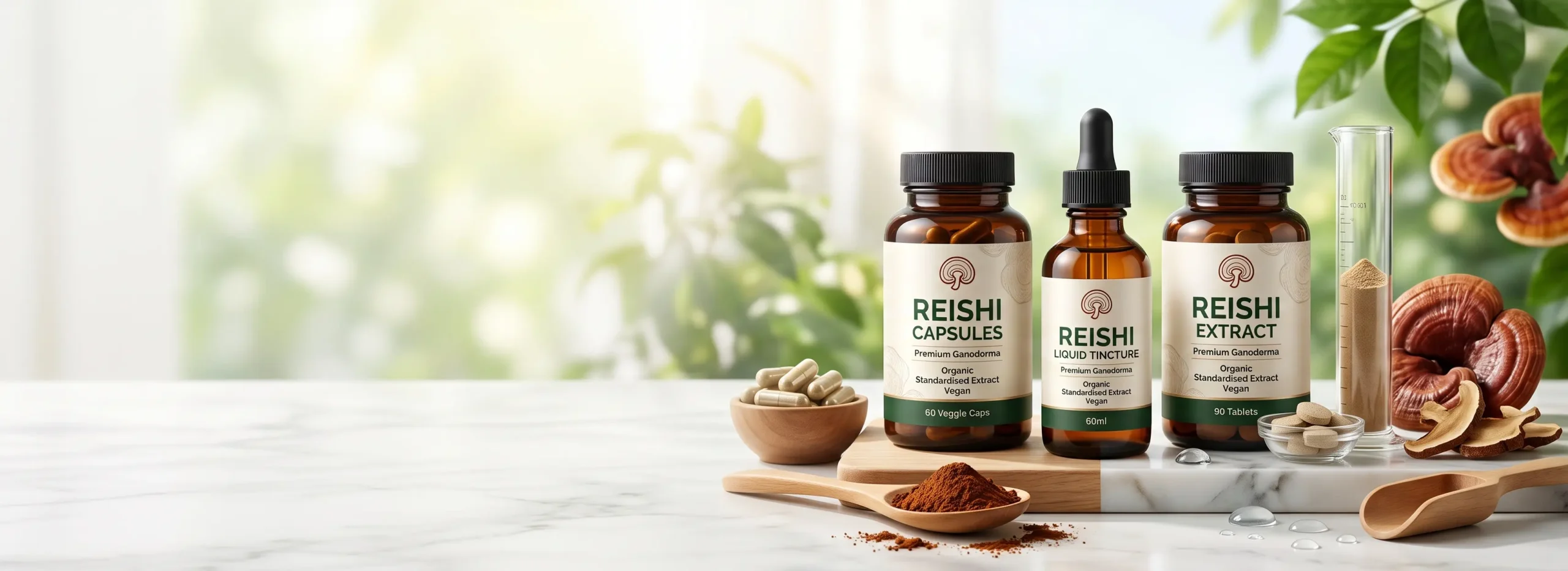
KS Nutripharma® is a reishi supplement manufacturer for OEM, ODM, and private-label programs. We manufacture finished mushroom supplement capsules, tablets, powders, and gummies against a defined fruiting-body or declared-mycelium specification, a named marker assay, and a batch COA.
Have an incumbent COA? Compare My Reishi COAs — we map biomass, extraction path, marker definitions, analytical methods, and finished-unit requirements before you change suppliers.
Specification already set? Request a Manufacturing Quote
Reishi Supplement Manufacturing at a Glance
Field | Typical project answer |
|---|---|
| Identity | Authenticated binomial on the PO. “Reishi” / “lingzhi” is not enough. If the label requires Ganoderma lucidum, verify against the agreed reference |
| What we manufacture | Finished units: capsules, tablets, powders, gummies. Development architectures F01–F06 for private-label formulation briefs |
| What we control | Biomass disclosure · powder vs water extract vs dual extract · beta-glucan or triterpenes + method · finished-unit assay when the panel prints a marker |
| Quality / pack | In-house QC · batch COA · HDPE + induction seal + desiccant as default pack |
Facility certifications currently held:
cGMP · ISO 9001 · ISO 22000 · HACCP · FSSC 22000 · Halal · Kosher
Certifications
Which Reishi Specification Should You Start With?
Lock four variables, then we can quote the same specification across suppliers:
- Fruiting body or mycelium?
- Powder, water extract, or dual extract?
- Beta-glucan, polysaccharides, or triterpenes?
- Capsule, tablet, powder, or gummy?
If the label will print beta-glucan, specify the analyte and the analytical method on the PO. Total polysaccharides are not equivalent to beta-glucan.
Your brief | Recommended starting point |
|---|---|
| Simple mushroom powder / scoop | Fruiting-body powder |
| Cost-sensitive capsule | Ratio extract, 10:1 or 20:1 commonly quoted, or a defined marker extract |
| Beta-glucan on the label | Water extract + named beta-glucan method |
| Triterpenes / ganoderic acids on the label | Dual extract + named triterpene method. UV and HPLC are different grades |
| Multi-mushroom formula | Separate specification for each fungus, F02 |
| Marker-controlled / dual-marker SKU | Dual-marker extract, F06 |
| Spore powder | Separate spore specification; wall-breaking rate ≥95% when the destination market requires it |
| Spore oil | Softgel with an oil-phase specification |
Reishi Supplement Formula Architectures
Code | Architecture | Typical format |
|---|---|---|
| F01 | Single-ingredient reishi | Capsule / tablet / powder |
| F02 | Reishi + mushroom complex | Capsule; powder after taste review |
| F03 | Reishi + evening formula | Capsule |
| F04 | Reishi + botanical complex | Capsule; tablet if load requires it |
| F05 | Reishi + vitamin / mineral | Capsule or tablet |
| F06 | Marker-controlled / dual-marker reishi | Capsule / coated tablet |
Use when: One mushroom on the panel.
Typical combinations: fruiting-body powder · ratio extract · polysaccharide-specified extract · water extract with named beta-glucan · dual extract when triterpenes will be printed.
Key specification: Powder vs extract; water vs dual; milligrams; assay and method. F06 adds dual-marker or method-specific testing.
Use when: The BOM names a second fungus. Each species needs its own identity, biomass, marker, and method.
Typical combinations: reishi + cordyceps · reishi + lion’s mane · reishi + turkey tail · reishi + chaga.
Key specification: Two or more COAs and a combined fill. A ten-mushroom blend cannot be released under a single undifferentiated “reishi 500 mg” specification.
Use when: An evening-use formula is required.
Typical combinations: reishi + L-theanine · reishi + magnesium bisglycinate · reishi + glycine · reishi + L-theanine + magnesium.
Key specification: Reishi assay, companion identity and dosage, and final capsule fill weight. Companions reduce the reishi milligrams that fit one capsule.
Use when: Reishi is combined with a botanical.
Typical combinations: reishi + ashwagandha · reishi + Panax ginseng · reishi + turmeric / curcumin · reishi + ginger or olive leaf if named.
Key specification: Botanical species, plant part, DER or marker, assay method, solvent, taste, and combined fill weight.
Use when: Reishi is combined with vitamins or minerals in a finished dietary supplement.
Typical combinations: reishi + vitamin D3 · reishi + zinc · reishi + vitamin C · reishi + D3 + zinc.
Key specification: Nutrient form; zinc salt vs elemental; D3 dry vs oil-compatible; destination DV / NRV; separate assays. Tablet when the premix will not fit one shell.
Use when: The specification requires a named glucan method, dual-marker testing, or a specific extract type.
Typical combinations: high beta-glucan fruiting-body extract · beta-glucan + triterpene dual-marker · fruiting-body dual extract · broken-spore powder or spore-oil softgel.
Key specification: Both analytes if dual-marker; UV vs HPLC for triterpenes. Bitterness and residual-solvent limits often require a coated tablet.
Choose the Reishi Format: Capsules, Tablets, Powder or Gummies
Project-scoped: spore-oil softgels require an oil phase; oral liquids, granules, tea, fermented drinks. Vegetarian softgels are not HPMC hard-capsule shells.
Best for: Marker extracts and multi-ingredient fills that fit a two-piece shell.
Why: Size 0 typically ~350–450 mg; Size 00 ~500–650 mg — confirm against tap density. HPMC covers a vegetarian-shell brief.
What to specify: Shell, HPMC or gelatin; extract mg and method.
Manufacturing note: Hygroscopic extracts need humidity control at fill. → Hard capsules
Best for: Compact servings; coated dual extract when bitterness is an issue; mineral combinations that exceed one shell.
Why: Unextracted fruiting-body fiber is elastic on the press. Film coat is a bitterness and moisture tool, not delayed-release unless specified.
What to specify: Tablet weight, coat type, assay after press.
Manufacturing note: Re-validate a capsule BOM before a tablet run. → Tablets
Best for: Scoop / stick servings at gram level.
Why: Powder allows a larger serving than capsule formats; final fill weight depends on target dose and bulk density. Dual-extract powder is bitter in an open pack.
What to specify: Mesh; fruiting body vs mycelium; stick vs jar; milled powder vs extract powder.
Manufacturing note: Barrier film and desiccant are part of the quote. → Powders and granules
Best for: Lower extract load after flavor review.
Why: High extract loads are often limited by taste, heat exposure, water activity, and finished-piece stability. Gummy and capsule servings should be evaluated separately.
What to specify: mg extract per piece; finished-piece assay if beta-glucan is printed.
Manufacturing note: Confirm gummy load and assay separately from a capsule run. → Gummies
Fruiting body, cap and stipe, is the default specification when the label requires fruiting-body material. Mycelium on grain is fungus plus a named cereal; it is a different PO. Any biomass change requires buyer approval and a revised raw-material specification. Fermentation broths and drink bases are separate beverage projects.
Fruiting body vs mycelium: Fruiting Body vs. Mycelium.
Water extraction is commonly used for beta-glucan-focused reishi extracts, while triterpene-focused specifications commonly involve an alcohol/ethanol extraction fraction. The actual extraction process should follow the raw-material specification and validated assay method. Do not set a triterpene release limit against a water-only drum.
Grade | Common quote band | Not suitable for |
|---|---|---|
| Fruiting-body powder | 80–120 mesh; native beta-glucan varies by lot and method — use the COA | High-potency extract dosing within a low capsule fill weight |
| Ratio extract | 10:1 / 20:1 commonly quoted; name solvent. DER is yield, not potency | Treating 10:1 as 10× marker |
| Polysaccharide-specified | 10%–50% UV | A beta-glucan label specification without a validated beta-glucan assay |
| Beta-glucan water extract | 10% / 20% / 30% + named glucan method | Triterpenes on pack |
| Dual extract | Beta-glucan band + triterpenes ~1–7%; name UV or HPLC | Release against a water-only extract specification |
| Mycelium on grain | Polysaccharides often quoted; declare grain | Fruiting-body Supplement Facts |
| Broken-spore / spore oil | Wall-breaking rate ≥95% when the destination market requires it; oil = softgel | Quoting as fruiting-body extract |
Mesh, moisture, often NMT ~5–7% on spray-dried extract, and tapped density are matched to the filler during feasibility. Spray-dry carriers must be declared.
Total polysaccharide or total carbohydrate assays measure a broader carbohydrate fraction. They can include fungal beta-glucans, cereal carbohydrates from grain biomass, and processing carriers. A high polysaccharide number is not interchangeable with a named beta-glucan result.
Source and assay method: What Are Beta-Glucans and Which Source Is Right for You?.
If beta-glucan will be printed, name a glucan procedure, often total glucan minus enzymatically measured alpha-glucan. Different glucan methods can produce materially different results — specify the method on the PO rather than relying on the percentage alone.
Incoming extract % is not finished-unit milligrams. If the panel prints a marker, finished-unit assay belongs in release. Extract mg × named % = labeled marker mg only when the same method is used on the finished unit.
Do not compare the percentage alone. Compare the complete specification. Illustrative only:
Specification | Supplier A | Supplier B | What it means |
|---|---|---|---|
| Species | G. lucidum, method stated | Ganoderma sp. | Different identity confidence |
| Biomass | Fruiting body | Mycelium + rice | Different raw material |
| Extraction | Water | Water + ethanol | Different marker profile |
| Polysaccharides | 30% UV | 40% UV | Not directly comparable |
| Beta-glucan | 25%, named method | Not reported | Different analyte |
| Triterpenes | Not reported | 2% HPLC | Different extraction target |
| Finished assay | Available if printed | Not stated | Different release control |
Before approving a drum: identity + method · fruiting body vs mycelium · grain if mycelium · solvent · DER if claimed · beta-glucan method if printed · triterpene UV vs HPLC if printed · metals and micro as numbers · finished-unit assay if the panel prints a marker.
Quality control: incoming identity → named marker assay → blend → fill → pack → finished tests as scoped → batch release.
Incoming identity is verified by HPTLC or a stated equivalent, with residual-solvent testing applied where required by the extraction specification. Third-party testing, including SGS or Eurofins, can be added where the project requires it.
Pack: HDPE + induction seal + desiccant as default; amber glass or high-barrier sticks as specified. Shelf life on artwork is supported by stability data on this formula and pack.
Organic certification is a separate sourcing pathway. If an organic claim is required, name the destination scheme on the RFQ. We will not print an organic claim on a conventional lot.
OEM: confirm BOM and spec → feasibility → sample → production.
ODM: F01–F06 or custom → sample → verification → production.
| Stage | Typical |
|---|---|
| First technical reply | About one business day on a complete brief |
| Sample | 7–15 days after specification lock |
| Mass production | 30–45 days after formula, artwork, pack, and schedule |
| Capsules | About 3,000–5,000 units |
| Tablets | About 5,000–10,000 units |
| Powder / stick | Quoted by batch mass |
| Gummies | After feasibility and a sensory pilot |
Actual MOQ and lead time depend on formula, pack, testing, and quantity. An NDA is available. A project manager is assigned when the specification is in review.
Minimum RFQ. Architecture, F01–F06 or custom · identity · biomass · powder / water / dual extract · DER if claimed · beta-glucan x% by named method if printed · triterpenes y% by UV or HPLC if printed · companions · serving · format · count · destination · quantity.
Compare My Reishi COAs · Send Your BOM · Request a Manufacturing Quote
Final label language should be reviewed against the regulations of the destination market.
Medication-interaction, pregnancy, lactation, and pediatric considerations require appropriate safety and regulatory review.
Shelf life must be supported by stability data on the finished formula and pack.
Finished-product claims remain the brand owner’s responsibility.
Can you match an incumbent reishi COA?
Send the incumbent COA and target Supplement Facts panel. We compare species, biomass, extraction, marker definitions, analytical methods, and finished-unit requirements before sampling. If the original biomass or analytical method cannot be matched, the difference is identified before quotation or sampling.
Can you formulate to an existing Supplement Facts panel?
Yes. Labeled amounts set fill weight, overage, and format. If listed milligrams will not fit the chosen shell or gummy piece, or if a mineral salt versus elemental amount changes the fill, we flag that before sampling.
Can you test the finished capsule for beta-glucan or triterpenes?
When the panel prints a marker, finished-unit assay belongs in release. Incoming extract percentage is not finished-unit milligrams. The method on the finished unit should match the method used to specify the extract. If the panel does not print a marker, finished-unit marker assay is optional and quoted separately.
Can you switch from fruiting body to mycelium after sampling?
A biomass change is a new raw-material specification. It needs buyer approval, a revised identity and biomass line, and usually a new sample. Mycelium-on-grain lots also require grain disclosure. We do not substitute mycelium into a fruiting-body SKU to meet a later cost target.
Can you develop a reishi gummy with a high extract load?
Feasibility depends on extract potency, taste, cook conditions, and piece size. Dual-extract lots are often too bitter. If the brief needs a high milligram marker serving, keep that serving in a capsule or tablet.
What should be included in a reishi raw-material specification?
Authenticated species; fruiting body vs mycelium, and grain if mycelium; powder vs water extract vs dual extract; solvent if claimed; DER if claimed; each printed marker with its method; mesh and moisture as needed for fill; residual solvents when ethanol is used; metals and micro limits. If the finished panel prints a marker, state that finished-unit assay is required.
Can you supply organic reishi?
Organic reishi can be handled through a separate sourcing and certification pathway. The destination-market certification scheme should be specified in the RFQ.
What if the incumbent lab method differs from the method you use in house?
Percentages from two glucan or triterpene methods are not interchangeable. We either run the incumbent method, or we document a method bridge and quote one named procedure on the PO. Do not average two percentages to force a match.
Ready to Manufacture Your Reishi Supplement?
Send two COAs, a BOM, or the target Supplement Facts panel. We map fruiting body vs mycelium, water vs dual extract, and the named beta-glucan or triterpene method before you pay for a sample. A finished formula is not required to start. Typical first reply is one business day on a complete brief. An NDA is available.
Have an incumbent COA? Compare My Reishi COAs
Specification already set? Request a Manufacturing Quote
Related Product Pages
- Cordyceps Supplement Manufacturer
- Lion’s Mane Mushroom Supplements
- Sleep Support Supplements
- How to Read a COA
Disclaimer: Wholesale / brand manufacturing and product-development reference only. Not intended to diagnose, treat, cure, or prevent any disease. Dietary supplements are not drugs. This page covers contract manufacturing of oral Ganoderma dietary supplements for human consumption. Structure/function claims and ingredient declarations remain the brand owner’s responsibility with qualified counsel. Product claims must comply with the regulations of the destination market. KS Nutripharma provides manufacturing feasibility and batch documentation — not legal approval. Milligram and assay figures are development examples for quotation, not recommended intakes.
Written by KS Nutripharma Formulation Team
Reviewed by KS Nutripharma Director of R&D (PhD, Food Science
19+ years nutraceutical development)
Technical review: identity, biomass disclosure, extract path, marker assay, dosage-form feasibility, and cGMP release
Updated September 2026