
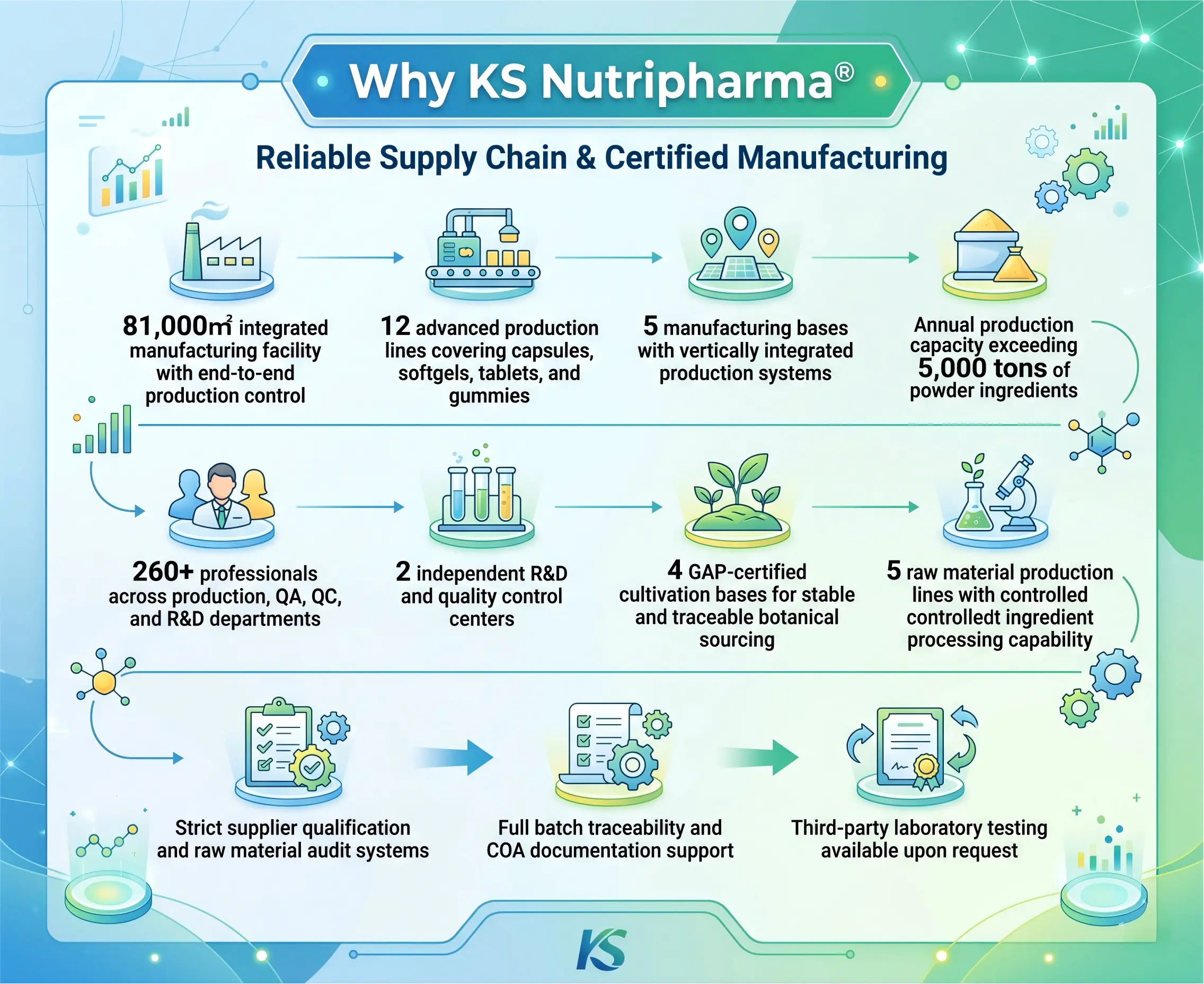
Why KS Nutripharma®
Reliable Supply Chain & Certified Manufacturing
- 81,000㎡ integrated manufacturing facility with end-to-end production control
- 12 advanced production lines covering capsules, softgels, tablets, and gummies
- 5 manufacturing bases with vertically integrated production systems
- Annual production capacity exceeding 5,000 tons of powder ingredients
- 260+ professionals across production, QA, QC, and R&D departments
- 2 independent R&D and quality control centers
- 4 GAP-certified cultivation bases for stable and traceable botanical sourcing
- 5 raw material production lines with controlled ingredient processing capability
- Strict supplier qualification and raw material audit systems
- Full batch traceability and COA documentation support
- Third-party laboratory testing available upon request
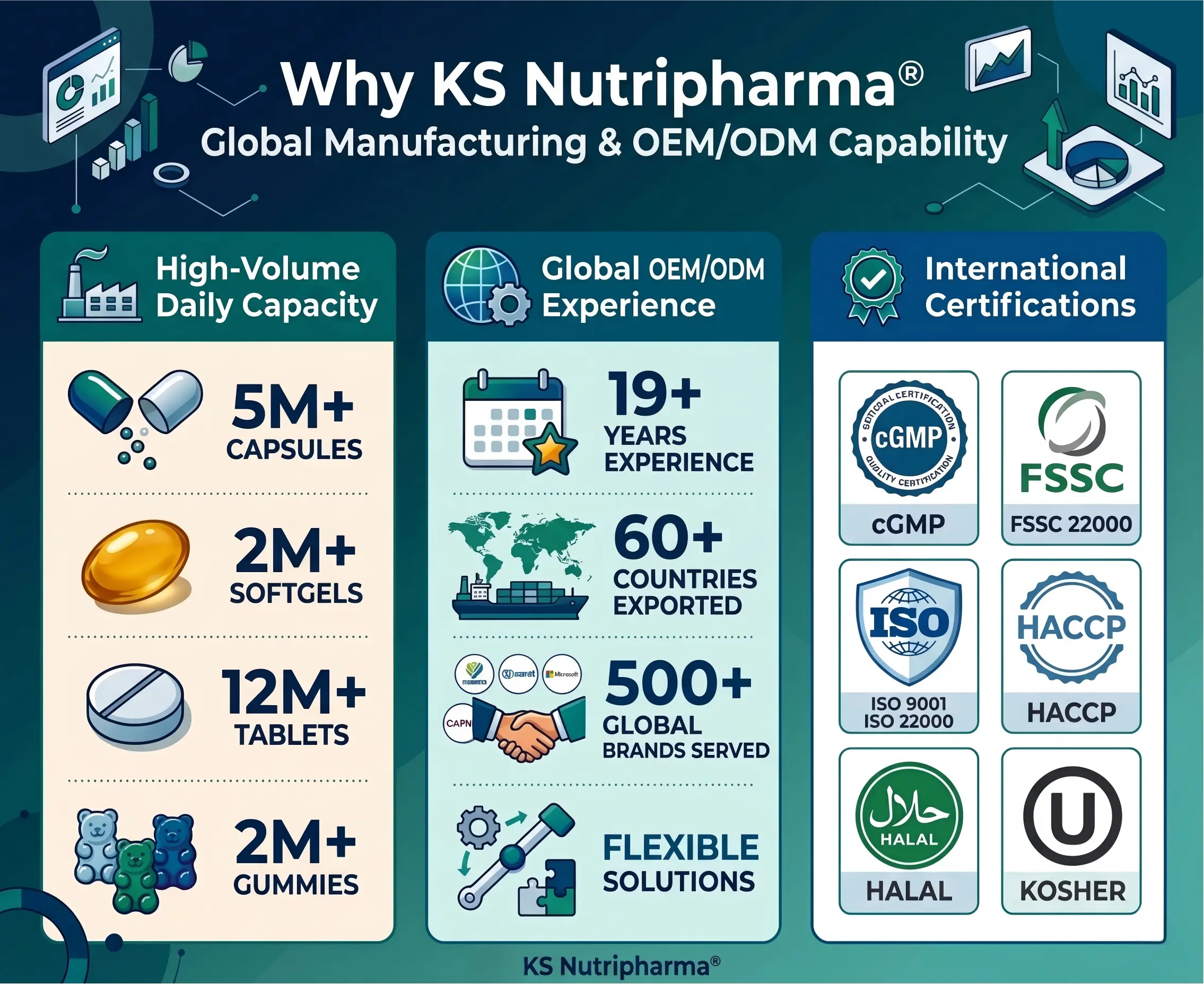
High-Volume Daily Production Capacity
- 5,000,000+ capsules per day
- 2,000,000+ softgels per day
- 12,000,000+ tablets per day
- 2,000,000+ gummies per day
Global OEM/ODM Commercialization Capability
- 19+ years of supplement manufacturing experience
- Exported to 60+ countries
- Serving 500+ global supplement brands
- Flexible OEM/ODM and private-label solutions
- Low MOQ to large-scale commercial production
- Multi-market regulatory documentation support
- Packaging and labeling coordination support
- Long-term supply-chain planning capability
International Certification Systems
Certified under: cGMP/ISO 22000/ ISO 9001/HACCP/FSSC 22000/HALAL/KOSHER
Why Probiotic OEM Projects Fail (And What Supplement Brands Should Lock First)
Probiotic launches rarely fail because “consumers do not care about gut health.” They fail because live microorganisms are treated like ordinary vitamins.
Failure mode | What buyers experience | What to lock before artwork |
|---|---|---|
| Day-1 CFU vs end-of-shelf-life CFU | Marketplace complaints, retailer QA rejection | Label claim policy: at manufacture and through expiry |
| Moisture / Aw drift | Powder clumping, CFU collapse in stick packs | Target Aw, barrier laminate, desiccant, fill RH window |
| Wrong format for the strain | Softgummies marketed as “high CFU” with weak retention | Format feasibility review before creative lock |
| Vague “clinically studied” language | Regulatory / platform risk | Strain IDs + claim pathway per market |
| Scale-up surprise | Pilot works, commercial lot drifts | Process RH, overage model, blend uniformity, packaging match |
Buyer Rule: Do not approve packaging until strain identity, CFU declaration logic, dosage form, barrier packaging, and destination-market claim language are written into one project brief.
What Products Are Brands Launching Now?
New Amazon/DTC brand
- Start with: Daily Multi-Strain Capsule or Shelf-Stable Spore Capsule
- Why: Clear search intent, easy comparison shopping, workable MOQ.
Women’s brand
- Start with: Women’s Flora Balance Capsule
- Why: Dedicated aisle traffic and stronger loyalty than a generic digestive SKU.
Functional beverage/lifestyle brand
- Start with: Synbiotic Stick Pack Drink Mix
- Why: Fits daily ritual, travel, and subscription formats.
Kids/Family brand
- Start with: Kids Daily Probiotic Powder or Family Probiotic Gummies
- Why: Compliance-led formats; validate retention before scaling gummies.
Practitioner/premium retail
- Start with: High-Potency Delayed-Release Capsule
- Why: Dose-readable CFU story and acid-protection positioning.
Already selling digestive enzymes?
- Add: Enzyme + Probiotic Combo Capsule
- Why: Same shopper, higher AOV, clearer “complete digestive” merchandising.
Not sure which lane fits? [Request a formula recommendation]
Market-Proven Probiotic Formulas for Private Label & OEM
Market reality: Still the largest probiotic entry SKU worldwide. Shoppers search “probiotic for digestion” and expect a multi-strain capsule with a clear billion-CFU number.
Typical formula direction
- Lactobacillus acidophilus
- Lactobacillus rhamnosus
- Bifidobacterium lactis / longum
- Optional: Lactobacillus plantarum, Streptococcus thermophilus
- Target band: 10-30 billion CFU/serving (label policy project-defined)
Best formats: Veggie capsules / delayed-release capsules Channel fit: Amazon / mass retail / private label starter lines Why brands launch it: Broad search coverage / easy first SKU / twin-SKU path into women’s / immune extensions
Market reality: One of the strongest differentiated probiotic lanes. Mature formulas commonly center on Lactobacillus systems used in women’s vaginal and urinary wellness positioning (market-reviewed wording only).
Typical formula direction
- Lactobacillus rhamnosus (GR-1-type commercial strains where licensed/available)
- Lactobacillus reuteri (RC-14-type commercial strains where licensed/available)
- Optional: Lactobacillus crispatus, Lactobacillus gasseri
- Optional companions: cranberry extract, D-mannose (combo SKUs)
Best formats: Capsules / delayed-release capsules
Why brands launch it: Higher loyalty than generic digestive / clearer brand story / premium price tolerance
Market reality: Parents prefer powder sachets and chewables over large adult capsules. BB-12 / LGG-style commercial directions dominate mature kids lines.
Typical formula direction
- Bifidobacterium animalis subsp. lactis (BB-12-type options where available)
- Lactobacillus rhamnosus (LGG-type options where available)
- Optional: mild prebiotic fiber at child-appropriate load
- Flavor system for milk / water / soft food mixing
Best formats: Sachets / stick packs / chewables (project-dependent)
Why brands launch it: High repeat purchase / gift/family merchandising / lower capsule fatigue
Market reality: Cross-border and warm-climate sellers prefer spore systems marketed for room-temperature storage. Bacillus coagulans (incl. BC30-type commercial materials where available) is a proven shelf-stable hero.
Typical formula direction
- Bacillus coagulans
- Optional: Bacillus subtilis / multi-spore companions
- Optional: resistant dextrin or inulin at low moisture impact
- Target band: often 1-10 billion CFU with strong stability narrative
Best formats: Capsules/stick packs
Why brands launch it: Fewer cold-chain objections / simpler logistics / cleaner storage statements
Market reality: Premium and practitioner-facing brands compete on CFU potency plus acid-protection delivery – not another 5-billion basic capsule.
Typical formula direction
- Multi-strain Lactobacillus + Bifidobacterium architecture
- Delayed-release / acid-resistant capsule
- Moisture-barrier bottle + desiccant
- CFU policy written for end-of-shelf-life where required by channel
Best formats: Delayed-release HPMC capsules
Why brands launch it: Higher AOV / clearer differentiation / supports “clinical-style” merchandising without disease claims
Market reality: Synbiotic (probiotic + prebiotic) and gut-immune stacks remain among the highest-converting adult daily formulas on Amazon and retail.
Typical formula direction
- Multi-strain probiotics (Lactobacillus + Bifidobacterium)
- Inulin or FOS
- Zinc citrate
- Vitamin D3
- Optional: vitamin C
Best formats: Capsules / delayed-release capsules
Why brands launch it: Dual-search coverage (gut + immune) / easy seasonal campaigns / strong subscription potential
Market reality: Stick packs converted probiotic use from “pill habit” to “morning drink ritual.” Mature in Japan, Korea, SEA, and growing fast in US/EU lifestyle channels.
Typical formula direction
- Multi-strain probiotics compatible with powder systems
- Inulin / FOS / GOS
- Vitamin C / zinc
- Flavor + acidulant map designed for low water activity
- Rapid-dissolve carriers
Best formats: Stick packs / sachets / canister twins
Why brands launch it: High convenience / giftable multipacks / beverage brand entry into microbiome
Market reality: Travel kits and blister/wallet packs sell when shoppers refuse refrigerated SKUs. Usually spore-led or high-barrier packaged vegetative systems.
Typical formula direction
- Bacillus coagulans or multi-spore blend
- Optional short-course high-CFU vegetative capsule in blister
- Compact 10-30 count travel packaging
Best formats: Blister packs / mini bottles / stick packs
Why brands launch it: Occasion-led SKU / add-on AOV / easy bundle with daily hero
SUPPLEMENT MARKET SEGMENTATION
The probiotic supplement market is increasingly driven by growing awareness of the gut-immune axis, microbiome diversity, stress-related digestive disruption, and long-term wellness maintenance.
Designed for consumers seeking long-term microbiome support integrated with immune wellness positioning.
Common Positioning
- Daily gut-immune support
- Synbiotic wellness systems
- Microbiome resilience
- Digestive wellness maintenance
- Immune-support nutrition
Common Ingredient Directions
- Lactobacillus strains
- Bifidobacterium strains
- Inulin
- Zinc
- Vitamin D3
Technical Challenges
- Moisture sensitivity
- CFU degradation
- Strain compatibility balancing
- Acid-survival instability
- Prebiotic interaction control
Suitable Dosage Forms
- Delayed-release capsules
- Sachets
- Stick packs
Suitable For
- Daily wellness brands
- Gut-health supplement companies
- Lifestyle nutrition systems
- E-commerce microbiome brands
Focused on improving probiotic viability under transportation and room-temperature storage conditions.
Common Positioning
- Shelf-stable microbiome systems
- Travel probiotic products
- Daily digestive support
- Stable probiotic wellness
Common Ingredient Directions
- Bacillus coagulans
- Spore-form probiotics
- Prebiotic fibers
- Zinc mineral systems
Technical Challenges
- Heat-sensitive strain protection
- Transportation stability
- Moisture migration
- Long-term CFU preservation
- Packaging compatibility
Suitable Dosage Forms
- Capsules
- Stick packs
- Sachets
Suitable For
- International e-commerce projects
- Retail probiotic systems
- Travel wellness products
- Subscription supplement brands
Designed for consumers increasingly preferring convenient probiotic drink systems over traditional capsules.
Common Positioning
- Synbiotic drink systems
- Functional microbiome beverages
- Daily gut wellness drinks
- Lifestyle digestive support
Common Ingredient Directions
- Multi-strain probiotics
- Inulin
- FOS
- Functional flavor systems
Technical Challenges
- Probiotic survival in powder systems
- Moisture-control balancing
- Flavor optimization
- Powder flowability
- Transportation stability
Suitable Dosage Forms
- Stick packs
- Sachets
- Functional powders
Suitable For
- Functional beverage brands
- Lifestyle wellness products
- Retail nutrition systems
- Hydration-oriented wellness products
Designed for premium microbiome positioning with advanced strain architecture and practitioner-oriented formulation systems.
Common Positioning
- Advanced microbiome wellness
- Clinical-style synbiotics
- Long-term digestive resilience
- Practitioner-oriented gut support
Common Ingredient Directions
- Clinically studied probiotic strains
- Postbiotic systems
- Precision prebiotic complexes
- Immune-support minerals
Commercial Advantages
- Higher premium positioning
- Stronger clinical-style branding
- Better professional-channel compatibility
- Improved long-term differentiation
Use this library to build or upgrade SKUs: choose the live culture layer, then add prebiotics, postbiotics, and companions shoppers already understand.
A. Probiotic Strain Library
Lactobacillus Systems
| Ingredients | Commercial role | Common SKU homes | Buyer notes |
|---|---|---|---|
| L. acidophilus | Classic digestive hero strain | Daily multi-strain | High familiarity on label |
| L. rhamnosus | Digestive + women’s + kids lines | Women’s, kids, daily | LGG-type options where available |
| L. reuteri | Women’s and specialty digestive | Women’s flora | Often paired with L. rhamnosus |
| L. plantarum | Digestive resilience / food-culture story | Daily, travel, synbiotic | Good stack strain |
| L. casei / paracasei | Daily multi-strain filler-to-hero | Daily capsules | Confirm taxonomy naming for market |
| L. gasseri | Women’s / body-composition adjacent | Women’s specialty | Claim language must stay conservative |
| L. crispatus | Women’s flora specialty | Women’s premium | Supply and dossier planning required |
| L. helveticus | Gut-mood / specialty stacks | Premium daily | Often paired with B. longum in mood-gut SKUs |
| L. salivarius | Oral-adjacent / specialty blends | Specialty multi-strain | Less common as solo hero |
Bifidobacterium Systems
| Ingredients | Commercial role | Common SKU homes | Buyer notes |
|---|---|---|---|
| B. lactis / animalis subsp. lactis | Workhorse adult + kids strain | Daily, kids, synbiotic | BB-12-type options where available |
| B. longum | Adult digestive + specialty stacks | Daily, premium, mood-gut | Familiar premium marker |
| B. bifidum | Classic multi-strain component | Daily capsules | Common blend member |
| B. breve | Kids / specialty adult | Kids, infant-adjacent* | Confirm age-gate and market rules |
| B. infantis | Infant / early-life specialty* | Infant sachets* | Strict regulatory and age positioning |
Infant/early-life SKUs require market-specific regulatory review before development.
Spore-Form / Soil-Based Systems
| Ingredients | Commercial role | Common SKU homes | Buyer notes |
|---|---|---|---|
| Bacillus coagulans | Shelf-stable hero | Travel, Amazon FBA, gummies | BC30-type materials where available |
| Bacillus subtilis | Multi-spore stacks | SBO formulas | Often companion, not solo |
| Bacillus clausii | Specialty spore SKUs | Pharmacy-adjacent, travel | Market acceptance varies |
| Bacillus indicus | Carotenoid-producing spore story | Differentiated SBO | Premium niche |
Yeast Probiotics
| Ingredients | Commercial role | Common SKU homes | Buyer notes |
|---|---|---|---|
| Saccharomyces boulardii | Yeast probiotic specialty | Travel, digestive resilience, pharmacy | Often separate from bacterial blends |
Other Culture Options
| Ingredient | Commercial role | Common SKU homes | Buyer notes |
|---|---|---|---|
| Streptococcus thermophilus | Yogurt-culture multi-strain | Daily blends | Support strain, rarely solo hero |
| Lactococcus lactis | Specialty / fermented-culture blends | Differentiated multi-strain | Niche label story |
Strain procurement rule for buyers: Lock strain IDs, CFU basis (at manufacture vs through expiry), and documentation path before packaging artwork.
B. Prebiotic & Synbiotic Fiber Library
Ingredients | Why brands use it | Best formats | Watch-outs |
|---|---|---|---|
| Inulin | Most recognizable synbiotic fiber | Capsules, stick packs, powders | GI tolerance at high dose; moisture in powders |
| FOS (fructo-oligosaccharides) | Classic synbiotic partner | Capsules, sachets | Sweetness + humidity management |
| GOS (galacto-oligosaccharides) | Premium synbiotic / kids-adjacent | Powders, sachets | Cost and sensory |
| XOS (xylo-oligosaccharides) | Low-dose prebiotic differentiation | Capsules, sticks | Newer shopper education needed |
| Resistant dextrin | Lower sensory impact fiber | Stick packs, drinks | Positioning vs “prebiotic” claims |
| PHGG (partially hydrolyzed guar gum) | Gentle fiber story | Powders, sticks | Less mainstream than inulin |
| Acacia fiber | Clean-label fiber alternative | Powders, capsules | Supply and labeling clarity |
| HMOs (e.g. 2′-FL) | Premium adult / specialty synbiotic | Capsules, sachets | Cost; claim and age-gate discipline |
| Resistant starch / potato starch systems | Microbiome fiber stacks | Powders | Capsule fill volume |
C. Postbiotic & Fermentate Options
| Ingredient direction | Commercial role | Best for |
|---|---|---|
| Heat-treated probiotic fermentates | Stability-led microbiome storytelling | Capsules, sachets where live CFU is secondary |
| Short-chain fatty acid-support positioning stacks | Premium differentiation | Practitioner / premium DTC |
| Yeast fermentates / nutritional yeast fractions | Immune-adjacent stacks | Seasonal SKUs (claim-reviewed) |
Postbiotic language is market-sensitive. Confirm definition and labeling rules per destination market.
D. Companion Actives Already Selling With Probiotics
Immune-adjacent micronutrients
Ingredients | Typical commercial use |
|---|---|
| Vitamin D3 | Gut-immune daily capsules and gummies |
| Zinc (citrate/gluconate/bisglycinate) | Immune + women’s/daily stacks |
| Vitamin C | Stick packs, seasonal immune synbiotics |
| Selenium | Premium immune-adjacent capsules |
| Vitamin A/beta-carotene | Specialty immune stacks (careful dosing) |
Digestive companions
Ingredients | Typical commercial uses |
|---|---|
| Digestive enzyme blend | Enzyme + probiotic combos |
| Lactase | Dairy-heavy diet occasion SKUs |
| Ginger extract | Meal-time digestive capsules |
| Peppermint/fennel | Comfort-oriented digestive blends |
| L-Glutamine | Premium gut-barrier lifestyle stacks |
| Slippery elm/marshmallow root | Soothing digestive botanicals |
| Chamomile | Evening digestive-calm SKUs |
Women’s companions
Ingredients | Typical commercial uses |
|---|---|
| Cranberry extract (PACs standardized) | Women’s flora + urinary wellness combos |
| D-Mannose | Women’s combo sachets/capsules |
| Pomegranate extract | Women’s premium differentiation |
Metabolic/lifestyle companions
Ingredients | Typical commercial uses |
|---|---|
| Green tea extract / EGCG | Metabolic synbiotic capsules |
| Chromium | Craving / metabolic adjacency |
| Berberine | Advanced metabolic stacks (regulatory caution) |
| Glucomannan / fiber systems | Satiety-oriented powders |
Gut-mood/stress-adjacent companions
Ingredients | Typical commercial use |
|---|---|
| L-Theanine | Calm gut-daily stacks |
| Magnesium (bisglycinate / citrate) | Evening digestive-calm SKUs |
| Ashwagandha | Stress + gut lifestyle stacks |
| Saffron extract | Mood-gut premium experiments |
| System | When you need it |
|---|---|
| Delayed-release / acid-resistant capsules | High-CFU vegetative formulas; premium acid-protection story |
| HPMC vegan capsules | Vegan / clean-label lines |
| Moisture-barrier bottles + desiccant | Most capsule probiotics |
| Aluminum stick packs / high-barrier sachets | Powder and travel SKUs |
| Blister packaging | Travel counts; unit-dose protection |
| Low-Aw gummy matrices | Family gummies with retention targets |
| Flow aids / anti-caking (disclosed) | Powder fill and stick-pack line efficiency |
| Flavor masking systems | Synbiotic drinks and kids powders |
| Format | Best for | Main risk | Typical MOQ* | Lead time* |
|---|---|---|---|---|
| Delayed-release capsules | High-CFU / premium daily | Moisture, fill RH | 5,000 units | 4-6 weeks |
| Standard capsules | Entry daily/combos | Weaker acid story | 5,000 units | 4-6 weeks |
| Stick packs/sachets | Drink mixes, kids, travel | Seal leaks, Aw rise | 10,000 units | 5-7 weeks |
| Functional powders | Canisters, scoops | Caking after opening | 2,000 units | 3-5 weeks |
| Gummies | Kids/family trial | Heat and Aw retention | 10,000 units | 6-8 weeks |
Confirm per strain, CFU load, and packaging.
| Decision | What to lock |
|---|---|
| CFU promise | At manufacture vs through end of shelf life |
| Strain identity | Commercial strain IDs and naming for labels |
| Water activity / moisture | Especially powders, sticks, gummies |
| Packaging | Bottle + desiccant, Alu stick, blister, climate lane |
| Release docs | COA with CFU method, microbes, heavy metals |
| Optional deeper pack | Aw, viability trend, transport simulation, strain ID verification |
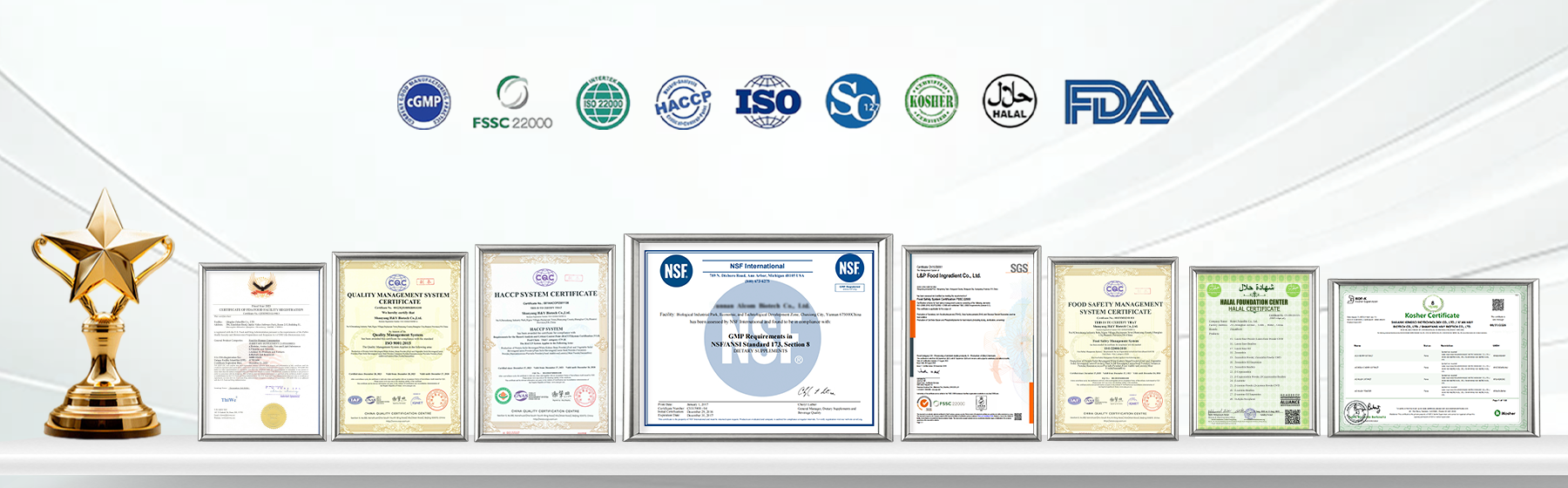
Facility posture: cGMP / ISO 9001 / ISO 22000 / HACCP / FSSC 22000 / Halal / Kosher / FDA-registered / Non-GMO options
Project support may include
- Supplement Facts / strain-name coordination
- CFU declaration alignment
- Storage and shelf-life statement support
- Export documentation preparation
- Market notes for North America, Europe, Southeast Asia, Middle East, Latin America
Final label claims remain brand-owned and must be market-reviewed.
| Stage | Typical volume | Designed for |
|---|---|---|
| Pilot | 500-1,000 units | Formula lock, Amazon test, pack check |
| First commercial | 5,000-10,000 units | Regional / e-comm launch |
| Full-scale | 100,000+ units | Retail and export programs |
Format references: Capsules from 5,000 (4-6 weeks) / Powders from 2,000 (3-5 weeks) / Stick packs from 10,000 (5-7 weeks) / Gummies from 10,000 (6-8 weeks)
| Stage | Duration |
|---|---|
| Requirement confirmation | 3-5 business days |
| Sample development | 7-14 business days |
| Stability pre-testing | 2-4 weeks |
| Pilot production | 1-2 weeks |
| Commercial manufacturing | 2-4 weeks |
Typical standard programs: 6-10 weeks. Strain complexity, packaging, and multi-market labeling can extend timelines.
Procurement teams usually verify these items before a first PO. Request the pack with your inquiry.
| Trust item | What you can request | Why it matters |
|---|---|---|
| Manufacturing certifications | cGMP / ISO 9001 / ISO 22000 / HACCP / FSSC 22000 / Halal / Kosher documentation set | Confirms facility posture for retailer and importer questionnaires |
| FDA-registered facility posture | Registration-related confirmation for your compliance file | Common US import / Amazon documentation ask |
| Sample COA (redacted) | CFU method stated, microbiology, heavy metals fields | Shows how release data will look on your batches |
| Probiotic test panel list | CFU, microbes, Aw/moisture options, strain-ID path, metals | Defines QC scope before artwork and PO |
| Packaging compatibility notes | Bottle + desiccant / Alu stick / blister recommendations by climate lane | Prevents CFU loss after a good lab sample |
| Traceability overview | Lot linkage, retention sample practice, COA-to-batch mapping | Supports audit and recall readiness |
Typical release documents on commercial batches (project-scoped): finished-goods COA / microbial panel / heavy metals / allergen statements / export support files / retention sample reference
Probiotic SKUs fail when live cultures are processed like ordinary vitamins. These are the control points KS Nutripharma locks before scale-up.
| Control point | What we manage | Buyer confirmation before PO |
|---|---|---|
| Humidity / RH window | Controlled encapsulation and powder fill environments | Process RH window for your format |
| Water activity (Aw) | Formula + pack designed to limit moisture-driven CFU loss | Target Aw for powders, sticks, gummies |
| Temperature exposure | Low-heat handling where strain risk requires it; gummy feasibility gates | Peak process temperature limits by format |
| Oxygen / open-time discipline | Reduced open exposure during blending and fill | Handling SOP summary for high-CFU vegetative blends |
| CFU overage model | Overage tied to labeled promise (at manufacture vs through expiry) | Written CFU policy in project brief |
| Packaging match | Desiccant bottles, Alu sticks, blisters matched to climate lane | Pack structure approved before artwork |
| Blend uniformity | Strain distribution and fill-weight consistency | Fill-weight / uniformity checks on pilot |
| Incoming strain control | Qualified supply, CFU documentation, lot continuity planning | Strain IDs + supply continuity notes |
Quality path: qualified incoming materials -> controlled process window -> in-process checks -> finished-goods release -> retention samples -> deviation review when needed
Ready to Launch Your Probiotic SKU?
Share your target market, dosage form, CFU promise, preferred strains or formula number (1-12), packaging, and first-order volume. KS Nutripharma will return a feasibility path with formula architecture, stability/packaging notes, MOQ, and timeline.
KS Nutripharma – Probiotic and synbiotic contract manufacturing for global supplement brands.
What You Receive Within 24 Hours of Inquiry
Send target market, dosage form, CFU promise, preferred formula (1-12) or strain direction, packaging, and first-order volume. Within 24 business hours, you will receive a structured feasibility reply covering:
- Recommended formula path (or why a requested format is high-risk)
- Strain / CFU / packaging risk flags
- Suggested dosage form and pack structure
- Indicative MOQ and timeline band
- Documentation list for your channel (COA fields, certs, optional stability scope)
- Next-step options: NDA, sample, or pilot planning
Yes, when overage, packaging, storage statement, and stability scope are defined in the project brief.
Yes, after feasibility review. Process-tolerant strains (often spore systems) are usually more realistic than fragile high-CFU vegetative blends.
No. Strain type, format, packaging, and labeled storage determine logistics. Shelf-stable claims still need humidity control and evidence.
Capsule pilots often 500-1,000 units; first commercial commonly 5,000-10,000. Stick packs and gummies usually need higher launch volumes.
Yes, where supply and licensing allow. Lock dossier and continuity before artwork.
NDA-based project coding, restricted access, and controlled manufacturing documentation.
Certification documentation set, redacted sample COA layout, probiotic test panel list, and a written feasibility reply with MOQ/timeline bands.
We review batch and process data, define corrective actions, and align rework or replacement options when the deviation is manufacturing-related under the agreed scope.
Formulation and quality-supported project coordination. Technical questions on viability, packaging, and documentation are handled inside the project thread – not left as open sales follow-ups only.