
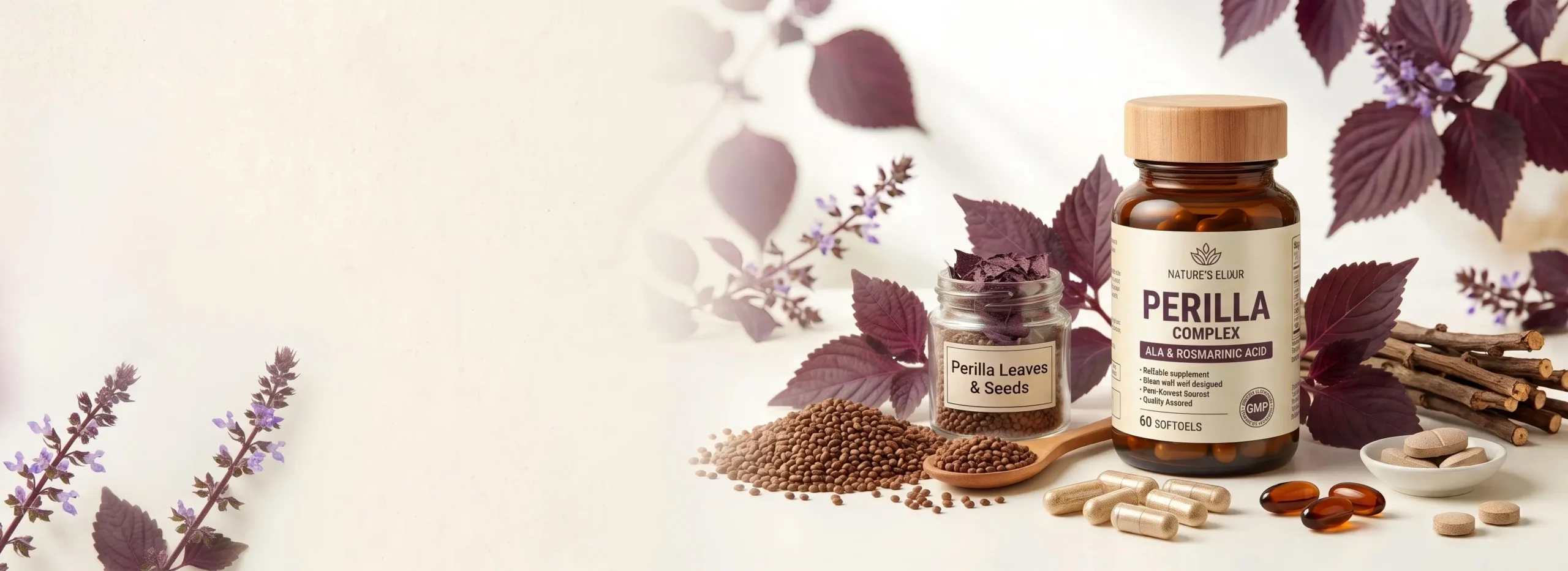
KS Nutripharma is a perilla supplement manufacturer and supplier for OEM, ODM, and private-label programs. We manufacture finished perilla dietary supplements, including Perilla frutescens seed-oil softgels specified to alpha-linolenic acid (ALA) and leaf-extract capsules specified to rosmarinic acid. Each project is built around a defined plant part, analytical method, material specification, packaging requirements, and finished-product COA.
For seed-oil products, perilla seed oil, perilla oil, and egoma oil (荏胡麻油 / エゴマ油) commonly refer to the seed-oil route. The approved specification and supporting documentation should identify the species and plant part.
- Seed oil → ALA → softgel
- Leaf extract → rosmarinic acid → capsule
COA · ALA / GC · rosmarinic acid / HPLC · oxidation testing · MOQ
Compare two oil COAs · Send BOM
Typical first reply is one business day on a complete brief. NDA available.
Perilla Supplement Manufacturing at a Glance
Buyer needs | Starting specification |
|---|---|
| Seed oil | P. frutescens; ALA %, GC, oxidation limits |
| Leaf extract | Rosmarinic acid %, HPLC |
| Format | Softgel / capsule / powder |
| Typical planning MOQ | 3,000–5,000 units |
| Sample | 7–15 days |
| Production | 30–45 days |
cGMP · ISO 9001 · ISO 22000 · HACCP · FSSC 22000 · Halal · Kosher · in-house lab + SGS/Eurofins pathways · batch COA
About Us · Manufacturing Capacity · Certifications · Quality Control
81,000+ m² GMP facility · 12 production lines
Perilla Formula Architectures
Development examples, not recommended intakes. Pick the closest architecture or send a BOM.
Commercial perilla oil softgels are generally developed from standardized seed oil with a confirmed ALA specification. Perilla oil capsules are typically used when the fill is a flowable microencapsulated powder rather than bulk oil.
Use when: The brief is a perilla seed oil supplement or an egoma-oil softgel.
Specify: P. frutescens seed oil; ALA specification and reporting basis confirmed; fill 500 / 750 / 1,000 mg oil; oxidation specification with method and units; antioxidant strategy and label treatment for tocopherols if used; gelatin or a suitable vegetarian softgel system such as starch/carrageenan, subject to fill compatibility.
Trade-off: Simplest oil-phase architecture. Adding a second lipid introduces another specification/assay line and usually increases unit cost.
Use when: The panel must print ALA and a second oil-soluble active.
Specify: Seed-oil fill + ALA specification; companion and milligrams. Combinations include algal DHA, CoQ10 (ubiquinone or ubiquinol), or another oil-soluble active. One softgel versus dual-phase fill is a feasibility review.
Trade-off: Additional active specifications and assay requirements, with higher formulation and unit cost than a single-oil softgel.
Use when: The brief is a perilla leaf supplement / perilla extract supplement, or the panel prints rosmarinic acid.
Specify: P. frutescens leaf; rosmarinic acid HPLC % + method; extract often 150–300 mg per serving; metals / pesticides.
Trade-off: Bitterness and green color. A second dry active adds another assay line.
Use when: The second dry active is quercetin.
Specify: Leaf specification as above; quercetin milligrams and form on a separate assay line.
Trade-off: Additional specification and assay requirements, plus greater formulation and QC complexity than a single-herb leaf capsule.
Choose the Perilla Format: Softgels, Capsules, Tablets or Powder
Once the material route is set, lock the manufacturing variables below.
Softgels
Best for: Perilla seed oil and oil-plus-lipid formulas.
Why: Controlled oil fill and a sealed unit format.
What to lock: Oil fill weight, fill formulation, shell material, shell weight, seam integrity, and packaging barrier.
Manufacturing note: Seam integrity and the drying curve are what we check for leaks. Vegetarian softgels require a compatible plant-based shell system, with shell composition confirmed during feasibility review.
→ Softgel Solutions
Best for: Leaf extract or a flowable microencapsulated powder. Dry vegan path = HPMC hard capsule.
Why: Dry fill with a two-piece shell.
What to lock: Shell, extract mg, whether a second dry active shares the fill.
Manufacturing note: Two-piece capsules are used for dry fills or a flowable oil powder; bulk seed oil in that shell is a scoped liquid-fill or adsorption review.
→ Hard Capsules
Best for: Higher-load dry leaf-extract formulas where serving size or unit count favors tablet compression.
Why: Count and pack density when a capsule serving grows.
What to lock: Compression, hardness, assay after press, coat if color or odor needs it.
Manufacturing note: Seed oil is normally delivered as a softgel; dry tablet development requires a different material architecture. Processing conditions should be reviewed for heat-sensitive or oxidation-sensitive botanical markers.
→ Tablets
Best for: Microencapsulated oil powder; sticks when companions need grams.
Why: Room for gram-level companions that will not fit one capsule.
What to lock: Oil load %, free surface oil, measured encapsulation efficiency, water activity, hot- vs cold-water disperse, ALA on the powder as filled.
Manufacturing note: High free-surface oil can accelerate oxidation during storage, so oil-powder projects should specify encapsulation efficiency, surface oil, moisture and packaging before scale-up. See moisture-control stability engineering.
→ Powders & Granules
Best for: A channel that already requires a gummy, after a pilot.
Why: Leaf extract can present bitterness and color challenges, while high oil loading creates additional constraints during gummy cooking, dispersion, and finished-product stability.
What to lock: Active per piece, pectin vs gelatin, flavor, finished-piece assay.
Manufacturing note: High oil loads can make gummy development less practical than softgels, so the pilot should establish active load per piece before artwork is finalized.
→ Gummies
Best for: Amber-bottle adult oil drops, after feasibility.
Why: Liquid formats allow the active to be specified per mL and can be packaged in light-protective containers.
What to lock: Marker per mL, dropper calibration, barrier bottle, product class before artwork.
Manufacturing note: Other formats, including liquids, are quoted after feasibility review.
→ Liquids
Most RFQs say perilla 1,000 mg or egoma oil. Plant part, marker, and analytical method must be fixed before suppliers can be compared.
Seed oil → ALA by an agreed validated GC method. Leaf extract → rosmarinic acid by HPLC.
1. Plant part
Write seed oil, microencapsulated seed-oil powder, or leaf extract on the PO. Ordinary milled seed powder should not be treated as equivalent to a standardized perilla seed oil with a defined ALA specification. A perilla seed extract brief must name the plant part and the analyte.
Species is Perilla frutescens. Korean 들깨 / 들기름 usually means the same seed oil—still write the Latin name. Culinary shiso is leaf. Flavoring-grade perilla leaf oil is a different material from P. frutescens seed oil. ALA percentage alone does not establish botanical identity.
2. Active marker
Oil projects specify ALA. Leaf projects specify rosmarinic acid. Name the molecule on the PO. Extract ratio describes the extraction concentration; for standardized material, quotation should be based on the specified marker rather than extract ratio alone.
3. Analytical method
Oil: ALA % by an agreed validated GC method, and whether that % is of fatty acids or of the sample. Leaf: rosmarinic acid by HPLC. Two COAs showing “60% ALA” are not directly comparable unless the analytical method and reporting basis are the same.
4. Oxidation / safety
After seed disruption, exposure to oxygen, light, heat, and endogenous oxidative enzymes can accelerate lipid oxidation, increasing peroxide value and other applicable oxidation parameters. Oxidation is assessed against the approved release specification after filling, not only against the incoming oil COA. Where refining or deodorization is used, the specification should address the resulting fatty-acid profile and any market-specific PAH / benzo[a]pyrene requirements.
Cold-pressed is a processing descriptor, not a guarantee of higher ALA or lower peroxide value.
5. Finished format
Format selection depends on the material architecture and target label. Oil-based products are typically developed as softgels; dry leaf extracts are typically developed as hard capsules. Microencapsulated oil powder is a different purchase line when the brief is a stick or a dry blend.
Send two supplier COAs — missing part, analyte, and method marked in one business day.
For commercial development, perilla seed oil is often quoted in the 55–65% ALA range of total fatty acids, subject to source and specification. Confirm the approved ALA reporting basis before label calculation.
What buyers should check
- Peroxide value and acid value, with method and units
- Oxidation specification on release, alongside ALA %
- Light and oxygen exposure from filling through pack
- Light- and oxygen-barrier packaging, with headspace and nitrogen flushing considered where applicable
- Antioxidant strategy, including whether tocopherols are added for oxidation control and how they will be treated on the finished label
- Finished-unit assay after fill, not only the incoming drum
Oil pack: light- and oxygen-barrier. Oil-powder packs need moisture-barrier film plus measured encapsulation efficiency and surface oil.
Do not calculate the finished-product ALA declaration from the incoming oil COA alone. Confirm formulation dilution and finished-unit assay before approving the Supplement Facts panel. Quotes on this page refer to finished units rather than bulk oil drums.
Leaf extracts are specified to rosmarinic acid by HPLC. Common development targets include 2%, 5%, 10% and 20% rosmarinic acid, subject to raw-material availability and formulation requirements.
Extract milligrams and marker milligrams are calculated separately: 200 mg of a 10% extract ≈ 20 mg rosmarinic acid when that percentage is reported on the extract as filled. The same extract weight at 20% and at 2% yields different rosmarinic-acid milligrams.
A perilla leaf extract is a dry powder, so the default finished unit is a hard capsule. Softgels meter an oil fill; a rosmarinic-acid extract has no oil phase unless a second lipid is added, and that is a different architecture. Briefs for a perilla leaf supplement or perilla extract supplement should lock extract milligrams, rosmarinic-acid percentage, and HPLC method on the same PO.
Extract ratio describes concentration during processing. It does not tell you how many milligrams of rosmarinic acid will print on the panel. Two 10:1 extracts can still differ in marker content, color, and flow, so quotation should follow the named HPLC grade rather than ratio alone.
Specification differences that change fill and cost include particle size, residual moisture, destination pesticide and metal limits, and whether debittering or decoloring is required. Those steps can move assay and should be agreed before sampling. Gummies remain a weaker default: bitterness and green color are difficult to mask at a useful load, and cook heat can affect polyphenol assay. If the channel requires a gummy, establish active per piece in the pilot before artwork is finalized.
The approved specification and supporting documentation should identify P. frutescens and leaf as the part. Where required by the raw-material specification or target market, additional volatile constituents such as perillaketone or methyleugenol can be included in the testing panel. A higher rosmarinic-acid percentage changes fill, cost, and bitterness.
See how to read a COA. Incoming qualification is not finished-unit release: post-fill oxidation, free surface oil, and blend dilution can move the number on the panel.
- Identity: P. frutescens and the named part
- Oil: ALA method, oxidation specification, BaP / PAH if required, and fatty-acid profile for identity and composition verification
- Leaf: rosmarinic acid method; additional volatile-marker testing where required by the raw-material specification or target market
- Metals, microbiology, pesticides to the target-market panel
- Softgels: fill weight, seam / leak
- Microencapsulated powder: surface oil, moisture
Oil: light- and oxygen-barrier pack. Oil powder: moisture-barrier film.
| Form | Typical planning MOQ |
|---|---|
| Softgels / capsules | 3,000–5,000 finished units |
| Tablets | 5,000–10,000 units |
| Powder / sachets | 1,000–3,000 units. Microencapsulated oil powder or custom stick packaging may require a higher MOQ depending on oil load and film configuration |
Other formats, including gummies and liquids, are available after feasibility review.
A kilogram quote on drum oil is not a finished-unit MOQ. Final MOQ depends on dosage form, packaging configuration, and material requirements.
Samples typically take 7–15 days after specification lock. Mass production typically takes 30–45 days after formula, artwork, pack, and production schedule are confirmed.
Send destination market, product class, dosage form, and first-order quantity. Name Perilla frutescens and the material: seed oil, microencapsulated powder, or leaf extract. Give an ALA target as % or mg per serving plus method, or a leaf-marker target plus method. Note whether BaP / PAH is required, the shelf lane, and any companions (algal DHA, CoQ10, quercetin). Attach current COAs.
Destination-specific regulatory classification, claims, and testing requirements are reviewed against the target market before artwork approval. Seed-oil artwork is written from the oil specification; leaf-extract copy is written from the leaf specification.
Disease-treatment positioning and other market-restricted claims are outside this page’s manufacturing scope. Licensed branded extracts quote only with the authorization on the BOM. We quote from the BOM and COA you send. Finished-label compliance remains the brand owner’s responsibility.
Is egoma oil the same as perilla seed oil?
In commercial use, “egoma oil” commonly refers to oil obtained from the seeds of Perilla frutescens. However, the approved specification should still state species and plant part. Culinary shiso is typically leaf.
How should ALA be reported on a perilla oil COA?
Specify whether ALA is reported as a percentage of total fatty acids or as a percentage of the oil, and keep the analytical method and reporting basis consistent through finished-product calculation.
Can you make perilla formulas with DHA, CoQ10, or quercetin?
Yes, on an agreed BOM. Algal DHA or CoQ10 sit with the seed-oil path; quercetin sits with the leaf path. Each companion keeps its own assay line.
What testing documents are available?
Batch COA against the approved specification, incoming identity, and the oxidation or additional volatile-marker tests scoped for the material. Finished-unit assay is part of release when the label declares a marker. SGS / Eurofins pathways are available where the project requires them.
Start Your Perilla OEM Project
Compare two oil COAs — plant part, ALA or rosmarinic-acid method, and oxidation file.
Send your BOM — format, companions, destination, first-order quantity.
Request a packaging review — light/oxygen barrier for oil; moisture barrier for oil powder.
Typical first response is within one business day. Project manager assigned. NDA available.
Compare Two Oil COAs · Send Your BOM · Request a Packaging Review
Related Product Pages
- Ginkgo Biloba Supplement Manufacturer
- Liposomal CoQ10
- Black Seed Oil Capsules Manufacturer
- How to Read a COA
- Quality Control
Disclaimer: Wholesale / brand manufacturing and product-development reference only. Not intended to diagnose, treat, cure, or prevent any disease. Structure/function language and product classification vary by country. Brand owners remain responsible for finished-label compliance with local counsel. KS Nutripharma provides manufacturing feasibility and documentation support — not legal approval. Milligram and percentage figures on this page are development examples, not recommended intakes.
Written by KS Nutripharma Formulation Team | Reviewed by KS Nutripharma Director of R&D (PhD, Food Science | 19+ years nutraceutical development)
Technical review scope: formulation feasibility, dosage-form selection, P. frutescens plant-part identity, ALA vs rosmarinic-acid specification, oil-oxidation file, and QC release | Updated September 2026