
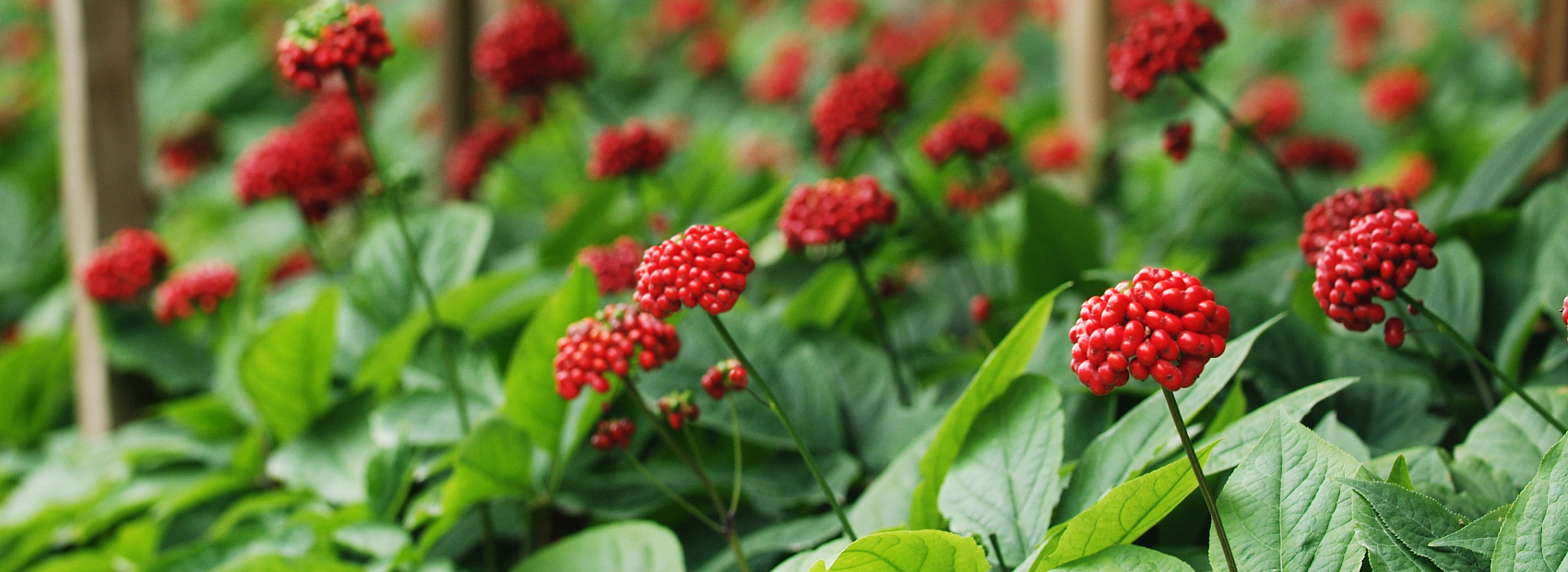
Panax Notoginseng Cultivation Base
Self-Owned Cultivation Base · Full Process Control · Complete Traceability
From Wenshan Panax Notoginseng Fields to Your Brand: A Closed-Loop Quality System
We do not simply purchase raw materials.
We build quality from the source.
Our self-owned cultivation base in Wenshan allows full responsibility for every batch.
From planting and harvesting to primary processing, extraction, and final formulation, all steps are completed within a controlled system.
This not only affects raw material quality.
It directly determines the stability, safety, and competitiveness of your finished products.
Why a Self-Owned Base Matters
In today’s nutraceutical manufacturing industry, over 70% of companies rely on externally sourced herbal materials (iiMedia Research, 2024).
This model introduces three structural risks:
- Significant batch variability (origin and harvest year differences)
- High uncertainty in pesticide residues and heavy metals
- Price volatility is affecting supply stability
These issues extend beyond raw materials.
They ultimately result in:
- Failed finished product testing
- Fluctuations in active ingredient levels
- Customer complaints and brand trust erosion
Our Approach: Control the First Production Stage
By owning the cultivation base, quality control starts at the source.
This delivers four key certainties:
- Source certainty– 100% self-owned raw materials
- Batch certainty– traceable to specific cultivation plots
- Testing certainty– risks controlled during planting
- Cost certainty– reduced volatility from intermediaries
This is not just supply chain optimization.
It is a systematic elimination of uncontrollable variables.
Base Strength: Standardization Beyond Scale
Core Region: Wenshan, Yunnan
Wenshan is widely recognized as the premium origin for Panax Notoginseng due to:
- Latitude: 23°N (near the Tropic of Cancer)
- Altitude: 1,200–1,800 meters
- Soil: Iron-rich red soil with trace minerals
- Average temperature: 16–20°C
- Annual rainfall: 1,000–1,300 mm
These conditions directly impact saponin accumulation.
Studies show that Panax Notoginseng grown in Wenshan core regions contains 12%–18% higher total saponins compared to non-core areas (China Journal of Chinese Materia Medica, 2023).
Cultivation Scale & Capacity Alignment
- Cultivation area: ~80–100 hectares
- Annual fresh harvest: ~800–1,000 tons
- Equivalent dried material: ~200–250 tons
- Extract output: ~30–50 tons per year
Finished product conversion capacity:
- Capsules (500 mg): ~60–100 million units/year
- Tablets (600 mg): ~50 million units/year
This ensures stable, long-term supply for multiple brands without external sourcing.
Compliance & Certification
- GAP (Good Agricultural Practice) certification
- Organic certification (selected plots)
- Geographical Indication: Wenshan Panax Notoginseng
- Third-party testing reports (batch-level pesticide and heavy metals)
These credentials support both internal control and client regulatory filings.
From Cultivation Standards to Product Quality: Direct Causality
We focus on measurable cause-and-effect relationships.
1. Pesticide Control → Finished Product Safety
We implement stricter-than-national standards:
- Prohibited use of high-toxicity pesticides
- Biological pest control methods
- Annual soil and water testing
Testing benchmarks:
- 500 pesticide indicators tested
- Detection rate: <0.5%
- Exceedance rate: 0
(Source: SGS & CTI annual reports)
Impact:
- Near 100% pass rate in finished product testing
- No need for corrective re-screening
This significantly reduces compliance risk.
2. Growth Cycle Control → Active Ingredient Stability
Key active compounds in Panax Notoginseng:
- Notoginsenoside Rg1
- Ginsenoside Rb1
- Notoginsenoside R1
Pharmacopoeia requirement: ≥5.0% total saponins
Our standard:
- Strict 3-year cultivation cycle
- No early harvesting
Measured results (3-year average):
- Total saponins: 6.5%–8.2%
- 30%–60% above pharmacopoeia standard
Benefits:
- Easier compliance in finished products
- Greater formulation flexibility
- Stronger efficacy claims
3. Primary Processing Efficiency → Ingredient Retention
Active compounds degrade after harvesting.
Industry average processing time: 48–72 hours
Our standard: within 24 hours
Process includes:
- Cleaning
- Slicing
- Low-temperature drying (≤60°C)
Research shows delayed processing leads to 5%–12% saponin loss (Research on Chinese Herbal Processing, 2022).
Processing speed directly impacts final product efficacy.
Full Supply Chain Visibility
We provide a transparent, end-to-end system:
Cultivation → Primary Processing → Extraction → Manufacturing → Packaging
Each stage includes:
- Batch identification
- Linked testing reports
- Production records
Traceability system:
End users can scan a QR code to access:
- Cultivation plot ID
- Planting timeline
- Testing reports
- Production batch data
This supports both quality assurance and brand storytelling.
Core Values for Our Brand Clients
1. Risk Reduction
- Raw material variability → minimized
- Testing failure risk → significantly reduced
- Supply disruption → controlled
2. Stronger Product Positioning
“Self-owned Wenshan cultivation base” is a clear market differentiator.
Products with origin + base positioning show:
- 15%–25% higher click-through rates
- 10%–18% higher conversion rates
(Source: Chanmama E-commerce Analytics, 2024)
3. Ready-to-Use Marketing Assets
We provide:
- Aerial footage of the base
- Full cultivation visuals
- Testing reports
- Educational content
Applicable for:
- Product pages
- Social media
- Video marketing
4. Supply Flexibility
- Large-scale production support
- Emergency replenishment
- Custom high-saponin specifications
Ideal for fast-growing brands.
Contract Manufacturing Solutions
Product Types
- Panax Notoginseng Powder
- Panax Notoginseng Extract
- Capsules
- Tablets
- Custom formulations
Business Models
ODM
We provide:
- Formula development
- Raw materials (self-owned base)
- Manufacturing and packaging
OEM
You provide the formula
We provide raw materials and production.
Compliance & Branding Support
- Cultivation-based certification documents
- Approved “self-owned base” claims (subject to review)
- Testing and traceability data
Recommendations
If you are developing Panax Notoginseng products:
Prioritize supply chain stability over raw material price alone.
Next Steps
- Schedule a base visit
- Request samples and a quotation
- Get a full contract manufacturing proposal
References
- Chinese Pharmacopoeia (2020 Edition)
- China Journal of Chinese Materia Medica, 2023, Issue 4
- Research on Chinese Herbal Processing, 2022, Issue 6
- iiMedia Research: China Herbal Supply Chain Report (2024)
- SGS Annual Pesticide Testing Report (2023)
- CTI (Centre Testing International) White Paper on Herbal Safety (2024)
- Chanmama E-commerce Data Report (2024)