
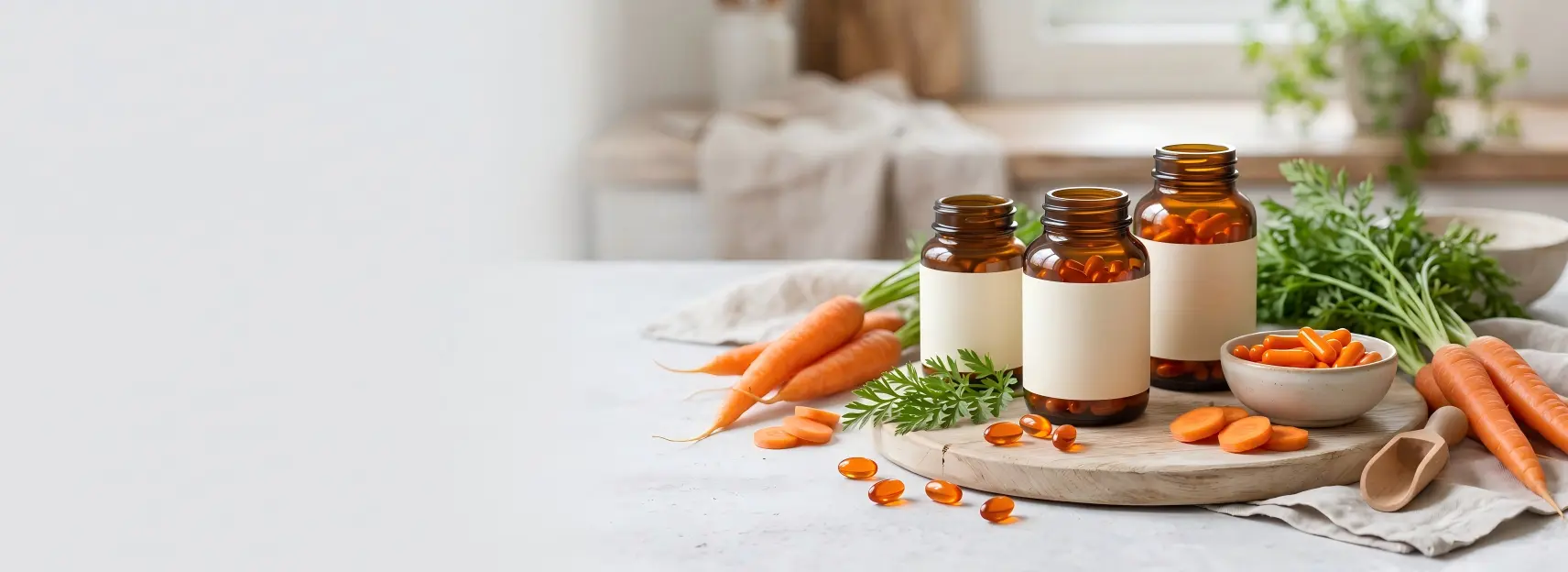
Natural Beta Carotene Supplements Contract Manufacturer & Private Label Partner
KS Nutripharma® develops and manufactures private-label beta carotene supplements for brands that need more than a generic contract product. Because we control the raw material grades ourselves — synthetic and fermentation-derived beta carotene in powder, oil suspension, CWS microcapsule and beadlet forms — we can build your supplement on a documented specification, a typical COA and a defined stability plan, then scale it from pilot batch to commercial production.
At a Glance
- ✓ OEM / Private Label Available—your brand, your specifications, our manufacturing
- ✓ MOQ from 3,000 units per SKU (powders and sachets); 3,000–5,000 units for tablets, capsules and softgels
- ✓ Lead Time: samples in 7–15 days; mass production in 30–45 days
- ✓ Certifications: cGMP, ISO 9001, ISO 22000, FSSC 22000, HACCP, Halal, Kosher, FDA-registered facility — certificate scope and numbers available on request
- ✓ 6 Dosage Forms:tablets (12M+ units/day), capsules (5M+/day), softgels (2M+/day), gummies (2M+/day), powders and liquids
- ✓ Request a Quote: technical response within 24 hours, including formula and MOQ recommendation
What “Natural” Means for Beta Carotene — Before You Put It on the Label
“Natural beta carotene” is one of the most searched phrases in this category — and one of the most regulated. The word “natural” is defined differently across markets, and not every source qualifies everywhere:
- Fermentation-derived beta caroteneis accepted as a natural-origin source in many markets, but a “natural” claim is not automatic: it typically requires source and production-process documentation to support it, and the rules differ between the US, the EU and other destinations.
- Synthetic (nature-identical) beta caroteneis chemically identical to the natural molecule and remains the global market mainstream — but it cannot carry a “natural” claim.
- Algal beta carotene (Dunaliella salina)is available on request for projects that require algal sourcing and its mixed-carotenoid profile.
Our recommendation: choose the claim scope first, then the source. Tell us your destination markets and the exact claim wording you intend to use; we will match the source and supply the supporting documentation — source declaration, process description and specification — needed to substantiate it. Where a claim cannot be supported for a given market, we will tell you before production, not after.
Beta Carotene Supplement Formats
Choose a dosage form based on your target dose, consumer preference, formulation requirements and market positioning. Typical single-ingredient products on the mainstream market deliver 6–15 mg of beta-carotene per serving (up to 25,000 IU provitamin A).
Market-Validated Reference Formulations
The following formulas are market-informed starting points. They require final ingredient verification, safety review, pilot production, stability testing and target-market label approval before commercialization.
A premium carotenoid formula for beauty-nutrition brands.
Reference Formula Per Serving
Recommended Dosage Forms
- Two-capsule serving
- Softgel plus capsule
- Powder sachet with microencapsulated carotenoids
- Premium gummy with adjusted amounts
Positioning
- Beauty from within
- Healthy skin appearance*
- Carotenoid and antioxidant nutrient complex*
- Daily beauty nutrition*
Claim Restrictions
Do not claim that the product:
- Prevents UV damage
- Replaces sunscreen
- Treats acne or pigmentation
- Guarantees tanning
- Produces a defined before-and-after result
A premium formula combining carotenoids with lipid-soluble healthy-aging ingredients.
Reference Formula Per Serving
Recommended Dosage Form
Two softgels
Positioning
- Healthy aging nutrition*
- Carotenoid and CoQ10 complex
- Cellular antioxidant support*
- Premium active-lifestyle formula
A plant-focused powder concept for clean-label and whole-food brands.
Reference Formula Per Serving
Recommended Dosage Forms
- Sachet
- Stick pack
- Scoopable powder
- Capsule blend
Positioning
- Whole-food carotenoid blend
- Plant-based daily nutrition
- Fruit and vegetable powder complex
- Clean-label powder concept
Required Verification
- Organic certification
- Pesticide testing
- Heavy-metal limits
- Microbiological specifications
- Beta-carotene standardization
- Color and flavor stability
A family-oriented concept for children aged four years and older. Final amounts require pediatric and market-specific review.
Reference Formula Per Two-Gummy Serving
Recommended Dosage Form
Pectin or gelatin gummy
Positioning
- Daily children’s multivitamin
- Vitamin A from beta-carotene
- General growth and immune nutrition*
- Family-friendly natural-source formula
Development Requirements
- Defined age group
- Pediatric safety review
- Child-resistant packaging where required
- Flavor and color assessment
- Sugar and sweetener review
- Choking and serving instructions
- Target-market nutrient limits
Trend-Led Product Formats
Beyond ingredient selection, dosage format plays an important role in product differentiation, consumer experience and retail positioning.
The following concepts adapt established carotenoid formulas into newer delivery formats. Reference amounts remain subject to ingredient specifications, technical feasibility, stability testing and target-market review.
Emerging Science-Informed Carotenoid Formulations
The next generation of carotenoid products may combine natural carotenoids with microbiome ingredients, mitochondrial nutrients and emerging healthy-aging compounds.
These concepts are R&D starting points—not clinically validated finished formulas. No synergistic effect should be assumed unless supported by formula-specific human evidence.
Every concept requires:
- Ingredient and supplier verification
- Target-market regulatory review
- Target-population safety assessment
- Dosage-form feasibility
- Pilot production
- Stability testing
- Claim substantiation
A premium formula combining an established urolithin A ingredient with carotenoids and CoQ10.
Reference Formula Direction
Recommended Formats
- Multi-capsule serving
- Capsule plus softgel
- Powder sachet plus softgel
- Daily-dose pack
Potential Positioning
- Active-aging nutrition
- Mitochondrial nutrient complex
- Healthy-energy support*
- Premium longevity formula
R&D Requirements
- Confirm urolithin A regulatory status
- Verify licensed or branded-ingredient requirements
- Assess large serving-size feasibility
- Separate oil-soluble ingredients where necessary
- Do not claim mitochondrial renewal, mitophagy or muscle improvement without adequate product-relevant evidence
Evidence Status
Urolithin A has independent human research. Its combination with beta-carotene, CoQ10 and astaxanthin has not been clinically validated.
An early-stage healthy-aging concept combining a standardized spermidine ingredient with natural carotenoids.
Reference Formula Direction
Recommended Formats
- Capsules
- Capsule plus softgel
- Multi-component daily pack
Potential Positioning
- Healthy-aging research concept
- Polyamine and carotenoid complex
- Cellular-nutrition formula
R&D Requirements
- Confirm spermidine source and standardization
- Review target-market regulatory status
- Evaluate total polyamine content
- Assess interactions and target population
- Do not claim autophagy activation, cellular rejuvenation or lifespan extension
Evidence Status
Spermidine is being studied in healthy-aging research. Its combination with beta-carotene has not been clinically validated.
The emerging concepts above are based on early-stage research rather than validated finished-product trials.
Relevant research includes:
- Probiotics for enhanced tissue carotenoid status: a randomized controlled trial
- Bioinformatic insights into carotenoids and gut microbiota dynamics
- Carotenoids and inulin fermentation in ex vivo adult gut microbiota
- NIH Vitamin A and Carotenoids Health Professional Fact Sheet
These studies do not demonstrate that the proposed multi-ingredient formulas provide synergistic clinical benefits.
Share your target market, intended positioning, preferred ingredients and dosage form.
KS Nutripharma will assess:
- Ingredient availability
- Regulatory status
- Evidence level
- Formula compatibility
- Serving-size feasibility
- Processing requirements
- Stability risks
- Required testing
- Packaging strategy
Dunaliella salina
Dunaliella salina is one of the best-established natural beta-carotene sources used in premium carotenoid supplements.
Potential Features
- Naturally occurring carotenoid profile
- Oil-soluble and powder delivery systems
- Suitable for softgels and selected capsule formulas
- Natural-source positioning
- Non-GMO options subject to documentation
- Supporting source and process documents
Suitable Applications
- Natural beta-carotene softgels
- Mixed carotenoid capsules
- Carotenoid complexes
- Premium vitamin A products
Blakeslea trispora
Fermentation-derived beta-carotene from Blakeslea trispora is used in established natural beta-carotene products.
Potential Features
- Fermentation-derived source
- Standardized potency
- Powder and oil-based options
- Suitable for scalable manufacturing
- Source documentation available by specification
Suitable Applications
- Softgels
- Capsules
- Tablets
- Gummies
- Multivitamins
A fermentation-derived ingredient does not automatically qualify for every natural, vegan or clean-label claim. Claims must be verified for the target market.
Palm Mixed Carotenoids
Palm fruit concentrates can provide beta-carotene together with alpha- and gamma-carotene and other naturally occurring compounds.
Potential Features
- Mixed carotenoid profile
- Oil-soluble ingredient system
- Suitable for broader carotenoid formulas
- Strong fit for beauty and healthy-aging concepts
- Sustainable sourcing documentation subject to availability
Suitable Applications
- Mixed carotenoid softgels
- Beauty-nutrition formulas
- Healthy-aging formulas
- Premium antioxidant concepts
Carrot Concentrates and Whole-Food Powders
Carrot concentrates may support whole-food and consumer-friendly product positioning.
Potential Features
- Familiar source story
- Suitable for gummies and powders
- Whole-food positioning
- Natural color contribution
- Potential fit for family-oriented products
Suitable Applications
- Gummies
- Chewables
- Powder blends
- Whole-food formulas
- Selected children’s products
Organic, vegan and whole-food claims require product-specific verification and certification.
| Product form | Source | Available specifications | Physical appearance | Sieve profile | Typical application |
| Standard powder | Fermentation / Synthetic | 5%–96% | Orange-red to reddish-brown powder | 80 mesh | Tablets, hard capsules, gummies, premixes; raw material for encapsulated products |
| Oil suspension | Fermentation / Synthetic | 10%, 20%, 30% | Orange-red to reddish-brown suspension | — | Softgels; natural color applications |
| Microcapsule powder (CWS) | Fermentation / Synthetic | 1%, 10% | Orange-red to reddish-brown powder | 95% through 60 mesh | Solid beverages, gummies, premixes |
| Microcapsule beadlets | Fermentation / Synthetic | 1%, 10% | Orange-red to reddish-brown granules | 100% through 20 mesh; 85% through 40 mesh; 15% through 100 mesh | Solid beverages, gummies, premixes, tablets, hard capsules |
| Custom emulsion | Per project | Per application | Per application | — | Beverages and liquid systems — developed per application |
Reference COA — β-Carotene CWS 1% (for reference)
Typical COA for reference only; batch results may vary. A batch-specific COA is issued with every production lot. Public versions mask the batch number, signatories and quality seal.
- Appearance:orange-yellow to orange-red free-flowing powder
- Odor / Taste: characteristic
- Beta-carotene content (HPLC): ≥1.0% — typical result 1.39%
- E (1%, 1 cm): ≥25 — typical result 34.7
- Loss on drying: ≤8.0% — typical result 3.28%
- Arsenic (As):≤2 ppm — complies
- Lead (Pb):≤2 ppm — complies
- Total plate count:≤1,000 CFU/g — complies
- Yeast and mold:≤100 CFU/g — complies
- coli: negative — complies
- Salmonella: negative — complies
Storage: sealed container, cool and dry place, protected from strong light and heat; use promptly after opening.
Shelf life: 24 months when properly stored.
Specification sheets and typical COAs for all grades are provided with your quotation.
Beta carotene is oil-soluble, poorly dispersible in water and sensitive to light and oxygen. KS Nutripharma evaluates microencapsulated, beadlet and emulsion systems according to the intended dosage form and application — our raw material program includes powder formulation, emulsification and beverage application development alongside supplement manufacturing.
Available delivery systems may include:
- Oil suspensions for softgels
- CWS microencapsulated powders
- Beta carotene beadlets
- Water-dispersible powder systems
- Emulsions for liquid applications
Formulation stability may be affected by:
- Temperature and light exposure
- Oxygen and processing conditions
- pH and mineral content
- Continuous-phase composition
- Wall-material selection
- Emulsification technology
- Enzymes and microorganisms
- Packaging and storage conditions
Our delivery systems are designed to improve dispersibility, color performance and shelf-life behavior; final performance in your product is subject to application testing and should be verified in your actual formulation. We support that verification with samples, application guidance and stability evaluation under agreed conditions.
Carotenoids
Vitamins and Minerals
Lipid-Soluble Nutrients
Beauty-Nutrition Ingredients
- Hyaluronic acid
- Ceramides
- Vitamin C
- Tocotrienols
- Astaxanthin
- Lycopene
- Collagen peptides
- Acerola cherry
- Selected botanical extracts
Combination suitability depends on dosage form, daily serving size and stability.
Botanical and Whole-Food Ingredients
- Bilberry extract
- Marigold extract
- Tomato extract
- Carrot concentrate
- Pumpkin powder
- Spinach powder
- Acerola cherry
- Elderberry extract
- Saffron extract
- Spirulina or phycocyanin
Each botanical requires identity, active-marker, contaminant and target-market review.
Ingredient and Dosage-Form Matching
Our R&D team evaluates each project according to formula compatibility, manufacturing feasibility and target-market requirements. Customization may include:
- Beta carotene source: synthetic or fermentation-derived; specialty natural sources (e.g., Dunaliella salina) on request
- Product form matched to your application:emulsion, oil suspension, crystal / high-content powder, standard powder, microcapsule CWS powder or beadlets
- Powder color customization:orange, pink, red and other shades adjusted to your application, dosage form and brand color system
- Target potency:1–15 mg beta-carotene per serving (≈1,670–25,000 IU provitamin A), assessed against destination-market limits
- Dosage form: tablets, capsules, softgels, gummies, powders or liquids
- Combination formulas: vitamin A, vitamin C, vitamin E, lutein, zeaxanthin, lycopene, astaxanthin or bilberry — subject to compatibility and stability assessment
- Capsule shell, carrier oil and excipient selection
- Flavor, color and sweetener options
- Vegetarian, vegan, non-GMO or allergen-free requirements
- Bottle, blister, pouch, sachet and bulk packaging
- Label and packaging review support
- Market-specific documentation
Application-based form and color customization: the product form — emulsion, oil suspension, crystal, standard powder, microcapsule powder or beadlets — is selected or developed around your application (tablets, softgels, gummies, beverages or premixes), and the powder shade can be customized across orange, pink and red tones to match your brand’s color system. Custom emulsions and color shades are confirmed during formula feasibility review.
Final ingredient options depend on availability, technical assessment and applicable regulations.
1. Market and Product Brief
Define the target market, consumer group, positioning, dosage form, serving size and price range.
2. Ingredient Verification
Confirm source, potency, carrier, certifications and supporting documentation.
3. Safety and Regulatory Review
Assess target population, total vitamin A contribution, claims, warnings and market-specific requirements.
4. Formulation Feasibility
Review ingredient compatibility, serving size, processing conditions and packaging.
5. Sample Development
Prepare a laboratory sample for appearance, taste, handling and preliminary technical evaluation.
6. Pilot Production
Confirm process transfer, uniformity, physical performance and packaging compatibility.
7. Stability Program
Establish applicable assay, appearance, microbiological, physical and packaging requirements.
8. Commercial Production
Manufacture and release the finished product according to the approved specification and quality plan.
Natural origin does not eliminate the known risks associated with high-dose supplemental beta-carotene.
High-dose beta-carotene supplements have been associated with increased lung-cancer risk among:
- Current smokers
- Former smokers
- People with occupational asbestos exposure
Accordingly:
- High-potency formulas require additional review.
- Beta-carotene should not be used as a universal replacement for lutein and zeaxanthin in AREDS2-style formulas.
- Products should not claim to prevent cancer, cardiovascular disease, AMD or other diseases.
- Tanning products must not claim to replace sunscreen or prevent UV damage.
- Children’s formulas require age-specific review.
- Natural, organic, vegan and Non-GMO claims require separate documentation.
KS Nutripharma combines scalable production capacity with flexible entry quantities.
Factory Infrastructure
- 19+ years of manufacturing experience
- 81,000+ m² GMP-compliant facility
- 2 dedicated R&D centers
- 12 automated production lines
- 260+ professionals
- 7 international certifications
- 500+ brands served
- Products supplied to 60+ export markets
Daily Production Capacity
| Dosage form | Daily capacity |
| Tablets | 12+ million units |
| Capsules | 5+ million units |
| Softgels | 2+ million units |
| Gummies | 2+ million units |
| Powders | Bulk blending supported |
| Liquids | High-volume filling supported |
Actual output and lead time depend on formula complexity, packaging, material availability and production scheduling.
Flexible MOQs
| Dosage form | Typical MOQ per SKU |
| Capsules | 3,000–5,000 units |
| Tablets | 3,000–5,000 units |
| Softgels | 3,000–5,000 units |
| Gummies | 5,000–10,000 units |
| Powders and sachets | 1,000–3,000 units |
| Liquids | Typically 5,000–10,000 units, confirmed after review |
MOQs are indicative and may change according to formula complexity, packaging, ingredient sourcing and testing requirements.
Standard Lead Times
- Sampling: 7–15 days
- Pilot batch: 15–25 days
- Mass production: 30–45 days
- Rush options: Subject to ingredient availability and production scheduling
Our facility operates under an international quality and food-safety framework covering the following certification programs:
- cGMP— dietary supplement GMP compliance (21 CFR Part 111 framework)
- ISO 9001— quality management
- ISO 22000 / FSSC 22000— food safety management
- HACCP— hazard analysis and critical control points
- Halalcertification
- Koshercertification
- FDA facility registration(United States)
Certificate scope, registration numbers and validity dates are provided on request and can be shared under NDA during project evaluation.
Market compliance support:
- United States:beta-carotene is a color additive exempt from certification (21 CFR 73.95) and a lawful dietary ingredient under DSHEA; labels declare vitamin A activity in mcg RAE.
- European Union:beta-carotene is an approved food additive (E 160a); vitamin A claims follow the NRV of 800 mcg RE under Regulation (EU) No 1169/2011.
- Label conversion guidance:1 mcg RAE = 2 mcg supplemental beta-carotene; 15 mg beta-carotene ≈ 25,000 IU provitamin A.
- Cautionary labeling:high-dose beta-carotene supplements (≥20 mg/day) are not recommended for smokers; we support appropriate warning statements for affected markets.
Each project is manufactured according to an agreed product specification and quality plan. Available documentation may include:
- Product specification and typical COA for the selected raw material grade
- Ingredient documentation (including source declaration: synthetic or Dunaliella salina)
- Batch documentation and Certificate of Analysis per production lot
- Allergen and dietary information
- Stability or shelf-life documentation, where applicable
- Manufacturing and certification documents
- Export documentation for supported markets
Standard testing items (per agreed specification):
- Identification:UV-Vis absorbance ratio (A455/A483) and HPLC retention-time match against reference standard
- Assay:beta-carotene content by HPLC / UV-Vis
- Physical:loss on drying, sieve analysis (powder grades)
- Heavy metals:lead, arsenic, cadmium, mercury
- Microbiology:total plate count, yeast and mold, coliforms, coli, Salmonella
- Oil-based forms:peroxide value and acid value
- Third-party verification:SGS, Intertek or Eurofins testing available on request
Tier-1 Raw Material Partnerships — Formulas built on beta carotene from dsm-firmenich, BASF, NHU and other leading producers, with full documentation and traceability.
Scalable Manufacturing — Move from pilot quantities to high-volume production without changing manufacturing partners.
Dedicated R&D Support — Two R&D centers support feasibility assessment, sample development and production transfer.
Multiple Dosage Forms — Develop tablets, capsules, softgels, gummies, powders and liquids through one manufacturing partner.
Flexible Entry Quantities — MOQ options support both market testing and established retail programs.
Export Experience — We have supported more than 500 brands across over 60 export markets.
Defined Project Timelines — Receive clear milestones for sampling, pilot production and commercial manufacturing.
Start Your Beta Carotene Supplement Project
Tell us what you want to manufacture. Our team will review your requirements and recommend an appropriate raw material grade, dosage form, MOQ and project path.
Recommended RFQ fields:
- Name and business email
- Company and website
- Country and target market
- Preferred dosage form
- Formula path: stock formula / ready-to-develop concept / fully custom
- Preferred source: synthetic / fermentation-derived / algal (on request)
- Target specifications (e.g., 10% CWS, 30% oil suspension, 5%–96% powder)
- Target serving size/potency (mg or IU)
- Estimated order quantity
- Packaging requirements
- Required certifications
- Target launch date
- Existing formula or reference product
Primary CTA: Get a Custom Manufacturing Quote⇒
For OEM and private label projects, we typically provide a comprehensive documentation package to support product development, regulatory review, import clearance, and commercial launch.
Standard Documentation Package
Raw Material Documents
Certificate of Analysis (COA)
Specification Sheet
Ingredient Origin Statement
Allergen Statement
Non-GMO Statement (if applicable)
Halal / Kosher Certificates (if requested)
Quality & Safety Documents
Heavy Metal Test Report
Microbiological Test Report
Residual Solvent Report (if applicable)
Third-Party Laboratory Reports (upon request)
Batch Traceability Records
Finished Product Documents
Finished Product COA
Master Formula Sheet
Nutrition Facts / Supplement Facts Draft
Label Compliance Review
Shelf-Life & Stability Summary
Packaging Specification
Regulatory & Export Documents
FDA Registration Information
cGMP Compliance Statement
ISO 22000 / HACCP Certificates
Free Sale Certificate (if available)
Certificate of Origin
Commercial Invoice & Packing List
That depends on the source and your destination market. Fermentation-derived beta carotene can support natural-origin positioning in many markets, but a “natural” claim typically requires source and production-process documentation, which we supply with the project. Synthetic beta carotene cannot carry a natural claim. We confirm claim feasibility per market before production.
The COA shown is a typical COA for reference; batch results may vary. Public versions mask the batch number, signatories and quality seal. A batch-specific COA is issued with every production lot.
The 30% oil suspension is the standard choice — it delivers the market-benchmark 15 mg dose in a small fill volume. The 10% and 20% grades are used for lower-dose products or larger softgels.
Yes, using the fermentation-derived 30% oil suspension; label conversion and claim wording are confirmed during regulatory review for your destination market.
We use CWS microcapsule grades whose wall material is designed to improve stability against heat, oxygen and light; actual assay retention is verified in pilot batches under your process conditions and packaging.
Raw material grades carry a 24-month shelf life when properly stored (sealed, cool and dry, protected from light and heat). Finished-product shelf life is confirmed through stability evaluation under the agreed specification and packaging.
Yes. Potency is set per serving within destination-market limits, and beta carotene can be combined with vitamins A, C, D and E, lutein, zeaxanthin, lycopene or astaxanthin subject to compatibility and stability review.
Yes — those are served by dedicated pages: our ingredient line (/ingredients/beta-carotene-powder-supplier/) covers bulk specifications, and our beverage solution page (/solutions/beta-carotene-beverage-colorant/) covers coloring applications. This page focuses on finished supplements.
Standard sampling normally takes 7–15 days after the formula and project requirements are confirmed.
Standard mass production takes approximately 30–45 days. Timing depends on materials, formula complexity, packaging and production scheduling.
Yes. Third-party verification through SGS, Intertek or Eurofins can be arranged on request, in addition to batch COAs issued against the agreed specification.
We can support formula and label-document review within the agreed project scope, including IU/RAE conversion and market-specific cautionary statements. The brand owner remains responsible for final legal approval in the destination market.
Yes. Specification sheets and typical COAs for the selected raw material grade are supplied with your quotation, and batch COAs are issued per production lot according to the agreed testing plan.
KS Nutripharma has supplied products to more than 60 export markets. Shipping feasibility and documentation are confirmed for each destination.