

Advanced Liposomal Curcumin Manufacturing Solutions
Develop premium liposomal curcumin supplements with a manufacturing partner focused on scalable production, formulation expertise, and global private label solutions. At KS Nutripharma®, we help supplement brands transform innovative product concepts into commercially viable products through customized formulation development, liposomal delivery technology, rigorous quality management, and flexible manufacturing services.
Curcumin remains one of the most widely recognized botanical ingredients in the global nutraceutical industry. However, its naturally poor water solubility, limited gastrointestinal absorption, and rapid metabolism continue to present formulation challenges for conventional supplements. As consumer demand shifts toward higher-performance delivery systems, liposomal encapsulation has become an increasingly adopted strategy for developing premium products positioned for healthy aging, joint mobility, sports nutrition, antioxidant support, and daily wellness.
Every OEM project at KS Nutripharma begins with a comprehensive evaluation of ingredient compatibility, dosage form selection, manufacturing feasibility, regulatory considerations, and commercial positioning. Whether you are launching a new liposomal curcumin product or expanding an existing supplement portfolio, our technical team supports each stage of development—from formulation optimization and pilot sampling to large-scale manufacturing, quality verification, private labeling, and international distribution.
| 19+ Years Nutraceutical Manufacturing | 81,000 m² GMP-Compliant Facility | 12 Production Lines |
| 500+ Brands Served Globally | 60+ Export Markets | 2 Dedicated R&D Centers |
| 5 M Capsules / Day | 2M Softgels / Day | 12M Tablets / Day |
| 2 M Gummies / Day | 7 International Certifications | 100% Batch Traceability |
Why Partner with KSNutripharma?
- Liposomal formulation engineering and phospholipid delivery expertise
- Flexible customization for ingredients, dosage strength, and delivery formats
- Scalable manufacturing from pilot batches to high-volume production
- Complete technical documentation, including COA, stability support, and regulatory files
- One-stop OEM partner from concept development to finished branded products
Dedicated Liposome Production Infrastructure
- High-Pressure Homogenization Systems: Industrial-scale high-pressure homogenization systems optimized for liposome formation, particle size reduction, and batch-to-batch consistency.
- Liposomal Drying Technologies — Spray-dried and freeze-dried manufacturing options selected according to formulation characteristics, stability objectives, dosage form, and commercial positioning.
- Liposome Characterization — In-house characterization capabilities including particle size distribution, polydispersity index (PDI), encapsulation efficiency evaluation, and zeta potential analysis for formulation optimization and quality verification.
- Powder Redispersibility – Evaluation of powder redispersibility after reconstitution to support consistent product performance.
- Process Scale-Up Engineering – Process transfer from laboratory development to pilot production and full-scale commercial manufacturing while maintaining critical quality attributes.
- Dynamic Light Scattering (DLS)— In-house particle size analysis.
- HPLC Analytical Laboratory—Analytical laboratory supporting raw material identification, assay verification, encapsulation efficiency studies, stability evaluation, and finished product quality control.
- Phospholipid Carrier Development— Scientific selection and optimization of phospholipid carrier systems based on ingredient compatibility, phosphatidylcholine content, dosage form, and stability requirements.
- ICH-Compliant Stability Chambers— Stability studies designed according to ICH guidelines, including evaluation of particle size stability, encapsulation integrity, moisture control, and active ingredient retention throughout shelf life.
- Pilot Development & Process Validation— Pre-commercial validation batches (1–10 kg powder; 3,000–50,000 finished units), supports formulation optimization, engineering verification, process scale-up, and commercial readiness prior to full-scale manufacturing.
WHY LIPOSOMAL CURCUMIN IS A GROWING PREMIUM CATEGORY
The global curcumin market was valued at USD 678.4 million in 2025 and is projected to reach USD 1.69 billion by 2036, expanding at approximately 9.6% annually [1]. Three converging factors are driving demand for liposomal delivery formats:
Healthy Aging Demographics:
The World Health Organization projects that by 2050, the global population aged 60+ will reach 2.1 billion [2]. This demographic transition creates sustained demand for supplements supporting joint mobility, cognitive function, and inflammatory response balance.
Premium Supplement Market Expansion:
Approximately 75% of supplement consumers indicate willingness to pay premium prices for clean-label, science-backed ingredients [3]. Liposomal delivery supports premium positioning by enabling reduced serving sizes and measurable quality attributes.
Bioavailability Technology Demand:
Standard curcumin exhibits low aqueous solubility and rapid metabolism. Human clinical research demonstrates that liquid liposomal curcumin can achieve substantially higher plasma curcuminoid levels compared to non-liposomal formulations [4]. The commercial implication: brands offering liposomal curcumin can command retail prices 3-5x higher than standard turmeric powder products.
Liposomal Curcumin vs Liposomal Turmeric
These terms are frequently used interchangeably, but they represent different ingredient specifications with distinct cost structures and positioning implications.
| Factor | Turmeric Powder | Turmeric Extract | 95% Curcumin | Liposomal Curcumin |
| Curcuminoid % | 2-5% | 10-50% | ≥95% | ≥95% (encapsulated) |
| Relative Absorption | Baseline | 2-3x | 5-10x with piperine | 20-47x |
| Daily Dose | 2,000-4,000 mg | 500-1,000 mg | 250-500 mg | 100-250 mg |
| Cost/Serving | $ | $$ | $$$ | $$$$ |
| Premium Positioning | Low | Medium | High | Very High |
Commercially Proven Liposomal Curcumin Formulation Systems
Rather than developing products from scratch, many successful supplement brands build upon formulation systems that have already demonstrated strong commercial acceptance. These combinations provide a practical starting point for OEM development while allowing flexibility for dosage, delivery format, and brand positioning.
Emerging Liposomal Curcumin Formulation Trends (2026+)
Ten combination formulations representing the leading edge of liposomal curcumin innovation.
Ingredients Compatible with Liposomal Curcumin
This section is designed as a formulation toolbox, not a fixed product formula. Ingredients are structured for modular OEM customization.
Available Dosage Forms & Commercial Manufacturing Strategy
| Factor | Softgels | Capsules | Powders | Stick Packs | Liquid |
| Premium Perception | Highest | High | Medium | High | Highest |
| Bioavailability | Highest | High | High | Highest | Highest |
| MOQ Flexibility | High | High | Low | Medium | High |
| Shelf Stability | Highest | High | Medium | High | Medium |
| Cost per Unit | $$$ | $$ | $ | $$ | $$$$ |
Liposomal Carrier Engineering & Formulation Optimization
The performance of a liposomal curcumin supplement depends not only on the curcuminoid extract itself, but also on the selection and optimization of the phospholipid carrier system. Carrier composition influences encapsulation efficiency, physical stability, ingredient compatibility, manufacturing reproducibility, and long-term product performance.
At KS Nutripharma, carrier selection is evaluated during formulation development based on the physicochemical characteristics of the active ingredient, target dosage form, manufacturing process, and commercial positioning.
Critical Quality Attributes (CQAs) for Liposomal Curcumin Manufacturing
Consistent with Quality by Design (QbD) principles described in ICH Q8(R2), KS Nutripharma monitors a range of critical quality attributes throughout formulation development and commercial manufacturing. These parameters help evaluate product consistency, manufacturing reproducibility, and long-term stability while supporting regulatory documentation and quality assurance.
Accelerated and real-time stability studies are performed where applicable to evaluate product performance throughout the intended shelf life under established storage conditions.
Commercial manufacturing includes ongoing monitoring of key quality parameters to support process reproducibility, consistent product quality, and long-term manufacturing reliability.
Rather than relying on a single quality parameter, successful liposomal manufacturing requires balancing multiple critical quality attributes throughout formulation development and commercial production. Consistent raw materials, validated manufacturing processes, and comprehensive quality verification together contribute to reliable product performance, regulatory readiness, and scalable OEM manufacturing.
Critical Quality Attributes can only be achieved when key manufacturing parameters are maintained within validated operating ranges. During commercial production, formulation consistency is supported through process monitoring and equipment control.
Typical process parameters include:
- Hydration temperature
- Mixing sequence
- Homogenization pressure
- Homogenization cycles
- Processing time
- Cooling profile
- Filling conditions
These parameters are optimized during formulation development and verified during scale-up to support consistent batch quality.
Consistent raw material quality is the foundation of every liposomal curcumin formulation. Before any ingredient enters commercial production, KS Nutripharma applies a structured qualification process to evaluate supplier reliability, ingredient identity, safety, and manufacturing suitability. This systematic approach helps support formulation consistency, batch reproducibility, and long-term supply stability.
Supplier Qualification
Raw materials are sourced from qualified suppliers that demonstrate consistent manufacturing capability and established quality management systems.
Supplier evaluation typically includes:
- Manufacturing qualification and quality system review
- Regulatory and certification documentation
- Certificate of Analysis (COA) verification
- Batch consistency assessment
- Supply chain stability and traceability
Incoming Raw Material Evaluation
Each qualified lot is evaluated according to established quality control procedures before release for manufacturing.
Typical quality assessments include:
| Evaluation Category | Purpose |
|---|---|
| Identity Verification | Confirm botanical identity and ingredient authenticity |
| Curcuminoid Assay | Verify standardized active ingredient content |
| Residual Solvent Testing | Evaluate compliance with applicable quality requirements |
| Heavy Metal Analysis | Assess lead, cadmium, arsenic, and mercury levels |
| Microbiological Testing | Verify microbiological quality according to applicable standards |
| Pesticide Residue Screening | Evaluate compliance with customer and market requirements |
| Documentation Review | Confirm specifications, COA, and traceability records |
Manufacturing Suitability Assessment
In addition to analytical testing, raw materials are evaluated for their compatibility with liposomal formulation development and commercial manufacturing.
Typical assessment factors include:
- Standardization consistency
- Particle characteristics
- Dispersion behavior
- Process compatibility
- Oxidative stability
- Batch-to-batch reproducibility
This evaluation helps support efficient formulation development and scalable commercial production.
Why Raw Material Qualification Matters
Reliable liposomal performance begins with reliable raw materials. A structured qualification process helps reduce manufacturing variability, supports consistent product quality, and strengthens long-term supply reliability for OEM and private label projects.
OEM Engineering Perspective
Not all curcumin extracts are equally suitable for liposomal formulation. Beyond standardized curcuminoid content, factors such as phospholipid compatibility, dispersion characteristics, oxidative stability, and manufacturing reproducibility can influence formulation performance. Evaluating these characteristics during raw material selection helps establish a stronger foundation for subsequent formulation optimization and commercial-scale manufacturing.
Developing a commercially successful liposomal curcumin supplement involves more than encapsulating curcumin into phospholipid vesicles. Throughout formulation development and scale-up manufacturing, multiple engineering variables must be optimized simultaneously to achieve product stability, manufacturing reproducibility, and long-term commercial performance.
At KS Nutripharma, our formulation strategy follows a systematic engineering approach that evaluates raw materials, carrier systems, processing conditions, analytical verification, and manufacturing scalability to support reliable OEM production.
Challenge 1. Curcumin Stability Throughout Shelf Life
Curcumin is naturally sensitive to light, oxygen, temperature, and formulation conditions. Without appropriate formulation design, degradation may affect product appearance, active ingredient retention, and overall shelf stability.
Development Approach
Our formulation team evaluates phospholipid composition, antioxidant systems, processing conditions, and packaging compatibility to support product stability throughout the intended shelf life while maintaining manufacturing consistency.
Challenge 2. Liposomal Carrier Selection & Compatibility
The performance of a liposomal formulation depends not only on the active ingredient but also on the characteristics of the phospholipid carrier system. Different phospholipid sources and compositions may influence encapsulation behavior, physical stability, ingredient compatibility, and manufacturing reproducibility.
Development Approach
Carrier systems are selected and optimized according to formulation objectives, dosage form, regulatory requirements, and target market positioning. Compatibility between curcumin and the liposomal carrier is evaluated during formulation development before pilot-scale production.
Challenge 3. Encapsulation Efficiency
Efficient incorporation of curcuminoids into the liposomal carrier is essential for achieving formulation consistency and reducing variability between production batches.
Development Approach
Formulation parameters, phospholipid composition, hydration conditions, and processing techniques are optimized to improve encapsulation performance while maintaining manufacturing feasibility for commercial-scale production.
Challenge 4. Particle Size Uniformity
Consistent particle size distribution contributes to formulation stability, manufacturing reproducibility, and product quality. Particle size alone, however, should always be evaluated together with other critical quality attributes.
Development Approach
Manufacturing parameters such as hydration, homogenization, and process control are optimized to achieve a stable and uniform liposomal system throughout production.
Challenge 5. Oxidative Stability
Both curcumin and phospholipids are susceptible to oxidative degradation during processing and storage. Oxidation may influence product potency, appearance, and shelf-life performance.
Development Approach
Formulation development includes evaluation of antioxidant strategies, oxygen exposure control, processing conditions, and protective packaging to support long-term formulation stability.
Challenge 6. Multi-Ingredient Compatibility
Many commercial formulations combine liposomal curcumin with vitamins, minerals, botanical extracts, or specialty nutrients. Ingredient interactions may influence dispersion characteristics, stability, and manufacturing performance.
Development Approach
Compatibility studies are conducted to evaluate ingredient interactions, solubility characteristics, oxidation sensitivity, dosage balance, and formulation stability before commercial manufacturing.
Challenge 7. Sensory Optimization
Curcumin possesses a naturally bitter taste and characteristic color, which can present formulation challenges for liquid supplements, powders, and other orally administered dosage forms.
Development Approach
Flavor systems, sweetener selection, masking technologies, and packaging formats are evaluated according to the intended dosage form and target consumer preferences while maintaining formulation quality.
Challenge 8. Commercial Scale-Up & Batch Reproducibility
Formulations that perform well at laboratory scale may require further optimization before large-scale commercial manufacturing. Process consistency becomes increasingly important as production volume increases.
Development Approach
Scale-up activities focus on maintaining formulation consistency through validated manufacturing procedures, process optimization, equipment qualification, and continuous quality monitoring to support reliable commercial production.
Engineering Perspective
Successful liposomal curcumin manufacturing depends on balancing multiple formulation and process variables rather than optimizing a single parameter. Raw material quality, phospholipid carrier selection, process design, analytical verification, manufacturing scalability, and quality management all contribute to the consistency and commercial success of the finished product.
For OEM and private label projects, this engineering-based development approach helps reduce manufacturing variability, improve formulation robustness, and support scalable production for global supplement markets.
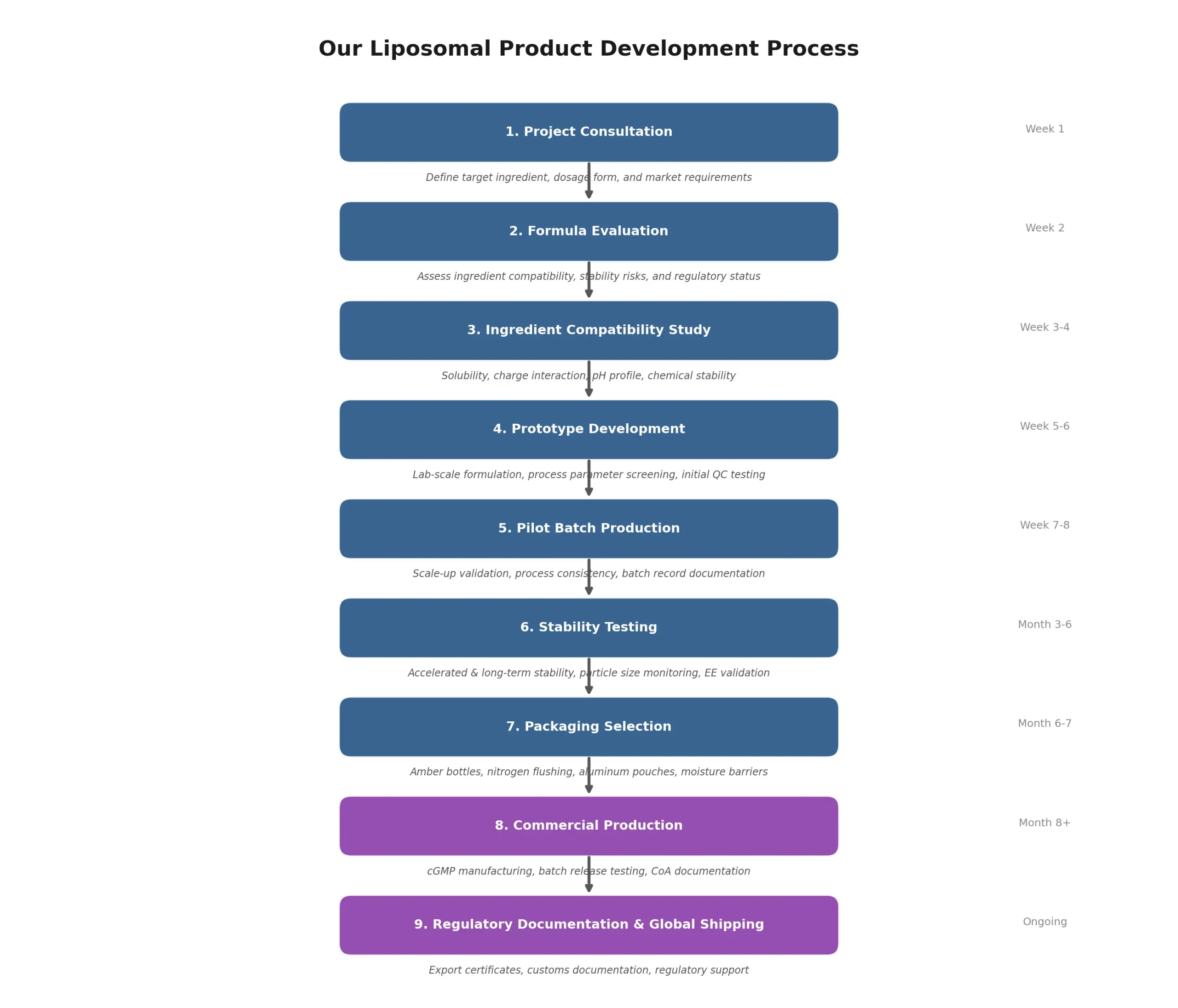
| Stage | Timeline | Key Deliverables |
| 1. Inquiry | 1–3 days | Requirements document; initial feasibility assessment |
| 2. Formula & Quotation | 3–7 days | Custom formula proposal; pricing; regulatory pathway review |
| 3. Sample | 1–2 weeks | Physical sample with COA; organoleptic evaluation |
| 4. Pilot Batch | 2–3 weeks | 1–10 kg powder or 5,000–50,000 units; stability samples retained |
| 5. Scale-Up | 3–4 weeks | Process parameter lock; equivalence data; batch record validation |
| 6. Commercial Production | Per schedule | Full-scale manufacturing; in-process controls; finished product testing |
| 7. QC Release & Delivery | 1–2 weeks | Final COA; regulatory documentation; export logistics |
Commercial Production Overview
Formula Design → Pilot Batch → Scale-Up Validation → Commercial Production → QC Testing → Global Delivery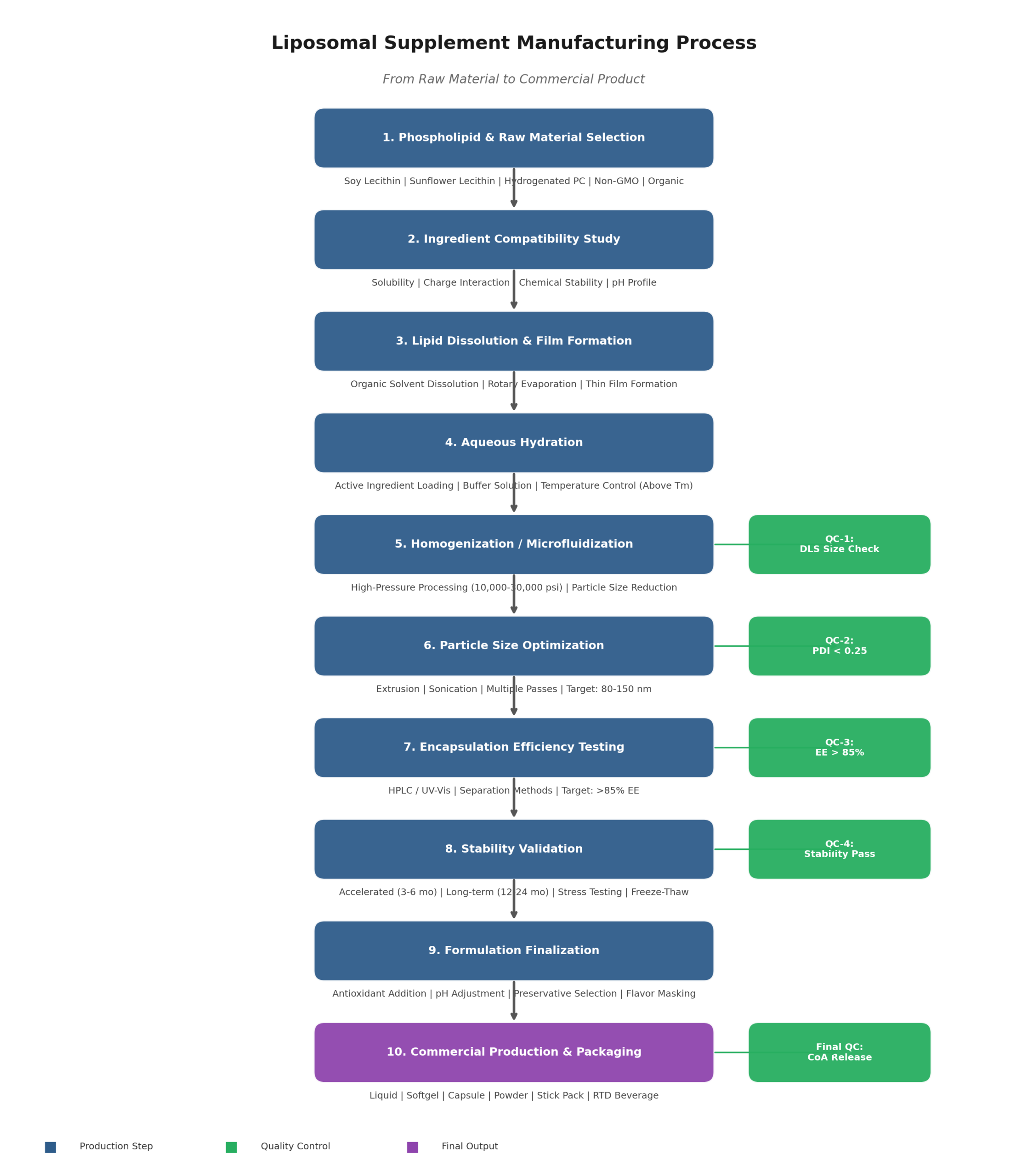
| Packaging Format | Barrier Properties | Best For | Shelf Life Support |
| Aluminum Laminate Pouches | Excellent moisture, oxygen, and light barrier | Stick packs; bulk powder; export shipments | 24–36 months |
| HDPE Bottles + Induction Seal | Good moisture barrier; moderate oxygen barrier | Standard retail; North American market | 18–24 months (with desiccant) |
| Blister Packs (Alu-Alu) | Excellent individual dose protection; zero moisture transmission | Pharmacy channel; clinical trials; premium positioning | 24–36 months |
| Amber Glass Bottles | Excellent light protection; good oxygen barrier (with proper seal) | Liquid formulations; premium positioning | 12–18 months (liquid) |
| Nitrogen-Flushed Containers | Displaced oxygen reduces oxidation risk | High-value formulations; extended shelf life targets | +6–12 months extension |
Packaging Components
- Desiccants:Silica gel canisters (1–3 g per bottle, depending on headspace volume) for powder products
- Oxygen Absorbers:Iron-based scavengers for oxygen-sensitive formulations
- Nitrogen Flushing:Applied during filling to reduce headspace oxygen to <3%
- Secondary Packaging:Cartons with UV varnish for light protection; tamper-evident seals
Storage Recommendations
| Product Form | Recommended Storage | Acceptable Range | Critical Warnings |
| Powder (spray-dried) | 15–25°C; <60% RH | 5–30°C; <75% RH | Protect from moisture and direct sunlight |
| Powder (freeze-dried) | 2–8°C preferred; 15–25°C acceptable | 2–30°C; <60% RH | Refrigeration extends shelf life; protect from moisture |
| Liquid suspension | 2–8°C | 2–25°C (short-term) | Shake well before use; do not freeze |
| Capsule / Softgel | 15–25°C; <60% RH | 5–30°C; <75% RH | Protect from heat and humidity |
Standard Batch Documentation
- Certificate of Analysis (COA)— Batch-specific test results for all specification parameters
- Product Specification— Complete quality specification with test methods and acceptance criteria
- Technical Data Sheet (TDS)— Product description, composition, physicochemical properties, handling guidelines
- Material Safety Data Sheet (MSDS)— Safety information, hazard classification, handling precautions, first aid
- Residual Solvent Report— GC-MS analysis confirming compliance with ICH Q3C limits
- Heavy Metal Report— ICP-MS data for Pb, Cd, As, Hg
- Microbiology Report— TAMC, TYMC, specified organism testing per USP <61>, <62>
- Stability Summary— Available stability data with storage conditions and retest period
Regulatory & Compliance Statements
- Allergen Statement— Free from major allergens; customizable per market requirements
- Non-GMO Statement— Available for non-GMO formulations
- BSE/TSE Statement— Free from bovine spongiform encephalopathy / transmissible spongiform encephalopathy risk materials
- Halal Certificate— Available upon request
- Kosher Certificate— Available upon request
- ISO 22000— Certified
- FSSC 22000— Certified
- cGMP Compliance— Per 21 CFR Part 111 (US) and applicable EU regulations
Quality management extends beyond finished-product testing. At KS Nutripharma, quality is integrated throughout raw material qualification, formulation development, manufacturing, packaging, and final product release.
Raw Material Qualification
Qualified raw materials are evaluated before production to verify identity, quality, and manufacturing suitability.
Typical quality assessments include:
- Ingredient identity verification
- Active ingredient standardization
- Heavy metal analysis
- Microbiological testing
- Residual solvent evaluation (where applicable)
- Documentation and traceability review
In-Process Quality Control
Throughout manufacturing, production parameters are monitored to support formulation consistency and manufacturing reproducibility.
Typical controls include:
- Process verification
- Environmental monitoring
- Critical process parameter monitoring
- Batch documentation
- Equipment verification
Finished Product Verification
Finished products undergo quality evaluation before release according to product specifications and applicable customer requirements.
Typical quality assessments may include:
- Active ingredient assay
- Physical appearance
- Particle size evaluation (for liposomal formulations)
- Microbiological quality
- Heavy metal analysis
- Packaging inspection
- Certificate of Analysis (COA)
A Quality-First Manufacturing Philosophy
Reliable liposomal supplements depend on consistent raw materials, validated manufacturing processes, comprehensive quality verification, and continuous process improvement. By integrating quality management throughout the entire manufacturing workflow, KS Nutripharma helps brands develop products that are designed for consistency, regulatory readiness, and long-term commercial success in global markets.
Choosing the Right Liposomal Curcumin Strategy for Your Brand
Different brands require different formulation strategies depending on market positioning, sales channels, and commercial objectives. Selecting the appropriate product architecture early helps optimize development timelines and investment.
Market Entry Strategy
Recommended for
- New supplement brands
- Cross-border e-commerce
- Private label launches
Typical characteristics:
- Single-ingredient liposomal curcumin
- Capsules or softgels
- Cost-efficient formulation
- Fast commercialization
Premium Retail Strategy
Recommended for
- Health food retailers
- Premium wellness brands
- International distributors
Typical characteristics:
- Liposomal curcumin with complementary functional ingredients
- Premium softgels or liquid supplements
- Enhanced packaging presentation
- Strong brand differentiation
Practitioner & Professional Strategy
Recommended for
- Healthcare professionals
- Functional medicine practitioners
- Clinical nutrition brands
Typical characteristics:
- Advanced multi-ingredient formulations
- Professional packaging
- Higher ingredient loading
- Technical documentation support
Channel-Based Dosage Recommendations
| Sales Channel | Recommended Dosage Forms |
|---|---|
| E-commerce | Capsules, Softgels |
| Retail Stores | Softgels, Liquid Supplements |
| Practitioner Clinics | Liquid Supplements, Softgels |
| International Distribution | Capsules, Softgels |
Building the Right Formula
When selecting a liposomal curcumin formulation, brands typically evaluate:
- Target consumer group
- Intended health positioning
- Desired dosage form
- Complementary ingredients
- Packaging strategy
- Regulatory requirements
- Budget and commercialization timeline
Developing the right formulation involves balancing technical feasibility, market demand, manufacturing scalability, and long-term brand positioning rather than focusing on a single formulation parameter.
Ready to Develop Your Liposomal Curcumin Product?
Whether you are launching your first private label supplement or expanding an established product portfolio, our technical and commercial teams are ready to support your project.
To receive a customized OEM proposal, simply share:
- Preferred dosage form
- Active ingredients and target strength
- Target market or country
- Packaging requirements
- Estimated order quantity
Our team will work with you to develop a formulation and manufacturing plan aligned with your brand objectives, regulatory requirements, and commercialization timeline.
Request a Formula Consultation | Request Samples | Get an OEM Quotation
Conventional 95% curcuminoids, organic 95%, water-dispersible 95%, C3 Complex, and BCM-95. All include COA, heavy metal, and pesticide screening.
Capsules and softgels from 3,000 units; gummies from 5,000; stick packs from 10,000; bulk powder from 50 kg.
Yes. Strict NDAs and exclusive manufacturing agreements. Your formula remains proprietary.
We offer multiple phospholipid systems to accommodate different formulation requirements, target markets, and product positioning strategies.
Available options typically include:
- Sunflower-Derived Phospholipids – Suitable for non-GMO positioning and products targeting allergen-conscious consumers.
- Soy-Derived Phospholipids – A widely used and cost-effective option with proven performance in liposomal formulations.
- High-Phosphatidylcholine (PC) Phospholipids – Selected for formulations requiring higher phosphatidylcholine content and enhanced liposomal carrier performance.
- Customized Phospholipid Systems – Carrier compositions can be optimized according to ingredient compatibility, dosage form, stability objectives, and commercial positioning.
Rather than applying a single phospholipid system to every product, our formulation team evaluates carrier selection based on factors including ingredient characteristics, formulation objectives, regulatory requirements, target markets, and manufacturing scalability.
During formulation development, phospholipid systems are assessed for compatibility, stability, encapsulation performance, and commercial manufacturing feasibility to help support consistent product quality throughout large-scale production.
Why Does Phospholipid Selection Matter?
Different phospholipid sources may influence several formulation characteristics, including:
- Ingredient compatibility
- Encapsulation efficiency
- Physical and oxidative stability
- Dosage form suitability
- Label positioning (e.g., Non-GMO)
- Consumer preferences and target market requirements
Selecting the appropriate carrier system is an important part of developing a stable, scalable, and commercially successful liposomal supplement.
[1] Future Market Insights. Curcumin Market Size, Growth & Trends 2025 to 2035. https://www.futuremarketinsights.com/reports/curcumin-market
[2] World Health Organization. Ageing and Health Fact Sheet, October 2025. https://www.who.int/news-room/fact-sheets/detail/ageing-and-health
[3] Champion Bio. Premium Supplement Ingredients 2025-2026. https://www.champion-bio.com/news-detail/premium-supplement-ingredients-2025-2026/
[4] PlantaCorp. Human Clinical Study on Liposomal Curcumin Bioavailability, 2020. https://purazell.de/blog/wp-content/uploads/2026/03/Curcumin-Bioavailability-Study.pdf
[5] Hegde T, Reddy M, Iyer D. Liposomal encapsulation of curcumin. Int J Adv Chem Res. 2025;7(3):42-45. https://www.chemistryjournals.net/archives/2025.v7.i3.A.390/
[6] Inside Tx. Mastering Thin Film Hydration Method for Liposomes. 2026. https://insidetx.com/resources/reviews/mastering-thin-film-hydration-method-for-liposome-and-lipid-nanoparticle-formulation/
[7] QuickCompany. Patent Application 202531082927. https://www.quickcompany.in/patents/202531082927-a7af
[8] Yu G et al. Effectiveness of Boswellia for osteoarthritis: systematic review and meta-analysis. BMC Complement Med Ther. 2020.
[9] Sangouni AA et al. Effects of curcumin and/or CoQ10 on metabolic control. Nutr J. 2022. https://pmc.ncbi.nlm.nih.gov/articles/PMC9528102/
[10] PMC. Curcumin and omega-3 in experimental osteoarthritis. https://pmc.ncbi.nlm.nih.gov/articles/PMC12