
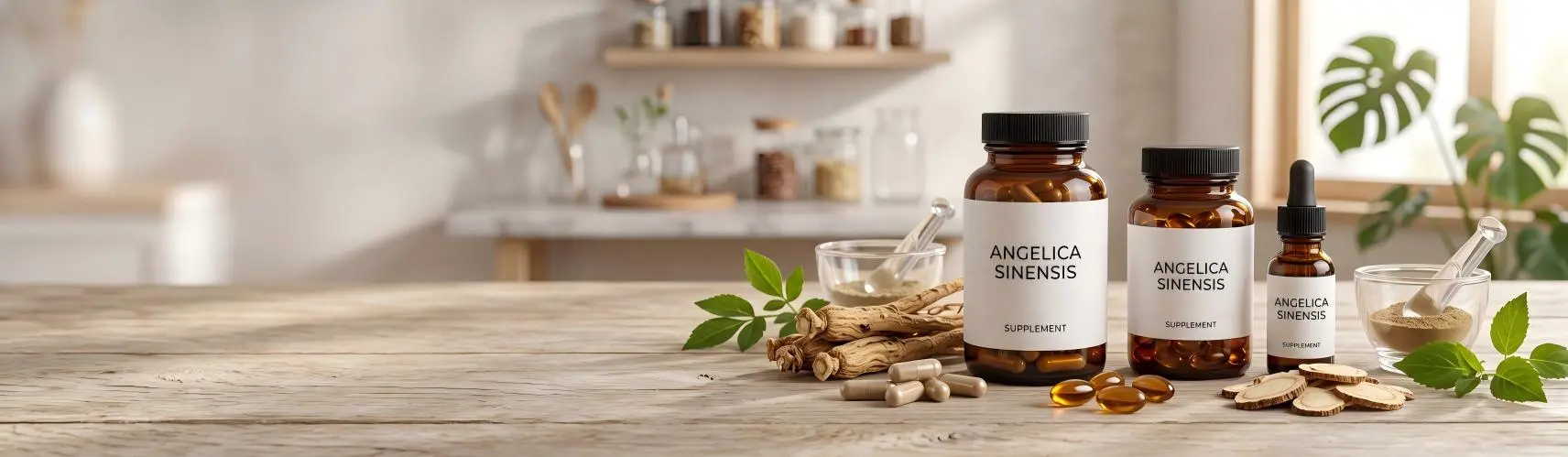
Dong Quai Supplement OEM/ODM Solutions
KS Nutripharma is a Dong Quai supplement manufacturer for OEM, ODM, and private-label programs. We take Angelica sinensis (Chinese angelica, danggui) root from a locked grade through finished women’s wellness capsules, tablets, or powders — with batch COA release.
Dong Quai extract is not a complete material specification. The species, plant part, extract type, marker, and assay method have to be defined before quotes can be compared on a like-for-like basis. We build finished SKUs around Angelica sinensis root powder, ratio extracts, or marker-specified grades for ligustilide, ferulic acid, or polysaccharides, then quote the finished product against the approved specification.
Already have a formula? Send Your BOM
Still deciding the specification? Get a Dong Quai Spec Recommendation
Comparing suppliers? Send Your COA for Comparison
What you confirm so the first quote is usable | Typical project answer |
|---|---|
| Botanical | Dong Quai = Angelica sinensis (Oliv.) Diels = Chinese angelica / danggui. Dried root. Other Angelica species are quoted as different materials |
| Working grades | Root powder (identity). Ratio 4:1, 10:1, or 20:1. Ligustilide 1% or 2% HPLC. Ferulic acid 0.1%–1% HPLC (0.3% commonly quoted). Polysaccharide 10%, 20%, or 30% UV when an aqueous grade is required. Final specification is project-dependent |
| Assay / release | Ligustilide and/or ferulic acid by HPLC; polysaccharide by UV (or the named method on the file). Incoming identity, moisture, microbiology, heavy metals, pesticides, residual solvents as scoped. Sample and commercial batch released against the same spec |
| Serving math | 500 mg of a 1% ligustilide extract = 5 mg ligustilide — not 500 mg ligustilide. Illustration only; not a dosage recommendation |
| Formula architectures | F01 extract · F02 root powder · F03 chasteberry · F04 black cohosh · F05 B6 + magnesium · F06 evening primrose oil · F07 red clover |
| Recommended format | Capsules first. Tablets when minerals or vitamins drive fill. Softgel or dual SKU when an oil-based ingredient is on the panel. Powder, gummies, and liquids as their own SKUs |
| Target market | Country, food-supplement vs herbal-medicine classification, and label and claims review |
| Documents | Batch COA · specification sheet · SDS · Halal / Kosher when required · third-party testing (SGS / Eurofins) as scoped |
| MOQ / lead time | Indicative by format — confirmed after formula, pack, and testing |
| Program | OEM / ODM / private-label finished SKUs. Bulk root powder or extract can be quoted on the same project |
cGMP | ISO 9001 | ISO 22000 | HACCP | FSSC 22000 | Halal | Kosher | In-house lab + third-party pathways (SGS / Eurofins) | Batch COA | Traceable release
-> About Us | Manufacturing Capacity | Certifications | Quality Control
What you receive with a Dong Quai OEM project
- Matched Angelica sinensis root specification
- Formula and dosage-form feasibility review
- Sample based on the approved specification
- Prototype COA
- Production quotation by SKU
- Batch release documentation
- Packaging and export support
This page is manufacturing feasibility and documentation support — not legal approval of the finished label.
Dong Quai Supplement Formulation for Private Label SKUs
These are starting architectures for dietary-supplement SKUs — not frozen catalog products and not traditional multi-herb prescriptions. Serving size, extract grade, format, and pack stay customizable.
Choose the closest card, or send a BOM. KS Nutripharma’s formulation team and R&D center match it to your channel and destination market, then lock the A. sinensis root grade against that BOM. You receive a SKU-level cost, feasibility read, and sample plan. Final claim language stays with your brand and local counsel.
Custom nutrient combinations (short B-vitamin lists, iron, folate / 5-MTHF) and other custom stacks (peony, maca, ginger, soy isoflavones, extra GLA oils, or a three-botanical panel) are quoted as custom BOMs after you name the channel and market. Each companion keeps its own specification and claim file. Folate / 5-MTHF in a women’s nutrition BOM does not convert the SKU into a prenatal vitamin.
Already have a formula? Send Your BOM
For women’s wellness lines that need a concentrated, single-ingredient SKU and a simple Supplement Facts panel. Capsules are the usual start; tablets when the channel wants a compact unit.
Specification: Lock A. sinensis root, extract type, and — if the label will name a marker — ligustilide or ferulic acid with the HPLC method. Fill weight is calculated from extract strength.
For labels that should show dried root rather than a concentrated extract. Capsules are typical; a two-capsule serving is common when fill exceeds one shell.
Specification: Lock A. sinensis root, particle size, and capsule count versus serving weight. Identity-led SKUs use this card; a numbered marker milligram belongs on F01.
Two-botanical women’s SKUs already sold in natural retail, pairing Dong Quai with Vitex rather than black cohosh or red clover. Capsules first; tablets after compression review.
Specification: Lock both species, both markers and methods, and destination-market warnings. Each botanical keeps its own identity file.
Related manufacturing path: Chasteberry Supplement Manufacturer
Midlife botanical sets next to menopause supplement assortments, with black cohosh as a separately specified root. Capsules; tablets when the channel wants a compact pair.
Specification: Lock black cohosh identity and triterpene method as a separate spec, plus the Dong Quai marker if named. Claim language follows destination-market requirements.
A women’s nutrition formula for brands building a hormone-balance product line, combining Dong Quai with vitamin B6 and magnesium. Tablets often win once the mineral is added; capsules when the salt keeps fill modest.
Specification: Lock B6 form, magnesium salt (oxide versus glycinate changes tablet size), and extract grade. Serving numbers follow destination-market requirements.
For women’s formulas that already include an oil-based ingredient such as evening primrose oil. Dual SKU (extract capsule + EPO softgel) is the usual path; a single oil-filled softgel after fill-system review.
Specification: Lock EPO identity and GLA specification, plus shell type or dual-SKU pack logic.
A phytoestrogen-adjacent botanical pair for brands that already specify a red clover HPLC isoflavone grade — distinct from Vitex (F03) and black cohosh (F04). Capsules.
Specification: Lock red clover isoflavone % and HPLC method as a separate spec.
Related manufacturing path: Red Clover Supplements Manufacturer
Choose the Right Dong Quai Dosage Form: Capsules, Tablets or Powder
Once the formula architecture and target serving are defined, dosage form becomes a manufacturing and commercial decision. The same Dong Quai formula is not automatically transferable across formats. Each path is re-engineered around fill weight, processing conditions, sensory profile, stability, and finished-product assay.
For capsules and tablets, the usual starting material is a dry Dong Quai extract. Oil-based grades are handled as a separate formulation route.
When to choose it: Quantified-marker formulas, multi-botanical blends, and most single- or dual-active configurations (see F01–F04 and F07).
What changes: Capsules can reduce direct sensory exposure compared with powders. Fill weight and bulk density determine capsule size; gelatin or HPMC shells avoid compression heat.
What must be locked: Fill weight, shell type, and whether one capsule can carry the serving.
Best fit: The usual Dong Quai capsules manufacturer starting path when the target serving fits the selected size and pack.
→ Hard Capsules
When to choose it: Higher-load formulas, compact serving formats, or formulas that exceed practical capsule fill limits.
What changes: Higher pack density and, at volume, a lower unit cost. Direct compression is evaluated first; film coating can be scoped for swallowability, moisture, and residual odor. A capsule BOM is re-engineered for compression before a tablet sample.
What must be locked: Blend uniformity, hardness, and compression at sample — before a tablet MOQ is meaningful.
Best fit: The Dong Quai tablets manufacturer path for nutrition stacks and other high-fill BOMs (including F05 and custom nutrient combinations).
→ Tablets
When to choose it: Custom herbal drink mixes — a different selling SKU, not a cheaper F01.
What changes: Serving weight becomes flexible, but the consumer opens the pack every use. Taste, odor, color, dispersion, and moisture-barrier film enter the BOM.
What must be locked: Serving weight, film/barrier pack, and a sensory plan. Specify powder as its own SKU from the start.
Best fit: Convenience formats where the drink-mix serving cannot sit in a practical capsule count.
→ Powders & Granules
When to choose it: Formulas that already include an oil-based ingredient such as evening primrose oil (F06).
What changes: The oil belongs in a softgel fill. Dry Dong Quai extract is evaluated as a suspension, or the program splits into two finished SKUs.
What must be locked: Fill system, GLA/oil specification, shell type, or dual-SKU pack.
Best fit: Oil-plus-botanical panels. Dry-extract capsules stay on a capsule or tablet path.
Feasibility covers piece load, heat, water activity, sensory profile, and finished-product assay. Active-per-piece and serving configuration are confirmed before artwork.
A separate review of solvent system, serving volume, preservation, taste, precipitation, light/oxygen exposure, and assay in the finished matrix.
After you pick the SKU architecture, confirm classification and claim language before you freeze the root grade. The same Angelica sinensis root can sit on a dietary-supplement label in one market and on a herbal or traditional-medicine file in another.
Market | Regulatory route | What to confirm before formula freeze |
|---|---|---|
| United States | Dietary supplement framework (DSHEA) | Women’s wellness positioning should remain within the applicable structure/function framework. Disease, fertility-treatment, anemia, or blood-building claims require separate regulatory review. Dong Quai is not an FDA-approved drug |
| European Union / United Kingdom | Country-specific food-supplement and/or herbal-medicine files | Species wording and traditional-use language are file-specific. UK files are reviewed separately from EU files |
| Australia / Canada | Complementary medicine / natural health product paths as applicable | Product-specific indications, listing, or licensing |
| Other markets | Review required | Local classification, claims, notification or registration, and labeling |
If the RFQ named | Commercial framing (verify locally) | What usually delays artwork |
|---|---|---|
| F01–F02 | Women’s botanical / traditional Angelica sinensis root identity | Treat, cure, amenorrhea, anemia, or “blood tonic” disease copy |
| F03 / F07 | Multi-botanical women’s wellness | Hormone-drug or estrogen-therapy copy |
| F04 | Midlife botanical set | Hot-flash treatment |
| F05 / custom nutrient stacks | Nutrition stack | Prenatal claims without a prenatal file |
| F06 | Oil + botanical dual SKU or softgel | Copying a dry-extract claim onto an oil-filled softgel |
Pregnancy, medication-use, and other safety cautions should be reviewed as part of the market-specific regulatory file before sampling. We manufacture to the agreed specification and support Supplement Facts / local information-panel layout. Brand owners confirm finished-label compliance with local counsel.
We source Angelica sinensis root as part of the finished-supplement project. Dong Quai extract and Dong Quai root extract describe material types inside that project — not a complete purchase order.
Until species, plant part, extract type, marker, and assay method are named, a lower $/kg price is usually a different material, not a saving.
| Material type | What you are buying | When it fits the SKU |
|---|---|---|
| Root powder | Milled dried A. sinensis root; identity without a guaranteed marker milligram | F02 and some powder blends |
| Ratio extract (for example 4:1, 10:1, or 20:1) | Concentrated root described as an input-to-output ratio | Cost-sensitive F01 capsules that need extract identity |
| Ligustilide-specified extract | Released against named Z-ligustilide by HPLC. 1% or 2% HPLC are typical commercial grades — not a pharmacopoeial mandate. Final specification is project-dependent | Briefs that will state phthalide content |
| Ferulic-acid-specified extract | Released against named ferulic acid by HPLC. 0.1%–1% HPLC is the usual quoted band; 0.3% HPLC is commonly specified | Briefs that want the phenolic-acid marker used on some A. sinensis quality files |
| Polysaccharide-specified (aqueous) extract | Water-extracted grade released against a polysaccharide result by UV (or the named method). 10%, 20%, or 30% UV are typical catalog grades — not interchangeable with HPLC ligustilide | Briefs that specify an aqueous polysaccharide input |
| Custom | Organic-certified raw material, project-specific DER, solvent, or dual-marker specification | Named market-specific requirements |
A 10:1 ratio does not mean 10× ligustilide or ferulic acid. Ratio describes process concentration; marker specification describes an assayed result. Extraction solvent should be declared when the marker profile matters, because different systems produce different material profiles.
Lock Angelica sinensis. European angelica (A. archangelica) and other Angelica species (A. dahurica, A. gigas, A. acutiloba among them) have different chemistry and different label files — they should not be purchased as Dong Quai. High-purity ligustilide isolates, essential oils, and dry powder extracts are also separate commercial materials.
Standardized botanical pathways: Standard Extracts.
This is the file that makes supplier quotes comparable. Once the material type is chosen, lock the fields that control identity, serving math, process behavior, and the label.
Spec field | Why it matters for your SKU | What to lock |
|---|---|---|
| Botanical identity | Other Angelica species are not Dong Quai | Angelica sinensis (Oliv.) Diels |
| Plant part | Leaf, stem, or seed is a different commercial herb | Dried root |
| Material type | Powder, ratio, ligustilide, ferulic acid, and polysaccharide grades are quoted separately | Named type |
| Extract ratio / DER | Ratio is not potency | Defined if used (for example 4:1, 10:1, 20:1) |
| Extraction solvent | Changes the residual-solvent file and, when the marker profile matters, the fraction you are buying | Declared (hydroalcohol vs water vs project-specific) |
| Marker compounds | Ligustilide, ferulic acid, and polysaccharide are different analytes | Named analyte; minimum or as-specified |
| Assay method | A number without a method is not comparable | HPLC for ligustilide and/or ferulic acid; polysaccharide method named when used |
| Moisture | Caking, flow, microbial risk | Specification-based |
| Particle size | Fill-weight variation, capping, poor flow | Matched to the capsule filler or press |
| Carrier / excipients | Fill weight, labeling, residual solvents | Declared (none, maltodextrin, or project-specific) |
| Heavy metals / pesticides / microbiology / residual solvents | Market limits differ | Tested against the destination requirement |
Appearance and characteristic root odor belong on the specification as control fields. They also explain why flavored powders and gummies need their own sensory plan.
Serving math
Raw-material weight × assay = marker amount per serving
Illustration only, not a dosage recommendation: 500 mg extract × 1% ligustilide = 5 mg ligustilide. A 500 mg Angelica sinensis extract line on Supplement Facts is not 500 mg ligustilide.
Final serving is confirmed from the selected grade, companion fill, capsule or tablet size, and target market. If the brief only says “Dong Quai 10:1” or “1% extract,” ask: ligustilide, ferulic acid, polysaccharide, or identity only? HPLC or another method? Carrier present?
Send the specification you intend to buy if you need a sample COA for comparison.
Consistency is built in process — incoming assay, fill, pack, and dating — rather than copied from a drum COA onto the bottle. F03–F06 and F07 companions are workable in the blender; each still keeps its own incoming specification.
01 — Marker stability
Ligustilide may require tighter process and storage controls than a ferulic-acid-led specification. When the specification depends on ligustilide, handling, headspace, and pack are evaluated during development. An aqueous polysaccharide grade is run against its own assay file.
02 — Odor and sensory control
Characteristic root odor is expected. Capsules isolate it; powders, gummies, and flavored formats need a sensory plan before artwork is locked.
03 — Flow and fill consistency
Low bulk density on root powder and some extracts shows up as fill-weight variation. Particle size, flow aids, and equipment set-up are confirmed at sample — especially for F02 and mineral stacks (F05 and custom nutrient combinations).
04 — Packaging and shelf life
HDPE / PET bottles with induction seals are a common capsule/tablet start. Blisters, pouches, sachets, cartons, and export cases as scoped; desiccant when moisture leads. Pack type is part of dating control.
Final shelf life is confirmed from the formulation, packaging system, storage conditions, and stability data. Incoming extract stability is not finished-SKU dating.
Humidity, barrier, and dating: Moisture Control & Stability Engineering.
The commercial batch is released against the same approved specification used for the sample. The chain is specification → sampling → testing → release. Ask what is tested at each stage, and against which method.
| Stage | What is checked |
|---|---|
| Incoming root / extract | Identity (A. sinensis dried root), appearance, named assay, moisture, microbiology, heavy metals, pesticides, residual solvents as scoped |
| In-process | Blend uniformity, capsule fill or tablet weight, hardness / friability where applicable, process moisture |
| Finished SKU | Agreed specification, microbiology, physical parameters, packaging inspection, batch documentation |
A usable Certificate of Analysis should contain four blocks:
- Identity: Botanical verification (macroscopic / microscopic and/or HPTLC as scoped)
- Potency: Named ligustilide and/or ferulic acid by HPLC; polysaccharide by the agreed method where specified
- Safety: Heavy metals, microbiology, pesticides, residual solvents as scoped
- Physical: Appearance, moisture, particle size, bulk density as specified
Sample and COA should match the commercial spec you intend to buy.
Lab: in-house release; SGS or Eurofins when the RFQ requires a third-party pack. Limits follow the approved spec and destination market. Methods: Quality Control.
01 — Send your requirements
Target market, F01–F06 / F07 or BOM, dosage form, quantity, packaging, target cost.
02 — Target market and specification review
Species, claim direction, population restrictions, Angelica sinensis grade, companion specs.
03 — Formula development
Fill weight, compatibility, format feasibility.
04 — Sample
Prototype against the locked specification.
05 — Pilot
Blend uniformity, fill or compression, in-process checks.
06 — Stability / QC as scoped
Dating evidence where the brief requires it.
07 — Production and packaging
Batch manufacture against the approved sample.
08 — Documentation and shipment
COA, batch records, export pack.
MOQ and lead time by format
MOQ and lead time depend on dosage form, formula complexity, packaging, testing, material availability, and production scheduling. A bulk extract kilogram and a finished capsule SKU are quoted separately.
| Project stage | Typical timeline |
|---|---|
| Formula discussion | Project dependent |
| Sample development | 7–15 days* |
| Pilot production | 15–25 days* |
| Mass production | 30–45 days* |
| Scope | Typical start | What usually drives the minimum |
|---|---|---|
| Bulk root powder / extract on the project | Quoted by kg | Grade, method, drum pack |
| Capsules | ~3,000–5,000 units | Capsule size, fill, pack |
| Tablets | ~5,000–10,000 units | Compression feasibility, pack |
| Powder / stick — retail | Often from ~10,000 units | Film, fill, moisture |
| Gummies / liquids | Project-scoped | Heat, taste, assay |
Actual MOQ and lead time depend on formula, pack, testing, and schedule.
HDPE / PET bottles | blisters | pouches | sachets | cartons | export master cases | desiccant and tamper-evident finishes as scoped.
Format, pack, and testing drive the project-specific MOQ and lead-time estimate.
Seven Fields for a Usable RFQ
The specification section above is how you choose the material. These seven fields are what we need to return an initial technical review.
| Field | What to include |
|---|---|
| 1. Target product | Finished supplement or bulk-on-project |
| 2. Material type | Root powder / ratio / ligustilide / ferulic acid / polysaccharide / “recommend” |
| 3. Marker and method | Named % + HPLC or named polysaccharide method — or “recommend”; attach a CoA if matching |
| 4. Formula | F01–F06, F07, or BOM |
| 5. Format | Capsules / tablets / powder / softgel (if oil-based) / other after feasibility |
| 6. Quantity | First PO + annual forecast |
| 7. Target market | Country + classification + channel |
A complete brief is usually enough for an initial technical review within two business days.
Integrated Dong Quai Manufacturing
Ingredient sourcing, formulation, manufacturing, QC, packaging, and export sit on one program — so you do not need a separate extract trader, formulator, filler, and packer for this project.
Site-level capacity (confirmed): 5 integrated bases · 81,000+ m² · 2 R&D centers · 12 automated production lines · 260+ professionals · since 2007 · 500+ brand projects · 60+ export markets.
Certifications: cGMP · ISO 9001 · ISO 22000 · HACCP · FSSC 22000 · Halal · Kosher.
Gummies and liquids exist as lines. Dong Quai in those formats remains project-scoped.
Site-level figures: Manufacturing Capacity.
Start Your Dong Quai Supplement Project
You do not need a finished formula to start. A selling market, a format, and a grade direction are enough for an initial technical review. If you already have a CoA or a BOM, send that — we will tell you whether the quotes in front of you are actually comparable.
Name the country the SKU will sell into, whether it is F01–F06, F07, or a custom BOM, and whether the label will state ligustilide, ferulic acid, polysaccharide, or Angelica sinensis root identity only.
Have a BOM? Send Your BOM
Still choosing a grade? Get a Dong Quai Spec Recommendation
Comparing suppliers? Send Your COA for Comparison