
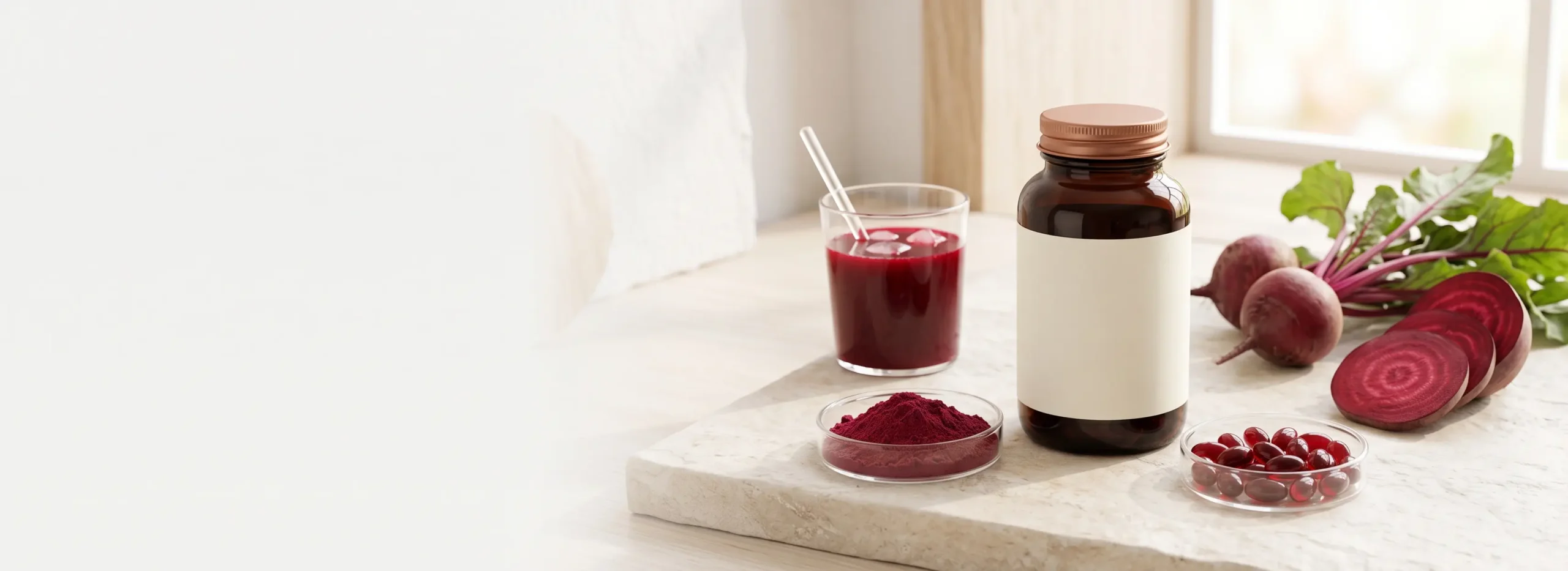
Professional Beetroot Supplement Contract Manufacturer
KS Nutripharma is a beetroot supplement manufacturer for OEM, ODM, and private-label programs. We manufacture finished beetroot dietary supplements—capsules, tablets, powders, and sticks—for energy and circulation-adjacent programs, from a named Beta vulgaris L. root grade through formulation, testing, and batch COA.
Beetroot supplement, beet supplement, and red beet supplement are the same category when the plant part is root. Whole-root powder, ratio extract, and nitrate-standardized material are specified separately. We select the beetroot grade around the finished-product requirement—not the other way around.
Already have a formula? Send Your BOM — we check grade, fill weight, dosage form, and testing.
Still choosing the beetroot grade? Request Formula Support — compare powder, extract, and nitrate-standardized options.
Comparing suppliers? Request a Sample / COA — review the specification and batch documentation.
What you can receive: a formulation proposal, ingredient specification, sample, batch COA, packaging proposal, MOQ, and lead time.
cGMP | ISO 9001 | ISO 22000 | HACCP | FSSC 22000 | Halal | Kosher | In-house lab + third-party testing when required | Batch COA
→ About Us | Manufacturing Capacity | Certifications | Quality Control
12 production lines · 81,000+ m² · 260+ professionals · since 2007 · 500+ brands · 60+ markets
Beetroot Supplement Manufacturing at a Glance
| What we manufacture | Beetroot capsules, tablets, powders, sticks; gummies after feasibility review; juice or shots as a liquid project |
| Botanical | B. vulgaris root |
| Ingredient routes | Whole-root powder · ratio extract · nitrate-standardized · betalains only if labeled |
| Nitrate testing | Incoming + finished when nitrate is claimed; identity-only when it is not |
| Typical starting quantity | Capsules ~3,000–5,000 · tablets ~5,000–10,000 · powder/stick often from ~10,000. Final MOQ depends on formula, pack, and setup |
| Samples | 7–15 days after the specification is approved |
| Mass production | 30–45 days after approval and scheduling |
| Documents | Batch COA; third-party testing through qualified laboratories when required by the specification or market |
Choose Your Beetroot Ingredient Specification
The beetroot ingredient is selected according to the finished-product requirements. Ingredient route, dosage form, assay, and finished-product COA are locked as one specification.
Route | What it means | Use when | What it does not establish |
|---|---|---|---|
| Whole-root powder | Identity beetroot | General beetroot powder products; F01 and selected F04 formulas | A numbered nitrate milligram unless extra tested |
| Ratio extract | Concentrated root as DER | Smaller fill; beetroot extract supplement / F02 | Nitrate or betalain content by multiplying the ratio |
| Nitrate-standardized | Released to a named nitrate assay | Nitrate-declared products where a defined nitrate amount is required | That every extract carries the same nitrate content |
| Betalains (optional) | Pigment specification | Color line if labeled | A nitrate claim |
| Juice concentrate | Liquid / food-adjacent | Shot or juice projects | A capsule COA as an mL assay |
Leaf and sugar-beet syrup are different materials. “Fresh beet equivalent” is marketing, not a COA line. Nitric oxide is a physiological response, not an ingredient specification.
Why this specification matters
If you specify only… | Procurement risk |
|---|---|
| “Beetroot powder” | Nitrate content may vary by crop and lot |
| “20:1 extract” | Concentration does not define nitrate |
| “High nitrate” | No measurable release target |
| “500 mg capsule” | Serving may not match the intended nitrate exposure |
| “Beetroot extract” | Different carriers or DERs may be quoted as the same line |
Nitrate specification
If the label will state nitrate, name inorganic nitrate (nitrite only if you specify it), raw % and/or finished mg/serving, method, incoming vs finished, and as-is vs dry basis.
Illustration only: 500 mg material at 2% nitrate = 10 mg nitrate per unit. Human protocols often use juice or concentrated shots with nitrate in the hundreds of milligrams — that serving is defined in Benefits, Safety and Label Considerations. When nitrate is claimed, incoming and finished assays are both required. Overage follows the process and stability plan for that dosage form.
Choose the Beetroot Supplement Format: Capsules, Tablets, Powder or Gummies
Beet juice or a concentrated sports shot may classify as food. Liquid projects are quoted after feasibility review; claimed nitrate is assayed per mL. → Liquids
Best for: Compact F01–F03 SKUs and combination formulas that fit a two-piece shell; a beetroot capsule manufacturer path.
Why: Convenient unit dosing and lower sensory exposure than an unflavored powder.
Typical formula cards: F01, F02, F03; combination SKUs when fill allows.
What to lock: HPMC or gelatin; fill weight; opaque shell if color shows through. Typical powder fill 500–1,000 mg. F05/F10 grams often need more than one capsule.
Manufacturing note: Hygroscopic beet powder stains and can cake. Dry beetroot is not a default oil-fill softgel.
→ Hard Capsules
Best for: Iron/B-vitamin loads or a compact CoQ10 bottle.
Why: Pack density.
Typical formula cards: Nutritional iron/B-vitamin formulas; selected CoQ10 combinations.
What to lock: Compression, coating, assay after press.
Manufacturing note: Hygroscopic beet powder often stays in a capsule.
→ Tablets
Best for: F04 drinks, or F05/F10 when amino grams dominate.
Why: Serving weight that a two-piece shell cannot hold.
Typical formula cards: F04; F05 and F10 when grams set the serving.
What to lock: Flavor, g/serving, nitrate per scoop if claimed, moisture-barrier film.
Manufacturing note: Caking, color in water, assay per scoop.
→ Powders & Granules
Best for: Briefs that already name a beet gummy or chew (often CoQ10 or fruit-polyphenol stacks).
Why: Convenience listings exist; heat, water activity, sugar, assay per piece, and color bleeding need a dedicated pilot.
Typical formula cards: Combination stacks after a dedicated pilot.
What to lock: Extract type; nitrate or identity-only; sugars; piece weight.
Manufacturing note: Available after feasibility review. A chew uses the same review as a gummy.
→ Gummies
Private Label Beetroot Formula Options
Starting architectures. Pick the closest group or send a BOM. KS formulation team and R&D center confirm the root grade against that BOM.
Also quoted after claim review: magnesium or vitamin K2; resveratrol; caffeine or electrolytes; pine bark or black ginger; BCAA, creatine, or HMB when those amounts are on the BOM.
Use when: Supplement Facts show beetroot powder, not a numbered nitrate milligram.
Specify: Root; powder vs juice powder if named; particle size; identity-only or nitrate tested. Typical capsule fill 500–1,000 mg, or unflavored powder.
Main constraint: Hygroscopic, stains, earthy flavor. Crop nitrate varies. Guaranteed nitrate uses the nitrate-standardized route above.
Use when: The label will say extract and fill must stay smaller than F01.
Specify: DER, solvent, carrier, extract mg per serving.
Main constraint: Carrier weight is not beetroot weight. Add a nitrate method only if the label will number nitrate.
Use when: The label will number nitrate for a sports or circulation SKU.
Specify: Nitrate % and/or mg/serving; method; incoming vs finished.
Main constraint: material mg × assay = nitrate mg (illustration, not a recommended dose). Unit count must hold that math.
Use when: The retail path is a mix-in-water beetroot powder supplement in grams.
Specify: g per serving; nitrate if claimed; flavor; sugar vs sugar-free; stick vs canister.
Main constraint: Sensory, caking, color in water, and assay per scoop. A capsule BOM cannot be relabeled as this SKU.
Use when: An energy / training stack names citrulline grams.
Specify: L-citrulline vs malate and grams per serving; beetroot route; capsule count vs powder.
Main constraint: Beetroot nitrate does not replace the stated citrulline dose. High grams usually need powder or several capsules. Caffeine is a separate pre-workout specification.
Use when: The SKU wants beet plus named ubiquinone.
Specify: CoQ10 form and mg; one unit vs dual SKU or companion softgel.
Main constraint: Fat-soluble CoQ10 vs dry beet powder needs compatibility review. A gummy uses the gummy format card.
Use when: Circulation SKUs add grape seed polyphenols / OPC in antioxidant programs.
Specify: OPC or polyphenol method; each milligram; beetroot route.
Main constraint: Grape seed has its own assay. It is not a nitrate booster.
Use when: The companion is fruit polyphenol rather than grape seed.
Specify: Fruit/peel identity and marker if claimed; beetroot grade.
Main constraint: Punicalagins have their own assay.
Use when: Beetroot is a botanical companion to named iron and B vitamins.
Specify: Iron salt and elemental mg; B12 form; folate vs folic acid vs 5-MTHF; beetroot as its own line.
Main constraint: Beetroot powder is not a reliable iron dose. Iron, folate, and B12 need their own formulation and label review. Anemia-treatment copy is out of scope.
Use when: The panel names arginine rather than (or in addition to) citrulline.
Specify: Arginine mg or grams; beetroot route; whether citrulline is also present.
Main constraint: Arginine fill is bulky. Powder is often more practical than a two-capsule serving.
Control path: Approved specification → Incoming QC → In-process checks → Finished QC → QA release.
Results outside the agreed specification are placed on hold for investigation. The batch is released only after the deviation is resolved under a documented QA procedure.
Stage | What we decide |
|---|---|
| Incoming | Root identity; powder vs extract; nitrate method if claimed; micro; metals (root-crop panel as scoped); pesticides as scoped |
| In-process | Blend uniformity; fill or tablet weight; hardness where applicable |
| Finished | Agreed spec; nitrate or identity-only; micro; pack |
| Uniformity | Especially iron and small extract fills |
| Release | Batch COA: identity · potency (nitrate or identity-only + method) · safety · physical. Retain sample |
In-house lab plus third-party testing through qualified laboratories when required by the specification or market. Quality control.
Challenge | Sample-plan focus |
|---|---|
| Crop nitrate variation | Identity grade vs nitrate release specification |
| Color / staining / flavor | Shell, coating, powder sensory |
| Hygroscopicity | Desiccant; stick-pack barrier |
| Amino-gram fill | Powder vs multi-capsule |
| CoQ10 | Dual assay |
| Iron | Uniformity + color |
| Gummy | Assay per piece on a dedicated pilot |
Powder and stick SKUs: Moisture Control & Stability.
Human studies of beetroot products have mainly evaluated nitrate-containing juice or concentrated preparations, then measured exercise or blood-pressure markers in a defined cohort. Those results stay with that preparation and exposure. They do not become structure/function copy for every commercial capsule.
Selected evidence
- Wylie et al. (2013), Journal of Applied Physiology — concentrated beetroot juice and exercise performance. Dose-response arm used stated nitrate loads (about 4.2–16.8 mmol) and reported exercise-economy and time-to-task outcomes in healthy men (PubMed PMID: 23640589).
- Siervo et al. (2013), Journal of Nutrition — meta-analysis of inorganic nitrate or beetroot juice and blood-pressure markers (PubMed PMID: 23596162).
Study exposures are not automatic label doses. Finished-product claims depend on the ingredient specification, serving size, and destination market. If nitrate is claimed, define the assay and the finished amount — see the specification table above.
What brands should review
- Gastrointestinal discomfort and earthy aftertaste
- Beeturia may cause pink or red urine or stool after beetroot consumption. Persistent or unexplained bleeding should not be attributed to beetroot without medical evaluation (Sauder and Rout, StatPearls, PubMed PMID: 30725697)
- If nitrate is included, medication-related considerations should be reviewed as part of finished-label compliance
- Oxalate questions on whole-root powder, where the brief raises them
- Iron, folate, and B12 review on nutritional combination formulas
- Destination-market structure/function rules; no hypertension-treatment or “FDA-approved” copy
Pregnancy and long-term use have no blanket “safe” line. Follow destination-market rules and the complete formula.
Pack selection starts with moisture and color staining, then dosage form, count, shelf-life target, market, and shipping.
HDPE or PET bottles with induction sealing are a common start for capsules and tablets. Desiccant when beet powder or F04 sticks require it. Stick packs need moisture-barrier film. Red beet stains scoops and light shells; check appearance after humidity, not only day-zero color. Dual-SKU kits need two counts, two lots, and one carton as scoped.
Supplement Facts must match the named grade. If nitrate is claimed, artwork milligrams and method must match the COA. Typical bottle counts are 60, 90, or 120. Language and notification numbers follow the destination market. Shelf life comes from formulation, pack, storage, and data.
01. RFQ — Market, architecture or BOM, format, pack, claim constraints.
02. Feasibility — Route, companions, fill.
03. Sample — Against the approved specification.
04. Approval — Assay, appearance, pack.
05. Artwork — Supplement Facts vs named lines.
06. Production — Commercial batch.
07. QA release — Incoming, in-process, finished, hold/release.
08. Shipment — Export documents and dispatch.
One manufacturing project can cover root identity, formulation, dosage form, packaging, testing, and finished-batch release.
Typical starting quantities; final MOQ depends on formula, packaging, and production setup.
Stage | Planning range |
|---|---|
| Sample | 7–15 days after the specification is approved |
| Pilot | 15–25 days |
| Mass production | 30–45 days after approval and scheduling |
Scope | Typical starting range |
|---|---|
| Capsules | ~3,000–5,000 units |
| Tablets | ~5,000–10,000 units |
| Powder / stick | Often from ~10,000 units |
| Gummies / liquids | Available after feasibility review |
| Bulk on the finished project | Quoted by kg |
Flavored sticks, gummy pilots, and new nitrate methods add time before the sample clock. Bulk kg MOQ and finished-unit MOQ are separate.
Quote driver | What changes the number |
|---|---|
| Material | Powder vs extract vs nitrate method |
| Formula | Amino grams, CoQ10, iron, dual SKU |
| Format | Capsule vs tablet vs powder vs gummy |
| Pack | Bottle, pouch, stick, carton |
| Market | Testing panel and label review |
How to Compare Beetroot Supplement Supplier Quotes
A lower price is not necessarily a lower-cost equivalent if the quoted beetroot materials have different specifications. Align these six points before you rank quotations:
- Botanical identity — B. vulgaris root, not leaf or sugar-beet syrup.
- Ingredient route — whole-root powder vs ratio extract vs nitrate-standardized material.
- Assay method — identity-only, or a named nitrate method (and basis).
- Active amount per serving — material mg × assay, not a headline grade alone.
- Finished-product testing — incoming and finished checks against the same specification.
- Packaging, MOQ, and lead time — format and pack change the commercial number.
Send two competing specifications or COAs with the RFQ. We map them onto the same botanical, route, method, and serving math before quoting.
Get a More Accurate Beetroot Supplement Quote
Send these seven items:
- Destination market
- Starting architecture or BOM
- Format and pack
- Powder, extract, or nitrate specification (method + mg, or identity-only)
- Quantity and timeline
- Claim constraints (blood-pressure, nitric-oxide, and anemia language)
- Existing CoA
Send Your BOM · Request Formula Support
Related Resources
- How to Read a COA
- Antioxidant Supplements
- Hard Capsules
- Tablets
- Powders & Granules
- Gummies
- Liquids
- Moisture Control & Stability
- CoQ10 Supplement Manufacturer
- 5-MTHF Supplement Manufacturer
- Iron Supplement Manufacturer
- Vitamin B12 Supplement Manufacturer
A finished dietary supplement from B. vulgaris root. Same category as beet or red beet supplement on this page.
Yes, when the plant part is root.
See Choose Your Beetroot Ingredient Specification. A ratio does not establish nitrate; a nitrate-declared product needs a named assay.
This page does not make that claim. Human data are mostly juice or named nitrate exposures. Artwork follows destination-market review.
Set per project. 500–1,000 mg powder per capsule is a typical fill range, not a recommended intake.
Capsules, tablets, powders, and sticks as standard paths. Gummies and liquids after feasibility review.
Capsules typically from about 3,000–5,000 units. Tablets ~5,000–10,000. Powder/stick often from ~10,000. Final MOQ depends on formula, packaging, and production setup.
7–15 days after the specification is approved.
Batch COA on agreed identity, nitrate or identity-only, and safety tests as scoped.