
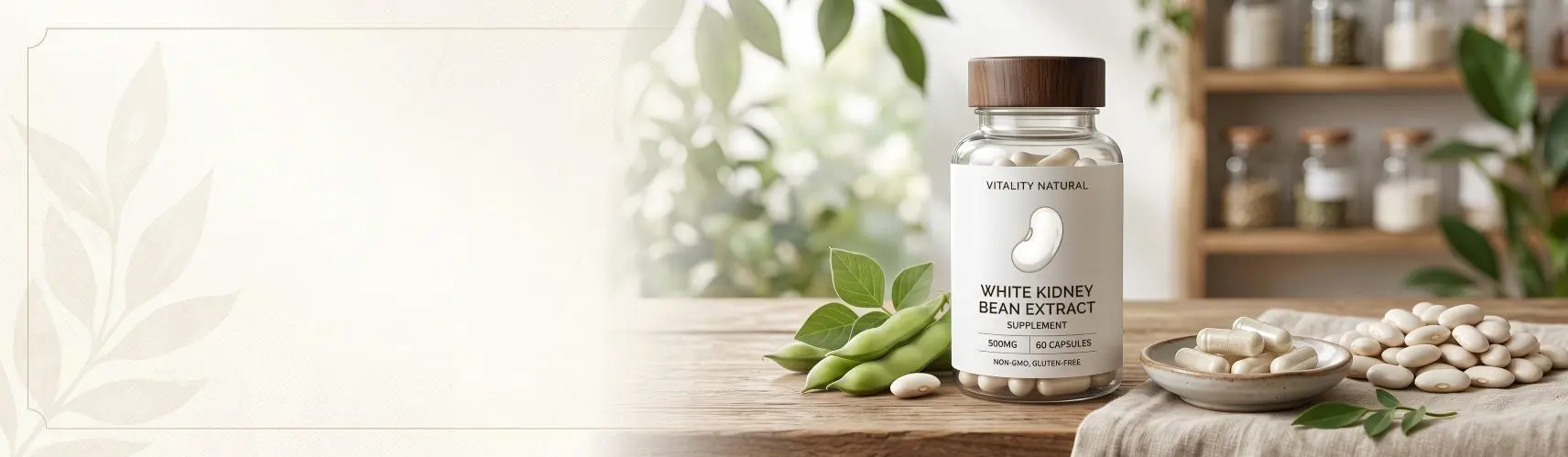
White Kidney Bean Extract Supplement Manufacturing at a Glance
KS Nutripharma is a white kidney bean extract supplement manufacturer for OEM, ODM, and private-label programs. We turn a locked Phaseolus vulgaris spec into finished capsules, tablets, powders, and project-scoped gummies for digestive wellness assortments, meal-support SKUs, and weight-management lifestyle lines.
Ratio extract, AAIU-standardized extract, and licensed branded grades (including Phase 2® when supply is in scope) are different materials. We confirm serving math and format before quoting, then release against that file and COA.
OEM / ODM / Private Label · Capsules · Tablets · Powders · Gummy pilot
Request Sample + COA · Upload Existing Formula / NDA · Get Extract Specification Advice
cGMP · ISO 9001 · ISO 22000 · HACCP · FSSC 22000 · Halal · Kosher · In-house lab + third-party pathways (SGS / Eurofins) · Batch COA · Traceable release
→ About Us · Manufacturing Capacity · Certifications · Quality Control
Buyer Snapshot
Use this to qualify the project before comparing factories. A white kidney bean supplement is not specified until botanical identity, extract type, activity or ratio, serving, and format are locked.
Lock this | What we run |
|---|---|
| Botanical | Phaseolus vulgaris L. seed |
| Functional component | α-amylase inhibitor proteins (phaseolamin-type). Not a single isolated compound on every COA. |
| Extract path | Ratio (4:1 / 10:1 / 20:1) · AAIU-standardized · licensed branded grade when supply is in scope |
| Example starting SKU | Capsule · ~1,000 mg extract / serving · two-capsule serving · 60-count bottle — subject to bulk density and the rest of the BOM |
| Formats | Capsules · tablets · powders / stick packs · gummy pilot* |
| Programs | OEM · ODM · private label · bulk extract |
| Quote basis | Cost per locked serving — not $/kg of unmatched grades |
| Documents | Spec · batch COA · identity / activity or ratio · micro · metals · finished-product assay as scoped |
| MOQ / lead time | By format — Sample, MOQ & Lead Time |
A gummy pilot is for a realistic piece load. It is not a first-line path for a ~1,000 mg extract serving.
“White kidney bean extract” is not a complete specification. Two 10:1 quotes are not comparable if one has no activity method on the COA.
Which Extract Path to Buy
Path | Buy this when | Do not assume | Lock on the RFQ |
|---|---|---|---|
| Raw powder | Food-adjacent identity, lowest input cost | Enzyme-inhibitory consistency; a small capsule serving | Identity + safety tests |
| Ratio extract | Cost-sensitive private label, moderate serving | That 10:1 equals 10:1 activity on another COA | Ratio + identity + safety; add AAIU if you need potency |
| AAIU-standardized | Label consistency without a brand license | That any AAIU number matches any method | Activity target + named method + serving math |
| Licensed branded (e.g. Phase 2®) | Trademark and that grade’s literature set | That a generic “Phase 2 type” is the same material | License status, trademark use, that grade’s COA |
Standardized botanical extract pathways: Standard Extracts.
Send two competing specs. We normalize botanical, activity basis, method, serving, and documentation before quoting.
White Kidney Bean Supplement Formula Concepts
Four commercial starting points—not locked Supplement Facts. Name F01–F04 on the RFQ, or send a BOM.
Extract grade, serving, format, and pack stay customizable. Companions keep their own assay and claim-risk files. Metabolic stacks that add berberine or similar actives are quoted after ingredient-specific review—not as a default card on this page.
Best for: First private-label SKU; white kidney bean as the label spine.
Architecture: White kidney bean extract + chromium + Gymnema sylvestre · default capsule
Buyer note: Keep the bean extract high enough that companions do not take over fill weight or the story.
Send us: extract path (ratio / AAIU / licensed), serving target, max capsule count.
Best for: Pre-meal convenience next to digestive / meal-support sets.
Architecture: White kidney bean extract + apple cider vinegar powder + cinnamon · default capsule
Buyer note: ACV powder in a capsule is not the same as a liquid-vinegar serving used in some feeding studies. Lock acetic-acid spec.
Send us: ACV spec, cinnamon type, serving, pack count.
Best for: Satiety / reduced-portion positioning without a stimulant stack.
Architecture: White kidney bean extract + glucomannan and/or inulin · default capsule (powder if fiber load will not fit)
Buyer note: Fiber expansion and capsule count decide format. Do not copy a drink-mix fiber dose into two capsules.
Send us: fiber type and grams per serving, whether powder is acceptable.
Best for: Weight-management lifestyle lines that want carb-control plus green tea and carnitine.
Architecture: White kidney bean extract + green tea extract + L-carnitine · default capsule
Buyer note: Declare caffeine when the green tea path includes it. This is lifestyle positioning, not a medical weight-loss formula.
Send us: EGCG / caffeine limit, carnitine form, serving.
Dosage Forms
Pick the format from serving weight, swallowability, and whether taste can sit in the product. Process failure modes are in Production Problems We Solve.
Serving math buyers actually need: lock extract mg or AAIU per serving → check bulk density of the full BOM → then capsule size and count. An example ~1,000 mg extract serving often lands as two size-00 capsules once companions are included. One capsule is possible only if density and the BOM allow it. Confirm at sample—not from a catalog fill chart.
- Capsules
Usual first format for white kidney bean capsules and white kidney bean extract capsules. Gelatin or HPMC. Quote fill weight, size, and serving count together—not “1,000 mg” with no size.
- Tablets
White kidney bean tablets, including extract tablets, are used when the channel wants fewer units per bottle or a coated swallow. Compressibility is confirmed on the selected extract and excipient system, not assumed. Film coating is scoped for odor, humidity, or swallowability.
→ Tablets
- Powders & stick packs
Use when grams of fiber (F03) or a drink-mix occasion will not fit a capsule. Flavor, dispersion, and pack barrier are part of the SKU. Instantization when the brief is a drink mix.
- Gummies
Lifestyle or trial SKUs only. Feasibility depends on extract sensory load, gelling system, piece weight, and how many pieces the buyer will print as a serving. Higher extract loads raise taste, color, texture, and heat-stability risk. If the piece cannot carry the target, we split the serving or move to capsule/tablet—we do not force the format.
→ Gummies
A white kidney bean formula can look straightforward on paper but become difficult when extract load, capsule size, tablet compression, gummy dosage, flavor, or multi-ingredient uniformity are considered together.
The goal is not simply to manufacture the formula. It is to make sure the dose, dosage form, sensory profile, packaging, testing, and production plan are commercially workable before the first large production run.
Site-level capabilities include cGMP manufacturing, 5 production bases, 81,000+ m² of facilities, and 12 production lines. Capacity depends on format and production scheduling. See MOQ & lead time and Processing Technologies.
| Your formulation concern | What this means for your product | How the project is handled |
|---|---|---|
| High extract load vs. capsule size | A serving around 1,000–1,500 mg of extract plus other actives may require size 00/000 capsules or multiple capsules per serving. | Bulk density and flow are reviewed before the capsule format is finalized, so serving size and capsule size are evaluated together. |
| Keeping the serving practical | A technically correct dose can still create an inconvenient 3–4 capsule serving. | The formulation is checked against your target maximum capsules per serving before the BOM is locked. |
| Tablet compression and disintegration | Some native extracts do not compress, flow, coat, or disintegrate consistently at the required loading. | Granulation or other processing adjustments can be evaluated, with hardness, friability, weight variation, and disintegration checked during sample development. |
| Gummy dosage and sensory profile | Extract bitterness, earthy notes, color, and heat exposure during depositing can affect both consumer experience and active stability. | Active loading per piece is assessed together with masking, flavor, thermal exposure, and serving size before gummy tooling. |
| Powder flow, caking, and flavor | Some extract systems may absorb moisture, cake during storage, or produce noticeable bean notes in a drink mix. | Carrier selection, anti-caking strategy, flavor system, film barrier, and packaging are evaluated together with the target market’s humidity conditions. |
| Uniformity in multi-ingredient formulas | Fiber, minerals, tea extracts, carnitine, and other ingredients can change blend density and flow. Passing the white kidney bean assay alone does not demonstrate uniformity of the complete formula. | Blend order, mixing parameters, in-process uniformity, and finished-product testing are established for the locked actives. |
Before committing to a commercial format, you can identify whether the proposed dose fits the intended capsule, tablet, powder, or gummy format—and whether the packaging and stability plan are appropriate for the formula.
If a high extract load cannot realistically fit into one small capsule, the formulation is adjusted openly through dose, capsule size, serving count, or dosage form rather than silently overfilling the capsule.
Humidity exposure, packaging selection, and dating are evaluated at the finished-product level through Moisture Control & Stability Engineering.
A commercial lot should not be judged only by whether the white kidney bean extract passes its headline assay. For a multi-ingredient supplement, the raw material, complete formula, manufacturing process, and finished-product specification all need to align.
The quality pathway follows:
Raw Material → In-Process Control → Finished Product Testing → QA Release
If the COA marker, analytical method, grade, or specification does not match the approved BOM and project file, the lot is not released. Licensed branded lots are released against that grade’s file, not against a generic AAIU substitute.
The commercial batch should be released against the same approved specification used for the sample—not a materially different extract grade or assay basis.
| Production stage | What is checked | Why it matters to your project |
| Raw material qualification | Botanical identity; activity or extract ratio using the named method; moisture; microbiological limits; heavy metals; pesticides and residual solvents where applicable | Confirms that the incoming material matches the specification used for formulation and quotation. |
| In-process control | Blend uniformity; weight variation; capsule filling or compression parameters; moisture where relevant | Helps prevent a compliant raw material from becoming a non-uniform finished product. |
| Finished product testing | Identity; assay against the locked specification; microbiological limits; appearance; disintegration; hardness; fill weight, as applicable | Confirms that the finished SKU meets the agreed product specification rather than only the ingredient specification. |
| QA release | Approved specification, batch COA, testing records, and required document package | Gives procurement and quality teams the documentation needed for lot acceptance and downstream compliance. |
Testing options: In-house laboratory testing is available, with SGS or Eurofins third-party testing when required by the RFQ, customer quality system, or destination market. Methods: Quality Control.
Typical document package: specification · batch COA · identity / assay results · heavy metals / microbiology · residual solvents and pesticide documentation where required · allergen statement · stability protocol or data when scoped · licensed branded-ingredient documentation where applicable.
Shelf life should be assigned from the finished-product and packaging stability file, rather than using a generic 24-month assumption.
White kidney bean research is not automatically interchangeable across every extract on the market.
Human studies have evaluated white kidney bean and phaseolamin-type preparations for starch-digestion and body-composition-related outcomes, but study results depend on the specific extract, standardization, dose, meal protocol, and study design.
For procurement and formulation, the important question is therefore not simply “Does white kidney bean have research?” but:
Does the evidence correspond to the extract specification and dose being used in this SKU?
| Evidence question | Practical rule for your product |
| What did the study actually measure? | Claims should reflect the endpoint investigated in the cited study rather than extending the finding to unrelated outcomes. |
| Which extract was studied? | A result from a standardized or branded extract should not automatically be transferred to an unnamed ratio extract. |
| Does the commercial grade match the study material? | Extract identity, standardization, analytical method, and dose should be checked before using research as claim support. |
| Can the finished label use the same claim? | Structure/function and other commercial claims should be reviewed against the actual ingredient, dose, formulation, and destination-market requirements. |
Celleno et al., International Journal of Medical Sciences (2007), and Barrett & Udani, Nutrition Journal (2011), provide research context for the preparations evaluated in those studies. They should not be treated as a universal claim package for every white kidney bean 10:1 or ratio extract.
This product is not a medicine and should not be positioned as a guaranteed weight-loss product or as a substitute for prescription glucose-lowering therapy.
Whether you already have a locked formula or only have a product concept, the manufacturing route can be matched to the level of development work you need.
| Project route | What you provide | What you can receive |
| OEM | Locked BOM, ingredient specifications, dosage form, packaging requirements | Manufacturability review followed by production against the approved specification |
| ODM | Target market, product positioning, dosage form, target volume, and desired product concept | Formula architecture, extract specification, dosage-form recommendations, and production specification |
| Private Label | Brand requirements plus an existing formula or selected formula from the product library | Finished white kidney bean supplement under your brand, with packaging and documentation according to the project scope |
| Bulk Extract | Required extract type, activity or ratio, quantity, and packaging format | Qualified P. vulgaris extract for downstream formulation or manufacturing |
You do not have to provide a fully developed formula when the project is still at the concept stage. Customers with an existing BOM can move directly into a manufacturability and quotation review.
MOQ and lead time depend on dosage form, formula complexity, packaging, testing requirements, material availability, and production scheduling.
A bulk extract order and a finished gummy SKU should not be quoted using the same MOQ logic.
| Manufacturing format | Typical white kidney bean application | Site-level capacity* |
| Capsules | Extract-led and multi-ingredient capsule formulas | 5M+ capsules/day |
| Tablets | Compact, higher-volume commercial SKUs | 12M+ tablets/day |
| Powder / Granule | Drink mixes, sachets, and dry blends | 5,000+ tons/year |
| Gummies | Flavor-led products requiring realistic active loading | 2.5M+ pieces/day |
*Site-level capacity. Actual project allocation depends on production scheduling, formula, packaging, and current capacity.
Typical development and production timing
| Project stage | Typical timeline |
| Formula discussion | Project dependent |
| Sample development | 7–15 days* |
| Pilot production | 15–25 days* |
| Mass production | 30–45 days* |
*Indicative timelines. Final timing is confirmed after formula, material availability, packaging, testing, and production scheduling are reviewed.
A locked formula with available ingredients and standard packaging can normally move faster than a new flavored gummy requiring custom development and tooling.
Typical starting ranges
| Project scope | Typical starting range | Main variables |
| Bulk white kidney bean extract | Project dependent | Extract grade, activity/ratio, specification, pack format, and lot size |
| Capsules | ~3,000–5,000 units | Capsule size, fill weight, formula, packaging, and sourcing |
| Tablets | ~5,000–10,000 units | Compression feasibility, tablet specification, packaging, and sourcing |
| Powder — bulk | Quoted by kg | Extract specification and bulk packaging |
| Powder — retail | Quoted by finished units | Stick/tub format, fill weight, packaging, and testing |
| Stick / sachet | Often from ~10,000 units | Film, fill weight, moisture protection, and packaging |
| Gummies | ~5,000–10,000 units | Active loading, flavor, piece weight, tooling, and packaging |
Do not compare a 25 kg ingredient MOQ directly with a finished retail SKU MOQ. They represent different production stages and cost structures.
Packaging options
HDPE / PET bottles with induction seals · blisters · foil bags · stick multipacks · retail cartons · export master cases · desiccant and tamper-evident finishes as scoped.
For marketplace and DTC products, HDPE bottles with induction seals are often practical starting formats. Blisters may be preferable when portability, individual-dose protection, or pharmacy-style presentation is important.
Packaging is also part of moisture protection and shelf-life control, not simply a branding decision.
Send These Details and Get a More Useful First Quote
A product name alone—such as “white kidney bean OEM”—leaves too many variables open for a meaningful technical quotation.
A short specification can help the formulation and procurement teams evaluate extract suitability, dosage-form feasibility, packaging, MOQ, lead time, and testing requirements together.
• Product: white kidney bean extract supplement
  [OEM / ODM / private label / bulk extract]

• Extract path:
  [ratio / AAIU-standardized / licensed branded / recommend]

• Target serving:
  [extract mg or AAIU per serving]

• Format:
  [capsule / tablet / powder / gummy]

• Formula:
  [F01–F04 or locked BOM]

• Key constraint:
  [maximum 2 capsules / vegetarian capsule / gummy required / none]

• Market & packaging:
  [destination market / 60-count HDPE / blister / stick]

• Volume:
  [first PO + estimated annual volume]

• Required documents:
  [COA / heavy metals / micro / solvents / pesticides / stability / third-party testing]

• Existing competing specifications, if available:
  [Spec A vs Spec B]
With this information, the first technical response can focus on the decisions that matter most to your launch:
recommended extract path · dosage-form feasibility · packaging route · key manufacturing considerations · estimated MOQ · indicative lead time · required document package
This is more useful than receiving a frozen unit price before the specification is defined.
Get Extract Specification Advice · Upload Existing Formula / NDA
Raw powder is milled white kidney bean material and generally has greater variability in enzyme-inhibitory activity. A standardized extract specifies a measured activity using a defined analytical method. A licensed branded ingredient is a separate specification and supply pathway.
An extract ratio describes the relationship between starting raw material and resulting extract. AAIU describes measured alpha-amylase inhibitory activity. AAIU values should only be compared when the analytical method is equivalent.
Yes. White kidney bean formulas can be developed using ratio extracts or independently standardized AAIU extracts. Phase 2® is relevant when the product brief specifically requires that trademarked ingredient and licensed supply is available.
Many commercial formulations start around 1,000 mg of extract per serving, often divided across two capsules. However, study doses should not simply be copied to every commercial extract. Final serving size depends on the selected grade, activity, bulk density, complete BOM, and target market.
Often, approximately 1,000 mg can fit into two size-00 capsules, but actual feasibility depends on bulk density and the complete formulation. The final capsule size and fill weight should be confirmed during sample development.
Not necessarily. A ~1,000 mg extract target may be difficult to accommodate in a conventional gummy without increasing piece weight or serving count. The practical solution may be a lower per-piece dose, multiple pieces, or a different dosage form.
At minimum, the COA should identify the botanical material, extract type, locked activity or ratio, analytical method, batch/lot information, and the applicable safety parameters. The sample COA and commercial COA should correspond to the same approved specification.
MOQ varies by format. Typical starting ranges for capsules, tablets, powders, sticks, gummies, and bulk extract are provided in Sample, MOQ & Lead Time. The final MOQ is confirmed after the formula, packaging, testing, material availability, and production schedule are reviewed.