
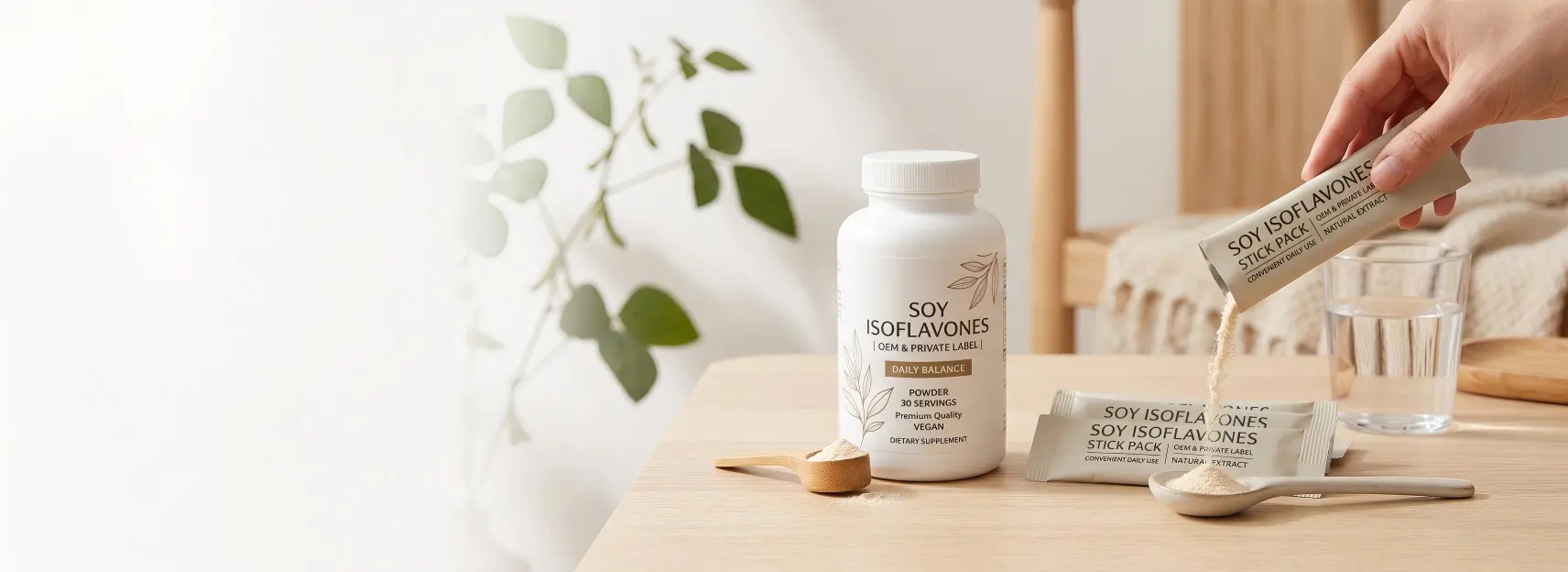
Professional Soy Isoflavone Powder OEM Manufacturing Platform
Drink-Mix Scoops Without Capsule-Clone Volume Myths
KS Nutripharma® · Complete OEM, ODM & Private Label Infrastructure
Powder wins when you need a daily cup ritual or a multi-gram stack — collagen, protein, or fiber — after a dry hero already exists on shelf. It is not a swallow-and-go assay format. We lock serving grams, bulk density and scoop geometry, wet-out dispersibility, beany-note masking, and moisture/pack barrier before tub artwork or stick film freezes.
Platform At-A-Glance: Commercial & Procurement Specs
Procurement baselines only. Engineering limits, moisture targets, and masking detail live in the technical guide later on this page.
Parameter | Standard baseline | Custom options | Procurement note |
|---|---|---|---|
| Assay/serving band | Soy isoflavones, typically 40–80 mg/scoop | Higher via scoop math | Assay = extract load × scoop grams |
| Serving architecture | Beauty/wellness scoops · Protein scoops | Brand-owned scoop story | Gram claims follow measured density (DFM gates) |
| Format path | Flavored tub or unflavored premix | Stick-pack sibling finish | Premix locks before unit-dose film |
| Packaging | Induction-sealed HDPE tub · high-barrier pouch + desiccant | Bulk liner · stick handoff | Barrier selected with moisture gate |
| Program MOQ | From 25 kg (quote-confirmed) | Tub count or bulk kg bands | Premix + pack set final MOQ |
| Lead time | Samples 7–15 days · mass often 4–7 weeks after formula & artwork lock | Flavored / instantized programs may extend | Confirm after brief |
| Capacity | 5,000+ tons powder/year | Multi-line blend & pack | DTC tubs and export premix |
| Models | OEM · ODM · Private Label | — | Parent hub commercial terms |
→ Capability overview: Powders & Granules
Key Insights for Brand Owners
- Volume First: Powder carries multi-gram stacks (e.g. collagen peptides) that exceed hard-capsule fill limits — a drink ritual, not a swallow-and-go assay clone.
- Engineering Order: We lock bulk density → scoop volume → label grams before tub artwork is released for print.
- Process Sequence: Clear cold-water wet-out dispersibility first; apply organoleptic flavoring second.
- Raw Extract Redirect: Looking for raw bulk extract (40% 60% 80% HPLC) rather than finished drink-mix manufacturing? Visit our Bulk Soy Isoflavone Extract Supplier page.
- Honest Manufacturing Guardrail: We decline briefs that force high-calcium minerals or oil-only actives into a drink scoop when tablets or softgels are the honest format.
When to Choose Powder vs Other Formats
Choose powder format when… | Switch to alternative formats when… | Recommended alternative |
|---|---|---|
| Active volume: Multi-gram companions (e.g. 5–10 g collagen/protein) exceed capsule fill | You need a single-unit, high-assay swallow-and-go product | Capsules |
| Product experience: Brand strategy centers on a flavored daily cup or spoon-measured ritual | High-density chalky minerals (e.g. high-calcium bone formulas) dominate the brief | Tablets |
| Versatility: Unflavored base needed for smoothie stacking or multi-channel finishing | Actives are entirely lipid-soluble oils | Softgels |
| Dose size: High-dose / multi-gram matrix exceeds sweet-treat gummy loading limits | Low-dose trial discovery or social-first chewable positioning is required | Gummies |
| Development stage: Premix needs cold-water dispersibility and density lock before unit-dose scale | Premix rheology is fully locked and only travel packaging remains | Stick Pack |
Rule of thumb: Powder owns the multi-gram drink ritual. Stick packs are a finishing layer after powder flow and bulk density freeze — not a shortcut around powder DFM.
Flavored Tub vs Unflavored Premix
Decision factors | Flavored tub | Unflavored premix |
|---|---|---|
| Positioning | Standalone drink ritual SKU | Stacking / bulk / private premix |
| Channels | Amazon · DTC tubs | Bulk · export · stick handoff |
| Formula fit | A · B · D · E · F · G | C · H · stick prep |
| Cost / time | Higher (masking + sensory) | Lower / faster to sample |
| Launch stage | Growing DTC drink brand | First pilot · stick prep |
Skip flavored first when you need the fastest sample or only stick finishing. Skip unflavored-only when the cup must convert alone on Amazon/DTC. Flavor does not raise assay potency.
Recommended Starter Formulations
Eight production blueprints. Dosage lives here; DFM gates and the technical guide own density, moisture, and masking detail — formula cards do not restate those parameters.
Serving target (typical): Soy isoflavones 40–60 mg + collagen peptides 5–10 g + HA 20–50 mg + Vitamin C 50–100 mg · total scoop often 8–12 g
Path: Flavored or lightly flavored tub · optional unflavored pilot
Powder role: Flagship volume use — collagen grams will not fit a hard capsule
Build notes: Instantization as scoped · berry or vanilla spine · hygroscopic collagen needs moisture gate + barrier pack
Sibling: Stick pack after premix flow locks
Serving target (typical): Soy isoflavones 40–80 mg + HA 20–50 mg + biotin 2.5–5 mg + Vitamin C 50–100 mg · total scoop often 4–7 g
Path: Entry DTC beauty cup without collagen COGS
Powder role: Nutricosmetic ritual when buyers will not pay for 5–10 g peptides
Build notes: Lighter carrier · citrus-berry OK at mid extract load; escalate spine if aftertaste appears
Not the same as: Formula A · gummy HA duo
Serving target (typical): Soy isoflavones 40–80 mg / directed scoop · optional lean water-soluble companions · unflavored
Path: Smoothie stack · B2B premix · stick handoff
Powder role: Fastest powder pilot — no full sensory budget
Build notes: Neutral carriers only · wet-out must pass without flavor cover · screen water and plant milk if both are on-label
Use: Bulk premix or stick finishing
Serving target (typical): Soy isoflavones 40–60 mg + plant protein 15–20 g (pea / rice / soy protein isolate as scoped — protein carrier, not the isoflavone active) · total scoop often 20–30 g
Path: RTM nutrition tub · gym-adjacent women’s wellness
Powder role: Protein grams define the format
Build notes: Cocoa–vanilla or chai spines · foam control · do not reuse Formula A scoop SKUs · heavy calcium stays on tablets
Serving target (typical): Soy isoflavones 40–80 mg + prebiotic fiber 3–5 g (inulin / FOS / PHGG as scoped) · optional Vit C · total scoop often 6–10 g
Path: Daily wellness cup · subscription DTC
Powder role: Meaningful fiber dose needs a drink matrix
Build notes: Berry or citrus-ginger · fiber raises viscosity — budget wet-out loops · GI labeling as scoped by market
Not the same as: Formula D · Formula A
Serving target (typical): Soy isoflavones 40–80 mg + matcha / green tea powder 500–1,500 mg · total scoop often 5–8 g
Path: Morning ritual Amazon / DTC SKU
Powder role: Matcha spine masks isoflavone beany notes while owning the brand ritual
Build notes: Balance tea bitterness · avoid stacking extra bitter botanicals · caffeine declaration as scoped
Serving target (typical): Soy isoflavones 50–80 mg + cocoa / vanilla masking · optional magnesium (glycinate / citrate as scoped) · total scoop often 6–12 g
Path: Evening comfort cup · higher extract load
Powder role: Deep spine when berry-only masks fail
Build notes: Microencapsulation on extract fraction when scoped · re-verify scoop cc vs Formula B/F after cocoa solids change density
Serving target (typical): Soy isoflavones 40–80 mg only · minimal carriers · flavored or unflavored
Path: Assay-led private label · export base · lowest BOM
Powder role: Prove cup performance before stacking collagen / protein / fiber
Build notes: One flavor spine if flavored · bridge from bulk soy isoflavone extract grade into finished premix
Upgrade: A / D / E companions only after wet-out and scoop math clear
Typical Manufacturing Case Studies: Engineering Feasibility in Action
Real-world engineering scenarios showing how early formula alignment prevents production bottlenecks, protects product integrity, and speeds time-to-market. Anonymized — qualitative commercial impact only (no invented % leak or cost claims).
Client scenario: DTC beauty brand needed soy isoflavones + 8 g collagen peptides after capsule volume failed.
Engineering barrier: Design locked a 15 cc scoop for 10 g; pilot density ~0.45 g/cc → true volume ≈ 22 cc. Proceeding would have caused fill mismatch, label non-compliance, and artwork scrap.
What we changed: Density calibration → scoop verification before print → induction HDPE tub fill (Phase 1). Stick geometry held for Phase 2 after the same density window froze.
Measured outcome: Label grams matched physical scoop · artwork released once · stick deferred until density lock.
Client scenario: Amazon wellness tub — returns from beany aftertaste under light citrus.
Engineering barrier: Citrus top-notes failed on high-purity extract; heavier flavor risked slower cold-water wet-out.
What we changed: Berry–vanilla spine → sweet-to-acid rebalance → microencapsulation on extract fraction for premium SKU, re-checked on the dispersibility screen.
Measured outcome: Sensory retain approved · wet-out held vs prior pilot · avoided full active redesign.
Client scenario: Export brand — fast unflavored premix, then travel sticks.
Engineering barrier: Printed barrier film before flow/density lock → film MOQ scrap and seal-area dust bridging risk.
What we changed: Premix dispersibility, density, and stick-ready flow first → deferred flavor → film print after clearance → stick pack finishing.
Measured outcome: Normal powder sample window · film after flow/density lock · pilot stick seal checks cleared without premature-print film scrap.
Ranked impact for most briefs: #1 Active stack · #2 Packaging & processing · then sensory and scale amortization.
Priority | Cost block | Relative impact | What moves the number | If budget is tight |
|---|---|---|---|---|
| #1 | Active stack | High | Collagen · protein · fiber · HA · soy isoflavone extract % | Start H or C; step up to A / D / E when channel pays |
| #2 | Packaging barrier | Medium → High | Tub → induction + desiccant → foil pouch | Induction HDPE temperate DTC; foil humid / export |
| #2 | Instantization / process | Medium → High | Standard blend vs scoped agglomeration | Clear wet-out before paying for agglomeration |
| #3 | Sensory / masking | Medium → High | Unflavored vs multi-round flavored · microencapsulation | Unflavored pilot → flavored extension |
| #4 | Scale & setup amortization | High $/kg at pilot · falls at volume | Fixed batch setup & line clearance on small kg lots | Request tiered pricing at pilot / growth / scale |
Get Modular / Tiered Pricing for Your Spec · Parent hub OEM terms
Gate criteria, moisture targets, and schedule risk live in Pre-Production Quality Gates below. What stays here is brand-equity protection — four advantages buyers use to choose this powder platform over a generic co-packer.
Differentiator | Industry failure mode we eliminate | What you get |
|---|---|---|
| Scoop & density lock | Scoop SKUs and tub art freeze before bulk density is measured — fill mismatch, label non-compliance, artwork scrap | Scoop volume verification before print (Gate 3) — density → scoop cc → label grams aligned |
| Integrated off-note masking | Returns driven by soy isoflavone beany aftertaste and astringency in beauty / wellness drinks | Berry · matcha · cocoa–vanilla spines ± microencapsulation as scoped — checked against wet-out, not flavor alone |
| Honest format guardrails | Forcing heavy chalky minerals or lipid-only actives into scoops that fail in customer cups | Clear redirect to tablets, softgels, or stick packs when powder is not viable |
| Single-source blend → pack | Blame-shifting between premixers, flavor houses, and co-packers | One formulation team from premix development through sealed retail tubs or stick handoff |
Canonical home for density, dispersibility, moisture, and sensory locks — including typical schedule damage if skipped.
Quality gate | Criteria | Risk if skipped (incl. schedule) | Deliverable |
|---|---|---|---|
| Gate 1 · Serving & scoop math | Soy isoflavones mg / scoop · companion grams · target scoop volume | Label vs fill mismatch · ~3–6 wk reprint loop | Scoop & serving feasibility note |
| Gate 2 · Dispersibility screen | Wet-out in water / plant milk · sediment / foam | Clumps after flavor spend · ~4–6 wk redo | Dispersibility retain / photo log |
| Gate 3 · Density & scoop verification | Measured bulk density · scoop cc vs label grams | Artwork scrap · tub over/under-fill | Scoop volume verification before print |
| Gate 4 · Moisture & barrier | LOD · RH-aware blend · induction HDPE or foil + desiccant | Caking relaunch · ~6–10 wk | LOD + pack barrier spec |
| Gate 5 · Sensory / path lock | Unflavored freeze or flavored retain · encapsulation scope | Beany returns · mid-project flavor rewrite · ~4–8 wk | Sensory retain (if flavored) · mass PO clearance |
Numeric LOD / RH / pack practices: Moisture & Shelf-Life Protection in the technical guide. Masking tools: Off-Note Masking Matrix.
Request Manufacturing Feasibility Audit · Request Powder Sample Kit
Feasibility feedback typically within 24–48 business hours. Mutual NDA available on request.
Illustrative planning ranges after brief review.
Stage | Window | Locks |
|---|---|---|
| Brief & serving intent | Week 1 | Path · companion architecture |
| Dispersibility & density pilots | Weeks 2–3 | Wet-out · scoop math |
| Instantization & masking (if any) | Weeks 3–5 | Process + sensory retain |
| Spec / pack / artwork | Weeks 5–6 | Gates 3–5 complete |
| Mass production | Weeks 6–10 | After formula & artwork lock |
Samples 7–15 days · mass often 4–7 weeks after lock. Flavored or instantized programs may extend.
Commercial terms sit above. Expand below for formulation physics, DFM tools, and line SOPs.
Panel 1: Scoop Volume & Bulk Density Calculator (Gate 3)
Scoop volume (cc) = Target serving (g) ÷ Bulk density (g/cc)| Target serving | Bulk density (example) | Scoop volume |
|---|---|---|
| 8 g | 0.50 g/cc | 16 cc |
| 10 g | 0.50 g/cc | 20 cc |
| 10 g | 0.45 g/cc | ≈ 22 cc |
| 12 g | 0.60 g/cc | 20 cc |
Send target grams + pilot density (or ask us to measure). We return scoop cc and scoop volume verification before packaging print — Gate 3.
Request Free Scoop Volume Verification on Your Brief
Panel 2: Off-Note Masking Technology (Beany & Bitter Control)
| Approach | Role | When |
|---|---|---|
| Flavor pairing | Cover beany notes | Berry botanical · matcha · dark cocoa / vanilla beat light citrus-only |
| Acid / sweetener balance | Soften astringency | Confirmed in sensory retain |
| Microencapsulation (scoped) | Limit extract–taste contact | Premium SKUs when standard mask fails |
| BOM simplification | Cut competing bitter botanicals | Midlife multi-herb stacks → capsules |
| Unflavored path | Do not hide unfinished wet-out | First pilots · stick handoff |
Masking changes perception. It does not raise isoflavone potency.
Panel 3: Moisture Protection & R&D Engineering Limits
Moisture & shelf-life protection
Canonical moisture / caking controls for soy isoflavone drink mixes (especially collagen, fiber, cocoa, fruit systems):
| Control | Typical practice | Why |
|---|---|---|
| LOD | Finished blend typically ≤ 4.0% | Hygroscopic stacks cake above wet specs |
| Blend RH | Sensitive compounding often RH < 40% | Limits moisture pickup before pack |
| Anti-caking aids | As scoped | Flow and scoop consistency |
| Primary pack | Induction-sealed HDPE tubs · high-barrier foil + desiccant | Shelf appearance in humid / export lanes |
These criteria feed Gate 4.
R&D engineering limits (line physics)
Procurement assay bands live in Platform At-A-Glance. This table is process physics only.
| Parameter | Typical engineering window | Line / cup impact |
|---|---|---|
| Mesh / particle band | Project-tuned to wet-out and blend uniformity | Segregation · chalky mouthfeel · assay drift |
| Bulk density | Often 0.40–0.65 g/cc after pilot | Scoop cc · tub fill height · stick auger feed |
| Wet-out / dispersibility | No hard clumps in target liquid | Return risk · instantization decision |
| Instantization | Standard blend vs scoped agglomeration | Premium cold-water performance |
| Foam / sediment | Checked in shaker or cup protocol | Ugly-cup complaints |
Panel 4: On-Line Manufacturing Diagnostics & Line SOP
Issue 1 — Clumping / poor wet-out
- Root cause: Hydrophobic extract · wrong carrier · flavor before wet-out cleared.
- Factory SOP: Dispersibility screen → wetting aids / carrier redesign → scoped agglomeration → then flavor (Gate 2).
Issue 2 — Scoop assay or fill drift
- Root cause: Segregation · scoop cc from marketing, not lab.
- Factory SOP: Particle matching · blend validation · Gate 3 vs measured density (Panel 1 calculator).
Issue 3 — Beany / bitter aftertaste
- Root cause: Extract load exceeds citrus-only mask · bitter botanical overload.
- Factory SOP: Apply Panel 2 masking matrix · simplify BOM · re-check wet-out.
Issue 4 — Post-pack caking
- Root cause: LOD drift · weak barrier · humid lane.
- Factory SOP: Re-run Panel 3 moisture controls before scale-up (Gate 4).
Line sequence: Target liquid & grams → Dispersibility → Density / scoop → Instantization → Masking → Moisture / barrier → Tub → Optional stick finish
| Inspection check | Method | What we verify |
|---|---|---|
| Active potency | HPLC (USP / AOAC practice) | Isoflavone monomers or total vs scoop claim · typical ±5% when scoped |
| Heavy metals | ICP-MS | As, Cd, Pb, Hg vs destination limits |
| Residual solvents (extract grades) | GC (USP / ICH as scoped) | Controlled extract lots in the BOM |
| Allergen & identity | Statements / docs as scoped | Soy source allergen · Non-GMO / IP by grade |
| Microbial | USP 2021 / 2022 style panels | TPC · yeast & mold · pathogens as scoped |
| Physical lock | Mesh · density · LOD · dispersibility retain | Against gates and golden sample |
| Inspection check | Method | What we verify |
|---|---|---|
| Active potency | HPLC (USP / AOAC practice) | Isoflavone monomers or total vs scoop claim · typical ±5% when scoped |
| Heavy metals | ICP-MS | As, Cd, Pb, Hg vs destination limits |
| Residual solvents (extract grades) | GC (USP / ICH as scoped) | Controlled extract lots in the BOM |
| Allergen & identity | Statements / docs as scoped | Soy source allergen · Non-GMO / IP by grade |
| Microbial | USP 2021 / 2022 style panels | TPC · yeast & mold · pathogens as scoped |
| Physical lock | Mesh · density · LOD · dispersibility retain | Against gates and golden sample |
Manufacturing credentials
KS Nutripharma Formulation Team owns scoop math, dispersibility, and masking; Director of R&D reviews commercial powder specs. cGMP · ISO 22000 · HACCP / FSSC pathways as scoped. Export: COA · TDS · SDS · COO as agreed.
Sample kit
Unflavored premix reference · flavored spine option when scoped · sample COA / spec / LOD–density log.
Request Spec, Sample COA & Sample Kit
Stocked kits often dispatch within 48 hours of brief confirmation; custom pilots 7–15 days.
Request a Precision Manufacturing Quote & Sample Kit
Confidential business inquiries only · Mutual NDA available · Engineering review typically within 24 business hours
Powder RFQ
1. Formula architecture
- A — Soy Isoflavones + Collagen Beauty Scoop
- B — Beauty-Light (HA + Biotin, no collagen)
- C — Unflavored Stacking Premix
- D — Plant-Protein + Soy Isoflavones Nutrition Scoop
- E — Prebiotic Fiber + Soy Isoflavones Daily Cup
- F — Matcha Soy Isoflavone Ritual
- G — Cocoa–Vanilla Soy Isoflavone Comfort Drink
- H — Lean Single-Active Soy Isoflavone Premix
- Custom OEM/ODM brief
2. Order volume — Pilot · hundreds of kg · growth · scale / export
3. Market — North America · EU/UK · cross-border DTC · Asia-Pacific / other
4. Packaging — Induction HDPE tub + scoop · foil pouch + desiccant · bulk liner · premix for stick
5. Spec notes — (e.g. Formula A · 50 mg isoflavones + 8 g collagen · 10 g scoop · berry · launch Q4)
6. Work email (business domain preferred) · 7. Company / brand
Submit RFQ & Request Free Powder Sample Kit →
Ready to Start Your Soy Isoflavone Program?
You need | Next step |
|---|---|
| Mixability first | Request a Free Powder Sample Kit |
| Price Formula A–H | Get My Powder Project Quote |
| DFM / masking review | Talk to a Powder Formulation Engineer |
Typically 40–80 mg per scoop serving inside a multi-gram drink matrix. Exact companion gram ratios (collagen, protein, fiber, and related stacks) are in Recommended Starter Formulations (A–H) above.
Start unflavored for rapid pilots, smoothie stacking, or stick-pack handoffs. Choose flavored when the SKU must convert as a standalone DTC / Amazon cup. Clear cold-water wet-out before funding sensory loops — see Gates 2 and 5.
Moisture / caking: expand Panel 3 (LOD typically ≤ 4.0%, blend RH often < 40%, barrier pack). Organoleptic masking: expand Panel 2 (berry, matcha, or cocoa–vanilla spines ± microencapsulation as scoped). Line troubleshooting: Panel 4.
Target serving (g) ÷ bulk density (g/cc) = scoop volume (cc). Use the calculator in Panel 1. We issue Gate 3 scoop volume verification before tub artwork is released for print.
Program MOQs typically start from ~hundreds of kg (quote-confirmed by formula and packaging). Pilot samples 7–15 days; mass production often 4–7 weeks after formula and artwork freeze.
Powder locks the core premix and tub ritual. Stick packs are a unit-dose finishing layer after powder flow and bulk density freeze — see Case 3 and the format selection matrix.
This page covers finished OEM/ODM drink-mix manufacturing. For raw 40% / 80% HPLC bulk extract, visit our Bulk Soy Isoflavone Extract Supplier page.
Commercial lots ship with HPLC active potency assay, ICP-MS heavy metals, extract residual-solvent screening as scoped, USP-style microbial clearance, and physical retains — see the Quality Control table above.