Medical Disclaimer: This article is for informational purposes only and does not constitute medical advice. Alpha GPC is a dietary supplement ingredient, not a drug intended to diagnose, treat, cure, or prevent any disease. Individuals with existing health conditions or those taking medications should consult a qualified healthcare provider before use.
Introduction
Alpha-glycerylphosphorylcholine (Alpha GPC) is one of the most bioavailable choline compounds used in dietary supplements today. With approximately 40% choline by weight and the ability to efficiently cross the blood–brain barrier, it serves as a direct precursor to acetylcholine—a neurotransmitter central to memory encoding, attention, and neuromuscular signaling. This guide summarizes the current evidence for Alpha GPC benefits across cognition, memory, focus, exercise performance, and healthy aging, with all claims supported by peer-reviewed or institutional sources.
What Is Alpha GPC?
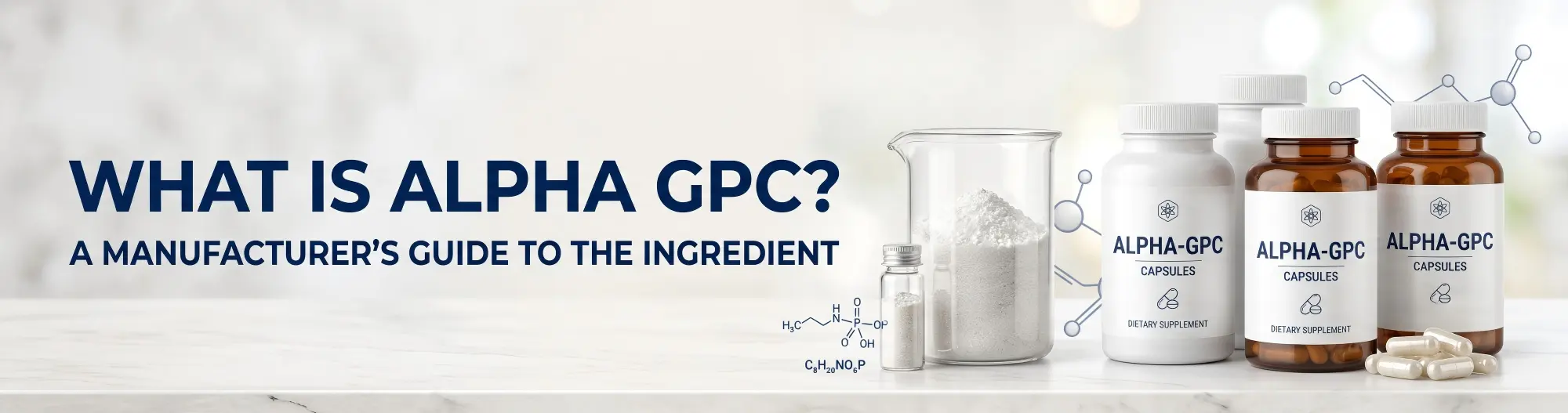
Alpha GPC (L-alpha-glycerylphosphorylcholine), also known as choline alphoscerate, is a phospholipid-derived choline compound. Unlike simple choline salts, Alpha GPC retains its glycerophosphate backbone, which contributes to its high solubility and rapid absorption. According to WebMD, 100 mg of Alpha GPC contains approximately 40 mg of free choline, making it one of the most concentrated choline sources available in supplement form. While trace amounts occur naturally in foods such as soy and red meat, nearly all supplemental Alpha GPC is produced synthetically to ensure purity and standardization.
Common Supplement Applications
Alpha GPC is currently formulated across a wide range of product categories:
• Nootropic capsules and tablets
• Memory support formulas
• Gaming and esports supplements
• Pre-workout powders and RTDs
• Healthy aging complexes
• Functional beverages and energy drinks
• Cognitive health softgels
How Does Alpha GPC Work?
Alpha GPC supports cognitive and physical performance through several well-documented mechanisms:
1. Increases acetylcholine synthesis. As a direct choline donor, Alpha GPC rapidly elevates choline levels in neural tissue, which is then converted to acetylcholine by the enzyme choline acetyltransferase. Higher acetylcholine levels enhance cholinergic neurotransmission in the hippocampus, prefrontal cortex, and neuromuscular junctions.
2. Enhances neuronal membrane integrity. The glycerophosphate moiety in Alpha GPC serves as a substrate for phosphatidylcholine synthesis, supporting cell membrane repair and fluidity in neurons.
3. Supports neurovascular function. Emerging clinical data suggest Alpha GPC may improve endothelial function and markers of angiogenesis, particularly in older adults with vascular risk factors.
4. Facilitates growth hormone response. Acute supplementation with Alpha GPC has been associated with increased growth hormone secretion during exercise, though this effect requires further long-term validation.
Evidence Level Summary
The following table summarizes the strength of clinical evidence for each major Alpha GPC benefit area, based on randomized controlled trials (RCTs), systematic reviews, and meta-analyses published in peer-reviewed journals.
| Potential Benefits | Evidence Level | Key Study Type | Typical Doses in Research |
| Memory support | Strong | Multiple RCTs & Meta-analyses | 1,200 mg/day |
| Focus & attention | Moderate | Limited RCTs in healthy adults | 300–600 mg/day |
| Exercise power output | Moderate | Several RCTs in athletes | 250–600 mg/day |
| Healthy aging / vascular cognition | Moderate | Clinical studies in elderly | 1,200 mg/day |
| Attention & executive function | Emerging | Preliminary evidence | 300–600 mg/day |
| Growth hormone stimulation | Limited | Acute studies only | 600 mg acute |
Benefits of Alpha GPC
1. Memory Support
Alpha GPC has been extensively studied for its effects on memory, particularly in adults with cognitive decline. A systematic review and meta-analysis published in PMC evaluated eight studies (seven RCTs and one prospective cohort) with 861 participants and found that Alpha GPC at 1,200 mg/day significantly improved Mini-Mental State Examination (MMSE) scores compared with placebo and other active treatments. The mean difference was 3.50 points (95% CI: 0.36 to 6.63), with improvements observed in orientation, memory, and language domains.
In healthy younger adults, acute supplementation has also shown promise. A double-blind, placebo-controlled crossover trial in 21 healthy men demonstrated that single doses of 315 mg or 630 mg Alpha GPC improved Stroop test performance and reduced completion times, indicating enhanced cognitive flexibility and selective attention.
2. Focus & Mental Clarity
By elevating acetylcholine in the prefrontal cortex and hippocampus, Alpha GPC supports sustained attention and information processing speed. In the acute supplementation trial noted above, the higher-dose group (630 mg) showed a tendency toward faster reaction times during the Flanker test, suggesting potential benefits for tasks requiring rapid inhibition control and decision-making.
A single-blind, randomized, placebo-controlled study published in PMC further reported that 400 mg/day of Alpha GPC for two weeks tended to increase motivation scores in healthy subjects without producing any side effects or addictive potential during the intervention or at 12-month follow-up.
3. Learning & Mental Performance
Alpha GPC is frequently incorporated into nootropic and study-support formulations due to its rapid onset and high bioavailability. The compound crosses the blood–brain barrier within 30–60 minutes of oral administration, making it suitable for acute cognitive demands such as examinations, competitive gaming, or complex problem-solving tasks. While direct RCTs on “learning” as an endpoint are limited, the mechanistic link between acetylcholine and synaptic plasticity provides a rational basis for its use in cognitive enhancement stacks.
4. Exercise & Athletic Performance
Alpha GPC has demonstrated ergogenic properties in clinical trials involving healthy, trained individuals.
Power Output: A randomized trial in 48 college-aged males found that 250 mg/day of Alpha GPC for 7 days produced the greatest improvements in countermovement jump (CMJ) maximum velocity and mechanical power compared with placebo and caffeine groups. Serum free choline was elevated by 59–132% in the Alpha GPC groups, confirming systemic absorption.
Mind-Muscle Connection: By optimizing acetylcholine availability at neuromuscular junctions, Alpha GPC may improve motor unit recruitment and coordination during resistance training. This is particularly relevant for pre-workout formulations targeting strength athletes.
Growth Hormone: Acute studies have reported that Alpha GPC can increase growth hormone secretion post-exercise, though this effect has not been consistently replicated across all trials and requires further long-term validation.
5. Healthy Aging & Neuroprotection
In older adults with vascular risk factors, Alpha GPC has shown benefits beyond pure cognition. A 6-month open-label study in frail, hypertensive elderly patients demonstrated that Alpha GPC significantly improved cognitive function at follow-up and was well tolerated with no major adverse effects. In vitro experiments from the same research group showed that Alpha GPC attenuated endothelial cell senescence induced by angiotensin II and improved markers of cell proliferation and angiogenesis.
The Alzheimer’s Drug Discovery Foundation (ADDF) notes that while Alpha GPC is not a disease-modifying therapy, preclinical evidence indicates it may help reduce certain age-dependent structural changes in the frontal cortex and hippocampus. It is important to emphasize that Alpha GPC does not treat, cure, or prevent Alzheimer’s disease or any other form of dementia.
6. Attention & Executive Function Support (Emerging)
Emerging research is exploring Alpha GPC’s role in attention and executive function. The acute cognitive trial in healthy young men showed improvements in Stroop and Flanker task performance—both of which tap into inhibitory control and selective attention. While these findings are preliminary and do not establish Alpha GPC as a treatment for attention disorders, they suggest a mechanistic basis for further investigation into cholinergic support of executive function.
Typical Dosages Used in Research
The following dosages reflect the ranges used in peer-reviewed clinical trials. Individual product formulations may vary. Always consult a healthcare provider before starting any new supplement regimen.
| Application | Dose Range | Timing |
| Cognitive support (healthy adults) | 300–600 mg/day | Morning or divided doses |
| Memory support (clinical populations) | 1,200 mg/day | Divided into 2–3 doses |
| Exercise performance | 250–600 mg | 30–60 min pre-workout |
| Acute cognitive demand | 315–630 mg | Single dose 30–60 min before task |
Alpha GPC Safety & Side Effects
Alpha GPC is generally well tolerated in clinical trials. A systematic review of adverse events reported that side effects are uncommon and typically mild, with an incidence of approximately 2.14% and only 0.7% of patients requiring discontinuation. The most commonly reported side effects include:
• Headache (often dose-related)
• Heartburn or gastrointestinal discomfort
• Nausea
• Dizziness
• Insomnia or overstimulation in sensitive individuals
Long-term safety data are reassuring for short-to-medium-term use. A single-blind RCT confirmed that 400 mg/day for 2 weeks produced no side effects or addictive potential, and clinical trials using 1,200 mg/day for up to 6 months reported no severe toxicities. However, a 2021 Korean retrospective observational study raised a hypothesis linking high choline intake to elevated TMAO (trimethylamine N-oxide) levels and potential cardiovascular risk. This finding has not been corroborated by interventional studies with Alpha GPC specifically, and a subsequent 2025 Korean study found the opposite association in the general population. Individuals with pre-existing cardiovascular disease should discuss Alpha GPC use with their physician.
Special Populations:
• Pregnancy and breastfeeding: Insufficient safety data; avoid unless directed by a healthcare provider.
• Epilepsy or seizure disorders: Use caution, as choline may affect seizure threshold.
• Anticholinergic medications: Alpha GPC may reduce effectiveness; consult a pharmacist.
• Acetylcholinesterase inhibitors: May be combined under medical supervision, but monitor for excessive cholinergic stimulation.
Alpha GPC vs. Other Choline Sources
Supplement manufacturers frequently choose between Alpha GPC and alternative choline sources. The following comparison is based on bioavailability data, molecular characteristics, and clinical evidence.
| Ingredients | Choline Content | BBB Penetration | Primary Use Case |
| Alpha GPC | ~40% | Excellent | Memory, focus, exercise |
| Citicoline (CDP-Choline) | ~18% | Excellent | Neuroprotection, stroke recovery |
| Choline Bitartrate | High | Poor | General choline support, liver health |
| Phosphatidylcholine | Moderate | Limited | Liver support, membrane health |
Key Takeaway: Alpha GPC offers the highest choline concentration and rapid blood–brain barrier penetration, making it the preferred choice for acute cognitive and athletic performance applications. Citicoline provides additional cytidine and dopaminergic support, which may be preferable for long-term neuroprotection. Choline bitartrate is cost-effective but has poor central nervous system penetration. Phosphatidylcholine is best reserved for liver and membrane-support formulations.
Common Supplement Applications of Alpha GPC
Alpha GPC’s solubility, stability, and neutral taste profile make it suitable for a broad spectrum of delivery formats. For B2B buyers and formulation teams, the following applications represent the highest-demand segments:
Nootropic Capsules & Tablets
Standardized doses of 300–600 mg per serving, often stacked with L-theanine, caffeine, or bacopa monnieri. Alpha GPC’s hygroscopic nature requires controlled storage (relative humidity <50%) and moisture-barrier packaging.
Pre-Workout Powders & RTDs
Dosed at 250–600 mg per serving, typically 30–60 minutes pre-exercise. Alpha GPC pairs well with creatine, beta-alanine, and citrulline malate. Liquid formulations require pH monitoring to prevent hydrolysis over shelf life.
Gaming & Esports Supplements
Acute dosing (300–400 mg) for focus and reaction-time support. Often combined with L-tyrosine and phosphatidylserine in chewable or fast-melt formats.
Healthy Aging Complexes
Higher doses (600–1,200 mg/day) in softgel or capsule form, frequently combined with omega-3 fatty acids, vitamin E, and CoQ10 for vascular and cognitive support.
Functional Beverages & Energy Drinks
Water-soluble Alpha GPC can be incorporated into RTD beverages at 100–300 mg per serving. Flavor masking may be required at higher concentrations.
Memory Support Formulas
Positioned for students and professionals, typically at 300–600 mg/day in capsule or tablet form, often with ginkgo biloba or lion’s mane.
Emerging Formulation Trends
The Alpha GPC ingredient market is projected to grow significantly, with formulation innovation driving new applications:
Alpha GPC + L-Theanine
This stack is gaining traction in calm-focus products. L-theanine modulates alpha brain waves while Alpha GPC supports acetylcholine, creating a synergistic effect for sustained attention without jitters.
Alpha GPC + Creatine
Combining cholinergic support with phosphocreatine energy systems is emerging in sports nutrition, with early interest in strength-and-power formulations.
Alpha GPC in Functional Energy Drinks
Rapid growth in the RTD segment is driving demand for water-soluble, stable Alpha GPC powders suitable for beverage applications.
Frequently Asked Questions
What are the main benefits of Alpha GPC?
The primary evidence-backed benefits include memory support, enhanced focus, improved exercise power output, and cognitive support in healthy aging.
How long does Alpha GPC take to work?
Acute cognitive effects have been observed within 30–60 minutes of oral administration in clinical trials. Chronic benefits for memory and aging may require 90–180 days of consistent use.
Is Alpha GPC safe?
Alpha-GPC is generally well tolerated at recommended doses (300–1,200 mg/day). Side effects are uncommon and typically mild. Individuals with cardiovascular disease, seizure disorders, or those taking cholinergic medications should consult a healthcare provider before use.
What is the best dosage of Alpha GPC?
For cognitive support in healthy adults, 300–600 mg/day is commonly used. For exercise performance, 250–600 mg taken 30–60 minutes pre-workout. Clinical studies in older adults have used up to 1,200 mg/day. Start low and titrate as needed.
Is Alpha GPC better than Citicoline?
Alpha GPC delivers a higher choline concentration (~40% vs. ~18%) and faster blood–brain barrier penetration, making it preferable for acute cognitive and athletic performance. Citicoline offers additional cytidine and dopaminergic support, which may be better suited for long-term neuroprotection. The choice depends on formulation goals.
Can Alpha GPC be used in pre-workout supplements?
Yes. Clinical evidence supports doses of 250–600 mg in pre-workout formulations for improved power output and neuromuscular efficiency. It is compatible with common pre-workout ingredients such as creatine, beta-alanine, and caffeine.
Sourcing Alpha GPC for Your Product Line
If you are formulating nootropics, sports nutrition, or healthy-aging supplements, the quality and traceability of your Alpha GPC raw material directly impact the credibility of your finished product.
Our Alpha GPC product landing page is designed for B2B buyers who need transparent, first-screen specifications:
• OEM Available — Custom formulation and private-label support
• MOQ — Flexible minimum order quantities to match your scale
• Lead Time — Clearly stated production and delivery schedules
• Certifications — Full documentation for regulatory compliance (GMP, ISO, COA, etc.)
• Dosage Forms + Daily Production Capacity — Powder, capsule, tablet, and custom blend options with stated manufacturing throughput
• Request Quote — Direct RFQ button for immediate pricing and sample availability
Visit our Alpha GPC supplement manufacturing page to review full specifications, request a Certificate of Analysis, and obtain a tailored quote for your next formulation.
References
All claims in this article are supported by the following peer-reviewed or institutional sources. URLs were verified as of July 2026.
- Sagaro GG, et al. Activity of Choline Alphoscerate on Adult-Onset Cognitive Dysfunctions: A Systematic Review and Meta-Analysis. PMC, 2023.
- Bellar D, et al. Evaluation of the effects of two doses of alpha glycerylphosphorylcholine on physical and psychomotor performance. Journal of the International Society of Sports Nutrition, 2015.
- Tamura Y, et al. A Single-Blind, Randomized, Placebo-Controlled Human Study on Alpha-GPC and Motivation. PMC, 2021.
- Acute Alpha-Glycerylphosphorylcholine Supplementation Enhances Cognitive Performance in Healthy Men. PMC, 2024.
- Choline supplementation improves cognitive function in frail hypertensive patients: novel insights on endothelial function from the INTERVENTIONIST study. PMC, 2023.
- Alpha-GPC (alfoscerate) Cognitive Vitality Report. Alzheimer’s Drug Discovery Foundation (ADDF).
- Alpha-GPC: Uses, Side Effects, and More. WebMD, 2026.
- Choline supplements: An update. PMC, 2023.
- Comparison of the effects of choline alphoscerate and citicoline in patients with dementia disorders: a systematic review and meta-analysis. Frontiers in Neurology, 2025.
- Alpha-GPC and Stroke Risk: An In-Depth Analysis of Neuroprotective Effects and Vascular Disease Controversy. Deep Research Archives, 2025.
© 2026 KS Nutripharma®. All rights reserved. This content is provided for educational and B2B formulation purposes only. Product specifications, MOQ, and lead times are subject to change. Contact our sales team for the most current information.