

Engineering Liposomal CoQ10 Formulations for Commercial Manufacturing
Develop premium liposomal CoQ10 supplements with KS NutriPharma®. From raw material selection and phospholipid carrier engineering to encapsulation optimization and commercial manufacturing, we support global supplement brands with customized OEM and private label solutions designed for premium product positioning.
| 19+ Years Nutraceutical Manufacturing | 81,000 m² GMP-Compliant Facility | 12 Production Lines |
| 500+ Brands Served Globally | 60+ Export Markets | 2 Dedicated R&D Centers |
| 5 M Capsules / Day | 2M Softgels / Day | 12M Tablets / Day |
| 2 M Gummies / Day | 7 International Certifications | 100% Batch Traceability |
Dedicated Liposome Production Infrastructure
- High-Pressure Homogenization Systems: Industrial-scale high-pressure homogenization systems optimized for liposome formation, particle size reduction, and batch-to-batch consistency.
- Liposomal Drying Technologies — Spray-dried and freeze-dried manufacturing options selected according to formulation characteristics, stability objectives, dosage form, and commercial positioning.
- Liposome Characterization — In-house characterization capabilities including particle size distribution, polydispersity index (PDI), encapsulation efficiency evaluation, and zeta potential analysis for formulation optimization and quality verification.
- Powder Redispersibility – Evaluation of powder redispersibility after reconstitution to support consistent product performance.
- Process Scale-Up Engineering – Process transfer from laboratory development to pilot production and full-scale commercial manufacturing while maintaining critical quality attributes.
- Dynamic Light Scattering (DLS)— In-house particle size analysis (target: 80–200 nm, PDI <0.30)
- HPLC Analytical Laboratory—Analytical laboratory supporting raw material identification, assay verification, encapsulation efficiency studies, stability evaluation, and finished product quality control.
- Phospholipid Carrier Development— Scientific selection and optimization of phospholipid carrier systems based on ingredient compatibility, phosphatidylcholine content, dosage form, and stability requirements.
- ICH-Compliant Stability Chambers— Stability studies designed according to ICH guidelines, including evaluation of particle size stability, encapsulation integrity, moisture control, and active ingredient retention throughout shelf life.
- Pilot Development & Process Validation— Pre-commercial validation batches (1–10 kg powder; 5,000–50,000 finished units), supports formulation optimization, engineering verification, process scale-up, and commercial readiness prior to full-scale manufacturing.
Liposomal CoQ10 Manufacturing Options
Hard Capsules · Softgels · Stick Packs · Liquid Sachets · Bulk Powders · Functional Beverages · Oral Liquids
HDPE Bottles · Aluminum Laminate Pouches · Blister Packs (Alu-Alu) · Amber Glass · Nitrogen-Flushed Containers · Bulk Packaging
Supporting international brands across North America, Europe, Oceania, Southeast Asia and the Middle East.
US FDA (21 CFR Part 111) · EU Food Supplements (EC 1925/2006) · TGA Listing · HALAL · KOSHER
Key Raw Material Options for Liposomal Formulation
In liposomal CoQ10 systems, raw material selection directly impacts encapsulation efficiency, particle stability, and final product performance.
Ubiquinone (Oxidized CoQ10)
Most commonly used in liposomal systems due to high stability and strong process tolerance. It is the preferred option for scalable commercial production.
Ubiquinol (Reduced CoQ10)
Active antioxidant form used in premium formulations. More sensitive to oxidation and requires stronger formulation protection during processing and storage.
Crystalline Powder
Preferred starting material for liposomal systems. Enables better control of particle size and encapsulation efficiency.
Oil Suspension
Pre-dispersed form that can improve initial mixing behavior, mainly used when targeting softgel-based liposomal dispersions.
Water-Dispersible CoQ10
Pre-modified form for aqueous systems, less commonly used in customized liposomal development due to limited formulation flexibility.
Liposomal CoQ10 does not rely on oil solubilization.
Performance depends on phospholipid carrier systems and process control, especially:
- Particle size control
- Encapsulation efficiency (EE%)
- Oxidative stability
- Liposome structural integrity
Raw material choice supports the system, but does not define final performance alone.
For most liposomal CoQ10 developments:
Ubiquinone + Crystalline Powder = optimal balance of stability, scalability, and formulation control
Ubiquinol is selected when premium positioning and an enhanced bioactivity narrative are required.
Core Insights
Liposomal CoQ10 performance is determined more by:
phospholipid system + encapsulation process + particle engineering
than by raw material alone.
Why Choose Liposomal CoQ10?
Although conventional CoQ10 remains one of the most widely used ingredients in dietary supplements, its physicochemical properties present several formulation challenges. Premium supplement brands increasingly adopt liposomal delivery systems to address these challenges while supporting product differentiation.
Conventional CoQ10 is characterized by several formulation limitations:
- Poor water solubility
- Highly crystalline structure
- Difficult dispersion in aqueous systems
- Limited compatibility with beverage formulations
- Challenging powder redispersion
- Higher formulation complexity in multi-ingredient products
These characteristics often require additional formulation strategies depending on the intended dosage form and product positioning.
Liposomal technology utilizes phospholipid carrier systems to encapsulate lipid-soluble ingredients within phospholipid vesicles, creating formulations suitable for premium delivery systems.
Compared with conventional CoQ10 ingredients, liposomal formulations may offer advantages in:
- Improved dispersion characteristics
- Enhanced formulation homogeneity
- Better compatibility with aqueous systems
- Flexible dosage form development
- Premium product positioning
- Advanced delivery technology for differentiated product portfolios
For OEM and private label customers, liposomal CoQ10 provides additional commercial opportunities beyond ingredient selection.
- Product Differentiation: Supports premium product positioning in competitive supplement markets.
- Multiple Dosage Forms: Suitable for capsules, softgels, powders, stick packs, and liquid formulations.
- Formulation Flexibility: Compatible with a broad range of complementary nutraceutical ingredients.
- Premium Market Positioning: Increasingly adopted in healthy aging, cardiovascular wellness, and cellular health product categories.
- Technology-Driven Branding: Provides brands with an advanced delivery platform to support product innovation and market differentiation.
| If Your Goal Is… | Recommended Ingredient Platform |
| Cost-effective daily supplements | Conventional CoQ10 |
| Premium naturally derived positioning | Fermentation-Derived CoQ10 |
| Functional beverages | Water-Soluble CoQ10 (CWS) |
| Premium delivery technology | Liposomal CoQ10 |
| High-end healthy aging formulations | Ubiquinol |
| Advanced OEM innovation | Liposomal CoQ10 + Customized Formulations |
Commercial Formulation Concepts
Market-Driven Liposomal CoQ10 Combination Strategies
Liposomal CoQ10 formulations are no longer positioned as single-ingredient antioxidants. In global supplement markets, particularly premium channels, CoQ10 is increasingly used as a core mitochondrial energy platform, combined with synergistic bioactives targeting energy metabolism, cardiovascular support, and healthy aging.
These formulation concepts reflect real-world product architectures observed across major retail ecosystems such as Amazon, iHerb, Costco, GNC, and Walmart.
These combinations represent validated retail demand structures already widely used in premium supplement SKUs:
- Liposomal CoQ10 (Baseline mitochondrial support platform)
- CoQ10 + PQQ (Mitochondrial biogenesis + energy regeneration)
- CoQ10 + Vitamin E (Lipid-phase antioxidant synergy)
- CoQ10 + Omega-3 (Cardiovascular lipid metabolism support)
- CoQ10 + Magnesium (ATP activation + muscle energy support)
- CoQ10 + Vitamin D3 (Energy + immune-metabolic synergy)
These formulations are primarily driven by:
- Cardiovascular health positioning
- Anti-fatigue / energy positioning
- Healthy aging category expansion
These are increasingly observed in premium brand innovation pipelines and early-stage SKU development:
- CoQ10 + NMN (Mitochondrial energy + NAD+ pathway support)
- CoQ10 + Urolithin A (Mitophagy + mitochondrial recycling)
- CoQ10 + Spermidine (Autophagy + cellular renewal)
- CoQ10 + Astaxanthin (Mitochondrial oxidative protection)
- CoQ10 + Resveratrol (SIRT1 activation + antioxidant synergy)
- CoQ10 + PQQ + Urolithin A (Triple mitochondrial performance stack)
- CoQ10 + Ergothioneine (Cellular oxidative stress buffering system)
These combinations are strongly aligned with:
- Longevity science positioning
- Cellular health narrative shift
- Premium anti-aging product expansion
Based on recurring global B2B formulation requests, the most frequently combined actives with CoQ10 include:
- PQQ
- Vitamin E
- Omega-3 fatty acids
- Resveratrol
- Astaxanthin
- Urolithin A
- NMN
- NR (Nicotinamide Riboside)
- Spermidine
- Pterostilbene
- L-Carnitine
- Alpha Lipoic Acid (ALA)
These ingredients are typically requested for:
- Private label brand development
- Amazon / DTC product differentiation
- Premium anti-aging formulations
- Sports nutrition energy systems
Liposomal Technology & Quality Verification
Core Engineering Parameters for Liposomal Systems
Liposomal CoQ10 performance is determined not by ingredient presence, but by structural integrity, dispersion stability, and encapsulation efficiency—this directly impacts absorption consistency, product stability, and retail performance.
Critical Quality Control Parameters:
→ Ensures consistent absorption behavior and predictable bioavailability across every batch.
→ Maximizes active ingredient utilization, reducing waste and improving dosage efficiency.
→ Prevents particle aggregation, helping maintain long-term formulation stability.
→ Ensures uniform particle distribution, improving consistency of performance and appearance.
→ Protects active ingredients from oxidation, extending product efficacy and shelf life.
→ Guarantees the liposomal structure can fully recover after drying, maintaining functional integrity.
→ Enables scalable manufacturing without damaging liposomal structure during production.
→ Maintains high structural preservation, supporting premium-grade powder formulations.
→ Improves membrane-mimicking efficiency, enhancing delivery performance and biological relevance.
→ Ensures reliable long-term product performance throughout commercial distribution cycles.
Available Manufacturing Formats
Instead of offering a single dosage form, KS NutriPharma provides multiple liposomal delivery formats to support different product positioning strategies, consumer preferences, and commercial objectives. Our formulation team recommends the most appropriate manufacturing format based on ingredient characteristics, target markets, and brand requirements.
Ideal For
- Daily wellness supplements
- Cost-efficient product lines
- Multi-ingredient formulations
- Large-volume commercial production
Manufacturing Platform
- Spray-dried liposomal powder
- Powder blending and encapsulation
- Available in vegetarian or gelatin capsules
Key Advantages
- Excellent production efficiency
- Flexible formulation options
- Easy combination with complementary ingredients
- Suitable for global retail markets
MOQ: 100,000 units
MOQ: 100,000 units
Ideal For
- Premium supplement brands
- Lipid-based formulations
- High-end healthy aging products
- Consumer-friendly daily supplementation
Manufacturing Platform
- Liposomal liquid suspension
- Oil-compatible encapsulation systems
Key Advantages
- Excellent compatibility with phospholipid systems
- Premium consumer perception
- Convenient once-daily dosing
- Suitable for global premium product positioning
MOQ: 50,000 units
Ideal For
- Travel-friendly products
- Functional powder blends
- Direct-to-consumer brands
- Personalized nutrition concepts
Manufacturing Platform
- Spray-dried liposomal powder
- Single-serving packaging
Key Advantages
- Portable and convenient
- Flexible flavor development
- Easy combination with multiple functional ingredients
- Suitable for e-commerce and subscription brands
MOQ:50,000 units
Ideal For
- Premium liquid supplements
- Ready-to-drink wellness products
- High-value daily nutrition
Manufacturing Platform
- Liposomal liquid formulations
- Single-dose liquid packaging
Key Advantages
- Convenient single-serving format
- No mixing required
- Premium consumer experience
- Suitable for daily supplementation
MOQ: 25 KG
Ideal For
- Contract packers
- Private label manufacturers
- Regional distributors
- Custom formulation companies
Manufacturing Platform
- Spray-dried liposomal powder
- Freeze-dried liposomal powder
Key Advantages
- Flexible downstream processing
- Suitable for capsules, tablets, powders, and sachets
- Custom particle size options
- Commercial-scale supply
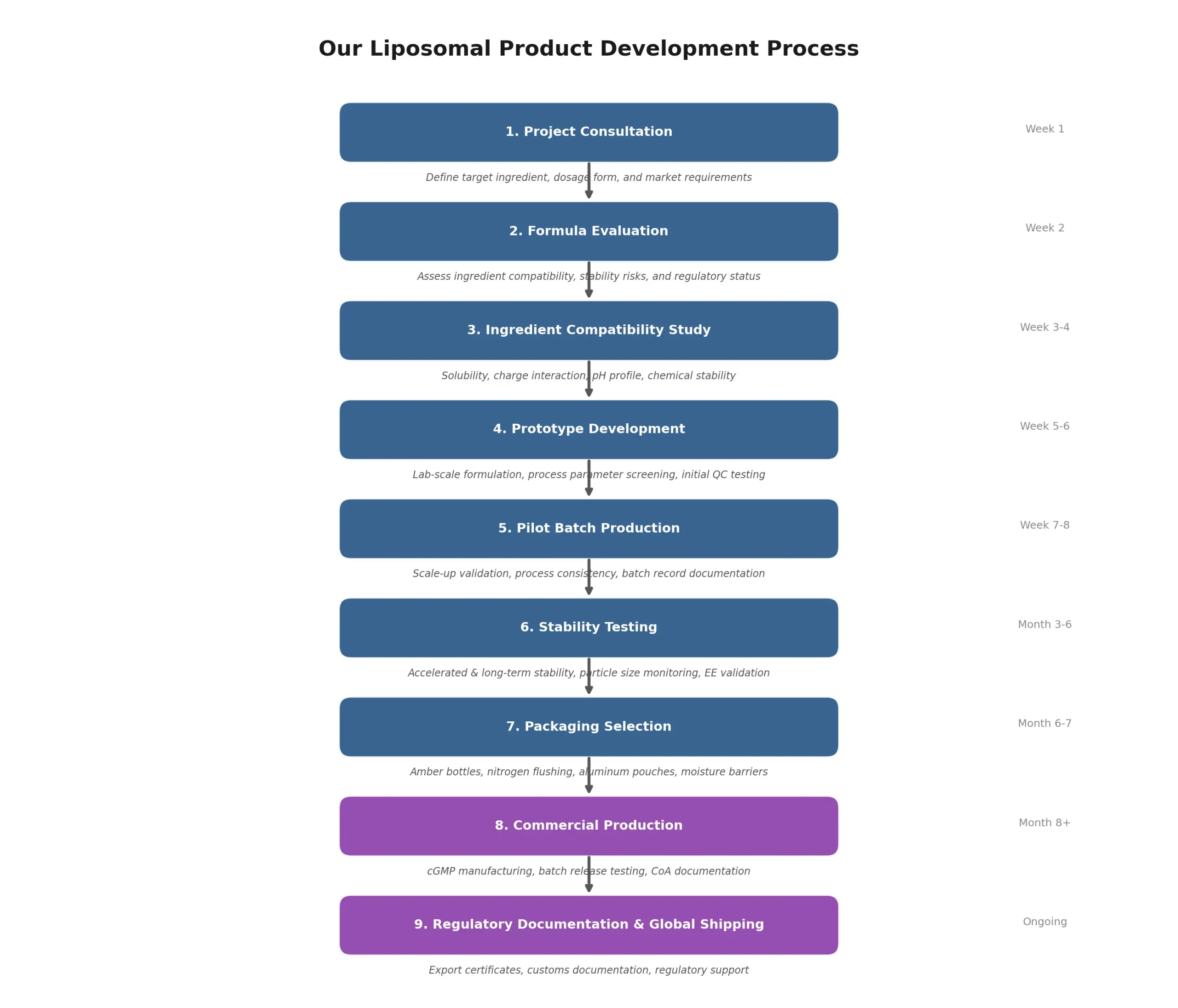
| Stage | Timeline | Key Deliverables |
| 1. Inquiry | 1–3 days | Requirements document; initial feasibility assessment |
| 2. Formula & Quotation | 3–7 days | Custom formula proposal; pricing; regulatory pathway review |
| 3. Sample | 1–2 weeks | Physical sample with COA; organoleptic evaluation |
| 4. Pilot Batch | 2–3 weeks | 1–10 kg powder or 5,000–50,000 units; stability samples retained |
| 5. Scale-Up | 3–4 weeks | Process parameter lock; equivalence data; batch record validation |
| 6. Commercial Production | Per schedule | Full-scale manufacturing; in-process controls; finished product testing |
| 7. QC Release & Delivery | 1–2 weeks | Final COA; regulatory documentation; export logistics |
Commercial Production Overview
Formula Design → Pilot Batch → Scale-Up Validation → Commercial Production → QC Testing → Global Delivery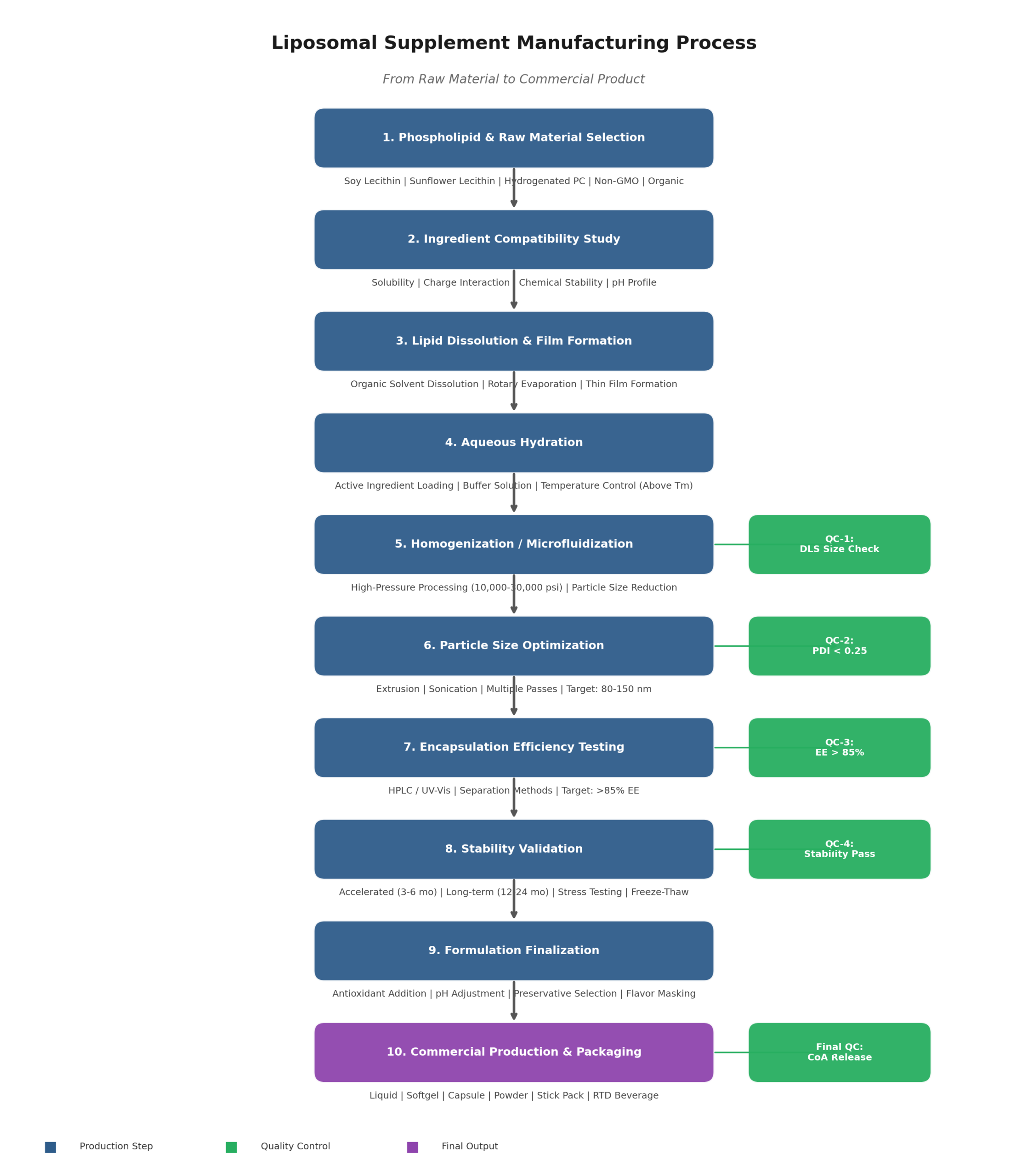
| Packaging Format | Barrier Properties | Best For | Shelf Life Support |
| Aluminum Laminate Pouches | Excellent moisture, oxygen, and light barrier | Stick packs; bulk powder; export shipments | 24–36 months |
| HDPE Bottles + Induction Seal | Good moisture barrier; moderate oxygen barrier | Standard retail; North American market | 18–24 months (with desiccant) |
| Blister Packs (Alu-Alu) | Excellent individual dose protection; zero moisture transmission | Pharmacy channel; clinical trials; premium positioning | 24–36 months |
| Amber Glass Bottles | Excellent light protection; good oxygen barrier (with proper seal) | Liquid formulations; premium positioning | 12–18 months (liquid) |
| Nitrogen-Flushed Containers | Displaced oxygen reduces oxidation risk | High-value formulations; extended shelf life targets | +6–12 months extension |
Packaging Components
- Desiccants:Silica gel canisters (1–3 g per bottle, depending on headspace volume) for powder products
- Oxygen Absorbers:Iron-based scavengers for oxygen-sensitive formulations
- Nitrogen Flushing:Applied during filling to reduce headspace oxygen to <3%
- Secondary Packaging:Cartons with UV varnish for light protection; tamper-evident seals
Storage Recommendations
| Product Form | Recommended Storage | Acceptable Range | Critical Warnings |
| Powder (spray-dried) | 15–25°C; <60% RH | 5–30°C; <75% RH | Protect from moisture and direct sunlight |
| Powder (freeze-dried) | 2–8°C preferred; 15–25°C acceptable | 2–30°C; <60% RH | Refrigeration extends shelf life; protect from moisture |
| Liquid suspension | 2–8°C | 2–25°C (short-term) | Shake well before use; do not freeze |
| Capsule / Softgel | 15–25°C; <60% RH | 5–30°C; <75% RH | Protect from heat and humidity |
Standard Batch Documentation
- Certificate of Analysis (COA)— Batch-specific test results for all specification parameters
- Product Specification— Complete quality specification with test methods and acceptance criteria
- Technical Data Sheet (TDS)— Product description, composition, physicochemical properties, handling guidelines
- Material Safety Data Sheet (MSDS)— Safety information, hazard classification, handling precautions, first aid
- Residual Solvent Report— GC-MS analysis confirming compliance with ICH Q3C limits
- Heavy Metal Report— ICP-MS data for Pb, Cd, As, Hg
- Microbiology Report— TAMC, TYMC, specified organism testing per USP <61>, <62>
- Stability Summary— Available stability data with storage conditions and retest period
Regulatory & Compliance Statements
- Allergen Statement— Free from major allergens; customizable per market requirements
- Non-GMO Statement— Available for non-GMO formulations
- BSE/TSE Statement— Free from bovine spongiform encephalopathy / transmissible spongiform encephalopathy risk materials
- Halal Certificate— Available upon request
- Kosher Certificate— Available upon request
- ISO 22000— Certified
- FSSC 22000— Certified
- cGMP Compliance— Per 21 CFR Part 111 (US) and applicable EU regulations
Ready to Develop Your Liposomal CoQ10 Product with KS Nutripharma?
Whether you are launching a new premium liposomal supplement or expanding your existing product portfolio, our formulation scientists and manufacturing team are ready to support every stage of development—from concept and pilot production to full-scale commercial manufacturing.
Let’s Build Your Next Liposomal Supplement Together
✔ Custom Formula Development
✔ OEM & Private Label Manufacturing
✔ Pilot Batch Production
✔ Regulatory Documentation
✔ Global Export Support
Request a Formula Consultation | Request Samples | Get an OEM Quotation