Introduction
The global glutathione supplement market reached USD 1.427 billion in 2025 and is projected to grow to USD 2.125 billion by 2031, reflecting a CAGR of 6.86%. Within this expanding landscape, liposomal delivery technology has emerged as the most significant advancement in antioxidant supplement formulation. The liposomal supplements market alone was valued at USD 377.39 million in 2025, and is forecasted to reach USD 745.02 million by 2034, growing at 7.85% annually.
Why Liposomal Delivery Is Gaining Attention
Growing Consumer Concerns About Absorption
Many consumers question whether conventional glutathione survives digestion and reaches systemic circulation effectively. This concern is well-founded. A comprehensive review published in PMC (2025) states: “Standard oral glutathione might not effectively raise systemic levels in healthy individuals due to low bioavailability.” The study further notes that “Allen et al. reported no significant differences in glutathione status after 4 weeks of oral glutathione supplementation at 500 mg twice daily,” and that “high doses (3 g) of oral glutathione also found similarly unimpressive results.”
The Shift Toward Premium Supplement Formats
Liposomal products have become increasingly popular across multiple wellness categories:
- Healthy aging supplements – targeting cellular senescence and oxidative stress management
- Beauty-from-within products – addressing skin elasticity, radiance, and UV protection
- Cellular wellness formulas – supporting mitochondrial function and detoxification pathways
- High-end antioxidant products – positioned as premium alternatives to conventional formulations
Market Growth of Liposomal Nutraceuticals
The broader liposomal nutraceuticals market is experiencing robust growth. According to WBCIL (2025), liposomal delivery technology is being applied to:
- Liposomal vitamins (C, D, B-complex) – with demonstrated 5-10x improved absorption
- Liposomal minerals (iron, magnesium, zinc) – addressing common GI side effects
- Liposomal antioxidants (glutathione, CoQ10, resveratrol) – protecting oxidation-sensitive compounds
Understanding Oral Glutathione Bioavailability
Why Bioavailability Became a Major Discussion Topic
One of the most common questions in supplement communities is: “Does oral glutathione actually work?”
The answer requires understanding three key barriers:
- Digestive Environment: Glutathione is a tripeptide (γ-glutamyl-cysteinyl-glycine) that faces rapid hydrolysis by intestinal peptidases.
- Enzymatic Breakdown: The enzyme γ-glutamyl transpeptidase (GGT) in the brush border membrane actively degrades glutathione during absorption.
- First-Pass Metabolism: Even when absorbed, glutathione undergoes significant hepatic metabolism before reaching systemic circulation.
Factors Affecting Glutathione Utilization
Multiple factors influence the effectiveness of glutathione supplementation:
| Factors | Impact on Bioavailability |
|---|---|
| Ingredient Quality | Reduced (GSH) vs. oxidized (GSSG) form; pharmaceutical-grade vs. food-grade purity |
| Dosage | Dose-dependent response; 250-1000 mg/day range most studied |
| Delivery Technology | Liposomal > Micellar > Standard oral powder |
| Supporting Nutrients | Vitamin C, selenium, alpha-lipoic acid enhance recycling |
| Consumer Compliance | Sustained daily intake required for tissue saturation |
Current Scientific Perspectives
A landmark 6-month randomized, double-blind, placebo-controlled trial published in the European Journal of Nutrition demonstrated that:
- High-dose group (1000 mg/day): Glutathione levels increased up to 35% in erythrocytes, plasma, and lymphocytes, and 260% in buccal cells at 6 months
- Low-dose group (250 mg/day): Glutathione levels increased 17% and 29% in blood and erythrocytes
- Immune function: High-dose subjects showed a twofold increase in natural killer cell cytotoxicity after 3 months
- Washout period: Glutathione stores returned to baseline after one-month discontinuation
What Is Liposomal Glutathione?
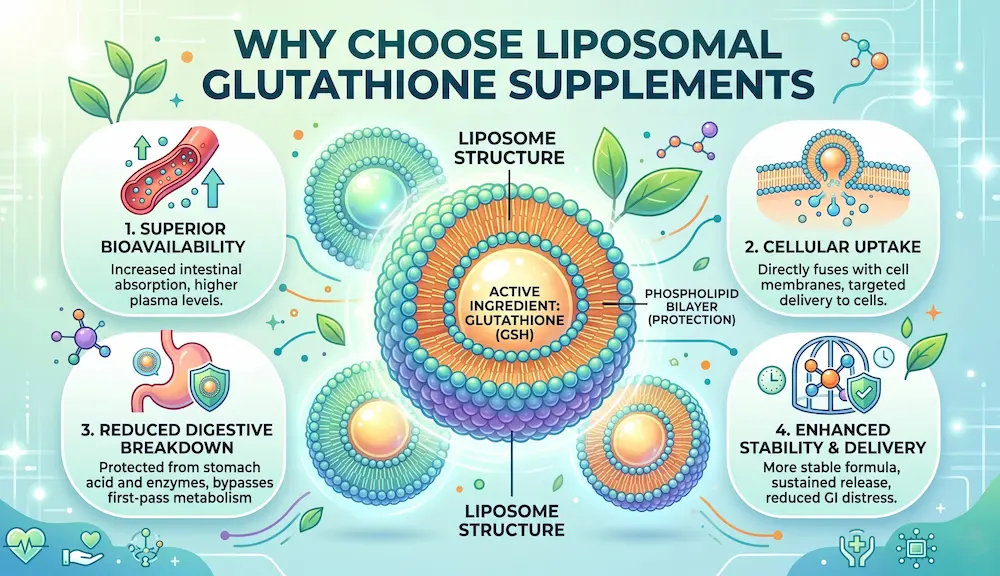
Liposomal glutathione is an advanced delivery form of reduced glutathione (GSH) encapsulated within phospholipid vesicles known as liposomes. This delivery technology is designed to protect glutathione from degradation during digestion and improve its absorption compared with conventional oral glutathione supplements.
Understanding Liposome Technology
Liposomes are microscopic phospholipid vesicles (typically 100-220 nanometers in diameter) designed to encapsulate active ingredients within a lipid bilayer structure. This architecture mimics cell membranes, enabling enhanced protection and delivery of sensitive compounds.
How Liposomal Delivery Systems Work
The liposomal delivery mechanism involves three key stages:
- Protective Encapsulation: The phospholipid bilayer shields glutathione from gastric acid, digestive enzymes, and oxidative degradation during transit through the GI tract.
- Mucosal Adhesion: Liposomes adhere to intestinal epithelial membranes, facilitating direct cellular uptake through endocytosis and membrane fusion.
- Systemic Release: Once absorbed, liposomes release their glutathione payload into lymphatic circulation and portal blood, bypassing first-pass hepatic metabolism.
Why Glutathione Is Frequently Used in Liposomal Systems
Glutathione is particularly suited for liposomal encapsulation because:
- Oxidation Sensitivity: GSH is highly susceptible to oxidation to GSSG; the phospholipid bilayer provides an anaerobic environment.
- Premium Positioning: Liposomal delivery commands higher market positioning and consumer willingness to pay.
- Clinical Validation: Multiple human studies now demonstrate measurable superiority over conventional oral forms.
Liposomal Glutathione vs. Conventional Glutathione
Key Differences Between Delivery Approaches
| Features | Conventional Glutathione | Liposomal Glutathione |
|---|---|---|
| Delivery Technology | Standard powder/capsule | Phospholipid vesicle encapsulation |
| Bioavailability | Limited; significant first-pass metabolism | Enhanced; 6x higher plasma concentration |
| Product Positioning | Mainstream commodity | Premium specialty |
| Manufacturing Complexity | Standard blending/filling | Multi-stage emulsification |
| Ingredient Cost | Lower (~$50-80/kg) | Higher (~$200-400/kg) |
| Formulation Complexity | Low | High; requires particle size control |
| Consumer Perception | Traditional | Advanced/Scientific |
| Shelf Stability | 24-36 months | 18-24 months (requires nitrogen protection) |
Clinical Evidence for Superior Absorption
A groundbreaking study published in the British Journal of Nutrition (Cambridge Core) compared liposomal glutathione (LipoDuo) against plain glutathione in both cellular and human models:
Cellular Uptake Results:
- Liposomal formulation demonstrated ~1.9-fold higher cellular uptake than plain glutathione, peaking at 6 hours (45% vs. 23%)
- Cell proliferation increased by up to 3-fold over control with liposomal delivery
- Wound closure assay: 100% closure at 24 hours (liposomal) vs. 59.8% (plain)
Human Pharmacokinetic Results:
- Maximum plasma concentration reached ~1800 ng/ml (6x higher than plain glutathione)
- Bimodal absorption pattern indicating both rapid and sustained release
- Plasma levels maintained >500 ng/ml at 24 hours post-dose
When Conventional Glutathione May Be Appropriate
- Budget-conscious product lines targeting mass market
- Products where sustained daily dosing (6+ months) is feasible
- Formulations combined with high-dose vitamin C for enhanced recycling
- Applications where topical/transdermal delivery is preferred
When Liposomal Glutathione May Be Preferred
- Premium positioning in beauty-from-within and healthy aging categories
- Products requiring rapid onset of perceived benefits
- Formulations targeting biohackers, athletes, and high-performance consumers
- ODM projects where differentiation and clinical validation are key selling points
Common Consumer Questions About Liposomal Glutathione
This section addresses the most frequently searched questions on Reddit, Quora, and Amazon reviews – directly reflecting purchase intent signals.
Is Liposomal Glutathione Better?
Based on current clinical evidence, liposomal glutathione demonstrates significantly enhanced bioavailability compared to standard oral forms. The 6x plasma concentration increase and 1.9x cellular uptake documented in peer-reviewed studies support its positioning as a superior delivery format for consumers seeking measurable results.
Why Is Liposomal Glutathione More Expensive?
The cost differential reflects:
- Raw material costs: Pharmaceutical-grade phospholipids (sunflower or soy lecithin) cost 3-5x more than standard excipients
- Manufacturing complexity: Multi-stage homogenization, microfluidization, and nitrogen protection systems
- Quality control requirements: Dynamic light scattering (DLS) analysis, zeta potential measurement, encapsulation efficiency testing
- Lower yields: Encapsulation efficiency typically ranges 70-85%, requiring higher input quantities
How Long Does It Take to Notice Results?
Clinical studies indicate:
- Acute effects: Enhanced energy and reduced oxidative stress markers may be detectable within 1-2 weeks
- Tissue saturation: Erythrocyte glutathione levels show significant elevation at 1-3 months
- Immune modulation: Natural killer cell activity improvements observed at 3 months (high-dose protocols)
- Skin benefits: Beauty-from-within applications typically require 8-12 weeks for visible results
Does Liposomal Glutathione Need Vitamin C?
While not strictly necessary, vitamin C serves multiple synergistic functions:
- Recycling support: Ascorbate reduces oxidized glutathione (GSSG) back to active GSH
- Stability enhancement: Vitamin C acts as an antioxidant preservative in the formulation
- Clinical synergy: Combined supplementation shows enhanced markers of oxidative stress reduction
- Consumer expectation: Many premium formulations include 500-1000 mg vitamin C per serving
What Makes a High-Quality Liposomal Product?
Key quality indicators include:
- Particle size: 100-220 nm (verified by DLS)
- Polydispersity index (PDI): <0.2 (indicates uniform particle distribution)
- Encapsulation efficiency: >80% (measured by HPLC before/after disruption)
- Phospholipid source: Non-GMO sunflower or soy lecithin
- Stability data: Accelerated and real-time stability studies per ICH Q1A(R2)
- Third-party testing: Independent verification of glutathione content and purity
Formulation Challenges in Liposomal Glutathione Supplements
Phospholipid Selection
The choice of phospholipid fundamentally determines liposome stability, bioavailability, and regulatory compliance:
| Phospholipid Source | Advantages | Considerations |
|---|---|---|
| Sunflower Lecithin | Non-allergenic, non-GMO, clean label | Higher cost, limited supply chain |
| Soy Lecithin | Established supply, cost-effective | Allergen labeling required in EU/US |
| Egg Phosphatidylcholine | High phosphatidylcholine content (~70%) | Not vegan, allergen concerns |
| Hydrogenated Phospholipids | Enhanced oxidation resistance | Processing complexity |
Key specifications: Phosphatidylcholine (PC) content >50%, peroxide value <5 meq O2/kg, acid value <20 mg KOH/g.
Oxidation Control
Both glutathione and phospholipids are oxidation-sensitive, requiring comprehensive protection strategies:
- Oxygen management: Nitrogen blanketing during all processing stages; dissolved oxygen <2 ppm in final product
- Antioxidant systems: Tocopherols (0.05-0.1%), rosemary extract, or ascorbyl palmitate added to phospholipid phase
- Packaging: Amber glass bottles with nitrogen flush; oxygen absorber sachets; induction-sealed closures
- Storage conditions: 15-25C, relative humidity <60%, protected from light
Taste Masking
A major challenge for liquid liposomal products, sachets, and direct-consumption formats:
- Flavor systems: Natural citrus, berry, or tropical fruit flavors at 0.5-2%
- Sweetener options: Stevia, monk fruit, or erythritol for clean-label positioning
- Texture modification: Xanthan gum or guar gum at 0.1-0.3% for improved mouthfeel
- pH adjustment: 3.5-4.5 range optimizes both stability and palatability
Particle Size Optimization
Particle size directly influences absorption, stability, and sensory performance:
- Optimal range: 100-220 nm for maximum intestinal uptake
- D90 specification: <300 nm to prevent sedimentation and aggregation
- PDI target: <0.2 indicates monodisperse, stable population
- Measurement method: Dynamic Light Scattering (DLS) at 25C, 173-degree backscatter angle
Emulsion Stability
Long-term stability requires integrated formulation expertise:
- Formulation expertise: HLB balance optimization, phase ratio control (lipid:aqueous typically 1:5 to 1:10)
- Processing control: Temperature <40C throughout manufacturing; shear rate optimization
- Quality monitoring: Zeta potential >|30| mV (indicates electrostatic stability); visual inspection for phase separation
Why Brands Choose KS NutriPharma for Liposomal Glutathione Manufacturing
Manufacturing Infrastructure
Scale and Capacity:
- 81,000 m² manufacturing campus with dedicated liposomal production suites
- 12 production lines across liquid, softgel, capsule, powder, and sachet formats
- 5,000+ tons annual production capacity supporting global brand demands
- Class 100,000 (ISO 8) cleanroom environments for liposomal processing
- Nitrogen generation systems on-site for oxygen-free manufacturing
Quality Systems:
- cGMP compliance with 21 CFR Part 111 (US) and EU GMP guidelines
- ISO 22000:2018 food safety management certification
- HACCP implementation across all production lines
- Third-party audits: NSF, UL, and SGS certification programs
- Full batch traceability from raw material to finished product
Liposomal Formulation Expertise
Technical Capabilities:
- In-house R&D laboratory with DLS, zeta potential, and HPLC/MS analytical instruments
- Process development team with 19+ years of liposomal formulation experience
- Patent-pending technologies for enhanced encapsulation efficiency and stability
- Custom phospholipid sourcing from validated suppliers (sunflower, soy, hydrogenated options)
- Particle size optimization achieving PDI <0.2 consistently across batches
Stability-Focused Development:
- Dedicated stability chambers (25°C/60% RH, 40°C/75% RH, 50°C/stress)
- Real-time stability programs following ICH Q1A(R2) guidelines
- Predictive shelf-life modeling using Arrhenius kinetics and statistical regression
- Annual batch verification for ongoing process validation
OEM / ODM / Private Label Support
Full-Service Partnership Model:
- Concept to commercialization: End-to-end project management
- Regulatory strategy: Market-specific compliance pathway identification
- Formula exclusivity: Option for exclusive formulation rights
- White-label packaging: Ready-to-brand finished products with MOQ flexibility
- Documentation package: Complete COA, specifications, stability data, and regulatory support files
Speed to Market:
- Existing formula library: Pre-validated liposomal glutathione bases ready for customization
- Rapid prototyping: 2-4 week turnaround for sample batches
- Streamlined validation: Parallel processing of stability and registration activities
- Global logistics: Established shipping partnerships for temperature-controlled distribution
Quality Assurance Commitment: Every batch of liposomal glutathione manufactured at KS NutriPharma undergoes:
- Raw material identity and purity verification (HPLC/MS)
- In-process particle size monitoring (DLS)
- Encapsulation efficiency confirmation (>80%)
- Finished product release testing (full analytical panel)
- Stability monitoring (real-time and accelerated)
- Third-party microbiological verification
Phospholipid Quality & Liposomal Carrier Systems
The quality of the phospholipid carrier system is one of the most important factors affecting liposome stability, encapsulation efficiency, bioavailability, and shelf life.
Premium liposomal glutathione formulations typically utilize carefully selected phospholipid systems, including:
Non-GMO Soy Lecithin
Non-GMO soy lecithin remains one of the most widely used phospholipid sources in commercial liposomal supplements due to its balanced phosphatidylcholine content, excellent emulsification properties, and cost-effectiveness.
Advantages:
- Established global supply chain
- Cost-efficient for large-scale production
- Suitable phospholipid profile for liposome formation
- Widely accepted in nutraceutical applications
Considerations:
- Allergen labeling may be required in certain markets
- Non-GMO certification is increasingly preferred by premium brands
Non-GMO Sunflower Lecithin
Sunflower lecithin has become increasingly popular among clean-label and allergen-conscious brands.
Advantages:
- Allergen-friendly
- Non-GMO positioning
- Consumer-friendly labeling
- Suitable for vegan formulations
Considerations:
- Higher raw material costs
- Greater supply chain variability compared with soy lecithin
Purified Phosphatidylcholine (PC)
High-phosphatidylcholine ingredients are frequently used in premium liposomal delivery systems to improve membrane integrity and encapsulation performance.
Advantages:
- Enhanced liposome stability
- Improved membrane fluidity
- Higher phospholipid purity
- Suitable for premium formulations
Typical phosphatidylcholine levels may range from 50% to over 90%, depending on formulation objectives.
Phytosterols (Plant Sterols)
Plant sterols are increasingly incorporated into advanced liposomal systems to strengthen phospholipid bilayer structures and improve long-term emulsion stability.
Advantages:
- Improved membrane rigidity
- Enhanced oxidation resistance
- Better particle stability during storage
- Supports premium liposomal system design
Phytosterols are particularly valuable in high-potency liposomal antioxidant formulations containing glutathione, CoQ10, astaxanthin, and other oxidation-sensitive ingredients.
Mixed Phospholipid Systems
Many next-generation liposomal products utilize customized phospholipid blends combining lecithins, phosphatidylcholine concentrates, and plant sterols to achieve optimal particle size, encapsulation efficiency, and stability performance.
Typical Performance Targets:
| Parameter | Target Specification | Testing Method |
|---|---|---|
| Phosphatidylcholine Content | >50% | HPLC or 31P-NMR |
| Encapsulation Efficiency | >80% | HPLC before/after disruption |
| Particle Size | 100-220 nm | Dynamic Light Scattering (DLS) |
| PDI | <0.2 | DLS |
| Peroxide Value | <5 meq O₂/kg | Titration per AOCS Cd 8b-90 |
Commercial Applications of Liposomal Glutathione
Today, liposomal glutathione is rarely sold as a standalone ingredient. Most successful products combine glutathione with synergistic nutrients to address specific consumer needs.
Beauty & Skin Brightening
Popular combinations include:
- Liposomal Glutathione + Vitamin C
- Liposomal Glutathione + White Tomato
- Liposomal Glutathione + Collagen
- Liposomal Glutathione + Hyaluronic Acid
Common positioning:
- Skin Radiance
- Beauty From Within
- Skin Tone Support
- Healthy Aging Beauty
Liver Health & Detoxification
Frequently used combinations include:
- Liposomal Glutathione + NAC
- Liposomal Glutathione + Milk Thistle
- Liposomal Glutathione + Alpha Lipoic Acid
Common positioning:
- Liver Support
- Detoxification
- Cellular Protection
Healthy Aging
Emerging formulations often combine:
- Liposomal Glutathione + NMN
- Liposomal Glutathione + Resveratrol
- Liposomal Glutathione + Quercetin
Common positioning:
- Cellular Wellness
- NAD+ Support
- Healthy Aging
Longevity & Mitochondrial Health
Advanced formulations frequently include:
- Liposomal Glutathione + CoQ10
- Liposomal Glutathione + PQQ
- Liposomal Glutathione + Ergothioneine
Common positioning:
- Mitochondrial Function
- Energy Production
- Longevity Support
Sports Recovery
Popular combinations include:
- Liposomal Glutathione + Magnesium
- Liposomal Glutathione + CoQ10
- Liposomal Glutathione + Tart Cherry
Common positioning:
- Exercise Recovery
- Oxidative Stress Management
- Athletic Performance
Frequently Asked Questions About Liposomal Glutathione Supplements
What is liposomal glutathione?
Liposomal glutathione is glutathione (a tripeptide antioxidant) encapsulated within microscopic phospholipid vesicles called liposomes. These vesicles, typically 100-220 nanometers in diameter, protect glutathione from digestive degradation and enhance its absorption into the bloodstream and cells. The phospholipid bilayer structure is biomimetic—identical to human cell membranes—facilitating direct cellular uptake through endocytosis and membrane fusion.
Is liposomal glutathione better than regular glutathione?
Clinical evidence indicates that liposomal glutathione achieves significantly higher bioavailability than conventional oral forms. A study published in the British Journal of Nutrition (2026) demonstrated that liposomal glutathione achieved 6× higher peak plasma concentrations and 1.9× higher cellular uptake compared to plain glutathione. However, “better” depends on application context—conventional forms may be adequate for general wellness at lower price points, while liposomal is preferred for therapeutic and premium applications requiring maximum absorption.
How do liposomes work?
Liposomes work through multiple mechanisms:
(1) Gastric protection: The phospholipid bilayer shields encapsulated glutathione from stomach acid and enzymatic degradation;
(2) Intestinal uptake: Liposomes merge with intestinal cell membranes through endocytosis, releasing payload directly into enterocytes;
(3) Lymphatic transport: Lipid-based vesicles can access intestinal lymphatic pathways, bypassing hepatic first-pass metabolism;
(4) Cellular delivery: The biomimetic structure facilitates direct cellular uptake, enhancing intracellular glutathione concentrations.
Why is liposomal glutathione expensive?
The cost premium reflects:
(1) Phospholipid raw materials (purified to ≥90% phosphatidylcholine);
(2) Specialized manufacturing equipment (high-shear homogenizers, microfluidic processors);
(3) Quality control complexity (particle size, zeta potential, encapsulation efficiency testing);
(4) Lower batch yields due to processing losses;
(5) Stability testing requirements (accelerated and real-time studies). The manufacturing complexity is 2-3× higher than conventional glutathione production.
Does liposomal glutathione require refrigeration?
High-quality liquid liposomal glutathione typically exhibits a shelf life of 18-24 months at room temperature (20-25°C) when unopened and stored away from light. Some formulations benefit from refrigeration after opening to further protect the phospholipid structure. Powder and softgel formats generally offer 24-36 month shelf life at room temperature. Always follow specific product storage instructions, as formulation variations affect stability requirements.
What dosage is commonly used?
Clinical evidence supports daily dosages of 500-1000 mg for measurable increases in systemic glutathione levels. The landmark 6-month European Journal of Nutrition study (Richie et al., 2014) used 250 mg/day (low dose) and 1000 mg/day (high dose), with both groups showing significant increases in blood, erythrocyte, and lymphocyte glutathione levels. The high-dose group achieved up to 35% increases in erythrocytes and 260% in buccal cells at 6 months.
Which format is most stable?
Softgel and powder formats generally offer the longest shelf life (24-36 months) due to reduced water activity and oxygen exposure. Liquid formulations require more careful packaging (nitrogen flush, amber glass) but offer the fastest absorption. The stability hierarchy is: softgel > powder > sachet > liquid. However, liquid formats provide the most immediate bioavailability and are preferred for therapeutic applications.
Can liposomal glutathione be formulated into gummies?
Yes, but with specific manufacturing adaptations. Cold-process gummy technologies (modified pectin systems setting at 40-50°C) are required because standard gummy manufacturing involves 80-90°C heating that would degrade liposomes. The liposomal emulsion must be added at the final mixing stage and integrated with the gelling matrix without separation. Individual nitrogen-flushed wrapping is essential for oxidation protection.
How long is the shelf life?
- Liquid formulations: 18-24 months unopened at 20-25°C; refrigerate after opening
- Powder formulations: 24-36 months in sealed, nitrogen-flushed containers
- Softgel formulations: 24-36 months at room temperature in blister packs or bottles
- Sachet formulations: 18-24 months in multi-layer aluminum laminate
Shelf life is validated through ICH-compliant accelerated stability studies (40°C/75% RH for 6 months) and real-time studies (25°C/60% RH for 24+ months).
What ingredients work well with liposomal glutathione?
Top synergistic ingredients:
- Vitamin C: Recycles oxidized glutathione back to active form; liposomal vitamin C shows 5-10× enhanced absorption
- CoQ10: Converges at mitochondrial level for combined cellular energy and antioxidant protection
- Alpha Lipoic Acid: Directly regenerates glutathione and supports insulin sensitivity
- Selenium: Essential cofactor for glutathione peroxidase (GPx) enzyme activity
- Resveratrol: Activates Nrf2 pathway synergistically with glutathione for endogenous antioxidant defense
- Ergothioneine: Premium longevity ingredient with specific cellular transport via OCTN1
Is liposomal glutathione safe?
Liposomal glutathione has demonstrated excellent safety profiles in clinical studies. The 6-month European Journal of Nutrition trial (54 subjects) reported no adverse effects at doses up to 1000 mg/day. A 2024 randomized crossover trial (PMC13023597) confirmed both liposomal and micellar formulations were well-tolerated. Standard safety considerations include: potential sulfur odor/taste (not a safety issue but may affect compliance), rare allergic reactions to phospholipid sources (soy or sunflower), and theoretical concern about immunosuppression at very high doses (not observed at standard supplemental levels).
What is the difference between reduced and oxidized glutathione?
Under physiological conditions, more than 98% of total glutathione exists in the reduced form (GSH), which is the biologically active antioxidant form. When GSH neutralizes free radicals, it becomes oxidized (GSSG). The GSH:GSSG ratio is a critical indicator of cellular redox status—healthy cells maintain a high ratio (>10:1), while oxidative stress shifts the balance toward GSSG. For supplementation, reduced glutathione (GSH) is preferred because it is immediately bioactive. Oxidized glutathione (GSSG) must be enzymatically reduced by glutathione reductase before becoming functional, and this conversion efficiency varies between individuals.
How is liposomal glutathione manufactured?
The manufacturing process involves:
(1) Hydration: Phospholipids are hydrated in aqueous buffer to form multilamellar vesicles;
(2) Size reduction: High-shear homogenization (15,000-25,000 rpm) reduces particle size;
(3) Refinement: Microfluidization or ultrasonic processing achieves target particle size (100-220 nm);
(4) Encapsulation: Glutathione is incorporated into the aqueous core during processing;
(5) Quality control: In-process testing for particle size, PDI, and encapsulation efficiency;
(6) Stabilization: Addition of antioxidants and pH adjustment;
(7) Packaging: Nitrogen-flushed containers under oxygen-free conditions.
The entire process is conducted under nitrogen blanket and temperature control (<40°C) to prevent oxidation.
What quality tests should I request from my manufacturer?
Essential quality tests for liposomal glutathione include:
- Particle size and PDI (Dynamic Light Scattering): 100-220 nm, PDI <0.2
- Zeta potential (Electrophoretic Light Scattering): -30 to -50 mV
- Encapsulation efficiency (HPLC/MS after separation): >80%
- Glutathione content and purity (HPLC/MS): ≥98% reduced GSH
- Oxidation status (LC-MS/MS): GSH:GSSG ratio >10:1
- Microbial limits (USP <61>): Total count <1000 CFU/g, pathogens absent
- Heavy metals (ICP-MS): Lead <10 ppm, Cadmium <1 ppm
- Stability data: 6-month accelerated (40°C/75% RH) and 12-month real-time (25°C/60% RH)
Can I make structure/function claims for liposomal glutathione?
United States (DSHEA): Permitted structure/function claims include “supports antioxidant defense,” “supports healthy detoxification processes,” and “supports immune system function.” These claims require substantiation but do not require FDA pre-approval. Disease claims (e.g., “treats,” “cures,” “prevents”) are prohibited without FDA drug approval.
European Union (EFSA): Health claims must be pre-approved through the EFSA Article 13 or 14 process. Currently, no specific health claims for glutathione are authorized under the EU Register on nutrition and health claims. General claims about antioxidant function may be permissible under certain conditions, but specific claims require individual authorization.
Other Markets: Regulatory requirements vary significantly. TGA Australia permits “traditionally used” claims under listed medicine status. Health Canada requires NPN approval with specific claim substantiation. Always consult regulatory experts for market-specific guidance.
CONTACT KS NUTRIPHARMA:
- Schedule a Technical Consultation: Discuss your target market, positioning, and formulation requirements with our liposomal development team
- Request Sample Evaluation: Receive prototype samples of our base liposomal glutathione formulations for internal evaluation
- Review Documentation Package: Access complete COA, specifications, stability data, and regulatory support files
- Initiate Development Project: Begin custom formulation or white-label production with defined timelines and milestones
Contact KS NutriPharma today to discuss your liposomal glutathione manufacturing requirements. Whether you are launching a new beauty brand, expanding your healthy aging portfolio, or developing a professional-grade detoxification formula, our team provides the technical expertise, manufacturing capacity, and regulatory support to bring your product to market with confidence.
Scientific References and Sources
- Richie JP Jr, et al. “Randomized controlled trial of oral glutathione supplementation on body stores of glutathione.” European Journal of Nutrition. 2014; published online May 5, 2014. Nutritional Outlook Summary
- Prasad KN, et al. “Liposomal glutathione outperforms plain glutathione in uptake, cell regeneration and systemic availability: evidence from cellular and human models.” British Journal of Nutrition. 2026; Cambridge Core. Full Article
- Targeted Metabolomic Assessment Study. “A Targeted Metabolomic Assessment of Oral Glutathione Bioavailability and Safety in Humans: A Randomized Crossover Clinical Trial.” Antioxidants. 2024; PMC13023597. Full Article
- Allen J, Bradley RD. “Effects of Oral Glutathione Supplementation on Systemic Oxidative Stress Biomarkers in Human Volunteers.” Journal of Alternative and Complementary Medicine. 2011;17:827-833. Referenced in PMC13023597
- Witschi A, et al. “The Systemic Availability of Oral Glutathione.” European Journal of Clinical Pharmacology. 1992;43:667-669. Referenced in PMC13023597
- Glutathione-Related Enzymes Review. “Glutathione-Related Enzymes and Proteins: A Review.” PMC. 2015; PMC9919958. Full Article
- Liposomal Delivery Study. “Liposomal delivery as a strategy to improve bioavailability.” Dove Medical Press. 2026; NDS. Full Article
- Purpura M, et al. “Liposomal delivery enhances absorption of vitamin C into plasma and leukocytes: a double-blind, placebo-controlled, randomized trial.” European Journal of Nutrition. 2024;63(8):3037-3046. Referenced in Dove Medical Press Study
- Jäger R, et al. “Impact of liposomal delivery on coenzyme Q10 absorption: a double-blind, placebo-controlled, randomized trial.” Frontiers in Nutrition. 2025;12:1605033. Referenced in Dove Medical Press Study
- Market Data Sources:
- Liposomal Technology Sources:
- Bioavailability Comparison Sources:
- Stability and Regulatory Sources:
- Oxidized vs Reduced Glutathione:
© 2026 KS NutriPharma. All rights reserved. This document contains proprietary manufacturing information and is intended for qualified business partners only.