
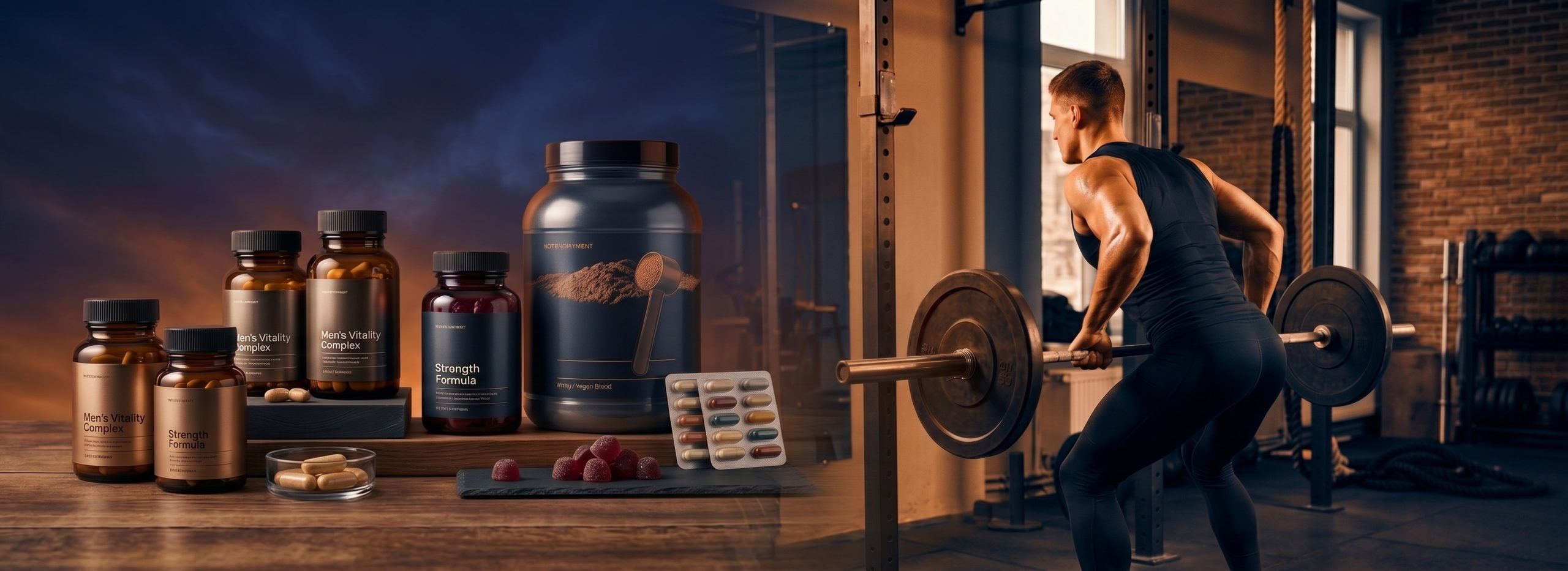
Muscle Building Supplements Manufacturing at a Glance
KS Nutripharma is a muscle building supplements manufacturer for sports nutrition brands that need custom OEM, ODM, or private-label production — protein powders, creatine systems, pre-workout blends, recovery formulas, and mass-gain SKUs, built on the same powder and granule manufacturing lines used for high-load drink mixes, stick packs, and tubs.
Pick a start-ready formula below to sample, or send an existing BOM. Flavor, pack, and destination-market dose are locked on the brief; we do not restart from a blank ingredient list unless you ask for a full ODM.
Buyer Snapshot
Finished sports-nutrition SKUs under your brand. Comparable quotes need product type, formula or BOM, format, stimulant status, and volume.
| RFQ field | Spec. |
|---|---|
| Scope | Finished SKU — protein, creatine, pre-workout, EAA, mass gainer |
| Product type | Protein (F01–F03) · creatine (F04–F05, F10) · pre-workout (F06–F07) · EAA (F08) · mass gainer (F09) |
| Default formula | F01 unless another card is named |
| Stimulant | F06 (caffeine) or F07 (stim-free) — separate SKUs |
| Protein | WPI (F01) · plant (F02) · WPC (F03) |
| Format | Powder tub · stick · capsule (F10). Gummy / shot only where the dose fits |
| Starting MOQ | Capsules 3,000–5,000 · tubs often 1,000–3,000 · sticks often from ~10,000 |
| Lead time | Sample 7–15 days · commercial typically 4–8 weeks after formula, pack, and artwork lock |
| Docs | Spec · COA · metals / micro · allergen · traceability |
Start-Ready Muscle-Building Formula Library
Established commercial SKUs. Starting doses match typical market servings. Flavor, pack, protein grade, and destination dose are set on the RFQ.
Positioning: Premium gym and daily-training line. One-scoop protein + creatine — no second SKU.
Claim territory: High-protein daily nutrition; creatine for strength-training positioning. WPI path for low-lactose / low-fat labels.
Specs (per ~34 g serving): WPI90 → 25 g protein (~5.5 g BCAA from the protein) · creatine monohydrate 3 g (5 g on request) · target lactose < 1% · fat < 1 g · milk allergen
Sensory & process: Instantized (granulation + lecithin) for cold-water mix; foam and wet-out signed off at sample. Standard flavors: chocolate, vanilla, coconut. Sweeteners: sucralose, or stevia / monk fruit for a cleaner label.
Customize & MOQ: Pack — 2 lb / 5 lb tub, stick pack. Add-ons — digestive enzyme blend; electrolytes. Docs — Non-GMO / gluten-free files where the supply path supports them. Reference MOQ: from ~500 tubs on a standard white-label pack · sticks from ~10,000 units.
Positioning: Vegan and lactose-intolerant training line. Dairy-free protein + creatine for the same daily-use occasion as F01.
Claim territory: Plant-protein nutrition; dairy-free / vegan labeling; creatine for strength-training positioning.
Specs (per ~40 g serving): Pea + rice blend → 22 g protein (complementary amino profile) · creatine monohydrate 3 g · dairy-free path
Sensory & process: Plant flavor-masking for pea notes. Particle-size control to cut grit vs a standard pea isolate. Mix and mouthfeel signed off at sample.
Customize & MOQ: Pack — 2 lb / 5 lb tub, stick pack. Add-ons — enzyme blend; creatine to 5 g (scoop weight up). Docs — vegan, Non-GMO, gluten-free where the supply path supports them.
Reference MOQ: from ~500 tubs · sticks from ~10,000 units.
Positioning: Price-led gym and mass-retail protein. Same daily-use occasion as F01 at a lower landed cost.
Claim territory: High-protein daily nutrition. Not a lactose-free SKU — that is F01 or F02.
Specs (per ~32 g serving): WPC80 → 24 g protein · instantized · milk allergen · lactose higher than F01
Sensory & process: Instantized for shaker mix. Chocolate / vanilla / unflavored. Stevia / monk fruit on request. Mix signed off at sample.
Customize & MOQ: Pack — 2 lb / 5 lb tub. Add creatine → run as F01 on a WPC base. Add-ons — enzyme blend. Reference MOQ: from ~500 tubs on a standard white-label pack.
Positioning: Core creatine SKU for gym retail and Amazon. Unflavored stack item or flavored single-serve.
Claim territory: Creatine for strength and high-intensity training positioning. Straight 5 g serving — category-standard dose.
Specs (per 5–6 g serving): Creatine monohydrate 5 g · mesh on spec · unflavored default
Sensory & process: Mesh and dispersion selected to cut grit and settlement. Unflavored for stacking; flavored stick uses a light fruit system. Stick moisture controlled in barrier film.
Customize & MOQ: Pack — tub or 5 g stick. Branded creatine grade only if named on the spec. Flavors — unflavored, fruit.
Reference MOQ: from ~500 tubs · sticks from ~10,000 units.
Positioning: Strength / high-intensity stack for gym channels. One powder instead of two tubs.
Claim territory: Creatine + beta-alanine for strength and high-intensity training positioning. Pack must carry tingling/sensory copy where required.
Specs (per ~10–12 g serving): Creatine 5 g · beta-alanine 3.2 g
Sensory & process: Flavor system built for 8+ g actives. Acid/sweetener balance to cover beta-alanine. Tingling is a label issue, not a process defect.
Customize & MOQ: Pack — tub or stick. Flavors — fruit / unflavored. Add-ons — taurine 1–2 g; citrulline (or move to F06/F07).
Reference MOQ: from ~500 tubs · sticks from ~10,000 units.
Positioning: Caffeinated pre-workout for gym and e-commerce. High-acid fruit SKU, not a protein flavor.
Claim territory: Pre-session training nutrition. Caffeine milligrams and warnings follow the destination market. Not the same SKU as F07.
Specs (per ~18–22 g serving): Citrulline malate 2:1 6–8 g · beta-alanine 3.2 g · creatine 3 g · caffeine 200 mg (150–300 mg on the brief)
Sensory & process: Malate acid is part of the flavor. High-active flavor-masking and stick-film moisture control. Caffeine bitterness balanced in the sweetener system.
Customize & MOQ: Pack — tub or stick. Add-ons — theanine 100–200 mg; tyrosine 500–1,000 mg; beet/nitrate (color and listing check). Sweeteners — sucralose or stevia / monk fruit.
Reference MOQ: from ~500 tubs · sticks from ~10,000 units.
Positioning: Evening, caffeine-sensitive, and stim-free retail line. Same performance spine as F06, different customer and artwork.
Claim territory: Pre-session training nutrition without caffeine. Stim-free means no caffeine and no other stimulants.
Specs (per ~16–20 g serving): Citrulline malate 2:1 6–8 g · beta-alanine 3.2 g · creatine 3 g · caffeine none
Sensory & process: Same high-active fruit system as F06, without caffeine to cover bitterness — flavor signed off as its own sample.
Customize & MOQ: Pack — tub or stick. Do not add caffeine after sample approval; that is F06. Add-ons — beet/nitrate on request.
Reference MOQ: from ~500 tubs · sticks from ~10,000 units.
Positioning: Intra-workout and post-session hydration + amino line. Gym bag and stick-pack e-commerce.
Claim territory: Amino-acid nutrition and electrolyte hydration. Not interchangeable with a BCAA-only SKU on the same artwork.
Specs (per ~14–18 g serving): EAA 8–10 g · sodium 200–300 mg · potassium 150–200 mg · magnesium 50–100 mg
Sensory & process: Amino bitterness covered with acid/sweetener balance and flavor-masking. Hygroscopic blend in moisture-barrier sticks. Mix signed off at sample.
Customize & MOQ: Pack — tub, sachet, stick. Add-ons — cluster dextrin 10–25 g; coconut water powder 1–3 g. BCAA-only quoted as a separate, lower-cost SKU. Docs — gluten-free / vegan where the amino path supports it.
Reference MOQ: from ~500 tubs · sticks from ~10,000 units.
Positioning: Hard-gainer and high-calorie tub for bodybuilding retail. Large scoop, chocolate/vanilla — not a 30 g whey SKU.
Claim territory: High-protein, high-calorie nutrition. kcal band is a spec, not a medical claim.
Specs (per ~150–180 g serving): WPC → 50 g protein · maltodextrin and/or oat 70–90 g carbohydrate · MCT 5–10 g · milk allergen
Sensory & process: Carb and MCT set so the scoop mixes in a realistic liquid volume. Instantized protein base; anti-caking for large-tub humidity. Chocolate / vanilla.
Customize & MOQ: Pack — 5 lb / 10 lb tub. Add-ons — digestive enzyme blend; creatine 3 g. Oat vs maltodextrin locked on the brief. Reference MOQ: from ~500 large tubs; kg-based quote on bulk.
Positioning: Travel, gym-bag, and no-shaker creatine. Honest serving math for retail reviews: 5 capsules ≈ 5 g, not 2.
Claim territory: Creatine for strength-training positioning in a closed unit dose.
Specs: Creatine monohydrate ~1,000 mg / 00# capsule · 5 caps/day · gelatin or HPMC · 150-count bottle = 30 servings
Sensory & process: Unflavored. Fill-weight and flow locked at sample. Trade-off is pill burden, stated on pack.
Customize & MOQ: Pack — bottle or blister. HPMC for vegan. 3 g/day = 3 caps if the brand will not carry a 5-cap serving. 5 g in 2 caps only if a different fill is proven at sample. Docs — vegan (HPMC), gluten-free where applicable. Reference MOQ: from ~3,000–5,000 bottles.
Advanced Formulation Engineering & Technical Feasibility
Sensory, physical stability, and stimulant-file issues are engineered before pilot — not discovered on the first commercial batch. Capabilities below sit on our processing and powder lines: instantization, fluid-bed granulation, particle-size control, flavor-masking, and project-scoped microencapsulation.
Sign-off before commercial production: mix, mouthfeel, and benchtop / sample stability are locked on the approved sample. Commercial release follows that sample — not a new process.
Concern: A 5 g creatine serving in standard 00# capsules is a high pill count. Coarse powder grit and cup settlement drive returns on flavored creatine and sticks.
Engineering: Creatine is specified to a defined mesh (commercial 200-mesh grades where the brief requires fast suspension). Dispersion and flavor systems are built for suspension, not for hiding grit with sweetness. Where travel is the SKU job, 00# fill weight is maximized on the proven capsule; where pill count is not acceptable, the same 5 g dose is engineered as an instantized tub or barrier-film stick. High-load filling is used to reduce capsule count only when density is proven at sample — we do not quote 5 g in two capsules as a default.
Commercial impact: One dose, three put-ups (tub, stick, capsule regimen) with mix and grit signed off before artwork. Fewer “gritty creatine” and “too many pills” review themes.
Concern: 24–25 g WPI/WPC servings foam, hang on the shaker, feel gritty, or cake after humidity — and flavor alone does not fix the protein system.
Engineering: Instantization via lecithin and fluid-bed / granulation so the protein wets in cold water. Particle-size distribution is set for the scoop, not only for the lab beaker. Foam is managed in the protein process (grade + instantization + fill), not by stacking defoamers on a poorly wetted powder. Tubs and sticks use moisture-barrier pack and humidity-controlled fill so hygroscopic blends do not cake in transit. Mix, foam, and mouthfeel are part of sample sign-off.
Commercial impact: A daily protein SKU that mixes in a shaker, holds texture through shipping, and protects repeat purchase. Flavor work starts after the protein system is signed off.
Concern: Citrulline malate + beta-alanine + caffeine is acidic, hygroscopic, and bitter. Stick packs cake. Stimulant limits and warning copy differ by market. Adding caffeine after a stim-free sample is a new SKU, not a tweak.
Engineering: Two pre-engineered bases — stimulant and stimulant-free — sharing the same acid/flavor spine so parallel SKUs stay sensorially aligned. Moisture-sensitive and bitter actives can use project-scoped microencapsulation plus high-barrier stick film; caffeine milligrams and destination warnings are reviewed against the target market before pilot. Flavor-masking is built for the malate acid load, not for a chocolate protein system.
Commercial impact: Stim and stim-free can launch as a pair without a second full R&D cycle. Stick caking and stimulant-file rework are designed out before the first commercial PO.
For F01–F03 and F09. Swap the protein path or add a carb/enzyme line without rebuilding the SKU from zero. Servings are common commercial ranges. Claim copy follows the destination market. Branded enzyme or dextrin grades only if named on the spec.
Lean / High-Protein Daily Upgrade
- Action: Swap WPC80 → WPI90
- Serving: 25–28 g protein (target lactose < 1% on WPI path)
- Engineering: Fluid-bed lecithination for cold-water wet-out and foam control
- Compliance: Milk allergen file. Lactose-light positioning only with COA support — not a lactose-free claim by default
- Value: Premium gym SKU: higher protein %, cleaner macros, one-scoop protein + creatine vs a two-tub stack
- Base SKU: F01
Dairy-Free / Vegan Daily Upgrade
- Action: Swap whey → pea + rice
- Serving: 22–25 g protein
- Engineering: Particle-size control + plant flavor-masking for pea notes and grit vs a standard pea isolate
- Compliance: Vegan / Non-GMO / gluten-free files where the supply path supports them. PDCAAS documented only if the brief requires that file
- Value: Opens lactose-intolerant and vegan channels without a second R&D program
- Base SKU: F02
Cost-Line Daily Protein
- Action: Keep WPC80
- Serving: ~24 g protein
- Engineering: Instantized whey; mix signed off at sample
- Compliance: Milk allergen. Do not reuse F01 lactose copy
- Value: Lower landed cost for mass-retail / first SKU; same daily-use occasion as F01
- Base SKU: F03
Digestive-Comfort Add-On
- Action: Add protease / enzyme blend
- Serving: 50–100 mg (assay on spec)
- Engineering: Post-blend enzyme assay; flavor checked at sample
- Compliance: Digestive-support positioning only where the market allows
- Value: Differentiates a whey SKU for “comfort” shoppers without changing the protein claim
- Base SKU: F01 / F03 / F09
Cleaner-Carb Gainer Upgrade
- Action: Add or swap highly branched cyclic dextrin ± MCT
- Serving: 15–30 g carb add-on, or F09 carb rebuild
- Engineering: Dextrin vs maltodextrin changes mouthfeel; spray-dried MCT to limit oiling
- Compliance: Carb source declared. GI / “sustained energy” copy is market-dependent
- Value: Premium gainer texture vs a sticky maltodextrin tub
- Base SKU: F09
Night / Slow-Protein SKU
- Action: Add or blend micellar casein
- Serving: 20–24 g protein
- Engineering: Thicker mix — not a cold-water juice SKU
- Compliance: Milk allergen; separate artwork from instant whey
- Value: Second SKU in the same protein line (AM whey / PM casein) without a new factory
- Base SKU: F01 or a casein-forward BOM
Whey and plant run as separate campaigns under cGMP allergen control — two BOMs, two artworks, two allergen files.
Also building strength or pre-workout SKUs?
For F04–F07. Add a strength stack or split stimulant vs stim-free without a second full R&D cycle.
Micronized Creatine Upgrade
- Action: Add or lock creatine monohydrate (defined mesh; 200-mesh when specified)
- Serving: 3 g in a protein scoop · 5 g standalone
- Engineering: Dispersed for cold-water suspension; grit signed off at sample. Capsules follow fill weight — 5 g is not a two-capsule default
- Compliance: Strength-training positioning. Mesh on spec
- Value: Category-standard 5 g serving with mix that holds Amazon reviews
- Base SKU: F04 / F01
Beta-Alanine Stack
- Action: Add beta-alanine (CarnoSyn-compatible grade on request)
- Serving: 1.6–3.2 g
- Engineering: Flavor built for the active load
- Compliance: Paresthesia (tingling) advisory where the market expects it
- Value: Strength-line SKU vs straight creatine, same factory path
- Base SKU: F05 / F06 / F07
Betaine (Moisture-Control) Add-On
- Action: Add betaine anhydrous
- Serving: 1.5–2.5 g
- Engineering: High-barrier tub liner or tri-layer stick film — not monolayer poly
- Compliance: Strength-stack add-on
- Value: Extra stack SKU without a new flavor program if the barrier pack is locked
- Base SKU: F05
Citrulline Path
- Action: Citrulline malate 2:1 or L-citrulline — one flavor system
- Serving: Malate 6–8 g · free citrulline 3–6 g
- Engineering: Malate = acid + scoop weight (fruit pre-workout). Free citrulline = lower-acid pump path. Not a 1:1 gram swap
- Compliance: Pre-session pump positioning
- Value: Two retail stories (classic sour pre vs cleaner pump) from one spine
- Base SKU: F06 / F07
Stimulant Platform
- Action: Caffeine anhydrous ± L-theanine
- Serving: Caffeine 150–300 mg (200 mg default) · theanine 100–200 mg
- Engineering: Theanine does not make a stim formula stim-free. Two bases, two artworks, two files
- Compliance: Destination stimulant warnings and milligram caps reviewed before pilot
- Value: Core gym pre-workout with a defined caffeine SKU — no post-sample caffeine add
- Base SKU: F06
Stim-Free Platform
- Action: Same citrulline + beta-alanine + creatine spine, no caffeine
- Serving: As F07
- Engineering: Flavor signed off without caffeine to cover bitterness
- Compliance: Stim-free = no caffeine and no other stimulants
- Value: Evening / caffeine-sensitive channel as a paired SKU, not a late BOM change
- Base SKU: F07
For F08. Amino + electrolyte SKUs for gym-bag and stick e-commerce — not a 25 g protein tub.
Full EAA
- Action: Lock full EAA complex
- Serving: 8–10 g
- Engineering: Acid/sweetener balance + flavor-masking for bitterness
- Compliance: Amino-acid / recovery positioning. Not a BCAA artwork
- Value: Premium intra/post SKU vs a BCAA cost-line
- Base SKU: F08
BCAA Cost-Line (Separate SKU)
- Action: BCAA 2:1:1 instead of EAA
- Serving: 5–7 g
- Engineering: Lower active load and cost vs EAA
- Compliance: Must not be labeled or sold as EAA
- Value: Entry-price amino SKU; keep EAA as the hero
- Base SKU: New SKU — not an F08 relabel
Electrolyte Core
- Action: Add or lock Na / K / Mg
- Serving: Sodium 200–300 mg · potassium 150–200 mg · magnesium 50–100 mg
- Engineering: Salt/acid balance in sticks; barrier film for hygroscopic blends
- Compliance: Sports-hydration band — not a medical ORS claim
- Value: Hydration + amino in one stick; higher repeat vs amino-only
- Base SKU: F08
Coconut Water Flavor / K
- Action: Add coconut water powder
- Serving: 1–3 g
- Engineering: Color and moisture watched in sticks
- Compliance: Flavor + potassium contribution; declare the ingredient
- Value: Cleaner hydration story on pack without a new electrolyte system
- Base SKU: F08
| Format | Fits these profiles | Engineering constraint |
|---|---|---|
| Powder tubs | Protein 20–30 g, gainers 100 g+, pre-workout 15–22 g, 5 g creatine | Hygroscopic actives need liner + desiccant path as specified |
| Sticks | Single-serve pre-workout, EAA, 5 g creatine | High-fat gainers and wet-acid pre-workouts need barrier film — not standard monolayer poly |
| Capsules (00# gelatin / HPMC) | Compact creatine regimens, 1–3 g amino or botanical add-ons | Not feasible as a default: 25 g protein, or 5 g creatine in fewer than ~5 standard 00# capsules |
| Tablets | Dense BCAA, electrolyte, mineral SKUs after compression sample | Not for multi-gram drink powders or high-acid pre-workout |
| Gummies | Low-dose accessory in a sports set | Not the hero format for 25 g protein or 5 g creatine |
| Liquid / shots | Separate liquid program | A powder RFQ does not include UHT protein RTD |
Default put-up for this category is powder. Instantization, granulation, and flavor run on the powder lines.
Incoming: supplier qualification → COA vs locked spec → identity → spec check → risk-based contaminants → release.
| Material | Release checks | Typical methods |
|---|---|---|
| Whey / plant protein | Protein, moisture, identity, micro, metals, allergen | Kjeldahl or Dumas · moisture · ICP-MS · USP-aligned micro where specified · milk allergen for whey |
| Creatine monohydrate | Assay, impurities | HPLC · creatinine / related impurities as specified · metals · micro |
| Amino acids (EAA, beta-alanine, citrulline) | Identity, assay | HPLC or UV per grade |
| Electrolytes / minerals | Assay vs label | Titration / ICP as specified |
In process: blend uniformity on validated processes · fill-weight control · milk vs plant campaign and cleaning validation.
Finished goods: appearance, weight, assay vs label where applicable, micro, metals by risk, powder mix, capsule/tablet disintegration. QA release, then COA.
Lab: in-house release; SGS or Eurofins when the RFQ requires a third-party pack. Heavy-metal limits follow the approved spec and destination market. Stability, when scoped, follows the agreed protocol and market. Methods: Quality Control.
Per scoped program:
- Raw-material COA and finished-product COA
- Product specification
- Micro and heavy-metal tests
- Allergen declaration
- Non-GMO and vegan files where the supply path supports them
- Residual-solvent statement where relevant
- Stability data or protocol when scoped
- Batch traceability / BPR for audit
Informed-Sport and other athlete-channel tests are scoped separately — not default on F01–F10.
Label copy stays within destination-market structure/function rules.
Protein powder: instantization, flavor mask, solubility, foam/clump control, tub and stick. Powder capacity 5,000+ tons/year.
Performance SKUs: creatine, beta-alanine, citrulline, amino acids, electrolytes; F06/F07 split; high-active flavor.
QC: incoming, in-process blend, finished-goods test, traceability, COA. 50+ QA/QC; ISO Class 8; digitized BPR.
Scale: five bases, 81,000+ m², 12 lines, two R&D centers. Capsules 5M+/day · tablets 12M+/day · gummies 2M+/day · liquids 3,000 tons/year. Since 2007; 500+ brand projects; 60+ export markets.
IP: NDA on request. OEM runs your locked BOM. ODM starts from a library formula or a blank brief. Client formulas are not resold.
Manufacturing Capacity · Certifications & Compliance · R&D Center
We support agile brand launches with turnkey white-label runs and scale seamlessly into full custom manufacturing.
| Dosage Form | Pilot & White-Label Run | Custom Formulation MOQ | Key Scale Drivers |
| Powder Tubs | 500 – 1,000 tubs (Fast-track) | 1,000 – 3,000 tubs | Custom blend profile, tub sizing, in-line scoop verification |
| Stick Packs / Sachets | 10,000 sticks | 20,000+ sticks | Multi-lane high-speed fill, moisture-barrier laminate film |
| Capsules (00# Gelatin / HPMC) | 3,000 bottles (~90 ct) | 5,000 – 10,000 bottles | Active bulk density, automated bottle labeling & induction sealing |
| Tablets & Caplets | 5,000 bottles | 10,000+ bottles | Tooling design, hardness/dissolution rate optimization |
| Functional Gummies | 5,000 bottles | 10,000+ bottles | Mold setup, pectin/gelatin matrix, active loading threshold |
| Liquid Shots & RTD | Project-based | Project-based | Cold-fill / aseptic processing requirements |
Our transparent milestone schedule keeps your product launch on track from initial brief to warehouse arrival.
| Milestone Phase | Working Timeline | Key Deliverables & Scope |
| 1. Feasibility & Cost Modeling | 24–48 Hours | Firm ingredient pricing, allergen mapping, regulatory pre-screening |
| 2. Rapid Prototyping (Bench Sample) | 7–12 Days | Custom flavor system, sensory evaluation, solubility & foam sign-off |
| 3. Artwork & Packaging Lock | Parallel Track | Die-line delivery, regulatory label copy review, film/tub sourcing |
| 4. Pilot Stability Pre-Check (Optional) | 2–3 Weeks | Real-time moisture exposure, active assay verification, seal integrity |
| 5. Commercial Batch Production | 4–6 Weeks (After approvals) | cGMP blending, automated filling, 3rd-party lab testing, COA issuance |
Lead-Time Acceleration Factors
Turnkey Library Formulas (e.g., F01–F05): Standard raw materials and domestic stock packaging typically reach finished-goods release in 6–8 weeks.
Complex Multi-Active Formulations: Custom exotic botanicals, imported branded actives, or custom-molded packaging will run on dedicated procurement lead-time schedules established during Step 1.
Request a Formula & Manufacturing Review
Send a formula number or BOM, plus flavor, format, market, and quantity. Feasibility, format, sourcing, and manufacturing scope are reviewed before quotation.
Request a Formula & Manufacturing Review · Send Existing Formula · Talk to Formulation
Fast-Track Quote & Formula Review
A complete brief is quoted as one SKU: cost breakdown, feasibility notes, and a sample plan. Library formulas typically sample in 7–15 days after lock. Quote reply on a complete F01–F10 brief: 24–48 hours.
Tick what you already know. Leave a line as “recommend” if you want us to fill it from channel and market.
Lock on the RFQ
- Which base formula (F01–F10), or “not specified — recommend from channel”?
- Product type: daily protein · creatine · pre-workout · EAA / hydration · mass gainer · creatine capsules
- Protein path: WPI90 · WPC80 · pea + rice · none (creatine / pre-workout / EAA only)
- Stimulant: caffeine mg (stimulant platform) · stim-free · N/A
- Serving (grams or capsule count) and servings per container — not only “1 scoop”
- Format: 2 lb / 5 lb tub · stick (single-serve) · capsule bottle (60 / 120 / 150 ct)
- Flavor & sweetener: chocolate/vanilla/fruit/unflavored · sucralose or stevia/monk fruit
- Add-ons/swaps from the line-extension cards (e.g. +5 g 200-mesh creatine, enzyme blend 100 mg — branded grade if named)
- Destination market and channel (US / EU / AU · Amazon / DTC / gym retail)
- Files needed: vegan · Non-GMO · gluten-free · allergen · Informed-Sport (scoped, not default)
- First PO and annual volume (white-label tubs from ~500; other formats per MOQ table)
- If this is a reformulation: prior defect (clump, grit, foam, caking, grit in creatine, stick hardening, tingling complaints)
Get Firm Quote & Request Pilot Sample · Upload Existing Formula / NDA