

Why KS Nutripharma®
Reliable Supply Chain & Certified Manufacturing
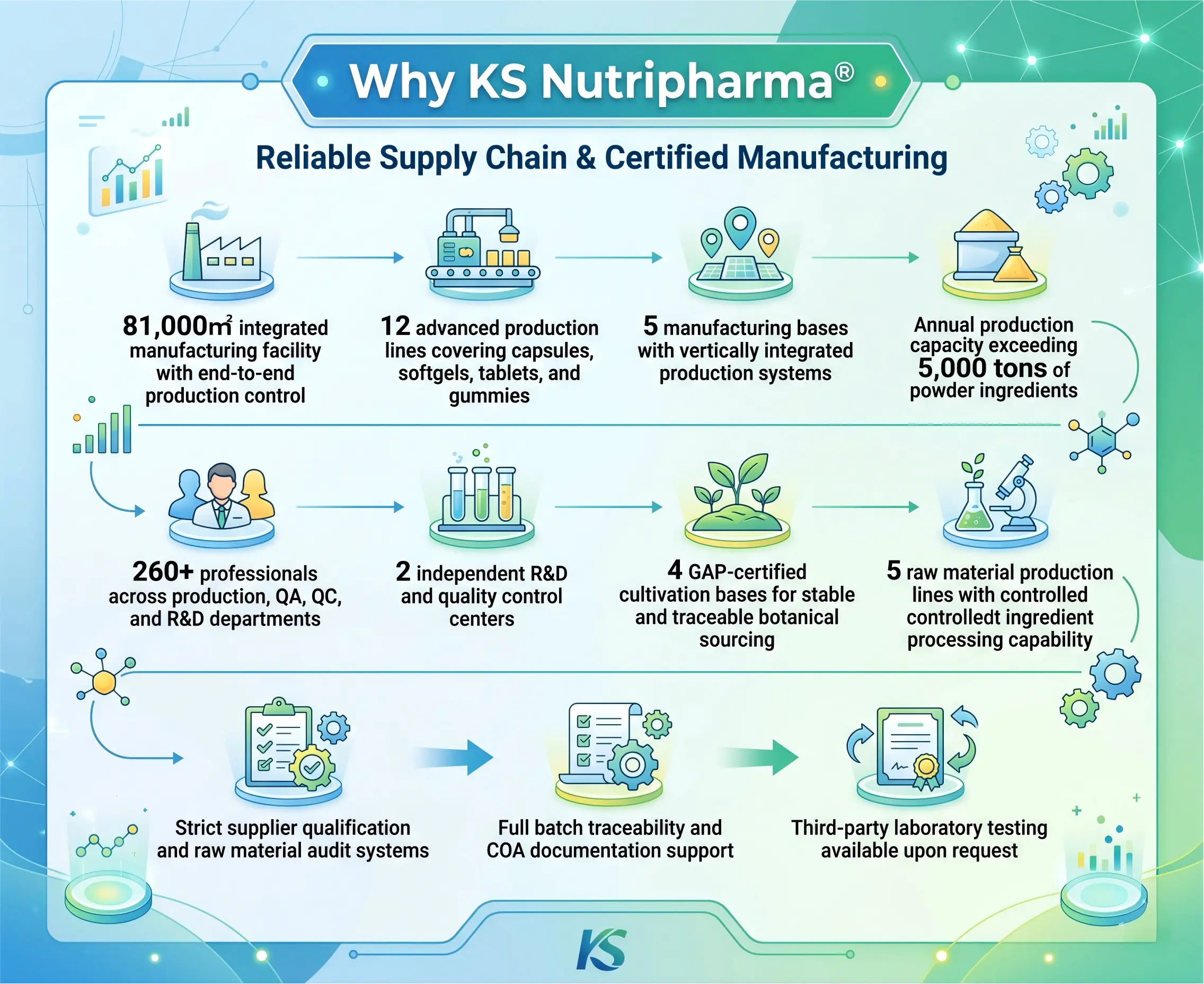
- 81,000㎡ integrated manufacturing facility with end-to-end production control
- 12 advanced production lines covering capsules, softgels, tablets, and gummies
- 5 manufacturing bases with vertically integrated production systems
- Annual production capacity exceeding 5,000 tons of powder ingredients
- 260+ professionals across production, QA, QC, and R&D departments
- 2 independent R&D and quality control centers
- 4 GAP-certified cultivation bases for stable and traceable botanical sourcing
- 5 raw material production lines with controlled ingredient processing capability
- Strict supplier qualification and raw material audit systems
- Full batch traceability and COA documentation support
- Third-party laboratory testing available upon request
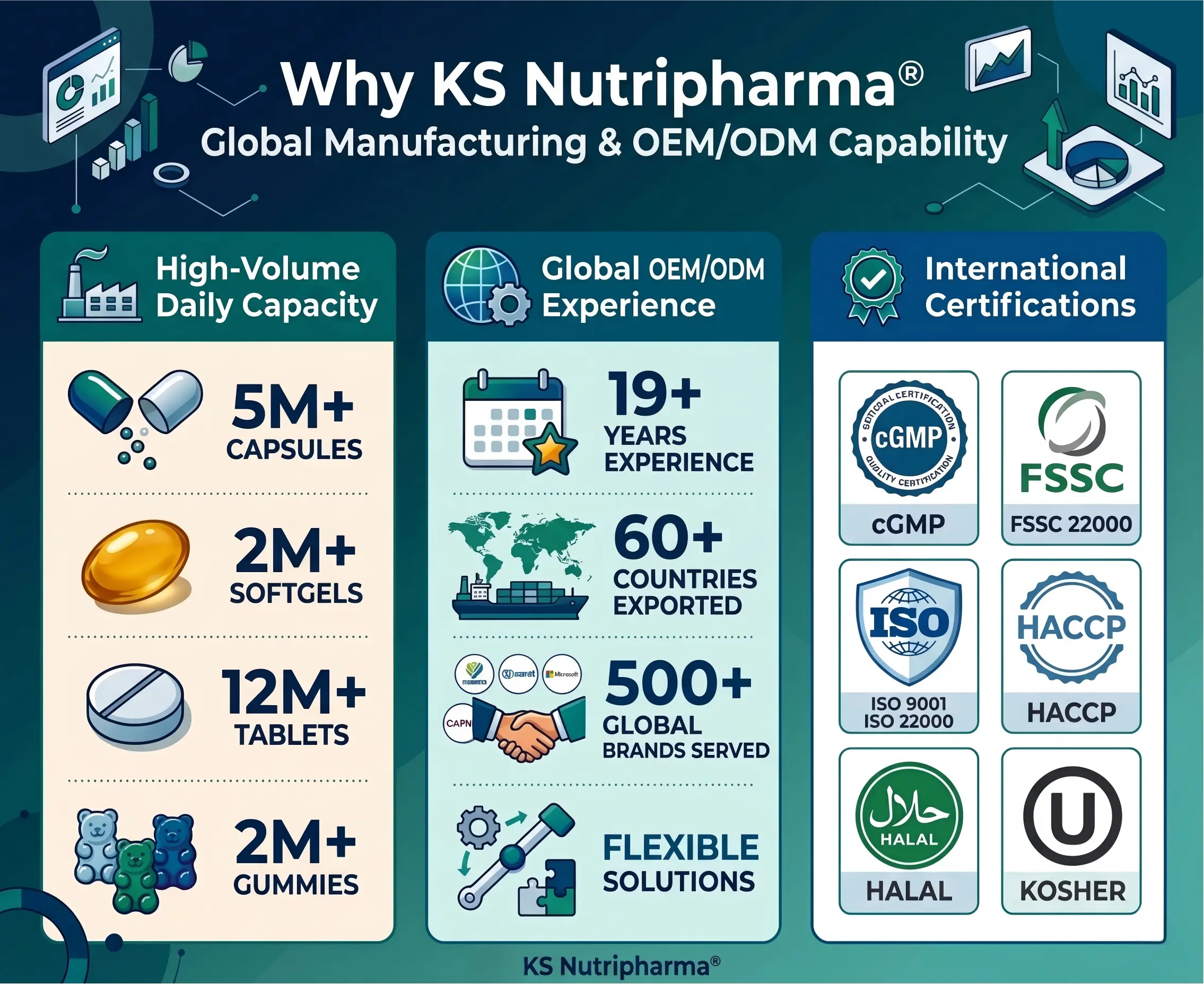
High-Volume Daily Production Capacity
- 5,000,000+ capsules per day
- 2,000,000+ softgels per day
- 12,000,000+ tablets per day
- 2,000,000+ gummies per day
Global OEM/ODM Commercialization Capability
- 19+ years of supplement manufacturing experience
- Exported to 60+ countries
- Serving 500+ global supplement brands
- Flexible OEM/ODM and private-label solutions
- Low MOQ to large-scale commercial production
- Multi-market regulatory documentation support
- Packaging and labeling coordination support
- Long-term supply-chain planning capability
International Certification Systems
Certified under: cGMP/ISO 22000/ ISO 9001/HACCP/FSSC 22000/HALAL/KOSHER
Hair Growth Supplements Contract Manufacturing Solutions
Modern hair growth supplements are rapidly evolving from simple “hair vitamins” into multi-pathway follicle wellness systems designed to support scalp microcirculation, oxidative stress management, nutritional replenishment, and long-term follicle vitality.
Consumers increasingly question whether hair supplements truly address the biological drivers behind shedding, thinning, scalp stress, hormonal imbalance, and nutrient absorption efficiency.
Brands now face significantly higher market pressure regarding:
- formulation differentiation
- visible consumer-perceived results
- ingredient transparency
- clean-label positioning
- retail review stability
- compliance-safe marketing claims
- scalable manufacturing reproducibility
KS Nutripharma supports advanced hair growth supplement development through structured follicle nutrition engineering, DHT-support formulation systems, bioavailability optimization technologies, and commercial-scale manufacturing frameworks designed for long-term retail stability and global market scalability.
1. Hair Growth Supplement Market Segmentation System
Effective segmentation identifies consumer clusters and biological pathways, guiding formulation, dosing, and positioning decisions. Poor segmentation leads to “biotin-only” commoditized products, low repeat purchase, and limited premium potential.
Segmentation Focus Areas & Commercial Controls:
Common Market Failures:
- Generic “beauty vitamin” formulations
- Low long-term compliance
- Weak repeat-purchase logic
KS Nutripharma Approach:
- Adaptogen-compatible formulations
- Scalp wellness-focused pathways
- Minimal daily serving complexity
- Repeat-purchase-oriented dose logic
Common Failures:
- Saw Palmetto potency variation
- Strong herbal odor
- Batch-to-batch inconsistency
- Amazon claim rejection
KS Nutripharma Controls:
- Fatty-acid standardized botanicals
- Odor-mitigation formulation systems
- Scalp-environment functional positioning
- Compliance-safe claim architecture
Common Failures:
- Trend-driven ingredients underdosed
- Collagen or amino acids insufficient
- Poor retail differentiation
KS Nutripharma Controls:
- Collagen + hair nutrient balancing
- Postpartum/aging hair recovery formulations
- Skin-hair-nail integrative design
- Retail-ready ingredient logic
Common Failures:
- Overpromised regrowth claims
- High-sugar, low-efficacy formats
- Practitioner-incompatible formulas
KS Nutripharma Controls:
- Standardized active marker use
- Evidence-aligned ingredient architecture
- Low-sugar, dosage-compliant systems
- Practitioner channel-ready design
2. Functional Ingredient System Architecture
Modern hair formulas rely on multi-pathway ingredient architectures rather than single “hero” actives. Ingredient architecture drives credibility, differentiation, and repeat purchase.
Problem → Control → Ingredient Implementation
Common Failures:
- Saw Palmetto assay variability
- Lipid oxidation
- Herbal bitterness
- Unstable botanical sourcing
Controls:
- Standardized Saw Palmetto and phytosterol systems
- Oxidation-controlled botanical handling
- Scalp-environment formulation logic
Key Ingredients:
Saw Palmetto Extract, Pumpkin Seed Extract, Stinging Nettle Root, Zinc Complexes, Beta-Sitosterol
Common Failures:
- High biotin but low amino support
- Low collagen inclusion
- Weak practitioner credibility
Controls:
- Balanced biotin, keratin amino acids, MSM, silica, collagen peptides
- Mineral cofactor integration
- Pathway-driven structural nutrition
Key Ingredients:
Biotin, Marine Collagen Peptides, Keratin Amino Acids, MSM, Silica, Vitamin B Complex, Selenium, Copper, L-Lysine, L-Cysteine
Common Failures:
- Polyphenol instability
- Antioxidant degradation
- Flavor conflicts
Controls:
- Tocotrienol coordination
- Astaxanthin integration
- Polyphenol balancing
- Oxidation-reduction formulation systems
Consumer Drivers: Pollution, UV exposure, lifestyle stress, scalp aging
Common Failures:
- Antioxidant interaction conflicts
- Oxidation-induced color or odor change
- Batch inconsistency
Controls:
- Ingredient interaction modeling (Astaxanthin, Grape Seed Extract, Polyphenol Complexes, Resveratrol, Green Tea Extract, Tocotrienols, Cyanotis arachnoidea)
- Stability-focused blending
- Sensory-preserving formulation
Common Complaints: “Hair supplements take too long”
Controls:
- Nutrient interaction balancing
- Amino-acid coordination
- Mineral absorption optimization
- Lipid-soluble nutrient stabilization
- Serving-size practicality and long-cycle compliance
3. Hair Growth Active Verification & Standardization System
Problem: Inconsistent actives and poorly designed dosage architectures are the leading causes of consumer distrust, poor repeat purchase, and failed practitioner adoption.
KS Nutripharma Controls:
Common Failures:
- Non-standardized sourcing
- Variable active-marker levels
- Extraction inconsistency
- Weak traceability
- Batch-to-batch potency fluctuation
Controls:
- Active-marker standardization for Saw Palmetto, Pumpkin Seed, Nettle Root, Polyphenols
- Supplier qualification and traceability review
- Batch-level benchmarking and incoming raw-material inspection
Common Failures:
- Label-focused, underdosed formulas
- Poor long-cycle compliance
- Negative reviews and refund risk
Controls:
- Active-priority ingredient selection
- Serving-size practicality for daily adherence
- Long-term dosage consistency
- Functional contribution verification for every ingredient
Common Failures:
- Nutrient interaction conflicts
- Flavor instability and odor issues
- Oxidation acceleration
- Visual inconsistency
Controls:
- Ingredient interaction assessment (minerals, botanicals, amino acids, antioxidants)
- Formula simplification where complexity reduces stability
- Long-term sensory and stability validation
- Repeat-purchase and practitioner compatibility alignment
4. Dosage Form & Delivery System Engineering
The wrong dosage form can limit active loading, reduce consumer compliance, create stability problems, and increase manufacturing costs.
For hair supplements, dosage-form selection should be based on formulation requirements rather than marketing trends.
Key evaluation factors include:
- active loading capacity
- serving size requirements
- long-term compliance
- sensory stability
- retail positioning
- manufacturing feasibility
Capsules remain the most practical format for botanical-heavy and DHT-support formulations.
Suitable For:
- Saw Palmetto formulas
- multi-botanical systems
- practitioner-oriented products
- low-sugar positioning
Common Industry Problems:
- fill-weight deviation
- poor powder flow
- capsule-shell compatibility issues
- active-content inconsistency
Control Methods:
- fill-weight verification
- flowability optimization
- blend-uniformity testing
- encapsulation-process validation
Commercial Advantage:
Higher active loading with fewer formulation restrictions compared with gummies and liquids.
Gummies perform well commercially but are often the most technically compromised hair supplement format.
Common Industry Problems:
- low active loading capacity
- gummy hardening
- moisture migration
- active degradation during cooking
- excessive sugar content
- underdosed formulas
Control Methods:
- low-temperature active incorporation
- pectin texture stabilization
- moisture-control systems
- active-retention verification
- shelf-life texture validation
Commercial Consideration:
Best suited for beauty-focused brands prioritizing compliance and consumer experience over maximum active density.
Powders allow significantly higher active inclusion than capsules or gummies.
Suitable For:
- collagen hair systems
- marine beauty products
- multi-benefit beauty formulas
- skin-hair-nail concepts
Common Industry Problems:
- marine odor
- powder clumping
- poor dissolution
- sedimentation
- flavor instability
Control Methods:
- agglomeration processing
- anti-caking systems
- dissolution optimization
- odor-masking technologies
- humidity-control management
Commercial Advantage:
Supports larger ingredient doses without increasing capsule count or serving burden.
Liquid shots are primarily used for premium-positioned beauty products.
Common Industry Problems:
- botanical precipitation
- phase separation
- flavor degradation
- oxidation instability
- shortened shelf life
Control Methods:
- suspension stabilization
- oxygen-reduced filling
- emulsion compatibility testing
- accelerated stability validation
Commercial Consideration:
Higher production cost and stability requirements, but stronger premium positioning and higher average selling price.
We do not start with the dosage form.
We start with:
- target consumer
- active dosage requirements
- positioning strategy
- serving-size practicality
- stability risks
Then determine the most suitable delivery system based on formulation feasibility and commercial objectives.
This approach helps reduce reformulation costs, stability failures, and post-launch consumer complaints.
5. REGULATORY & GLOBAL COMPLIANCE FRAMEWORK
Hair growth supplements are one of the most frequently flagged categories in the nutraceutical industry.
The majority of compliance issues are not caused by the formula itself, but by ingredient positioning, claim language, labeling, and marketing materials.
Common consequences include:
- Amazon listing suppression
- retailer onboarding rejection
- advertising disapproval
- customs clearance delays
- product relabeling costs
- market-entry postponement
Our compliance review starts during formulation development rather than after production.
Our facilities are compliant with internationally recognized standards, including:
- cGMP (Current Good Manufacturing Practice)
- HACCP (Hazard Analysis and Critical Control Points)
- ISO 9001 Quality Management System
- ISO 22000 Food Safety Management System
- FSSC 22000 Global Food Safety Certification
- FDA Registered Manufacturing Facility
- Kosher Certified Production System
- Halal Certified Manufacturing System
Hair supplements are commonly flagged for:
- “hair regrowth”
- “reverse baldness”
- “block DHT”
- “treat hair loss”
- before-and-after treatment claims
These statements may trigger drug classification concerns in certain markets.
We reduce claim risk through:
- structure/function positioning
- scalp wellness terminology
- follicle nourishment positioning
- appearance-support language review
- region-specific claim adaptation
DHT-support formulas frequently encounter regulatory scrutiny due to ingredient selection and marketing language.
Common issues include:
- unsupported DHT claims
- non-compliant botanical positioning
- inconsistent ingredient documentation
- dosage concerns in specific markets
We review:
- ingredient suitability
- documentation completeness
- market-specific restrictions
- label compatibility
before commercialization.
Many technically sound products fail retailer review because of listing content rather than formulation quality.
Common rejection triggers include:
- disease-treatment language
- unsupported performance claims
- inconsistent Supplement Facts panels
- missing substantiation documents
- non-compliant imagery
We support:
- listing-language review
- claim-risk assessment
- documentation preparation
- retailer compliance alignment
to reduce platform-related launch delays.
Hair supplement regulations vary significantly between markets.
Areas commonly requiring adjustment include:
- botanical usage
- maximum dosage levels
- warning statements
- claim language
- label structure
We help brands prepare for:
- United States
- European Union
- United Kingdom
- Southeast Asia
- Middle East markets
through market-specific compliance review.
Missing documentation remains one of the most common causes of customs delays.
We support preparation of:
- COA documentation
- product specifications
- ingredient declarations
- manufacturing records
- export-related technical files
to improve customs and distributor approval efficiency.
Before commercial production, we review:
- ingredient compliance
- claim language
- label structure
- retailer requirements
- export documentation
to identify potential compliance issues before they become commercial problems.
The goal is simple:
Reduce reformulation, relabeling, listing suspension, and market-entry delays after launch.
6. Hair Growth Manufacturing & Stability Engineering System
Hair growth formulas are more difficult to manufacture than standard multivitamins because they often combine oxidation-sensitive botanicals, minerals, amino acids, collagen peptides, and antioxidant systems within a single formula.
The most common manufacturing failures in commercial hair supplements include:
- Saw Palmetto potency loss during processing
- marine collagen odor development during storage
- antioxidant degradation over shelf life
- blend segregation in multi-ingredient powders
- fill-weight deviation during encapsulation
- moisture migration causing gummy hardening
- batch-to-batch sensory inconsistency
Our manufacturing system focuses on controlling these failure points before they become consumer complaints.
Ingredients such as Saw Palmetto, Tocotrienols, Astaxanthin, Grape Seed Extract, and other polyphenol-rich botanicals are highly sensitive to oxygen exposure.
We reduce active degradation through:
- low-temperature processing
- oxygen-reduced filling environments
- minimized open-air exposure time
- humidity-controlled production areas
This helps maintain active integrity throughout shelf life instead of only at release testing.
Hair formulas often contain ingredients with significantly different particle sizes and densities.
Without proper control, heavier minerals may separate from lighter botanical powders during blending and transfer.
We reduce blend segregation through:
- particle-size harmonization
- bulk-density balancing
- validated blending parameters
- in-process uniformity verification
This helps improve dosage consistency across every serving.
Moisture is one of the most overlooked causes of stability failure in hair supplements.
Common consequences include:
- gummy hardening
- powder clumping
- capsule shell deformation
- accelerated active degradation
We manage moisture risk through:
- humidity-controlled manufacturing
- moisture-barrier packaging selection
- water activity monitoring
- stability-focused formulation review
Many hair supplements lose repeat-purchase potential because of odor and taste issues rather than efficacy concerns.
Common complaints include:
- strong Saw Palmetto odor
- marine collagen smell
- sulfur-like notes from amino systems
- bitter botanical aftertaste
We improve long-term sensory performance through:
- odor-neutralization systems
- bitterness suppression technologies
- flavor-layer balancing
- sensory stability validation
Poor encapsulation control often results in:
- fill-weight deviation
- capsule-to-capsule inconsistency
- label claim variability
We monitor:
- fill-weight consistency
- capsule integrity
- active-content uniformity
- production-line calibration
to improve batch reproducibility.
Many formulas perform well in pilot batches but become unstable after commercial scale-up.
Typical scale-up failures include:
- blend segregation
- powder flow issues
- inconsistent encapsulation
- sensory variation between batches
Before commercial production, we evaluate:
- equipment compatibility
- bulk-density behavior
- flowability performance
- large-batch blending reproducibility
to help maintain consistency from first production run to long-term commercial manufacturing.
7. MOQ Flexibility & Commercial Scaling Pathway System
One of the most common mistakes in supplement launches is producing too much inventory before market demand has been validated.
Excess inventory creates:
- cash-flow pressure
- warehouse costs
- slow-moving stock
- packaging obsolescence
- reformulation limitations
Our scaling strategy is designed to match production volume with actual business growth.
Suitable for:
- new product launches
- market testing
- influencer campaigns
- distributor sampling
- retailer presentations
Key Objective:
Validate product-market fit before committing to larger inventory positions.
Control Focus:
- low inventory exposure
- packaging flexibility
- formulation verification
- consumer feedback collection
Once demand begins to stabilize, production priorities change.
Common Growth Challenges:
- stock shortages
- inconsistent lead times
- packaging supply constraints
- inaccurate demand forecasting
Control Methods:
- production scheduling alignment
- packaging capacity planning
- raw-material reservation
- inventory forecasting support
Goal:
Maintain product availability during early growth stages.
As order volumes increase, consistency becomes more important than initial formulation development.
Common Problems:
- batch-to-batch variation
- ingredient allocation shortages
- longer lead times
- supplier capacity limitations
Control Methods:
- repeat-batch validation
- secondary supplier qualification
- long-term procurement planning
- production-capacity reservation
Goal:
Support predictable growth without compromising product consistency.
Many successful hair brands eventually expand beyond a single product.
Typical Expansion Areas:
- hair, skin & nail systems
- collagen beauty products
- scalp wellness formulas
- healthy-aging beauty lines
Planning Considerations:
- ingredient overlap
- packaging standardization
- procurement efficiency
- manufacturing scalability
Goal:
Reduce operational complexity while expanding product portfolios.
The objective is not to produce the largest possible order.
The objective is to produce the right volume at the right stage of business growth.
Our planning process focuses on:
- inventory optimization
- supply continuity
- lead-time management
- scalable production planning
to reduce inventory risk while maintaining commercial flexibility.
8. Project Timeline & Commercial Delivery System
Most project delays are not caused by manufacturing.
They are caused by formula revisions, packaging changes, raw-material shortages, documentation issues, and poor cross-department communication.
Our project management process is designed to identify these risks before they affect launch schedules.
Common Causes of Delay:
- unrealistic ingredient combinations
- unstable dosage-form selection
- compliance conflicts
- unsupported claim positioning
Control Methods:
- formulation feasibility assessment
- ingredient compatibility review
- dosage-form validation
- compliance screening before prototyping
Goal:
Reduce reformulation cycles later in development.
Common Causes of Delay:
- flavor rejection
- odor problems
- poor dissolution
- texture instability
- ingredient incompatibility
Control Methods:
- prototype testing
- sensory evaluation
- compatibility verification
- preliminary stability screening
Goal:
Identify technical problems before commercial production.
Common Causes of Delay:
- packaging incompatibility
- moisture ingress
- odor migration
- active degradation
Control Methods:
- accelerated stability testing
- packaging compatibility review
- transportation simulation
- active-retention verification
Goal:
Prevent post-launch stability failures.
Common Causes of Delay:
- packaging arrival delays
- incomplete documentation
- production scheduling conflicts
- raw-material shortages
Control Methods:
- production scheduling review
- supplier confirmation
- packaging readiness verification
- documentation completion checks
Goal:
Improve on-time production execution.
High-risk areas are monitored throughout the project:
- raw-material lead times
- packaging availability
- stability outcomes
- production capacity
- documentation readiness
This helps reduce launch delays, missed retailer deadlines, and seasonal inventory risks.
9. End-to-End Supply Chain Orchestration System
Hair supplement performance is only as reliable as the supply chain behind it.
Many batch inconsistencies originate from raw-material variability rather than manufacturing.
Common Risks:
- assay inconsistency
- incomplete documentation
- unstable lead times
- quality variation between batches
Control Methods:
- supplier audits
- specification verification
- documentation review
- historical performance assessment
Botanical ingredients are one of the largest sources of product variability.
High-risk ingredients include:
- Saw Palmetto
- Pumpkin Seed Extract
- Nettle Root
- Polyphenol Extracts
Control Methods:
- active-marker verification
- batch benchmarking
- traceability systems
- retained-sample comparison
Fast-growing brands often encounter:
- stock shortages
- ingredient allocation issues
- production interruptions
Control Methods:
- secondary supplier qualification
- safety-stock planning
- procurement forecasting
- long-term sourcing agreements
Goal:
Reduce supply disruption during business growth.
10. Advanced R&D Innovation & Formulation Engineering System
Many hair supplements fail because formulas are built around trending ingredients instead of formulation logic.
Our R&D process focuses on compatibility, stability, and commercial practicality.
Common Problems:
- ingredient overcrowding
- overlapping mechanisms
- weak formulation focus
Control Methods:
- pathway prioritization
- ingredient-role mapping
- formulation simplification
- positioning alignment
Goal:
Build formulas consumers can understand and trust.
Common Problems:
- mineral competition
- excessive serving size
- poor nutrient coordination
Control Methods:
- nutrient interaction review
- dosage optimization
- serving-size balancing
- absorption-oriented ingredient selection
Goal:
Improve formulation efficiency without unnecessary complexity.
Common Problems:
- odor instability
- color variation
- oxidation sensitivity
- sensory conflicts
Control Methods:
- compatibility screening
- active standardization
- oxidation-control review
- sensory-risk assessment
Goal:
Improve long-term product stability.
Consumers frequently discontinue products because of:
- too many capsules
- unpleasant taste
- complicated daily routines
Control Methods:
- serving-size simplification
- sensory optimization
- dosage practicality review
Goal:
Support long-term repeat purchase behavior.
11. Intellectual Property Protection & Confidential Manufacturing System
Many brands are more concerned about formula protection than formula development.
Confidentiality risks increase significantly during scale-up and commercial manufacturing.
Common Risks:
- unauthorized formula sharing
- supplier information exposure
- product-copying concerns
Control Methods:
- NDA agreements
- controlled formula access
- restricted project visibility
- internal confidentiality procedures
Common Risks:
- excessive project visibility
- uncontrolled documentation access
- unnecessary information sharing
Control Methods:
- role-based access permissions
- segmented production information
- controlled documentation systems
- approval-based communication
Brands developing differentiated products often require:
- exclusive formulations
- retailer-exclusive SKUs
- proprietary ingredient systems
Protection Methods:
- custom formulation ownership structures
- controlled manufacturing records
- project-specific confidentiality management
Goal:
Protect product differentiation throughout the product lifecycle.
12. Product Lifecycle Optimization & Commercial Extension System
Common post-launch issues:
- flavor complaints
- active degradation over time
- minor packaging incompatibility
- shelf-life drift
Control Methods:
- sensory rebalancing protocols
- active-level recalibration
- packaging material reassessment
- accelerated stability testing
Brands often extend into:
- skin-hair-nail systems
- collagen + hair synergy products
- scalp wellness variations
- healthy-aging hair lines
Control Methods:
- active-compatibility mapping across SKUs
- formulation standardization for batch-to-batch reproducibility
- ingredient inventory forecasting for multi-product continuity
Typical risks:
- moisture ingress during packaging change
- odor migration
- color fading or opacity loss
- shelf-life reduction
Control Methods:
- pre-migration compatibility assessment
- moisture-barrier evaluation
- light- and odor-blocking packaging validation
- accelerated transport and shelf-life simulation
13. Technical Support, Root Cause Analysis (RCA) & After-Sales Engineering System
- 24-hour technical response support
- 72-hour structured root cause analysis (RCA)
- batch-level issue tracking system
- corrective action implementation (CAPA)
We systematically analyze:
- humidity exposure during logistics
- packaging integrity failure
- ingredient interaction instability
- storage condition deviations
- consumer handling variability
Based on RCA findings, we implement:
- formulation adjustment recommendations
- packaging material upgrades
- moisture control system improvements
- production parameter recalibration
Core Principle
After-sales support is not service — it is continuous product stability engineering.
14. Quality Assurance & Multi-Layer Testing System
Testing includes:
- botanical assay verification
- microbial screening
- heavy-metal testing
- specification confirmation
We maintain:
- lot tracking
- retained samples
- manufacturing documentation
- production-record systems
for long-term batch review capability.
Support includes:
- COA preparation
- specification documents
- export documentation
- retailer compliance files
Control Philosophy: QA is preventive engineering, not reactive checking.
15. Scientific Positioning & Evidence-Based Formulation System
We help brands avoid unrealistic “hair cure” positioning through:
- scalp wellness terminology
- density-maintenance positioning
- healthy hair appearance claims
Premium positioning increasingly focuses on:
- scalp-aging support
- antioxidant wellness
- environmental stress defense
- beauty longevity concepts
Clinical-style systems perform better through:
- transparent active levels
- standardized botanicals
- lower sugar positioning
- evidence-aligned formulation logic
16. Packaging Engineering & Real-World Stability Simulation System
Hair formulas are highly sensitive to:
- oxygen exposure
- moisture ingress
- light degradation
We improve protection through:
- oxygen-barrier packaging
- desiccant systems
- moisture-control architecture
- light-sensitive packaging selection
We evaluate:
- e-commerce vibration stress
- temperature fluctuation
- transport stability
- shelf-life consistency
before commercialization.
Support includes:
- premium retail packaging
- subscription-compatible formats
- multi-market packaging adaptation
- scalable packaging coordination
17. Sustainability & ESG Manufacturing System
Sustainable Ingredient Sourcing
We prioritize:
- long-cycle botanical sourcing
- supplier sustainability review
- scalable raw-material continuity
- responsible procurement systems
Clean-Label Manufacturing
Support includes:
- vegan-compatible systems
- reduced-additive positioning
- simplified formulation structures
- clean-label ingredient selection
Environmentally Responsible Packaging
Options include:
- recyclable packaging
- reduced-plastic formats
- sustainable material coordination
- retailer sustainability alignment