

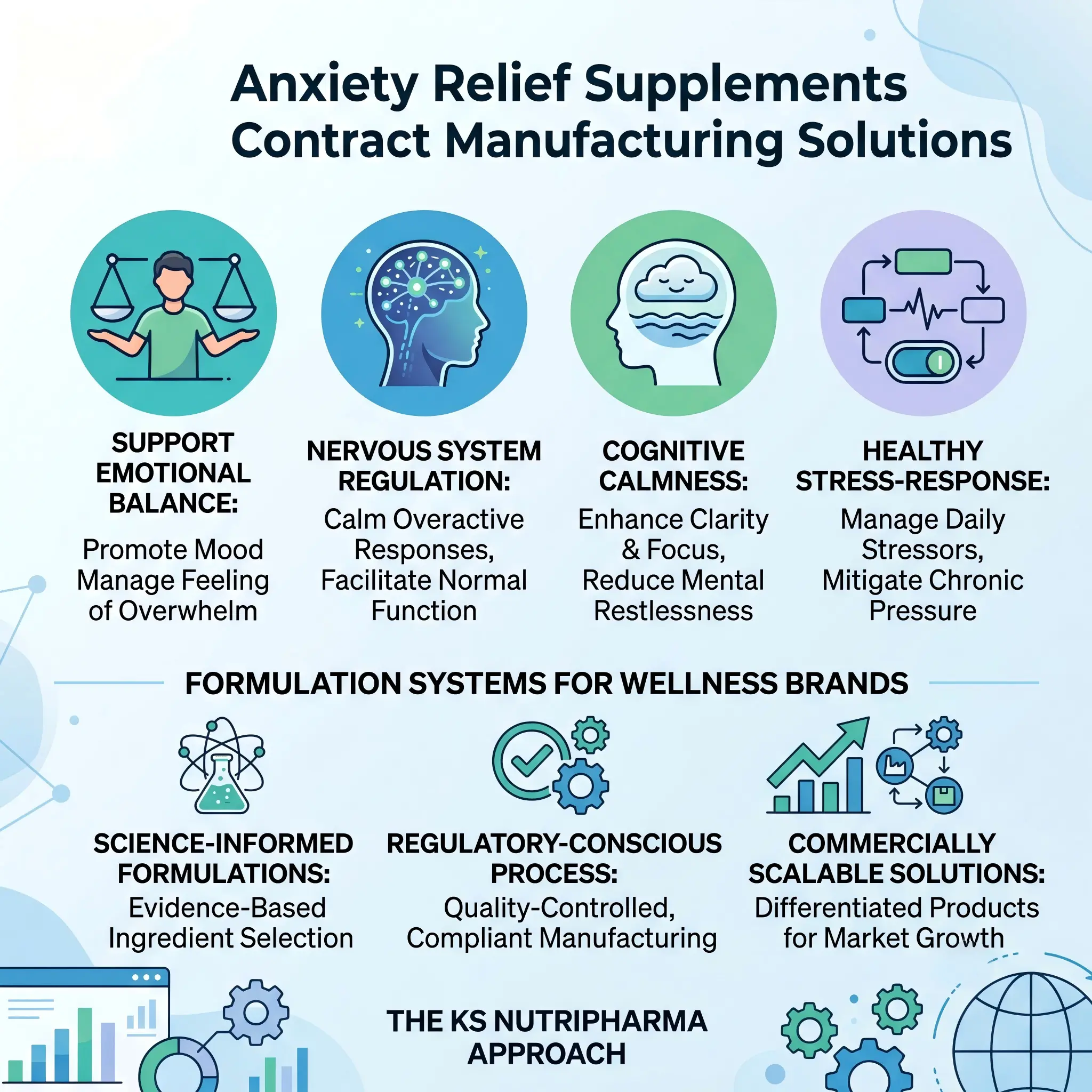
Anxiety Relief Supplements — Contract Manufacturing Solutions
At KS Nutripharma, we develop and manufacture anxiety relief supplement formulations designed to support emotional balance, nervous system regulation, cognitive calmness, and healthy stress-response pathways. Our formulation systems are built for wellness brands seeking science-informed, regulatory-conscious, and commercially scalable solutions within the rapidly growing emotional wellness category.
Unlike traditional relaxation products focused primarily on sedation, modern consumers increasingly seek support for emotional overwhelm, mental restlessness, digital overstimulation, and daily stress management while maintaining normal cognitive performance and productivity.
Our development approach combines evidence-based ingredient selection, consumer complaint analysis, formulation engineering, quality-controlled manufacturing, and global regulatory planning to help brands launch differentiated emotional wellness products with stronger consumer acceptance and long-term market sustainability.
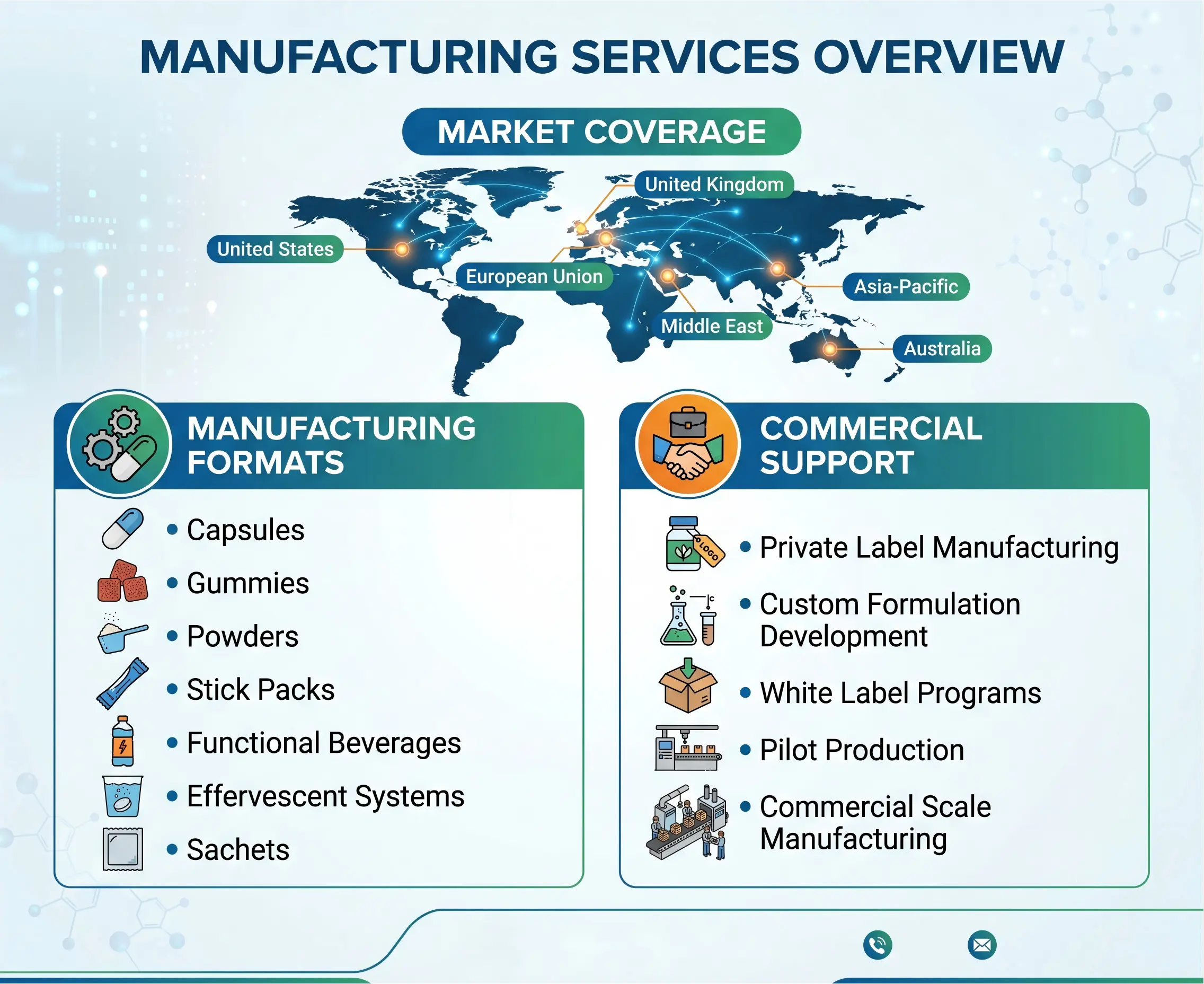
Manufacturing Formats
- Capsules
- Gummies
- Powders
- Stick Packs
- Functional Beverages
- Effervescent Systems
- Sachets
Market Coverage
- United States
- European Union
- United Kingdom
- Australia
- Middle East
- Asia-Pacific
Commercial Support
- Private Label Manufacturing
- Custom Formulation Development
- White Label Programs
- Pilot Production
- Commercial Scale Manufacturing
MARKET POSITIONING
Emotional Overactivation Regulation System
This category is positioned for short-cycle emotional stress states, not long-term physiological resilience.
We target:
- Situational anxiety & emotional overwhelm
- Cognitive looping / overthinking states
- Nervous tension & mental restlessness
- Modern digital overstimulation
- Emotional volatility in high-input environments
Core Positioning Logic:
This is not a performance system.
This is a neuro-emotional reset system.
Why Consumers Become Dissatisfied With Anxiety Supplements
Many consumers expect anxiety support supplements to function similarly to pharmaceutical interventions.
However, dietary supplements are generally designed to support normal stress response pathways rather than provide immediate therapeutic effects.
This expectation gap often contributes to negative product reviews and poor repeat-purchase rates.
Common expectation mismatches include:
| Consumer Expectations | Product Reality |
|---|---|
| Immediate emotional relief | Most ingredients require consistent use |
| Strong calming effect | Non-sedative formulations prioritize functionality |
| Permanent anxiety reduction | Supplements support healthy stress response pathways |
| Single-dose effectiveness | Multi-factor emotional wellness often requires cumulative support |
For brands entering this category, consumer education strategy is often as important as formulation strategy.
Core Value Proposition
KS Nutripharma operates as a formulation, manufacturing, and commercialization partner for emotional wellness brands.
Our objective is to reduce uncertainty throughout product development while improving launch readiness and long-term product sustainability.
Desired Product Outcomes
- Acute Emotional Recovery: Support recovery from temporary stress-triggered states.
- Cognitive Stability: Support emotional balance during periods of mental demand.
- Nervous System Regulation: Support healthy autonomic nervous system function.
- Long-Term Consumer Retention: Formulate products designed for repeat use and sustained consumer satisfaction.
Anxiety Relief Supplement Market Segmentation
Understanding Consumer Segments Within the Emotional Wellness Category
The anxiety relief supplement market is no longer driven by a single consumer profile. Different consumer groups experience stress differently and often seek distinct product benefits, ingredient systems, and delivery formats.
Successful product development begins with identifying the target consumer segment before selecting ingredients or dosage forms.
Emerging Trends in Anxiety Relief Supplements
Anxiety Relief Supplement Formulation Concepts for Different Consumer Needs
Product Positioning
Emotional wellbeing support tailored for women’s wellness brands.
Core Ingredients
- Saffron Extract
- Magnesium Glycinate
- Lemon Balm Extract
- Vitamin B Complex
- Adaptogenic Botanical Blend
Key Selling Points
- Emotional balance support
- Daily stress management
- Mood support positioning
- Women’s wellness focus
- Non-drowsy formulation
Target Consumers
- Women’s health brands
- Beauty and wellness brands
- Lifestyle wellness markets
Product Positioning
Science-forward emotional wellness formula built around highly researched ingredients.
Core Ingredients
- L-Theanine
- Saffron Extract
- Ashwagandha Extract
- Magnesium Glycinate
- PharmaGABA®
Key Selling Points
- Evidence-informed formulation
- Supports healthy stress response
- Emotional wellbeing support
- Premium ingredient profile
- Suitable for global wellness markets
Target Consumers
- Premium private label brands
- Practitioner channels
- E-commerce wellness brands
Ingredient selection is guided by available scientific literature, human clinical studies, dosage feasibility, safety assessments, regulatory acceptance, and manufacturing practicality.
Priority is generally given to ingredients demonstrating:
- Human clinical evidence
- Established safety profiles
- Multi-market regulatory acceptance
- Consistent supply availability
- Reliable standardization methods
Common Clinical Dosage Ranges
| Ingredients | Typical Clinical Range |
| L-Theanine | 100–400 mg |
| Lemon Balm Extract | 300–600 mg |
| Magnesium Glycinate | 100–300 mg elemental magnesium |
| Saffron Extract | 28–30 mg |
| Ashwagandha Extract | 300–600 mg |
| Rhodiola Rosea | 200–400 mg |
Final formulations are adjusted according to delivery format, target consumer group, intended positioning, and regional regulations.
Tri-Phase Emotional Stability System
Phase 1 – Neural Overactivation Control
Designed to support calmness during periods of acute emotional stimulation.
Common ingredients:
- L-Theanine
- Lemon Balm Extract
- PharmaGABA®
- Apigenin
Phase 2 – Autonomic Rebalancing
Supports transition from stress-response states toward recovery-oriented physiology.
Common ingredients:
- Magnesium Glycinate
- Magnesium L-Threonate
- Fermented GABA
- B-Vitamin Complex
Phase 3 – Emotional Baseline Support
Designed to support long-term emotional equilibrium.
Common ingredients:
- Saffron Extract
- Ashwagandha Extract
- Rhodiola Rosea
- Adaptogenic botanical systems
Not all stress-support ingredients serve the same purpose.
Acute Anxiety Support
Target Scenarios:
- Public speaking
- Travel stress
- Social stress
- Workplace pressure
Common Ingredients:
- L-Theanine
- Lemon Balm
- GABA
- Saffron
Daily Stress Adaptation
Target Scenarios:
- Chronic workload
- High-pressure occupations
- Emotional fatigue
Common Ingredients:
- Ashwagandha
- Rhodiola
- Magnesium Glycinate
- B Vitamins
Anxiety and Sleep Support
Target Scenarios:
- Racing thoughts
- Evening stress
- Pre-sleep mental activity
Common Ingredients:
- Magnesium Glycinate
- Apigenin
- L-Theanine
- Sleep-support ingredient systems
Understanding the Functional Differences Between Leading Anxiety Relief Ingredients
One of the most common formulation challenges is selecting ingredients that match the intended consumer use case.
While many ingredients are marketed under the same “stress support” category, their mechanisms, onset profiles, and positioning opportunities differ significantly.
Functional Comparison Overview
| Attribute | L-Theanine | GABA | Saffron Extract | Ashwagandha |
|---|---|---|---|---|
| Primary Positioning | Acute calm focus | Relaxation support | Emotional balance | Stress adaptation |
| Typical Usage | Situational stress | Tension management | Mood support | Daily resilience |
| Onset Profile | Fast | Moderate | Gradual | Gradual |
| Daytime Friendly | Excellent | Good | Excellent | Good |
| Sedation Risk | Very Low | Low to Moderate | Very Low | Low |
| Long-Term Use Suitability | High | Moderate | High | High |
| Consumer Awareness | High | Moderate | Growing | Very High |
| Regulatory Flexibility | Excellent | Good | Good | Good |
L-Theanine
Best For
- Acute emotional tension
- Workplace stress
- Focused calmness
- High-performance environments
Advantages
- Fast consumer perception
- Strong daytime compatibility
- Minimal drowsiness concerns
- Broad market acceptance
Potential Limitation
May not sufficiently address chronic stress when used alone.
GABA
Best For
- Relaxation positioning
- Evening-use products
- Calmness-oriented formulas
Advantages
- Strong consumer association with relaxation
- Synergistic potential with magnesium and theanine
Potential Limitation
Consumer experiences can vary considerably depending on dosage and formulation architecture.
Saffron Extract
Best For
- Emotional wellness products
- Premium mood-support formulations
- Long-term emotional balance systems
Advantages
- Premium ingredient perception
- Low-dose formulation efficiency
- Strong differentiation opportunity
Potential Limitation
Raw material quality varies significantly between suppliers, requiring strict standardization controls.
Ashwagandha
Best For
- Stress adaptation products
- Daily resilience formulas
- Cortisol-management positioning
Advantages
- Strong market awareness
- Broad clinical interest
- Adaptogenic positioning flexibility
Potential Limitation
May not provide the rapid consumer perception often expected from acute anxiety support products.
Ingredient Synergy Strategy
Many successful emotional wellness products combine multiple ingredient categories rather than relying on a single active.
Example: Acute Calmness Formula
- L-Theanine
- Lemon Balm Extract
- Magnesium Glycinate
Target Use:
- Presentations
- Travel stress
- High-pressure work situations
Example: Daily Emotional Balance Formula
- Saffron Extract
- Magnesium Glycinate
- B-Vitamin Complex
Target Use:
- Ongoing emotional wellbeing
- Mood support
- Everyday stress management
Example: Stress Adaptation Formula
- Ashwagandha Extract
- Rhodiola Rosea
- Magnesium Glycinate
Target Use:
- High workload periods
- Long-term stress exposure
- Resilience-focused positioning
Ingredient Selection Decision Framework
Rather than asking:
“Which ingredient is best?”
A more effective formulation question is:
“What consumer problem is the product designed to solve?”
The answer determines whether the formulation should prioritize:
- Acute calmness
- Relaxation support
- Emotional balance
- Stress adaptation
- Sleep-adjacent support
- Multi-pathway emotional wellness systems
At KS Nutripharma, ingredient selection begins with target consumer outcomes, regulatory considerations, delivery format feasibility, and commercial positioning objectives to support successful product development and long-term market performance.
Ingredient quality significantly influences efficacy, stability, and consumer satisfaction.
Supplier Evaluation Criteria
- Botanical authentication
- Active marker standardization
- Heavy metal compliance
- Pesticide residue screening
- Microbiological testing
- Traceability systems
- Supply continuity assessment
High-Risk Ingredient Verification
Saffron Extract
Verification includes:
- Crocin content
- Safranal content
- Authenticity testing
Ashwagandha Extract
Verification includes:
- Withanolide content
- Root-source confirmation
- Contaminant screening
Magnesium Glycinate
Verification includes:
- Chelation quality
- Elemental magnesium confirmation
- Solubility performance
Product stability directly influences consumer experience and shelf-life performance.
Common Stability Risks
| Ingredients | Stability Considerations |
| Saffron Extract | Light sensitivity |
| Lemon Balm Extract | Volatile compound loss |
| B Vitamins | Oxidation |
| Natural Flavors | Aroma degradation |
| Adaptogenic Extracts | Moisture sensitivity |
Stability Controls
- Accelerated stability testing
- Real-time stability programs
- Moisture management systems
- Oxygen barrier packaging
- Desiccant-compatible packaging
- Shelf-life validation studies
Different delivery formats influence consumer perception and compliance.
Capsules
Best for:
- Precise dosing
- Premium positioning
- Multi-ingredient formulations
Gummies
Best for:
- Daily compliance
- Mainstream consumer audiences
Stick Packs
Best for:
- On-the-go usage
- Travel positioning
- Acute emotional support
Functional Beverages
Best for:
- Lifestyle wellness positioning
- Fast-dissolving systems
Sublingual Powder Systems
Best for:
- Rapid-use positioning
- Alternative delivery strategies
Long-term commercial success depends on repeat purchase behavior.
Factors influencing retention include:
- Noticeable consumer experience
- Taste acceptance
- Ease of daily use
- Non-sedative performance
- Product consistency
- Trust in ingredient quality
Product development, therefore, focuses not only on efficacy positioning but also on long-term consumer compliance and satisfaction.
Raw Material Verification
- Full COA review
- Identity confirmation
- Active compound testing
Manufacturing Controls
- GMP-compliant production
- In-process quality monitoring
- Finished product verification
Analytical Testing
- HPLC standardization
- Heavy metal analysis
- Microbiological testing
- Stability assessment
Third-Party Verification
Available through:
- SGS
- Eurofins
- Independent accredited laboratories
Regulatory Development Support
Capability to support compliance planning for:
- United States
- European Union
- United Kingdom
- Australia
- Middle East
- Asia-Pacific
Claim Strategy Guidance
Appropriate examples include:
- Supports relaxation
- Supports emotional wellbeing
- Helps manage everyday stress
- Supports calm mood
- Supports healthy stress response
Claims Avoided
- Treats anxiety
- Prevents panic attacks
- Replaces medication
- Provides medical treatment
To reduce supply disruption risk, KS Nutripharma maintains:
- Multi-source ingredient strategies
- Traceability systems
- Supplier qualification programs
- Raw material authentication procedures
- Strategic inventory planning
Phase 1 — Technical Assessment
- Market feasibility review
- Regulatory evaluation
- Formula architecture planning
Phase 2 — Prototype Development
- Laboratory formulation
- Sensory optimization
- Stability pre-screening
Phase 3 — Validation & Compliance
- Cost modeling
- Label review
- Documentation preparation
Phase 4 — Manufacturing & Logistics
- Commercial production
- Quality release
- Global shipping coordination
Production Capacity
- Pilot runs
- Market testing batches
- Commercial production
- Large-scale global supply
Available Services
- Private Label
- White Label
- Custom Formulation
- Formula Optimization
- Packaging Development
- Regulatory Documentation Support
As brands move from concept validation to commercial expansion, production scalability becomes increasingly important.
KS NutriPharma operates an integrated manufacturing system designed to support both pilot-scale development and large-volume commercialization.
Manufacturing Resources Include:
- 81,000㎡ integrated manufacturing facilities
- 12 production lines across multiple dosage forms
- 5 manufacturing bases with coordinated production systems
- Annual processing capacity exceeding 5,000 tons of botanical and nutritional ingredients
- 260+ personnel across production, quality, regulatory, and R&D functions
Daily Production Capacity:
| Dosage Form | Capacity |
|---|---|
| Capsules | 5,000,000+ units/day |
| Softgels | 2,000,000+ units/day |
| Tablets | 12,000,000+ units/day |
| Gummies | 2,000,000+ units/day |
- Evidence-informed formulation development
- Regulatory-conscious product positioning
- Ingredient verification before production
- Quality validation throughout manufacturing
- Transparent commercialization planning
- Long-term supply chain support
Ingredient inclusion is guided by available human clinical evidence, mechanism-of-action research, and regulatory suitability across target markets.
Priority is generally given to ingredients with:
- Human clinical studies
- Established safety profiles
- Multi-market regulatory acceptance
- Documented dosage ranges
Examples include:
| Ingredients | Common Clinical Range |
|---|---|
| L-Theanine | 100–400 mg |
| Magnesium Glycinate | 100–300 mg elemental magnesium |
| Saffron Extract | 28–30 mg |
| Lemon Balm Extract | 300–600 mg |
Final formulations are adjusted according to dosage form, target market, and intended positioning.
Human Clinical Evidence Supporting Emotional Wellness Formulations
Within the emotional wellness category, ingredient selection should extend beyond ingredient popularity and marketing trends. Formulation decisions are increasingly influenced by the availability of human clinical research, documented mechanisms of action, safety profiles, and commercial feasibility.
At KS Nutripharma, ingredient evaluation prioritizes evidence-informed ingredients that have been investigated in human studies related to stress perception, emotional wellbeing, relaxation, cognitive tension management, or healthy stress-response support.
Evidence Evaluation Framework
Ingredients are typically assessed according to:
- Human clinical trial availability
- Reproducibility of outcomes
- Dosage feasibility in commercial products
- Safety and tolerability profile
- Regulatory acceptance across target markets
- Long-term consumer compliance potential
Representative Research-Supported Ingredients
| Ingredients | Primary Application | Typical Clinical Range | Common Study Focus |
|---|---|---|---|
| L-Theanine | Acute calmness support | 100–400 mg | Relaxation, stress response, cognitive calmness |
| Saffron Extract | Emotional balance support | 28–30 mg | Mood support, emotional wellbeing |
| Magnesium Glycinate | Nervous system support | 100–300 mg elemental magnesium | Stress management, relaxation support |
| Lemon Balm Extract | Cognitive tension management | 300–600 mg | Calmness, mental relaxation |
| Ashwagandha Extract | Adaptogenic stress support | 300–600 mg | Stress adaptation, resilience support |
| Rhodiola Rosea | Mental fatigue support | 200–400 mg | Cognitive performance under stress |
Translating Clinical Evidence Into Commercial Formulations
A common formulation mistake is copying clinical-study ingredients without considering:
- Delivery format limitations
- Ingredient interactions
- Stability constraints
- Cost structure
- Consumer compliance
- Regulatory positioning
Effective product development requires balancing scientific evidence with manufacturing practicality and market expectations.
Clinical Alignment Versus Marketing-Driven Formulation
Not every trending ingredient is supported by the same level of evidence.
Therefore, formulation architecture should consider:
- Strength of available evidence
- Consumer demand
- Commercial positioning
- Dosage feasibility
- Product economics
- Regulatory flexibility
This approach helps reduce formulation risk while supporting stronger long-term consumer trust.
Several anxiety-support ingredients may experience degradation when exposed to moisture, oxygen, heat, or incompatible formulation environments.
Examples include:
| Ingredients | Key Stability Risk |
|---|---|
| Saffron Extract | Light sensitivity |
| Lemon Balm Extract | Volatile compound loss |
| B Vitamins | Oxidation |
| Natural Flavors | Aroma degradation |
Formulation development may include:
- Moisture control systems
- Desiccant-compatible packaging
- Oxygen barrier materials
- Accelerated stability testing
- Real-time shelf-life validation
Consumer retention is one of the strongest indicators of product success within the emotional wellness category.
Factors influencing repeat purchase behavior may include:
- Noticeable user experience
- Taste and sensory acceptance
- Ease of daily use
- Tolerance profile
- Non-sedative functionality
- Consistent product performance
Formulation systems are therefore designed not only for efficacy positioning but also for long-term user compliance and product satisfaction.
As consumer demand evolves, brands are increasingly exploring next-generation emotional wellness ingredients.
Areas of interest include:
- Affron® Saffron Extract
- Zembrin®
- Lactium®
- PharmaGABA®
- Apigenin
- Magnesium L-Threonate
- Postbiotic Mood Support Systems
- Psychobiotic Formulation Concepts
Ingredient suitability depends on regulatory acceptance, dosage feasibility, formulation compatibility, and commercial positioning.
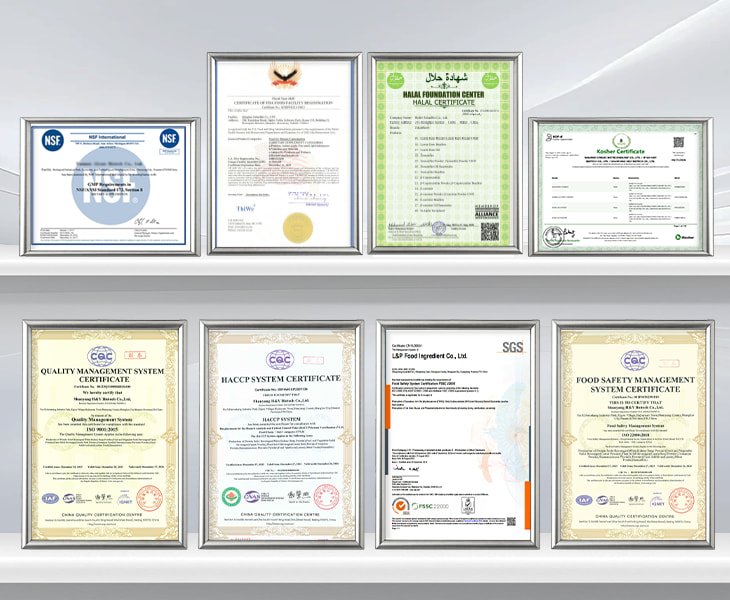
Manufacturing activities operate within established quality management frameworks designed to support international business requirements.
Certification Systems Include:
- cGMP
- FSSC 22000
- ISO 22000
- ISO 9001
- HACCP
- HALAL
- KOSHER
Quality management systems support consistent production practices, documentation control, traceability requirements, and customer audit readiness.
Ingredient consistency remains one of the most important factors influencing product quality and long-term consumer trust.
To support manufacturing reliability, our sourcing and quality systems include:
- Supplier qualification programs
- Raw material audit procedures
- Full batch traceability systems
- Certificate of Analysis (COA) documentation
- Incoming raw material verification
- Third-party laboratory testing support
Additionally, four GAP-certified cultivation bases contribute to improved sourcing transparency and botanical supply stability.