
Why KS Nutripharma®
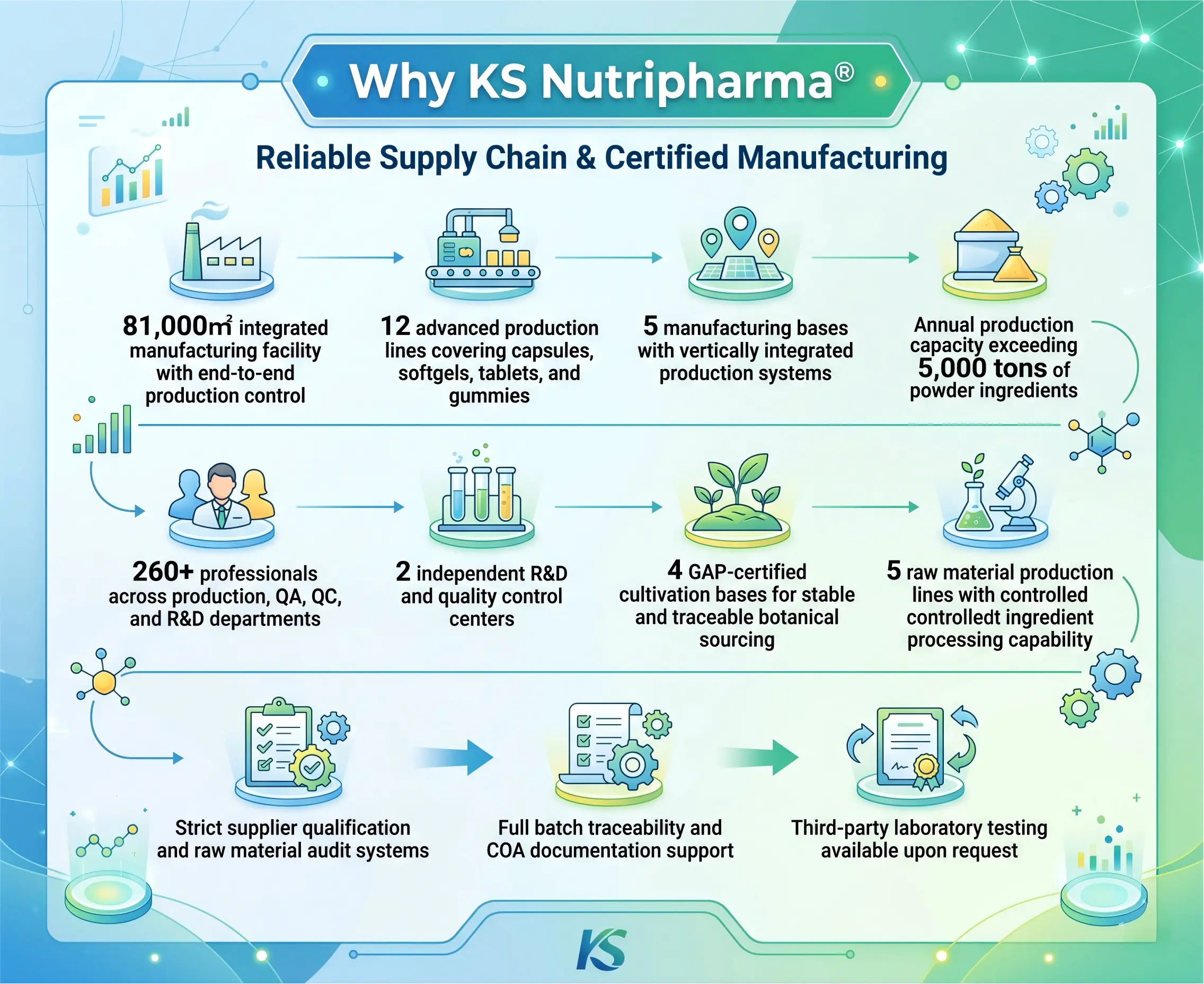
Reliable Supply Chain & Certified Manufacturing
- 81,000㎡ integrated manufacturing facility with end-to-end production control
- 12 advanced production lines covering capsules, softgels, tablets, and gummies
- 5 manufacturing bases with vertically integrated production systems
- Annual production capacity exceeding 5,000 tons of powder ingredients
- 260+ professionals across production, QA, QC, and R&D departments
- 2 independent R&D and quality control centers
- 4 GAP-certified cultivation bases for stable and traceable botanical sourcing
- 5 raw material production lines with controlled ingredient processing capability
- Strict supplier qualification and raw material audit systems
- Full batch traceability and COA documentation support
- Third-party laboratory testing available upon request
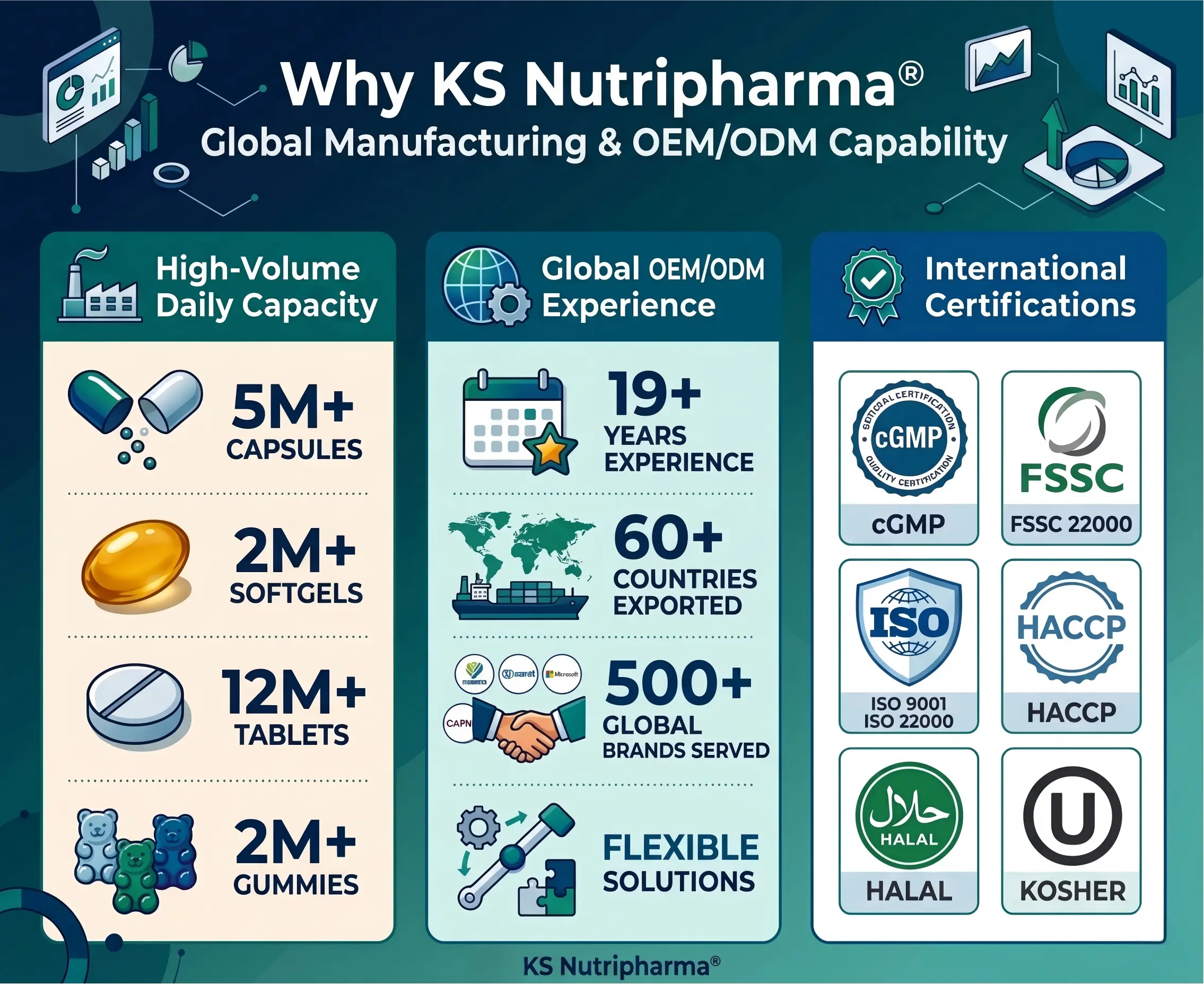
High-Volume Daily Production Capacity
- 5,000,000+ capsules per day
- 2,000,000+ softgels per day
- 12,000,000+ tablets per day
- 2,000,000+ gummies per day
Global OEM/ODM Commercialization Capability
- 19+ years of supplement manufacturing experience
- Exported to 60+ countries
- Serving 500+ global supplement brands
- Flexible OEM/ODM and private-label solutions
- Low MOQ to large-scale commercial production
- Multi-market regulatory documentation support
- Packaging and labeling coordination support
- Long-term supply-chain planning capability
International Certification Systems
Certified under: cGMP/ISO 22000/ ISO 9001/HACCP/FSSC 22000/HALAL/KOSHER
Women's Anti Aging Supplements Contract Manufacturer
KS Nutripharma operates as a full-service nutraceutical OEM/ODM manufacturing partner specializing in women’s healthy aging, menopause wellness, hormonal support, cellular vitality, and longevity-focused supplement development.
Our business model integrates:
- Market-driven formulation strategy
- Scientific ingredient architecture design
- Active-standardization systems
- Global regulatory adaptation
- Stability-focused manufacturing engineering
- Flexible OEM and private label production
- Long-term product lifecycle support
From preventive wellness products for women in their 30s and 40s to advanced menopause support systems and premium longevity formulations, we help brands build differentiated anti aging supplement portfolios designed for today’s healthy aging consumer.
Rather than focusing solely on cosmetic aging, our development framework addresses the broader biological and lifestyle factors associated with female aging, creating products positioned for stronger consumer engagement, higher retention rates, premium pricing opportunities, and long-term brand growth.
The women’s anti aging supplement market is undergoing a major transformation. While traditional anti aging products primarily focused on collagen, skin elasticity, and wrinkle reduction, today’s consumers increasingly seek comprehensive healthy aging solutions that support vitality, hormonal wellness, energy metabolism, cognitive function, healthy longevity, and overall quality of life throughout different stages of aging.
Across consumer discussions on Reddit, Quora, menopause communities, practitioner networks, and healthy aging forums, women are asking broader questions than ever before:
- How can I maintain energy as I get older?
- What nutritional support helps during perimenopause and menopause?
- How can I support healthy aging beyond appearance?
- Which ingredients support cellular vitality and long-term wellness?
- How can I maintain physical, mental, and metabolic resilience over time?
These evolving expectations have created a rapidly growing category that extends far beyond traditional beauty supplements.
For brands, retailers, healthcare practitioners, and longevity-focused wellness companies, success increasingly depends on developing multi-pathway healthy aging systems rather than single-ingredient anti wrinkle products.
1. Women’s Healthy Aging Product Architecture System
Women’s anti-aging supplements are no longer purchased solely for appearance-related concerns.
Most successful products in this category are built around specific aging transitions, physiological changes, and long-term wellness objectives rather than generic anti-aging claims.
For OEM brands, one of the most common commercialization mistakes is combining menopause support, longevity ingredients, collagen actives, and energy ingredients into a single overloaded formula without a clear consumer entry point.
We help brands segment product development according to real purchasing behavior and life-stage demand.
This segment is driven by consumers who are not yet experiencing menopause but are beginning to notice gradual changes in recovery, energy consistency, skin quality, sleep patterns, and stress resilience.
Common product positioning includes:
- daily healthy aging
- cellular wellness support
- vitality maintenance
- active lifestyle longevity
Formulation priorities typically focus on:
- antioxidant support
- mitochondrial nutrition
- stress adaptation
- beauty-wellness integration
The primary challenge is avoiding over-engineered formulations that increase cost without delivering meaningful consumer perception.
Perimenopause products represent one of the fastest-growing segments in women’s wellness.
Consumers entering hormonal transition frequently report:
- inconsistent energy
- sleep disruption
- mood variability
- changes in body composition
- reduced recovery capacity
Many formulations fail because brands focus on individual ingredients instead of pathway coverage.
Effective systems typically combine:
- phytoestrogen support
- stress adaptation systems
- metabolic wellness ingredients
- antioxidant protection
The objective is to create broad-spectrum support rather than single-symptom positioning.
Menopause-focused products increasingly target long-term quality-of-life outcomes.
Product development commonly centers on:
- healthy aging support
- vitality maintenance
- bone health support
- cognitive wellness
- metabolic balance
One recurring market issue is excessive dependence on botanical actives with inconsistent standardization.
Manufacturing success requires active verification, standardized extracts, and long-term potency monitoring to maintain batch reproducibility.
Premium anti aging products increasingly focus on biological aging pathways.
These formulations often incorporate:
- mitochondrial support ingredients
- NAD+ pathway ingredients
- senescence-support concepts
- cellular energy systems
Because ingredient costs are substantially higher than traditional wellness products, formulation efficiency becomes critical.
Our development process evaluates active contribution, dosage economics, and manufacturing feasibility before formula finalization.
This helps brands avoid clinically inspired formulas that are commercially unsustainable.
2. Functional Ingredient Engineering System
Ingredient selection determines whether an anti aging product becomes a repeat-purchase wellness system or a short-lived marketing product.
In women’s healthy aging supplements, formulation failure most often occurs because ingredients are selected according to trends rather than physiological relevance.
Our formulation framework is built around aging pathways rather than individual ingredient popularity.
Age-related decline in cellular energy production is increasingly recognized as a major contributor to fatigue, reduced resilience, and perceived aging.
Common active categories include:
- Urolithin A
- Coenzyme Q10
- PQQ
- Acetyl-L-Carnitine
- NAD+ precursor systems
Key formulation challenge:
Many mitochondrial actives are highly dosage-sensitive and significantly increase formula cost.
Control Strategy:
- active contribution analysis
- dosage efficiency modeling
- compatibility evaluation
- oxidation-risk assessment
Hormonal aging remains one of the strongest purchasing drivers among women over 40.
Common ingredient systems include:
- Soy Isoflavones
- Red Clover Extract
- Maca Extract
- Black Cohosh Extract
- Chasteberry Systems
Key formulation challenge:
Botanical actives often exhibit significant variability between suppliers.
Control Strategy:
- active-standardized extracts
- phytoactive verification
- supplier qualification protocols
- batch assay validation
Oxidative stress remains one of the most established healthy-aging pathways.
Common ingredients include:
- Astaxanthin
- CoQ10
- Tocotrienols
- Grape Seed Extract
- Olive Polyphenols
Key formulation challenge:
Many antioxidant actives are highly susceptible to degradation during processing and storage.
Control Strategy:
- oxygen exposure reduction
- low-temperature processing
- light protection systems
- accelerated stability verification
Although this category extends beyond beauty positioning, structural aging remains an important component of female healthy aging products.
Typical ingredients include:
- Collagen Peptides
- Hyaluronic Acid
- Ceramides
- Elastin-support complexes
- Polyphenol blends
Key formulation challenge:
Combining structural ingredients with longevity actives often creates dosage conflicts and oversized serving requirements.
Control Strategy:
- active prioritization
- dosage rationalization
- serving-size optimization
- delivery-format engineering
3. Scientific Validation & Dosage Integrity System
The anti aging category contains some of the highest levels of ingredient marketing inflation in the nutraceutical industry.
For brands targeting long-term credibility, formulation verification is often more important than ingredient count.
Many longevity ingredients command premium pricing but vary significantly in active content.
Validation includes:
- raw material authentication
- active-marker confirmation
- supplier qualification
- incoming batch verification
This reduces the risk of specification drift between production cycles.
Hormonal wellness formulas frequently depend on botanical ingredients.
The most common cause of batch inconsistency is variation in active-marker concentration.
Verification protocols focus on:
- isoflavone content
- triterpene content
- polyphenol concentration
- extraction consistency
This ensures commercial-scale reproducibility.
Many anti aging formulas contain ingredients with competing stability requirements.
Typical incompatibilities include:
- botanical extracts and minerals
- antioxidants and moisture-sensitive ingredients
- longevity actives and acidic systems
Compatibility testing evaluates:
- active interaction
- appearance stability
- odor development
- potency retention
before scale-up begins.
A formula that performs well in prototype form may fail during commercial storage.
Evaluation focuses on:
- active retention
- moisture sensitivity
- oxidation risk
- shelf-life performance
Only formulations meeting predefined stability criteria advance to mass production.
4. Delivery Format Selection & Commercialization Engineering
In women’s healthy aging supplements, delivery format selection directly affects formulation stability, active loading capacity, consumer compliance, manufacturing cost, and long-term commercial performance.
Many product failures originate not from the formulation itself, but from selecting a delivery format that is incompatible with the ingredient architecture.
Our development process evaluates delivery format feasibility before formula finalization to reduce stability risks and commercialization challenges.
Capsules remain the dominant format for menopause wellness, hormonal balance, and longevity-focused products because they offer the highest formulation flexibility and active loading efficiency.
Suitable For:
- phytoestrogen systems
- longevity ingredients
- mitochondrial support formulas
- botanical complexes
- practitioner-grade products
Common Problems:
- hygroscopic botanical blends causing capsule softening
- active segregation during encapsulation
- poor powder flow characteristics
- dosage inconsistency at scale
Control Measures:
- flowability optimization
- particle-size standardization
- moisture-control management
- encapsulation weight verification
Capsules are often the preferred solution when formulation performance takes priority over flavor experience.
Gummies continue to gain market share in women’s wellness due to superior consumer compliance and subscription retention rates.
However, they are also among the most technically restrictive delivery systems.
Suitable For:
- beauty-aging products
- menopause wellness gummies
- daily healthy aging formulas
- vitamin-antioxidant systems
Common Problems:
- insufficient active loading capacity
- moisture migration
- texture hardening
- ingredient interaction with gelling systems
- reduced stability of botanical actives
Control Measures:
- active concentration optimization
- water activity management
- texture stability validation
- compatibility testing before scale-up
Many longevity ingredients that perform well in capsules are unsuitable for gummies due to dosage limitations and stability concerns.
Powder systems are increasingly used for women’s healthy aging products because they accommodate larger active doses than capsules while providing greater formulation flexibility than gummies.
Suitable For:
- collagen-longevity combinations
- healthy aging drink mixes
- menopause nutrition systems
- beauty-wellness hybrid products
Common Problems:
- ingredient segregation
- moisture absorption
- flavor challenges
- poor dissolution performance
Control Measures:
- particle-size harmonization
- anti-caking system design
- flavor masking technology
- dissolution validation testing
Powders are often preferred when serving sizes exceed practical capsule limitations.
Stick packs have become increasingly popular in premium healthy aging categories due to portability and daily-use convenience.
Suitable For:
- longevity drink formulations
- beauty-aging systems
- healthy aging beverage concepts
- travel-friendly wellness products
Common Problems:
- powder compaction
- moisture intrusion
- flavor degradation during storage
Control Measures:
- barrier-material selection
- sachet integrity testing
- accelerated transportation simulation
- humidity-stability verification
For subscription-based wellness brands, stick packs frequently achieve higher compliance rates than bulk powder packaging.
Oral liquids represent one of the fastest-growing formats in Asian wellness markets and premium anti-aging categories.
When properly engineered, liquid systems offer strong perceived value and premium positioning opportunities.
Suitable For:
- beauty-aging beverages
- collagen-longevity hybrids
- women’s vitality systems
- premium healthy aging products
Common Problems:
- active precipitation
- flavor instability
- oxidation
- color migration
- preservative compatibility challenges
Control Measures:
- suspension stabilization
- pH optimization
- oxygen-management protocols
- shelf-life simulation testing
Liquid systems require significantly greater formulation and stability expertise than capsules or powders and therefore demand more extensive validation before commercialization.
Rather than beginning with a preferred dosage form, we recommend selecting the delivery format based on:
- ingredient dosage requirements
- stability characteristics
- target consumer profile
- expected retail positioning
- cost structure objectives
- distribution environment
The most successful women’s healthy aging products typically achieve alignment between formulation architecture and delivery format rather than forcing ingredients into a trend-driven format that compromises product performance.
5. Regulatory Risk Assessment & Claims Compliance System
Women’s healthy aging supplements frequently operate at the intersection of wellness, hormonal health, menopause support, and longevity nutrition.
This creates a significantly higher compliance burden than conventional beauty supplements.
Many otherwise viable products encounter regulatory challenges because marketing language evolves faster than regulatory acceptance.
The most frequent compliance issues originate from:
- anti-aging treatment claims
- hormone replacement implications
- menopause symptom treatment claims
- disease-prevention positioning
- age-reversal language
- longevity outcome guarantees
In many jurisdictions, these claims can immediately alter product classification and trigger additional regulatory requirements.
One of the most common launch failures occurs when product positioning exceeds what the ingredient profile can reasonably support.
Before commercialization, we review:
- ingredient-function consistency
- label architecture
- product naming structure
- marketing claim compatibility
- market-specific terminology
The objective is to reduce compliance exposure while preserving commercial positioning.
Ingredient acceptance varies significantly across regions.
Common challenges include:
- phytoestrogen restrictions
- novel ingredient acceptance
- longevity ingredient registration status
- dosage limitations
- labeling requirements
We support market-specific adaptation during product development rather than after production has been completed.
This approach minimizes reformulation costs and regulatory delays.
For export-oriented projects, documentation readiness is often as important as manufacturing capability.
Support includes:
- ingredient specifications
- certificate management
- batch traceability records
- testing documentation
- supplier qualification records
This creates a stronger compliance foundation for distributors, retailers, and cross-border sales channels.
6. Longevity Manufacturing & Stability Engineering System
Healthy aging formulas often contain some of the most stability-sensitive ingredients in the nutraceutical industry.
Unlike standard vitamin products, longevity formulations frequently combine botanical extracts, antioxidants, phytonutrients, mitochondrial support compounds, and moisture-sensitive actives within the same system.
Manufacturing consistency therefore becomes a critical commercial variable.
Many premium anti-aging ingredients gradually lose potency during processing and storage.
Typical risk factors include:
- oxygen exposure
- elevated temperature
- moisture migration
- prolonged processing time
Control Measures:
- controlled-environment production
- low-temperature processing where applicable
- validated holding-time limits
- active-specific handling procedures
The objective is not simply achieving label claim at production but maintaining potency throughout shelf life.
Oxidative degradation is one of the most common causes of performance loss in healthy aging products.
High-risk ingredients include:
- CoQ10
- Astaxanthin
- polyphenol complexes
- lipid-based actives
Control Measures:
- oxygen-reduced manufacturing environments
- protective packaging systems
- light-barrier materials
- accelerated stability verification
These controls help reduce potency loss during storage and international distribution.
Phytoestrogen systems frequently exhibit significant variability between raw material lots.
Without standardization, brands may experience:
- inconsistent potency
- sensory variation
- consumer complaints
- reduced product reproducibility
Control Measures:
- active-marker standardization
- supplier qualification programs
- incoming raw-material verification
- batch-to-batch analytical comparison
Many formulations remain stable during pilot production but deteriorate after six to twelve months of storage.
Verification focuses on:
- active retention trends
- moisture behavior
- capsule integrity
- color migration
- odor development
Only formulations demonstrating acceptable stability performance proceed to large-scale production.
7. Commercial Scale-Up & Launch Planning System
One of the most expensive mistakes in supplement manufacturing is moving directly from concept to full-scale production.
Many anti aging products require multiple optimization cycles before achieving commercial readiness.
Our scale-up framework is designed to identify manufacturing and market risks before inventory exposure becomes significant.
Typical Volume:
500–1,000 Units
Primary Objectives:
- formulation verification
- sensory assessment
- packaging compatibility
- early stability monitoring
Most formulation adjustments occur during this stage.
Launching without pilot validation frequently increases rework costs and inventory risk.
Typical Volume:
3,000–10,000 Units
Primary Objectives:
- initial sales validation
- retailer feedback collection
- consumer acceptance monitoring
- demand forecasting
This stage allows brands to evaluate market performance before large-scale inventory commitments.
Typical Volume:
50,000–100,000+ Units
Primary Objectives:
- manufacturing efficiency
- raw-material planning
- cost optimization
- long-term supply continuity
At this stage, supply-chain resilience becomes equally important as formulation quality.
8. Product Development & Commercialization Timeline
Successful anti aging supplements are rarely created by accelerating manufacturing timelines.
The most successful launches typically spend more time validating formulation stability, supply security, and commercialization readiness before production begins.
Typical Timeline:
3–5 Business Days
Evaluation Focus:
- ingredient compatibility
- dosage feasibility
- delivery format suitability
- target cost alignment
Many development risks can be identified before prototype creation begins.
Typical Timeline:
7–14 Business Days
Evaluation Focus:
- formulation performance
- taste and sensory characteristics
- capsule or powder behavior
- ingredient integration
This phase determines whether the concept is technically manufacturable.
Typical Timeline:
2–4 Weeks
Evaluation Focus:
- active retention
- moisture sensitivity
- oxidation behavior
- packaging compatibility
Stability failures discovered after commercialization are significantly more expensive to correct.
Typical Timeline:
2–4 Weeks
Activities Include:
- raw-material allocation
- production scheduling
- quality verification
- packaging execution
- batch release procedures
Production begins only after technical, quality, and documentation requirements have been completed.
9. Supply Chain Security & Active Continuity System
Women’s healthy aging products often rely on premium active ingredients with limited global manufacturing capacity, evolving regulatory status, and significant raw-material cost volatility.
For longevity-focused brands, supply-chain resilience directly affects product availability, pricing stability, and long-term consumer trust.
Several high-value active ingredients are supplied through highly concentrated global production networks.
Examples include:
- Urolithin A
- Ergothioneine
- NMN-compatible systems
- NR-compatible systems
- Spermidine
- PQQ
- specialty mitochondrial-support ingredients
Potential Risks:
- supplier concentration
- extended lead times
- sudden cost increases
- manufacturing interruptions
Control Measures:
- dual-source qualification
- approved secondary suppliers
- active-equivalency verification
- strategic inventory planning
The objective is maintaining uninterrupted production without altering product specifications.
Regulatory acceptance for longevity-focused ingredients continues to evolve across global markets.
A formulation that is commercially viable today may require adaptation as regulatory frameworks change.
Potential Risks:
- novel-food restrictions
- ingredient registration changes
- import limitations
- dosage restrictions
- claim restrictions
Control Measures:
- ongoing regulatory monitoring
- alternative ingredient pathways
- formulation contingency planning
- market-specific adaptation strategies
This helps reduce reformulation pressure when regulatory requirements change.
Menopause and hormonal-wellness products depend heavily on botanical extracts.
The greatest challenge is maintaining active-marker consistency despite seasonal and geographic variability.
Potential Risks:
- phytochemical fluctuations
- harvest variability
- extraction inconsistency
- supplier substitution
Control Measures:
- active-marker specifications
- HPLC verification
- botanical fingerprint analysis
- supplier qualification programs
These controls support consistent product performance across production cycles.
Packaging disruptions can delay production even when ingredients are fully available.
At the same time, packaging performance directly affects shelf-life stability.
Potential Risks:
- packaging shortages
- barrier-material inconsistency
- container-closure failure
- transportation damage
Control Measures:
- qualified packaging alternatives
- barrier-performance verification
- packaging redundancy planning
- transportation simulation testing
As production volumes increase, procurement becomes increasingly dependent on forecasting accuracy.
Potential Risks:
- peak-season shortages
- inventory imbalance
- manufacturing bottlenecks
- long lead-time materials
Control Measures:
- forecast-based procurement
- safety-stock planning
- forward purchasing programs
- production-capacity allocation
The objective is supporting predictable growth without compromising supply reliability.
10. Women’s Healthy Aging R&D Platform
Successful anti aging supplements are rarely built around individual ingredients.
Commercially sustainable products are usually developed around biological pathways, consumer needs, and long-term product evolution.
Our R&D framework focuses on creating formulation systems rather than isolated products.
Women’s aging is influenced by multiple physiological systems that change simultaneously over time.
Development considerations include:
- oxidative stress management
- cellular energy support
- metabolic wellness
- hormonal transition support
- vitality maintenance
The objective is building pathway-oriented formulations rather than trend-driven ingredient combinations.
Menopause products often fail because formulations are built around one headline ingredient while ignoring broader physiological needs.
Development focuses on:
- hormonal wellness support
- healthy aging integration
- vitality support
- daily-use compliance
- long-term supplementation suitability
This approach supports broader consumer retention after initial purchase.
The longevity category increasingly emphasizes cellular health rather than cosmetic anti-aging positioning.
Research areas include:
- mitochondrial support concepts
- energy metabolism pathways
- healthy aging nutrition
- active-aging product design
Development decisions prioritize formulation feasibility, stability, and commercial scalability.
Many brands launch a single anti aging product and later expand into broader women’s wellness categories.
Platform development considers future extensions into:
- menopause wellness
- women’s vitality
- beauty-aging systems
- healthy aging nutrition
- daily longevity support
This reduces redevelopment costs when portfolio expansion occurs.
11. Intellectual Property Protection & OEM Confidentiality System
Women’s healthy aging products frequently require significant investment in formulation development, ingredient sourcing, positioning strategy, and market validation.
Protecting these investments is essential for long-term brand value.
Confidentiality protection begins before formulation development starts.
Measures include:
- mutual NDA execution
- restricted project access
- controlled documentation management
- secure communication procedures
Only authorized personnel are permitted access to project-specific information.
One of the most common concerns among emerging brands is whether proprietary formulations can be reused for competing projects.
Protection mechanisms may include:
- custom formula documentation
- formulation version control
- project-specific access restrictions
- development-record management
These procedures help maintain separation between client projects.
Premium healthy aging products often rely on specialized ingredient sourcing strategies.
Information requiring protection may include:
- supplier networks
- sourcing specifications
- active-selection rationale
- cost structures
Internal controls are designed to limit unauthorized information distribution.
For qualifying projects, exclusivity arrangements may be evaluated based on:
- annual volume commitments
- market scope
- geographic territories
- formulation uniqueness
Exclusivity considerations are reviewed on a case-by-case basis according to commercial feasibility.
12. Product Lifecycle Optimization & Portfolio Expansion System
Most anti aging supplements do not remain commercially successful because of their initial launch.
They remain successful because brands continuously optimize formulas, adapt to market trends, and expand product ecosystems around evolving consumer needs.
The healthy aging category evolves rapidly.
New scientific publications, ingredient innovations, and regulatory developments frequently create opportunities for product improvement.
Common Upgrade Areas:
- ingredient replacement
- dosage optimization
- bioavailability enhancement
- cost-efficiency improvements
- label simplification
The objective is improving competitiveness without disrupting brand identity.
Many successful women’s wellness brands expand from a single anti aging product into multiple adjacent categories.
Common Expansion Pathways:
Stage 1
- Women’s Healthy Aging Formula
↓ Stage 2
- Menopause Support Formula
- Women’s Energy Formula
- Beauty & Longevity Formula
↓ Stage 3
- Healthy Aging Product Collection
This structured expansion model often produces higher customer lifetime value than repeatedly launching unrelated products.
As brands enter new markets, formulation adjustments may become necessary.
Adaptation considerations include:
- ingredient compliance
- dosage restrictions
- labeling requirements
- consumer preference differences
This reduces barriers to international expansion.
As production volume increases, brands often seek margin improvements.
However, uncontrolled cost reduction frequently damages product performance.
Optimization focuses on:
- ingredient sourcing efficiency
- packaging rationalization
- manufacturing efficiency
- inventory optimization
while maintaining formulation integrity and consumer experience.
13. Post-Production Technical Support, CAPA & Root Cause Investigation System
Technical risk does not terminate upon manufacturing completion. Complex formulations—particularly those utilizing sensitive botanicals, probiotics, and active micronutrients—frequently encounter environmental, packaging, or supply-chain variables after entering warehousing, cross-border logistics, or consumer use.
We maintain a highly structured, rapid-response technical framework designed to safeguard brand reputation, minimize inventory exposure, and transform post-market data into long-term product resilience.
When unexpected anomalies arise post-commercialization, immediate and systematic intervention is critical to mitigating operational and financial disruption.
24-Hour Technical Response Protocol: Immediate mobilization upon notification of any production concerns, stability anomalies, packaging deviations, quality inquiries, or logistics-related incidents to provide initial risk assessment and actionable technical guidance.
72-Hour Root Cause Analysis (RCA) Framework: Launch of a rigorous, cross-functional investigation to identify the underlying source of failure rather than merely treating superficial symptoms.
Investigation & Evaluation Scope:
Raw Material & Component Review: Auditing retaining samples, certificates of analysis (CoAs), and supplier batch records.
Manufacturing & Batch Record Assessment: Reviewing critical process parameters (CPPs), critical quality attributes (CQAs), and in-process controls.
Packaging & Containment Verification: Evaluating barrier integrity and potential component-product interactions.
Environmental & Logistics Analysis: Reviewing thermal, moisture, and transport condition data across the distribution chain.
Stability Trend Review: Analyzing historical data and real-time retention samples.
Advanced formulations are highly susceptible to localized micro-climates and environmental stressors. Our technical team is equipped to rapidly troubleshoot and resolve specific product and sensory matrix failures.
Critical Targeted Issues Monitored: Active degradation, moisture exposure, probiotic viability loss, capsule softening, powder caking, flavor drift, color variation, and high-barrier packaging performance failures.
Technical Remediation Protocols:
Comprehensive stability data reviews and emergency accelerated stability testing.
Container-closure integrity reassessments and packaging barrier upgrades.
Targeted formulation adjustment recommendations (e.g., overages, desiccant optimization, or matrix stabilization) for subsequent production runs to ensure long-term product consistency.
When systemic or recurring issues are identified, a formal CAPA program is strictly enforced to eliminate the risk of recurrence across future manufacturing cycles.
Corrective Actions (Immediate Remediation): Executing rapid process optimization, immediate packaging optimization, and tightening of raw material specifications.
Preventive Actions (Long-Term Mitigation):
Supplier Corrective Actions: Issuing formal SCARs (Supplier Corrective Action Reports) and conducting targeted supplier audits.
Quality System Enhancements: Updating Standard Operating Procedures (SOPs), refining master documentation, and implementing mandatory cross-functional training.
Commercial Benefit: Systematically drives down cost-of-quality errors and solidifies long-term operational reliability.
For recurring production projects, historical batch data serves as a strategic asset to proactively optimize product lines before deviations can occur.
Data-Driven Monitoring Matrix: Continuous tracking of consumer complaint trends, longitudinal stability performance, active ingredient retention data, and statistical manufacturing consistency indicators (e.g., process capability index).
Strategic Objective: Transitioning real-world operational and distribution data into actionable insights to continuously improve formulation robustness, production efficiency, and supply chain resilience over time.
14. Quality Assurance, Testing & Traceability System
Women’s healthy aging supplements often contain premium active ingredients, standardized botanicals, and stability-sensitive compounds.
Quality management therefore extends beyond finished-product testing.
Quality begins before production starts.
Incoming-material evaluation may include:
- identity verification
- active-marker confirmation
- microbiological screening
- heavy-metal assessment
- supplier qualification review
This reduces the risk of introducing variability into production.
Critical manufacturing parameters are monitored throughout production.
Verification may include:
- blend uniformity
- encapsulation consistency
- moisture control
- weight variation monitoring
- packaging integrity verification
These controls help maintain batch reproducibility.
Release testing typically focuses on:
- active-content verification
- microbiological compliance
- heavy metals
- physical specifications
- label-conformance review
Products are evaluated against predefined specifications before release.
Traceability systems support rapid investigation and regulatory readiness.
Records may include:
- raw-material sourcing
- production records
- packaging records
- testing results
- distribution documentation
This creates visibility throughout the product lifecycle.
15. Scientific Positioning & Commercialization Framework
Many anti aging supplements fail commercially because they are built around ingredients rather than consumer motivations.
The most successful brands translate scientific formulation architecture into understandable wellness positioning.
Consumers increasingly seek support for aging well rather than reversing aging.
Common positioning themes include:
- healthy aging
- active lifestyle support
- wellness maintenance
- long-term vitality
This positioning generally provides broader market applicability than appearance-focused messaging alone.
Menopause remains one of the fastest-growing segments within women’s wellness.
Effective commercialization typically focuses on:
- daily wellness support
- life-stage nutrition
- vitality maintenance
- healthy aging integration
This approach avoids disease-oriented messaging while maintaining strong consumer relevance.
Interest in cellular wellness and longevity continues to expand globally.
Positioning frameworks often include:
- cellular vitality
- energy support
- healthy aging nutrition
- active aging lifestyles
Scientific concepts are translated into consumer-friendly communication structures.
Many consumers perceive declining energy and recovery capacity as early indicators of aging.
Positioning strategies frequently combine:
- vitality support
- energy metabolism
- daily performance
- wellness resilience
This category often complements menopause and longevity product ecosystems.
16. Packaging Engineering, Retail Stability Validation
Packaging is a critical component of product stability, particularly for formulations containing antioxidants, botanical extracts, phytoestrogens, and longevity-focused active ingredients.
A technically sound formula can still fail commercially if packaging performance is inadequate.
Many healthy aging ingredients are susceptible to oxidation.
High-risk categories include:
- CoQ10
- Astaxanthin
- polyphenol complexes
- lipid-based actives
Packaging selection may focus on:
- oxygen-barrier materials
- induction sealing systems
- protective headspace management
- light-resistant packaging
Moisture remains one of the most common causes of product instability.
Potential outcomes include:
- capsule deformation
- gummy texture changes
- powder caking
- active degradation
Control strategies may include:
- desiccant integration
- high-barrier packaging materials
- environmental monitoring
- transportation-condition assessment
Global distribution frequently exposes products to challenging environmental conditions.
Validation may evaluate:
- vibration exposure
- temperature fluctuations
- humidity stress
- packaging durability
These assessments help identify risks before commercial distribution.
Shelf-life performance is monitored under defined storage conditions.
Evaluation may include:
- active retention
- sensory stability
- packaging integrity
- visual appearance consistency
The objective is maintaining product quality throughout its intended commercial lifespan.
17. Sustainability, Clean Label & Responsible Manufacturing Framework
Consumer expectations within women’s healthy aging supplements increasingly extend beyond product performance.
Ingredient transparency, responsible sourcing, and environmental considerations have become important purchasing factors across many markets.
Clean Label Development
Many brands seek formulations aligned with modern consumer preferences.
Options may include:
- non-GMO ingredients
- vegan-compatible systems
- allergen-conscious formulations
- artificial-additive reduction
Clean-label objectives are evaluated alongside formulation feasibility and stability requirements.
Responsible Botanical Sourcing
Botanical ingredients play an important role in many menopause and healthy aging formulations.
Responsible sourcing considerations may include:
- supplier qualification
- harvest consistency
- sustainability practices
- long-term sourcing continuity
These measures support both product quality and supply-chain resilience.
Environmentally Conscious Packaging
Packaging decisions increasingly influence brand perception.
Potential initiatives include:
- material reduction
- recyclable packaging options
- transportation-efficiency improvements
- packaging optimization programs
Practical implementation is balanced against stability and product-protection requirements.
Long-Term Manufacturing Partnerships
Sustainable manufacturing is not solely an environmental objective.
It also includes maintaining stable supplier relationships, quality consistency, and long-term operational reliability.
A resilient manufacturing ecosystem helps support continued product availability as brands expand into broader women’s healthy aging portfolios.