

Why KS Nutripharma®
Reliable Supply Chain & Certified Manufacturing
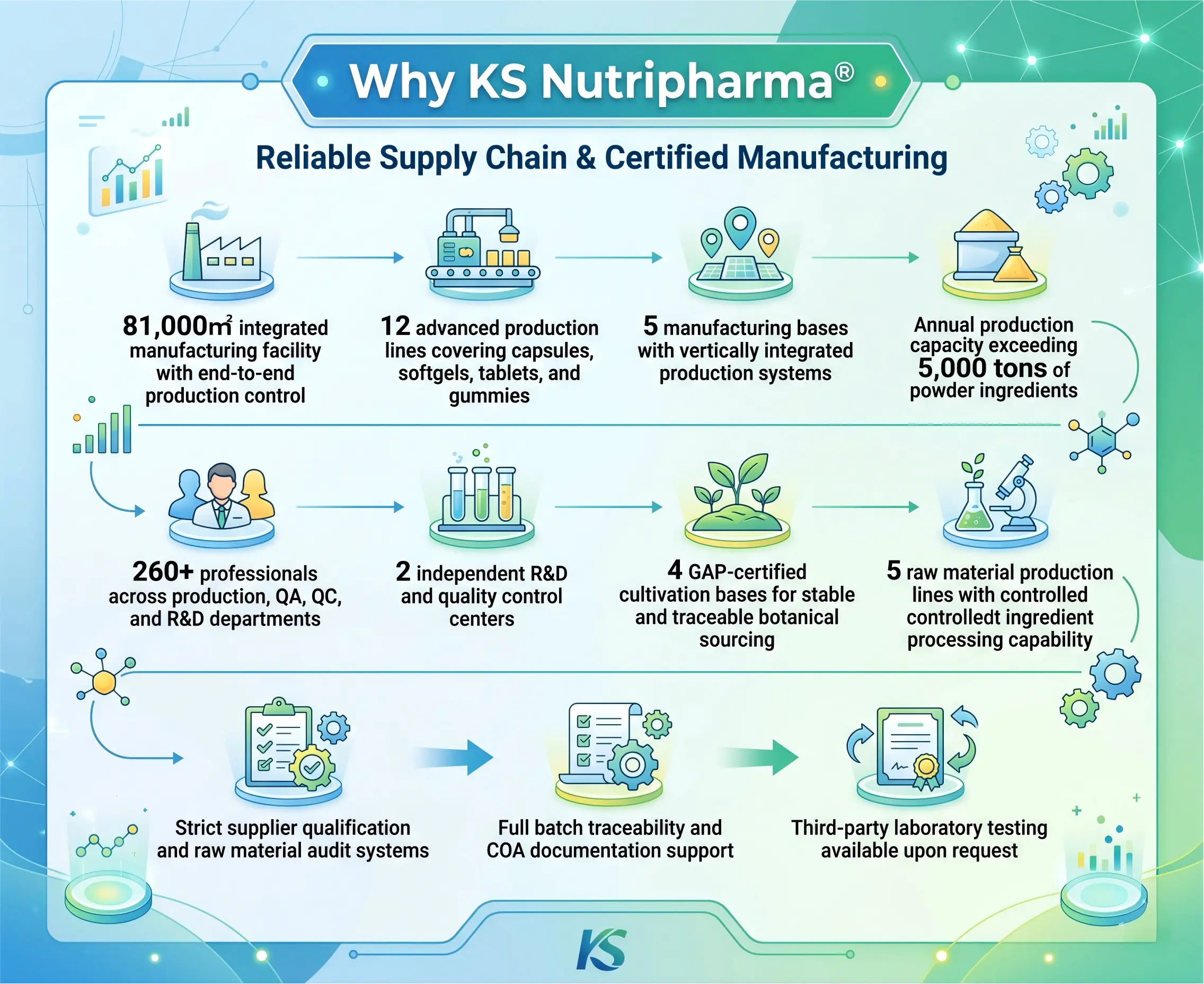
- 81,000㎡ integrated manufacturing facility with end-to-end production control
- 12 advanced production lines covering capsules, softgels, tablets, and gummies
- 5 manufacturing bases with vertically integrated production systems
- Annual production capacity exceeding 5,000 tons of powder ingredients
- 260+ professionals across production, QA, QC, and R&D departments
- 2 independent R&D and quality control centers
- 4 GAP-certified cultivation bases for stable and traceable botanical sourcing
- 5 raw material production lines with controlled ingredient processing capability
- Strict supplier qualification and raw material audit systems
- Full batch traceability and COA documentation support
- Third-party laboratory testing available upon request
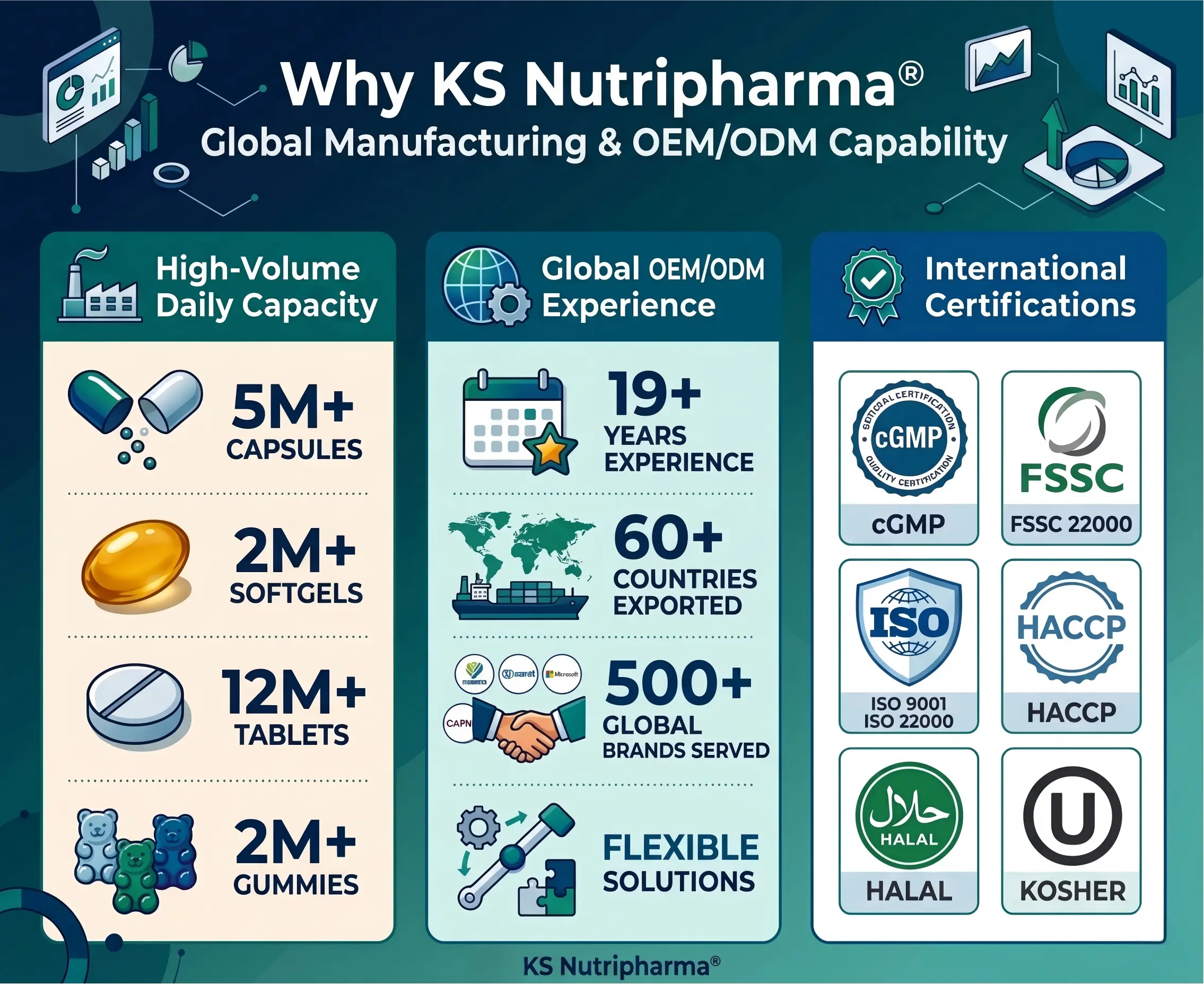
High-Volume Daily Production Capacity
- 5,000,000+ capsules per day
- 2,000,000+ softgels per day
- 12,000,000+ tablets per day
- 2,000,000+ gummies per day
Global OEM/ODM Commercialization Capability
- 19+ years of supplement manufacturing experience
- Exported to 60+ countries
- Serving 500+ global supplement brands
- Flexible OEM/ODM and private-label solutions
- Low MOQ to large-scale commercial production
- Multi-market regulatory documentation support
- Packaging and labeling coordination support
- Long-term supply-chain planning capability
International Certification Systems
Certified under: cGMP/ISO 22000/ ISO 9001/HACCP/FSSC 22000/HALAL/KOSHER
Acne Supplement Manufacturing for Hormonal, Gut-Skin Axis & Skin Clarity Brands
KS Nutripharma is a full-service nutraceutical manufacturer specializing in beauty, wellness, and condition-specific dietary supplements for global brands, distributors, clinics, retailers, and emerging DTC companies.
We provide end-to-end OEM and ODM solutions covering:
- Formula development
- Raw material sourcing
- Clinical ingredient integration
- Flavor and dosage form engineering
- Compliance Review
- Packaging Development
- Pilot Production
- Commercial-scale manufacturing
Within the beauty supplement category, acne supplements represent one of the fastest-evolving segments because consumer demand is shifting away from single-ingredient “skin-clearing” products toward multi-pathway wellness systems addressing hormonal fluctuations, microbiome balance, inflammatory responses, and skin health maintenance.
The challenge for brands is that acne is not a single condition from a formulation perspective. Products developed around only one mechanism often generate inconsistent consumer feedback, weak repurchase rates, and limited product differentiation.
KS Nutripharma applies an Acne Pathway Management Framework that maps formulations according to the biological pathways most commonly associated with recurring skin concerns, allowing brands to develop more targeted, scalable, and compliance-conscious supplement systems for global markets.
1. Acne Market Segmentation & Product Positioning Framework
The most successful acne supplement brands are no longer competing with ingredients. They are competing with positioning.
Consumer purchase decisions increasingly depend on whether a product clearly addresses the pathway they believe is contributing to recurring breakouts.
Primary Consumer Profile
- women aged 25–45
- cycle-related skin fluctuations
- recurring jawline breakouts
- long-term skin instability
Formulation Strategy
- Zinc
- Vitex
- Inositol
- Vitamin B6
- DIM-compatible systems
Development Challenges
- hormone-related compliance risks
- regional regulatory differences
- claim sensitivity across marketplaces
Commercial Value
Higher customer retention and stronger subscription potential than traditional teen acne products.
Primary Consumer Profile
- redness-prone skin
- reactive skin conditions
- post-breakout recovery concerns
Formulation Strategy
- Curcumin complexes
- Green Tea Extract
- Polyphenols
- Omega fatty acid systems
Development Challenges
- botanical standardization
- active degradation control
- taste management in powders and gummies
Commercial Value
Allows premium positioning through antioxidant and skin wellness claims rather than commodity acne claims.
Primary Consumer Profile
- digestive discomfort with skin concerns
- microbiome-conscious consumers
- wellness-focused buyers
Formulation Strategy
- probiotics
- prebiotics
- postbiotics
- microbiome-support nutrients
Development Challenges
- probiotic viability
- moisture control
- shelf-life preservation
Commercial Value
Creates natural expansion opportunities into gut health, microbiome, and women’s wellness categories.
Primary Consumer Profile
- oily skin concerns
- lifestyle-related breakouts
- first-time supplement users
Formulation Strategy
- Zinc
- Vitamin A precursors
- antioxidant complexes
- skin wellness nutrients
Development Challenges
- compliance-sensitive positioning
- parental acceptance
- retailer claim restrictions
Commercial Value
Large consumer volume and strong retail channel demand.
2. Functional Ingredient Architecture & Acne Pathway Engineering System
Recurring breakouts rarely originate from a single biological trigger.
Consumers experiencing similar skin symptoms may have completely different underlying drivers, including hormonal fluctuations, excessive sebum activity, microbiome imbalance, inflammatory responses, oxidative stress, or dietary-related metabolic factors.
For this reason, modern acne supplement development increasingly focuses on pathway engineering rather than single-ingredient formulation.
At KS Nutripharma, acne supplements are typically designed around five major biological support pathways.
Consumer Signals
Commonly associated with:
- oily skin appearance
- enlarged pores
- frequent congestion
- recurrent forehead and T-zone breakouts
Formulation Objective
Support healthy sebum activity while maintaining normal skin barrier function.
Ingredient Systems
- Zinc
- Green Tea Extract (EGCG)
- Beta-Carotene
- Vitamin B6
- Niacinamide
- Burdock Root Extract
- Pantothenic Acid (Vitamin B5)
Manufacturing Considerations
Botanical actives used in oil-balance formulas often exhibit potency variation between suppliers, requiring active-marker standardization and batch verification.
One of the fastest-growing segments in beauty nutrition.
Particularly relevant for adult female consumers experiencing cyclical skin fluctuations.
Consumer Signals
- jawline breakouts
- premenstrual skin changes
- recurring monthly flare-ups
- adult-onset acne concerns
Formulation Objective
Support hormonal wellness and endocrine balance without creating pharmaceutical-style positioning.
Ingredient Systems
- Vitex Extract
- Myo-Inositol
- D-Chiro-Inositol
- Zinc
- Vitamin B6
- Magnesium
- DIM-compatible systems
- Flaxseed Lignans
Manufacturing Considerations
Ingredient selection must account for regional regulatory differences and claim restrictions surrounding hormone-related positioning.
One of the highest-growth categories within acne supplement development.
Increasing consumer awareness of microbiome health has created demand for formulations connecting digestive wellness with skin appearance.
Consumer Signals
- bloating with breakouts
- digestive irregularity
- post-antibiotic skin concerns
- microbiome-focused wellness interests
Formulation Objective
Support digestive balance and microbiome diversity associated with healthy skin function.
Ingredient Systems
Probiotics
- Lactobacillus rhamnosus
- Lactobacillus plantarum
- Lactobacillus paracasei
- Bifidobacterium lactis
- Bifidobacterium longum
Prebiotics
- Inulin
- FOS
- GOS
- Acacia Fiber
Postbiotics
- Fermentation metabolites
- Heat-treated beneficial strains
Supportive Nutrients
- Zinc
- L-Glutamine
- Tributyrin
- Digestive enzyme systems
Manufacturing Considerations
CFU stability must be validated against temperature, moisture exposure, transportation conditions, and packaging configuration.
Many acne consumers report visible redness, skin reactivity, and prolonged post-breakout recovery.
These symptoms are often associated with inflammatory activity.
Formulation Objective
Support healthy inflammatory balance and skin comfort.
Ingredient Systems
- Curcumin
- Green Tea Polyphenols
- Boswellia Serrata
- Omega-3 Systems
- Quercetin
- Resveratrol
- Ginger Extract
Manufacturing Considerations
Many polyphenol-rich ingredients exhibit oxidation sensitivity and require protection during processing and storage.
Environmental exposure, lifestyle factors, and metabolic stress may contribute to oxidative burden affecting skin appearance.
This pathway has become increasingly popular among premium beauty brands because it expands beyond acne-only positioning.
Formulation Objective
Support antioxidant defense systems and skin recovery mechanisms.
Ingredient Systems
- Astaxanthin
- Vitamin C
- Vitamin E
- Grape Seed Extract
- Pine Bark Extract
- Coenzyme Q10
- Ergothioneine
- Lycopene
Manufacturing Considerations
Certain antioxidant compounds are highly sensitive to oxygen, heat, and light exposure, requiring stability-focused processing controls.
This category has emerged rapidly within functional wellness brands targeting consumers who associate dietary patterns with skin appearance.
Consumer Signals
- breakouts after high-sugar meals
- carbohydrate sensitivity concerns
- wellness-oriented consumers
Formulation Objective
Support healthy glucose metabolism and metabolic wellness.
Ingredient Systems
- Chromium Picolinate
- Berberine
- Cinnamon Extract
- Alpha-Lipoic Acid
- Magnesium
- Inositol
Commercial Opportunity
Creates natural expansion opportunities into:
- women’s wellness
- metabolic health
- weight management
- healthy aging
categories.
A frequently overlooked pathway in acne supplement development.
Many consumers focus exclusively on reducing oil production while neglecting barrier-support nutrition.
Formulation Objective
Support normal skin structure and barrier function.
Ingredient Systems
- Ceramide Complexes
- Hyaluronic Acid
- Phytoceramides
- Biotin
- Zinc
- Copper
- Vitamin C
- Collagen Peptides
Commercial Opportunity
Allows integration with broader beauty-from-within product lines while increasing average order value.
3. Clinical Evidence, Active Validation & Formula Credibility System
Acne supplements often fail not because of ingredient selection, but because formulation decisions are driven by ingredient trends rather than biological pathway relevance.
Consumers increasingly evaluate products based on formulation credibility, scientific rationale, ingredient transparency, and consistency of user experience.
For this reason, KS Nutripharma evaluates acne formulations through a multi-level validation framework covering active identity, clinical relevance, ingredient compatibility, and manufacturing reproducibility.
Acne supplements frequently incorporate trending ingredients with limited connection to the biological pathway they are intended to support.
This can create complex labels without improving consumer perception or repurchase behavior.
Evaluation Criteria
- pathway relevance
- human clinical evidence
- dosage feasibility
- long-term safety profile
- regulatory acceptance
Validation Objective
Ensure every active ingredient serves a defined formulation purpose rather than a marketing function.
Ingredient potency variation remains one of the most common causes of inconsistent product performance.
Particularly within botanical-based acne formulations.
Control Areas
- active marker verification
- identity testing
- potency confirmation
- supplier qualification
- batch consistency review
Typical Verification Targets
| Ingredient | Verification Marker |
|---|---|
| Green Tea Extract | EGCG |
| Curcumin | Curcuminoids |
| Grape Seed Extract | OPCs |
| Vitex | Agnusides |
| Berberine | Berberine HCl |
Commercial Impact
Improves batch reproducibility and reduces variability after scale-up.
Modern acne supplements often combine:
- hormonal support
- microbiome support
- inflammatory balance
- antioxidant systems
within a single formulation.
Without compatibility assessment, interactions may reduce stability, sensory quality, or active retention.
Assessment Areas
- ingredient interactions
- moisture sensitivity
- oxidation risk
- pH compatibility
- excipient compatibility
Validation Objective
Improve formulation robustness before commercialization.
For gut-skin axis products, probiotic inclusion alone does not determine product quality.
The key question is whether viable organisms remain present at the end of shelf life.
Control Areas
- strain verification
- CFU validation
- moisture resistance
- shelf-life stability
- packaging compatibility
Commercial Impact
Supports label integrity and retailer confidence.
Acne supplements frequently contain sensitive botanical extracts, antioxidants, probiotics, and micronutrients.
These ingredients may degrade during manufacturing or storage if stability risks are not addressed early.
Stability Review Areas
- heat exposure
- humidity exposure
- oxidation sensitivity
- transportation stress
- packaging interaction
KPI Focus
- active retention
- appearance stability
- microbiological stability
- shelf-life consistency
One of the most common reasons acne supplements fail commercially is formulation homogeneity.
Many products contain nearly identical ingredient lists with no meaningful positioning difference.
Evaluation Areas
- pathway uniqueness
- market saturation analysis
- positioning opportunities
- ingredient synergy assessment
- SKU expansion potential
Commercial Objective
Help brands build formulations that are easier to differentiate within crowded acne supplement markets.
4. Dosage Form Engineering & Consumer Compliance System
Acne supplement performance is influenced not only by ingredient selection but also by dosage form suitability, active stability, consumer adherence, and long-term usage behavior.
Many acne formulations fail commercially because the delivery format is selected based on manufacturing convenience rather than the biological pathway being targeted.
At KS Nutripharma, dosage form selection is evaluated according to formulation complexity, ingredient compatibility, target consumer profile, shelf-life requirements, and commercial positioning objectives.
Hard capsules remain the most versatile format for acne supplement development.
They are particularly suitable for formulations combining hormonal support, microbiome ingredients, antioxidants, minerals, and botanical extracts within a single product.
Best Suited For
- Hormonal Balance Systems
- Gut-Skin Axis Formulations
- Women’s Skin Wellness Products
- Multi-Pathway Acne Architectures
Advantages
- High active loading capacity
- Flexible ingredient combinations
- Better compatibility with probiotics
- Lower formulation restrictions
- Faster development timelines
Technical Control Points
- Powder flow consistency
- Fill-weight uniformity
- Moisture-sensitive ingredient protection
- Active segregation prevention
Commercial Benefits
Capsules allow brands to deliver clinically meaningful ingredient levels without requiring multiple product formats.
Gummies have become increasingly popular among younger consumers and beauty-focused supplement brands.
However, acne formulations present unique challenges because many acne-support ingredients are difficult to incorporate into gummy systems.
Common Challenges
- Limited active loading capacity
- Heat-sensitive ingredients
- Probiotic viability concerns
- Bitter botanical extracts
- Sugar perception issues
Suitable Formulation Strategies
Rather than attempting to incorporate every acne-support ingredient into a gummy, successful products typically focus on:
- Skin wellness support
- Antioxidant systems
- Zinc-based formulations
- Beauty positioning concepts
Technical Solutions
- Flavor masking technologies
- Low-sugar systems
- Pectin-based vegan gummies
- Stability-focused active selection
Commercial Benefits
High consumer compliance and strong repeat-purchase potential.
Powder delivery systems have become increasingly popular within premium beauty nutrition categories.
They allow significantly higher active inclusion levels than gummies and provide greater flexibility for microbiome, antioxidant, and beauty-support formulations.
Best Suited For
- Gut-Skin Axis Products
- Microbiome Formulas
- Beauty-From-Within Concepts
- Acne + Collagen Combination Systems
- Skin Recovery Programs
Common Technical Challenges
- Hygroscopic ingredients
- Flavor complexity
- Active ingredient segregation
- Moisture sensitivity
Engineering Controls
- Particle size optimization
- Anti-caking systems
- Flavor balancing
- Humidity-controlled production
Commercial Benefits
Powders support premium pricing while creating opportunities for cross-category positioning within beauty and wellness markets.
Single-serve stick packs continue to gain market share due to convenience, portability, and premium consumer perception.
For acne-focused brands, stick packs can transform a traditional supplement into a daily beauty ritual.
Best Suited For
- Beauty Drink Programs
- Gut-Skin Axis Products
- Daily Skin Wellness Systems
- Subscription-Based Brands
Technical Controls
- Filling precision validation
- Moisture barrier verification
- Seal integrity testing
- Transportation simulation
Commercial Benefits
Higher perceived value and stronger consumer engagement compared with conventional bottled products.
One of the most common mistakes in acne supplement development is selecting a delivery format before evaluating probiotic stability requirements.
For Gut-Skin Axis products, dosage form selection should begin with viability preservation rather than marketing preference.
Evaluation Factors
- Target CFU level
- Shelf-life objectives
- Distribution conditions
- Packaging system compatibility
- Regional climate considerations
Recommended Formats
- Capsules
- Sachets
- Stick packs
Additional Protection Options
- Microencapsulation systems
- Moisture barrier packaging
- Desiccant integration
Rather than choosing a format based solely on consumer preference, successful acne products typically align dosage form with the primary biological pathway being targeted.
| Target Pathway | Preferred Format |
| Hormonal Wellness | Capsules |
| Gut-Skin Axis | Capsules / Stick Packs |
| Inflammatory Balance | Capsules / Powders |
| Skin Recovery | Powders |
| Beauty Wellness | Gummies / Powders |
| Multi-Pathway Systems | Capsules |
This pathway-first approach improves formulation flexibility, active retention, and long-term consumer satisfaction.
5. Global Regulatory Compliance & Claims Risk Management System
Acne supplements operate within one of the most highly scrutinized regulatory environments in the dietary supplement industry.
Unlike general beauty supplements, acne-related products frequently encounter compliance challenges because consumer expectations naturally gravitate toward treatment-oriented language.
As a result, many otherwise viable products face marketplace restrictions, retailer rejection, advertising limitations, or regulatory review due to inappropriate claim positioning.
At KS Nutripharma, compliance planning begins during formula development rather than after packaging design.
Most regulatory authorities classify acne as a medical condition rather than a cosmetic concern.
This creates a narrow boundary between acceptable structure/function claims and prohibited disease-treatment claims.
Common Industry Mistakes
- “Treats acne”
- “Eliminates breakouts”
- “Cures hormonal acne”
- “Alternative to prescription acne products”
- “Prevents acne outbreaks”
Such statements may trigger drug-classification concerns in multiple markets.
Commercial Consequences
- Marketplace listing rejection
- Retailer refusal
- Product registration delays
- Advertising restrictions
- Increased legal exposure
The most successful acne supplement brands avoid disease language and instead focus on wellness-oriented positioning.
Common Positioning Themes
Hormonal Wellness Support
Supports skin wellness during hormonal fluctuations.
Gut-Skin Axis Support
Supports digestive and microbiome balance associated with healthy skin appearance.
Inflammatory Balance Support
Supports normal inflammatory responses and skin comfort.
Skin Clarity Support
Supports healthy-looking skin and skin wellness maintenance.
Antioxidant Protection
Supports protection against oxidative stress associated with environmental exposure.
Commercial Benefits
This approach improves regulatory flexibility while maintaining strong consumer relevance.
Ingredient acceptance varies significantly between countries and sales channels.
An ingredient suitable for one region may require reformulation for another.
Assessment Categories
- Ingredient legality
- Maximum dosage restrictions
- Novel ingredient requirements
- Label declaration rules
- Market-specific restrictions
Common Review Areas
Hormonal Support Ingredients
Particular attention is often required for:
- DIM systems
- Vitex extracts
- Hormone-support positioning
Probiotic Systems
Review may include:
- Strain-specific claims
- CFU declaration requirements
- Storage instructions
Botanical Ingredients
Review may include:
- Active standardization
- Novel food considerations
- Regional botanical restrictions
Many acne products pass manufacturing review but fail marketplace approval.
Different sales channels often apply additional standards beyond local regulations.
Common Sales Channels
- Amazon
- Health Food Retailers
- Pharmacy Chains
- Specialty Beauty Retailers
- DTC E-commerce Platforms
Review Areas
- Product title language
- Packaging claims
- Advertising content
- Product imagery
- Consumer-facing educational materials
Commercial Benefits
Improves listing approval rates and reduces launch delays.
Accurate documentation has become increasingly important for distributors, retailers, and international importers.
Available Support
- Supplement Facts development
- Ingredient declaration review
- Warning statement guidance
- Allergen review
- Claim assessment
- Packaging content review
Documentation Packages
- Certificate of Analysis (COA)
- Product Specifications
- Stability Reports
- Manufacturing Records
- Traceability Documentation
Acne supplements often face three major risks:
Risk 1 — Drug-Like Positioning
Mitigation:
- Structure/function claim review
- Disease language screening
Risk 2 — Unsupported Marketing Claims
Mitigation:
- Ingredient evidence review
- Documentation alignment
Risk 3 — Cross-Border Compliance Issues
Mitigation:
- Market-specific formulation assessment
- Export compliance review
By integrating compliance planning into formulation development, brands can reduce launch delays, improve retailer acceptance, and create products better suited for long-term international growth.
6. Manufacturing Stability & Product Performance Engineering System
One of the most common reasons acne supplements underperform after launch is not ingredient selection, but manufacturing instability, active degradation, formulation incompatibility, and inconsistent consumer experience across production batches.
Acne formulations frequently combine probiotics, botanical extracts, minerals, antioxidants, and hormone-support ingredients within a single system.
These ingredients often exhibit different sensitivities to heat, humidity, oxygen, compression force, water activity, and storage conditions.
Without proper manufacturing controls, products that perform well during development may lose consistency during scale-up or commercial distribution.
KS Nutripharma applies a product performance engineering framework designed to improve active retention, formulation stability, consumer experience, and long-term market reliability.
Modern acne formulas are increasingly complex.
A single product may simultaneously contain:
- probiotics
- zinc
- curcumin
- green tea extract
- inositol
- vitamins
Each ingredient behaves differently during manufacturing.
Common Industry Problems
- ingredient interaction
- potency loss
- color changes
- odor development
- moisture migration
Engineering Controls
- compatibility assessment
- process parameter validation
- ingredient segregation review
- stability simulation
Commercial Impact
Reduces reformulation risk after commercialization.
This is probably the most important subsection for Acne pages.
Because Gut-Skin Axis is now one of the fastest-growing acne categories.
Industry Challenge
Many products claim high CFU counts at manufacturing but fail to maintain viability throughout shelf life.
Risk Factors
- humidity exposure
- compression stress
- transportation temperatures
- packaging permeability
Protection Strategies
- strain-specific handling procedures
- low-moisture processing
- controlled environmental production
- microencapsulation options
- moisture barrier packaging
Commercial Impact
Improves consumer confidence and reduces efficacy-related complaints.
Acne formulations rely heavily on polyphenols and botanical extracts.
These compounds are often sensitive to:
- heat
- oxygen
- light exposure
Frequently Affected Ingredients
- Green Tea Extract
- Curcumin
- Resveratrol
- Grape Seed Extract
Engineering Controls
- low-temperature processing
- controlled blending procedures
- oxygen exposure reduction
- active retention monitoring
Commercial Impact
Improves consistency between development samples and commercial batches.
Many acne-support ingredients exhibit degradation when exposed to moisture or oxygen.
Common Consequences
- potency reduction
- color instability
- off-flavors
- shelf-life reduction
Control Measures
- water activity monitoring
- desiccant integration
- barrier packaging validation
- accelerated stability testing
Commercial Impact
Improves product appearance and long-term storage performance.
Common Problems
- metallic aftertaste
- bitterness
- sulfur notes
- botanical harshness
Engineering Solutions
- flavor masking systems
- sweetness balancing
- acid profile optimization
- aroma management
Commercial Impact
Improves consumer adherence and repeat purchase rates.
Validation Scope
- bottle compatibility
- desiccant systems
- blister evaluation
- stick-pack barrier testing
- transportation durability
Commercial Impact
Supports active stability throughout distribution and storage.
Key Evaluation Areas
- batch consistency
- mixing uniformity
- filling precision
- active distribution
- manufacturing repeatability
Commercial Impact
Reduces launch risk and protects brand reputation during growth.
Rather than focusing solely on manufacturing output, product evaluation should also consider long-term market performance.
Typical KPI Targets
- active retention
- probiotic viability
- batch consistency
- moisture stability
- sensory consistency
- packaging integrity
Objective
Maintain product quality throughout manufacturing, transportation, retail distribution, and consumer use.
7. MOQ, Pilot Launch & Commercial Scale-Up System
One of the most common concerns among acne supplement buyers is balancing development risk with market opportunity.
Launching a new acne product often involves uncertainty regarding consumer response, positioning effectiveness, inventory planning, and repeat purchase behavior.
For this reason, successful product development typically follows a staged commercialization model rather than immediate large-volume production.
KS Nutripharma supports acne supplement projects through a scalable manufacturing framework designed to reduce launch risk while preserving future growth capacity.
For new brands, emerging categories, or first-time acne product launches, the primary objective is validating market acceptance before committing to large inventories.
Suitable For
- DTC startups
- Amazon sellers
- Dermatology-focused brands
- New product concepts
- Regional market testing
Key Objectives
- Formula evaluation
- Consumer feedback collection
- Packaging validation
- Positioning assessment
- Initial marketing campaigns
Typical Production Volume
500–1,000 units
Commercial Benefit
Minimizes inventory exposure while allowing real-market performance evaluation.
Once consumer response has been validated, brands often transition into structured commercial production.
Suitable For
- Established DTC brands
- Retail pilot programs
- Distributor onboarding
- Subscription models
Key Objectives
- Inventory stabilization
- Production optimization
- Cost reduction
- Repeat-order planning
Typical Production Volume
5,000–10,000 units
Commercial Benefit
Improves supply reliability while maintaining flexibility for formulation refinement.
For products demonstrating strong sales velocity and repeat purchase behavior, production capacity can be scaled without disrupting formulation consistency.
Suitable For
- Multi-market distribution
- National retail expansion
- International export programs
- Mature subscription businesses
Typical Production Volume
50,000–100,000+ units
Commercial Benefit
Supports growth while maintaining manufacturing reproducibility and supply continuity.
One of the most common industry problems occurs when formulas perform well during pilot production but experience instability after commercialization.
Common Risks
- Ingredient segregation
- Probiotic viability loss
- Fill-weight inconsistency
- Flavor variation
- Packaging incompatibility
Control Measures
- Scale-up validation
- Manufacturing parameter review
- Stability verification
- Batch reproducibility assessment
Commercial Benefit
Reduces operational risk during growth phases.
8. Product Development Timeline & Launch Acceleration System
Speed-to-market has become a critical competitive factor within the acne supplement category.
However, accelerated development should not compromise formulation integrity, regulatory readiness, or manufacturing stability.
KS Nutripharma applies a structured product development process designed to balance launch speed with technical reliability.
Every project begins with defining the commercial objective before ingredient selection.
Development Focus
- Target consumer analysis
- Pathway selection
- Competitive benchmarking
- Ingredient architecture planning
- Dosage form evaluation
Deliverables
- Formula proposal
- Preliminary costing
- Commercial positioning direction
Typical Timeline
3–5 business days
Prototype creation allows ingredient compatibility, sensory profile, and formulation feasibility to be assessed before production commitment.
Development Focus
- Formula prototyping
- Flavor evaluation
- Appearance review
- Consumer experience assessment
Deliverables
- Product samples
- Technical specifications
- Formula optimization recommendations
Typical Timeline
7–14 business days
Prior to commercial production, critical product risks should be evaluated.
Verification Areas
- Ingredient compatibility
- Active retention
- Moisture sensitivity
- Packaging interaction
- Probiotic viability
Commercial Objective
Reduce post-launch quality issues.
Typical Timeline
2–4 weeks
Packaging development should proceed alongside production planning.
Review Areas
- Label content
- Claim positioning
- Packaging compatibility
- Artwork compliance review
Commercial Objective
Prevent launch delays caused by packaging revisions.
Following approval of formula, packaging, and specifications, commercial production begins.
Production Focus
- Batch consistency
- Quality verification
- Documentation preparation
- Packaging integration
Typical Timeline
2–4 weeks
Before shipment, projects may undergo final readiness evaluation covering:
- Formula stability
- Packaging integrity
- Documentation completeness
- Regulatory alignment
- Supply continuity planning
This process helps reduce post-launch disruptions and supports smoother market entry.
9. Strategic Supply Chain & Ingredient Security System
Acne supplement formulations often rely on specialized ingredients with limited sourcing options, variable crop yields, strain-specific requirements, or complex global supply chains.
As demand for microbiome, hormonal wellness, and beauty nutrition products continues to increase, supply chain stability has become a strategic advantage rather than a purchasing function.
KS Nutripharma implements a multi-layer sourcing and continuity framework designed to support long-term manufacturing reliability.
Dependence on a single supplier can create significant production risk.
Common Risks
- Raw material shortages
- Price volatility
- Quality inconsistency
- Extended lead times
Supply Strategy
- Primary supplier qualification
- Secondary supplier validation
- Alternative sourcing pathways
- Continuous supplier review
Commercial Benefit
Reduces production interruption risk.
Gut-skin axis products frequently depend on specific probiotic strains that cannot be easily substituted.
Key Considerations
- Strain identity preservation
- Manufacturing compatibility
- Viability performance
- Long-term availability
Control Measures
- Approved strain supplier network
- Strain documentation review
- Supply continuity planning
Commercial Benefit
Improves consistency for microbiome-focused product lines.
Botanical ingredients may exhibit substantial variability due to harvest conditions, geographical origin, and extraction processes.
High-Risk Categories
- Green Tea Extract
- Curcumin Extract
- Vitex Extract
- Berberine Sources
- Polyphenol-Rich Botanicals
Control Measures
- Active-marker specifications
- Standardization verification
- Supplier performance monitoring
Commercial Benefit
Supports formulation consistency across production cycles.
Premium acne supplements increasingly utilize branded or clinically documented ingredients to strengthen market differentiation.
Evaluation Criteria
- Scientific documentation
- Supply stability
- Global recognition
- Cost feasibility
- Long-term commercial viability
Commercial Benefit
Supports premium positioning and retailer confidence.
Unexpected demand spikes can create supply disruptions if inventory planning is not aligned with production requirements.
Planning Areas
- Safety stock evaluation
- Lead-time forecasting
- Seasonal demand analysis
- Production scheduling
Commercial Benefit
Improves fulfillment reliability during growth periods.
Supply-chain resilience has become increasingly important for international brands.
Our sourcing strategy considers:
- geopolitical risks
- transportation disruptions
- raw material availability
- regional sourcing diversification
The objective is to help brands maintain product availability while reducing dependence on any single sourcing channel or geographical region.
10. Acne Innovation Center & Pathway-Based R&D System
The acne supplement category continues to evolve rapidly as consumer understanding shifts beyond surface-level skin concerns toward hormonal wellness, microbiome health, inflammatory balance, and metabolic support.
As a result, successful acne product development increasingly depends on formulation architecture rather than ingredient accumulation.
KS Nutripharma applies a pathway-based R&D framework designed to help brands identify commercially relevant opportunities while maintaining formulation credibility and regulatory flexibility.
Adult acne remains one of the fastest-growing segments within beauty nutrition.
Many consumers no longer associate recurring breakouts solely with skincare routines but with broader hormonal wellness concerns.
R&D Focus Areas
- cycle-related skin wellness
- endocrine-support nutrition
- women’s wellness integration
- multi-pathway skin formulations
Commercial Opportunities
- Women’s Wellness Supplements
- Hormonal Balance Products
- Beauty-From-Within Systems
- Premium Subscription Programs
Microbiome-focused formulations have become one of the strongest growth drivers in acne supplementation.
Consumers increasingly connect digestive wellness with skin appearance and overall health.
R&D Focus Areas
- probiotic strain selection
- prebiotic integration
- postbiotic concepts
- microbiome-support combinations
Commercial Opportunities
- Gut Health Supplements
- Microbiome Product Lines
- Beauty Wellness Programs
- Functional Nutrition Systems
Many consumers experiencing recurring skin concerns also report sensitivity, redness, and prolonged recovery after breakouts.
R&D Focus Areas
- polyphenol systems
- antioxidant architectures
- botanical synergy evaluation
- inflammatory balance support
Commercial Opportunities
- Skin Recovery Products
- Antioxidant Beauty Systems
- Healthy Aging Extensions
A growing number of consumers associate dietary patterns and metabolic wellness with skin appearance.
R&D Focus Areas
- glucose metabolism support
- inositol systems
- berberine architectures
- chromium-based solutions
Commercial Opportunities
- Metabolic Wellness Products
- Women’s Health Extensions
- Lifestyle Nutrition Programs
Successful product development requires understanding not only ingredients but also market saturation.
Evaluation Areas
- ingredient overlap analysis
- competitor positioning
- pricing structure review
- formulation differentiation opportunities
Commercial Benefit
Helps brands avoid highly commoditized acne formulations.
11. Intellectual Property Protection & Confidential Manufacturing System
Many acne supplement projects involve proprietary formulations, custom ingredient combinations, or unique market positioning strategies.
Protecting these assets is essential for preserving competitive advantage.
KS Nutripharma operates a structured confidentiality framework designed to protect formulation integrity throughout development, production, and commercialization.
Confidentiality protection may be established before project discussions begin.
Coverage Areas
- formulation concepts
- ingredient systems
- commercial strategies
- packaging concepts
- market expansion plans
Commercial Benefit
Reduces exposure of proprietary information during supplier evaluation and project development.
Many brands invest significant resources into developing differentiated acne supplement architectures.
Protection Measures
- controlled formula access
- project-level authorization
- restricted documentation visibility
- internal confidentiality controls
Commercial Benefit
Helps preserve unique formulation positioning.
Certain projects involve exclusive ingredient ratios, branded ingredient combinations, or pathway-specific formulation systems.
Protection Areas
- ingredient composition
- dosage architecture
- sourcing structure
- manufacturing specifications
Commercial Benefit
Supports long-term product differentiation.
Competitive advantage often extends beyond the formula itself.
Protected Assets
- packaging concepts
- launch strategies
- product positioning
- market-entry plans
Commercial Benefit
Protects broader brand development initiatives.
Confidentiality should remain active throughout the product lifecycle rather than ending after production begins.
Ongoing Protections
- document control
- project access management
- version control procedures
- confidential record retention
Commercial Benefit
Supports long-term brand growth while protecting intellectual assets.
12. Product Lifecycle Optimization & Commercial Expansion System
The most successful acne supplement brands rarely rely on a single product throughout their growth journey.
As consumer needs evolve, formulations, dosage forms, packaging systems, and positioning strategies often require continuous refinement.
KS Nutripharma supports post-launch optimization and commercial expansion through a structured lifecycle management framework.
Consumer feedback frequently reveals opportunities for improvement that are not visible during product development.
Common Optimization Areas
- ingredient dosage refinement
- sensory improvements
- active system upgrades
- cost-efficiency adjustments
Commercial Benefit
Improves consumer satisfaction and repeat purchase behavior.
Online reviews often provide valuable insight into product performance and market expectations.
Analysis Areas
- consumer complaints
- repurchase drivers
- sensory feedback
- positioning effectiveness
- perceived value assessment
Commercial Benefit
Supports evidence-based product improvement decisions.
Acne supplements often serve as entry points into broader wellness ecosystems.
Common Expansion Directions
- Hormonal Balance Supplements
- Women’s Wellness Supplements
- Gut Health Supplements
- Skin Clarity Supplements
- Beauty Nutrition Programs
Commercial Benefit
Increases customer lifetime value and cross-category sales.
Consumer expectations and regulatory requirements vary significantly between markets.
Adaptation Areas
- ingredient preferences
- dosage forms
- flavor profiles
- label requirements
- positioning approaches
Commercial Benefit
Supports international market expansion.
Packaging requirements often change as brands grow.
Common Triggers
- retail expansion
- e-commerce scaling
- premium repositioning
- sustainability initiatives
Commercial Benefit
Maintains brand competitiveness throughout growth stages.
13. Technical Support, CAPA & Root Cause Investigation System
Technical support becomes most valuable when unexpected issues arise after commercialization.
For acne supplements, problems may emerge from formulation complexity, sensitive ingredients, environmental exposure, packaging interactions, or supply chain variability.
KS Nutripharma maintains a structured technical response framework designed to identify issues rapidly and implement corrective actions efficiently.
Rapid response helps minimize operational disruption.
Support Areas
- production concerns
- stability questions
- packaging issues
- quality inquiries
- logistics-related incidents
Objective
Provide timely technical guidance and issue assessment.
When issues occur, symptom correction alone is rarely sufficient.
Investigation Scope
- raw material evaluation
- manufacturing review
- packaging assessment
- storage condition analysis
- transportation review
Objective
Identify underlying causes rather than temporary fixes.
Corrective action should be accompanied by preventive measures to reduce recurrence risk.
CAPA Areas
- process optimization
- supplier review
- specification updates
- documentation improvements
- training implementation
Commercial Benefit
Improves operational reliability over time.
Acne formulations frequently contain probiotics, antioxidants, and botanical extracts that may respond differently to environmental conditions.
Common Issues
- active degradation
- moisture exposure
- probiotic viability loss
- sensory changes
- packaging interactions
Technical Response
- stability review
- accelerated testing
- packaging reassessment
- formulation adjustment recommendations
Commercial Benefit
Supports long-term product consistency.
Every technical issue generates data that can strengthen future manufacturing performance.
Improvement Areas
- formulation robustness
- production efficiency
- quality consistency
- packaging performance
- supply chain resilience
Objective
Transform operational experience into ongoing product improvement.
14. Quality Assurance, Traceability & Compliance Verification System
Acne supplements frequently combine probiotics, botanical extracts, vitamins, minerals, antioxidants, and microbiome-support ingredients within a single formulation.
This complexity increases the importance of raw material verification, process control, batch traceability, and finished-product quality assurance.
At KS Nutripharma, quality management extends beyond final product testing and begins at ingredient qualification.
Product consistency starts with ingredient quality.
Every ingredient introduced into production should meet predefined identity, purity, and specification requirements.
Verification Areas
- supplier qualification
- raw material identity confirmation
- specification review
- contamination risk assessment
- documentation verification
Focus Ingredients
- probiotic strains
- botanical extracts
- zinc compounds
- antioxidant ingredients
- specialty actives
Commercial Benefit
Reduces variability before manufacturing begins.
Before production, ingredients undergo verification against established specifications.
Testing Categories
- identity verification
- active marker analysis
- microbiological testing
- heavy metal screening
- moisture analysis
Commercial Benefit
Helps prevent quality deviations from entering production.
Acne supplements often involve multiple active ingredients with different physical characteristics.
Without process monitoring, ingredient distribution and fill accuracy may become inconsistent.
Monitoring Areas
- blending uniformity
- fill-weight consistency
- capsule integrity
- powder flow performance
- environmental conditions
Commercial Benefit
Improves batch reproducibility and manufacturing reliability.
Every batch should be evaluated against predefined release specifications.
Typical Evaluation Areas
- appearance
- potency
- microbial limits
- weight variation
- packaging integrity
Commercial Benefit
Supports consistent market performance.
Traceability is increasingly required by distributors, retailers, and regulatory authorities.
Traceability Scope
- raw material source
- supplier records
- production history
- packaging records
- finished goods distribution
Commercial Benefit
Accelerates investigations while improving audit readiness.
Large retail chains and international distributors often require extensive technical documentation.
Available Documentation
- Certificate of Analysis (COA)
- Product Specifications
- Stability Documentation
- Manufacturing Records
- Batch Traceability Files
Commercial Benefit
Supports retailer qualification and international expansion.
15. Scientific Commercialization & Market Positioning Framework
Many acne supplements fail commercially despite containing high-quality ingredients.
The primary reason is often poor positioning rather than poor formulation.
Consumers rarely purchase ingredients.
They purchase explanations that help them understand why a product is relevant to their situation.
KS Nutripharma supports scientific commercialization strategies designed to improve formulation credibility while maintaining regulatory flexibility.
One of the fastest-growing opportunities within acne supplementation.
Consumer Motivation
- recurring monthly breakouts
- adult skin fluctuations
- hormonal wellness awareness
Positioning Direction
- hormonal balance support
- women’s skin wellness
- endocrine wellness nutrition
Commercial Benefit
Supports premium pricing and strong repeat-purchase behavior.
Consumers increasingly connect digestive wellness with skin appearance.
Consumer Motivation
- bloating and breakouts
- microbiome awareness
- holistic wellness preferences
Positioning Direction
- microbiome support
- digestive wellness
- gut-skin connection
Commercial Benefit
Creates natural crossover into gut health categories.
Many consumers associate redness and reactive skin with recurring skin concerns.
Positioning Direction
- inflammatory balance support
- antioxidant wellness
- skin comfort support
Commercial Benefit
Allows differentiation beyond traditional acne language.
Particularly effective for retail and mass-market channels.
Positioning Direction
- skin clarity support
- healthy-looking skin
- daily beauty nutrition
Commercial Benefit
Broader consumer appeal and lower regulatory sensitivity.
Leading brands increasingly position acne supplements as part of a broader wellness journey.
Expansion Opportunities
- Women’s Wellness
- Gut Health
- Beauty From Within
- Healthy Aging
- Metabolic Wellness
Commercial Benefit
Increases customer lifetime value while reducing dependence on a single SKU.
Many acne formulas contain similar ingredient lists.
Differentiation often comes from pathway architecture rather than ingredient quantity.
Evaluation Areas
- market saturation
- positioning gaps
- pathway ownership opportunities
- premiumization strategies
Commercial Benefit
Improves market distinction and pricing flexibility.
16. Packaging Engineering, Retail Stability & Distribution Protection System
For acne supplements, packaging is not merely a branding element.
It is an active component of product stability and consumer experience.
Many quality issues attributed to formulation design are ultimately caused by packaging limitations, moisture ingress, oxygen exposure, transportation stress, or inappropriate material selection.
KS Nutripharma evaluates packaging systems according to ingredient sensitivity, distribution conditions, retail requirements, and shelf-life objectives.
Moisture remains one of the most significant threats to acne supplement stability.
This is particularly important for:
- probiotics
- botanical extracts
- hygroscopic powders
- antioxidant systems
Protection Strategies
- high-barrier containers
- desiccant integration
- moisture-resistant closures
- environmental packaging validation
Commercial Benefit
Supports active retention throughout shelf life.
Oxidation may affect potency, appearance, aroma, and consumer perception.
High-Risk Ingredients
- polyphenols
- green tea extract
- curcumin
- astaxanthin
- resveratrol
Protection Measures
- oxygen-barrier materials
- protective packaging structures
- oxidation-risk evaluation
Commercial Benefit
Improves long-term product consistency.
Gut-skin axis products require additional packaging considerations.
Evaluation Areas
- moisture permeability
- oxygen transmission
- storage stability
- transportation exposure
Packaging Options
- HDPE bottles
- blister systems
- foil sachets
- high-barrier stick packs
Commercial Benefit
Improves viability preservation throughout distribution.
Direct-to-consumer channels expose products to extended transportation and environmental variability.
Simulation Areas
- vibration resistance
- compression resistance
- temperature fluctuations
- packaging durability
Commercial Benefit
Reduces damage-related complaints and returns.
Retail environments often expose products to extended storage periods and varying conditions.
Assessment Areas
- packaging compatibility
- shelf-life validation
- appearance stability
- active retention
Commercial Benefit
Supports consistent retail performance.
As brands grow, packaging requirements frequently evolve.
Common Transitions
- startup to retail
- plastic to sustainable materials
- bottles to stick packs
- standard packaging to premium packaging
Commercial Benefit
Supports brand evolution without compromising product stability.
17. Sustainability, Clean Label & Future-Ready Acne Product Development System
Consumer expectations for acne supplements continue to evolve beyond ingredient efficacy alone.
Modern buyers increasingly evaluate products according to ingredient transparency, label simplicity, sourcing practices, environmental responsibility, and overall brand credibility.
As a result, sustainability and clean-label considerations are becoming important components of long-term product competitiveness.
At KS Nutripharma, sustainability is viewed not as a marketing feature but as part of a broader strategy for future-ready product development.
Clean Label Acne Formulation Strategy
Consumers increasingly scrutinize ingredient lists and actively compare products based on formulation simplicity and transparency.
Many brands are moving away from unnecessarily complex formulas containing excessive fillers, artificial additives, or difficult-to-understand ingredient declarations.
Development Objectives
- simplified ingredient architecture
- transparent labeling
- reduced additive dependency
- consumer-friendly formulations
Common Approaches
- artificial color reduction
- artificial flavor reduction
- non-GMO ingredient options
- vegetarian and vegan alternatives
- simplified excipient systems
Commercial Benefit
Improves consumer trust while supporting premium product positioning.
Vegan & Plant-Based Acne Supplement Development
Plant-based wellness continues to influence purchasing behavior across beauty and nutritional supplement categories.
Available Options
- vegan capsules
- plant-based gummies
- botanical acne-support systems
- dairy-free formulations
- allergen-conscious product development
Commercial Benefit
Expands accessibility to a broader consumer base while supporting international market opportunities.
Responsible Botanical Sourcing Framework
Many acne-support formulations depend heavily on botanical ingredients.
Long-term ingredient consistency requires responsible sourcing practices and supplier oversight.
Focus Areas
- supplier qualification
- sourcing transparency
- harvest consistency
- ingredient standardization
- supply continuity planning
Key Ingredient Categories
- green tea extract
- curcumin
- vitex
- berberine
- grape seed extract
Commercial Benefit
Supports both sustainability objectives and formulation consistency.
Environmentally Conscious Packaging Options
Packaging decisions increasingly influence consumer perception and retailer expectations.
Available Solutions
- recyclable packaging materials
- lightweight packaging formats
- reduced packaging waste strategies
- optimized transportation efficiency
Commercial Benefit
Supports ESG initiatives while maintaining functional packaging performance.
Microbiome-Friendly Product Development
One of the fastest-growing shifts within acne supplementation is the movement from aggressive “acne-fighting” positioning toward microbiome-conscious skin wellness.
Consumers increasingly seek products that support balance rather than correction.
Development Directions
- probiotic systems
- prebiotic support
- postbiotic innovations
- gut-skin axis formulations
- skin wellness positioning
Commercial Benefit
Aligns products with emerging consumer preferences and future market trends.
Whole-Body Skin Wellness Framework
The acne category is gradually converging with broader wellness sectors.
Consumers increasingly view skin appearance as a reflection of overall health rather than an isolated cosmetic issue.
Growth Areas
- hormonal wellness
- digestive wellness
- inflammatory balance
- metabolic support
- beauty-from-within concepts
Commercial Benefit
Creates opportunities for product line expansion beyond traditional acne positioning.
Future Innovation Pipeline Assessment
Acne supplement categories are evolving rapidly.
Brands that remain dependent on a single ingredient trend often face increasing competition and pricing pressure.
Strategic Evaluation Areas
- microbiome innovation
- next-generation probiotic systems
- clinically documented actives
- women’s wellness integration
- personalized nutrition concepts
- beauty wellness convergence
Commercial Benefit
Supports long-term category relevance and portfolio growth.
Building Sustainable Acne Product Ecosystems
The strongest acne brands are no longer built around individual products.
They are built around interconnected wellness ecosystems.
A successful acne supplement may eventually expand into:
- Hormonal Balance Supplements
- Women’s Wellness Supplements
- Gut Health Supplements
- Skin Clarity Supplements
- Microbiome Supplements
- Beauty From Within Programs
- Healthy Aging Solutions
By combining clean-label principles, responsible sourcing, sustainability considerations, and pathway-based innovation, brands can build acne product portfolios designed not only for current demand but also for long-term market evolution.