
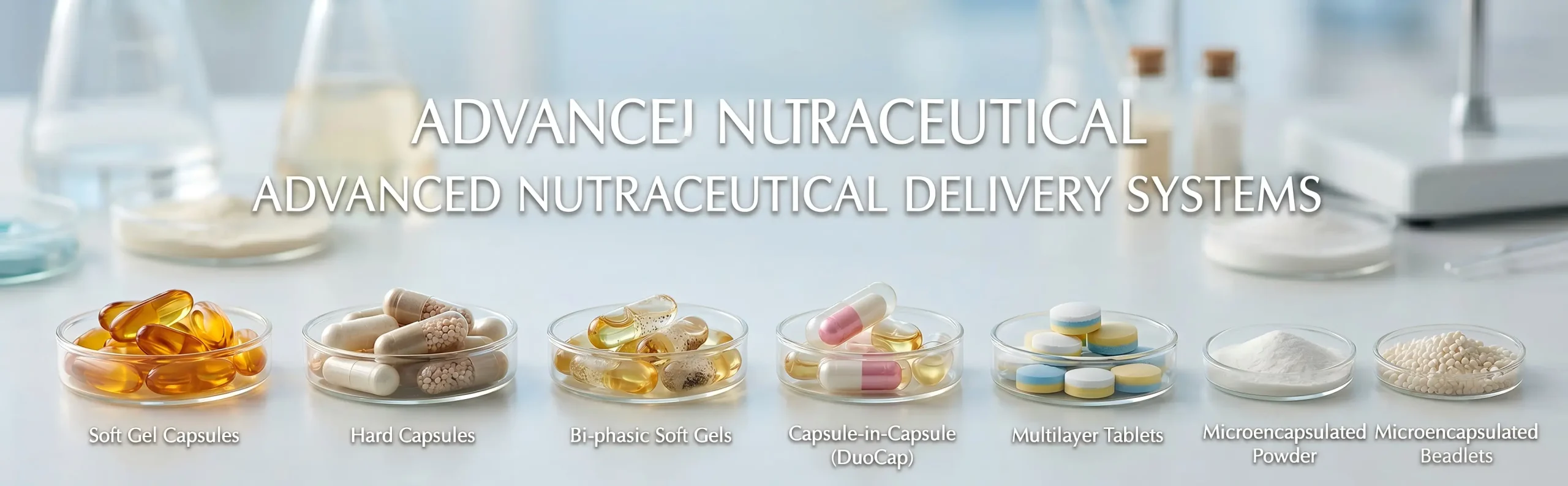
Advanced Nutraceutical Delivery Systems & Multi-Phase Supplement Formulation Engineering
Explore advanced nutraceutical delivery technologies including liquid-filled capsules, beadlet systems, capsule-in-capsule engineering, controlled-release delivery, lipid microencapsulation, and stability-focused supplement manufacturing for premium wellness brands.
Why Delivery Technology Has Become a Competitive Advantage
In today’s nutraceutical market, ingredient selection alone is no longer enough to create product differentiation.
Global supplement buyers are increasingly evaluating:
- Bioavailability performance
- Stability during shelf life
- Sensory experience
- Ingredient compatibility
- Consumer compliance
- Premium dosage form innovation
- Manufacturing scalability
- Regulatory and export readiness
Many high-value ingredients fail commercially not because of weak efficacy, but because of formulation instability, oxidation, moisture sensitivity, ingredient interaction, unpleasant sensory properties, or poor consumer adherence.
Common industry challenges include:
- Fish oils developing oxidation issues before end-of-shelf-life
- Probiotics losing viability during transportation
- Botanical actives interacting inside standard capsules
- Hygroscopic powders causing capsule softening
- Bitter actives reducing repeat purchase rates
- Multi-active formulas suffering segregation or fill inconsistency
- Premium brands lacking visible dosage differentiation
Advanced delivery engineering addresses these formulation bottlenecks through controlled release systems, multi-phase encapsulation, lipid protection technologies, and industrial stability optimization.
Our platform supports the development and commercial manufacturing of high-complexity nutraceutical dosage forms for global OEM and ODM supplement brands.
Liquid-Filled Hard Capsule (LFHC) Technology
Liquid-filled hard capsules combine the structural stability of hard-shell capsules with the absorption advantages of liquid delivery systems.
This technology is increasingly used in premium supplements because many lipophilic nutrients demonstrate improved dispersion and faster dissolution in liquid matrices compared with conventional dry powder systems.
Typical Challenges Solved
- Oil leakage during transportation
- Oxidation of sensitive lipid ingredients
- Poor dispersibility of fat-soluble nutrients
- Powder segregation in combination formulas
- Consumer preference for premium dosage forms
Suitable Ingredient Systems
- Omega-3 oils
- CoQ10
- Curcumin lipid complexes
- CBD-free hemp oils
- Fat-soluble vitamins
- Herbal oil extracts
- Liposomal nutrients
- Specialty phospholipid systems
Engineering Focus Areas
Successful LFHC manufacturing depends on precise control of:
- Viscosity behavior
- Capsule shell compatibility
- Oxygen exposure
- Seal integrity
- Fill temperature
- Humidity management
- Oil migration risk
- Oxidative stability
Commercial Benefits
- Premium product positioning
- Better fill uniformity
- Reduced ingredient separation
- Improved appearance consistency
- Enhanced consumer perception
- Stronger differentiation versus standard capsules
In high-end wellness categories, liquid-filled capsules often achieve significantly higher perceived value than standard powder capsules.
Multi-Particulate Beadlet Technology
Beadlet systems use precision-engineered particles to separate, protect, and release active ingredients under controlled conditions.
This technology is widely used when formulations require ingredient isolation, staged nutrient release, or enhanced stability.
Why Brands Use Beadlet Systems
Standard powder blending creates several technical limitations:
- Uneven active distribution
- Nutrient degradation
- Incompatible ingredient interaction
- Limited release control
- Moisture sensitivity
- Reduced shelf stability
Beadlet engineering helps solve these issues by physically protecting sensitive actives within specialized carrier structures.
Common Applications
- Delayed-release probiotics
- Multi-stage vitamin delivery
- Gastrointestinal wellness products
- Time-release energy systems
- Enzyme protection systems
- Sensitive botanical actives
Functional Advantages
- Controlled release performance
- Improved active survivability
- Better processing stability
- Reduced cross-interaction
- Enhanced flowability
- Higher formulation flexibility
Market Positioning Advantages
Beadlet formulations also create visual differentiation inside transparent capsules, helping brands communicate advanced technology positioning directly to consumers.
Capsule-in-Capsule Delivery Systems
Capsule-in-capsule systems enable two independent delivery environments within a single dosage form.
This technology is commonly used for formulations containing incompatible actives, dual-phase release objectives, or premium positioning requirements.
Problems Solved
Many advanced formulations experience instability because sensitive ingredients interact during storage.
Examples include:
- Probiotics exposed to moisture-sensitive actives
- Oxidation-sensitive oils mixed with reactive powders
- Enzymes destabilized by acidic compounds
- Fast-release and sustained-release ingredients competing within one blend
Capsule-in-capsule engineering physically separates these actives until consumption.
Suitable Product Concepts
- Oil + powder combinations
- Day/night formulations
- Fast-release + sustained-release systems
- Multi-functional wellness formulas
- Advanced sports nutrition products
- Practitioner-grade nutraceuticals
Technical Advantages
- Independent ingredient protection
- Sequential nutrient release
- Reduced compatibility conflicts
- Enhanced dosage sophistication
- Premium visual presentation
- Flexible formulation architecture
Commercial Value
Capsule-in-capsule formats are increasingly used in premium wellness products because they immediately communicate formulation complexity and technological sophistication.
Tablet-in-Capsule Technology
Tablet-in-capsule systems combine coated tablets with capsule-based delivery to create structured multi-phase release profiles.
This dosage form is particularly useful when certain ingredients require delayed release, targeted protection, or physical separation.
Typical Use Cases
- Gut-targeted delivery systems
- Delayed-release probiotics
- Botanical combinations
- Sustained energy products
- Multi-phase recovery formulas
- Sensitive active protection
Engineering Challenges
Tablet-in-capsule manufacturing requires high-precision process control, including:
- Dimensional tolerance management
- Tablet coating stability
- Capsule alignment accuracy
- Filling synchronization
- Mechanical integrity validation
Industrial Advantages
- Advanced release customization
- Higher formulation flexibility
- Better ingredient isolation
- Improved shelf-life control
- More sophisticated product architecture
Lipid Microencapsulation Technology
Many nutraceutical actives are highly sensitive to oxygen, moisture, heat, or gastric conditions.
Lipid microencapsulation creates protective carrier structures around active ingredients to improve stability, sensory performance, and survivability.
Key Problems Addressed
- Fish oil oxidation
- Garlic odor issues
- Bitter botanical taste
- Volatile ingredient degradation
- Moisture-sensitive actives
- Reduced probiotic survivability
Functional Benefits
- Taste masking
- Odor reduction
- Oxidation protection
- Controlled release capability
- Improved sensory acceptance
- Enhanced shelf stability
Common Ingredient Categories
- Fish oils
- Garlic extracts
- Curcumin
- Fermented ingredients
- Volatile botanicals
- Sulfur-containing compounds
- Sensitive probiotic systems
Consumer Compliance Impact
Poor sensory experience is one of the leading causes of low long-term supplement adherence.
Microencapsulation helps improve repeat purchase behavior by reducing unpleasant aftertaste, odor, and swallowing discomfort.
Controlled-Release & Targeted Delivery Engineering
Controlled-release technologies are designed to regulate when, where, and how nutrients are released within the gastrointestinal tract.
This is particularly important for ingredients that require prolonged exposure, gastric protection, or intestinal targeting.
Common Release Strategies
- Immediate release
- Sustained release
- Delayed release
- Enteric delivery
- Multi-stage release
- Site-specific targeting
Typical Product Applications
- Gut health supplements
- Probiotic systems
- Sports nutrition
- Energy management formulas
- Sleep support products
- Recovery supplements
Technical Variables
Release behavior is influenced by:
- Polymer systems
- Encapsulation structure
- Coating thickness
- Lipid matrix composition
- Moisture permeability
- Particle size engineering
Strategic Advantages for Brands
Controlled-release systems help brands create:
- Longer-lasting performance claims
- Premium product positioning
- Improved user experience
- Advanced technology differentiation
- Better active protection
Sensory Optimization & Consumer Compliance Engineering
Consumer retention increasingly depends on daily usability, not just ingredient potency.
Even clinically strong formulations can fail commercially when they create:
- Fishy burps
- Bitter aftertaste
- Strong odor
- Swallowing discomfort
- Powder residue issues
Sensory Engineering Solutions
Our formulation platform supports:
- Odor suppression systems
- Taste masking technologies
- Swallowability optimization
- Delayed sensory release
- Lipid barrier protection
- Texture optimization
High-Risk Ingredient Categories
- Fish oils
- Fermented compounds
- Sulfur ingredients
- Functional mushrooms
- Bitter herbal extracts
- Mineral complexes
Business Impact
Improved sensory performance often contributes directly to:
- Higher repeat purchase rates
- Better subscription retention
- Reduced customer complaints
- Stronger premium positioning
- Improved product reviews
Stability Engineering & Packaging Compatibility
Advanced formulations require integrated stability planning from the earliest development stage.
A technically advanced formula can still fail commercially if packaging systems cannot maintain stability during global distribution.
Common Stability Risks
- Oxygen exposure
- Moisture migration
- Capsule softening
- Oil oxidation
- UV degradation
- Release profile drift
- Active potency reduction
Stability Engineering Areas
- Water activity control
- Oxygen management
- Nitrogen flushing
- Moisture barrier optimization
- Thermal stability assessment
- Accelerated stability testing
- Packaging compatibility validation
Packaging Systems Supported
- Blister packaging
- Aluminum barrier systems
- HDPE containers
- Desiccant-integrated bottles
- UV-protective packaging
- Nitrogen-flushed containers
Why This Matters for International Buyers
Cross-border supplement distribution often exposes products to:
- High humidity
- Temperature fluctuation
- Extended shipping duration
- Warehouse instability
- Seasonal climate stress
Stability-focused engineering helps reduce product failure risk across international supply chains.
Industrial Manufacturing for Complex Dosage Forms
Commercializing advanced delivery systems requires far more than formulation development.
Scalable manufacturing demands process control systems capable of maintaining:
- Fill accuracy
- Release consistency
- Encapsulation integrity
- Moisture stability
- Production repeatability
- Batch-to-batch uniformity
Manufacturing Capabilities
Our infrastructure supports:
- Powder encapsulation
- Liquid filling
- Beadlet systems
- Capsule-in-capsule assembly
- Tablet-in-capsule formats
- Multi-phase formulations
- Controlled-release systems
Technical Manufacturing Support
- Scale-up engineering
- Process validation
- Leakage prevention
- Powder flow optimization
- Oxygen exposure reduction
- Stability-focused filling environments
- Packaging integration support
OEM & ODM Support
We support:
- Formula customization
- Private label manufacturing
- Pilot batch development
- Commercial scale production
- International export projects
- Regulatory-oriented product adaptation
Suitable for High-Growth Supplement Categories
Our advanced delivery platform supports complex formulations across multiple nutraceutical sectors.
Common Product Categories
- Gut health supplements
- Healthy aging products
- Sports nutrition systems
- Cognitive wellness formulas
- Immune support supplements
- Functional mushroom products
- Lipid-based nutraceuticals
- Practitioner-grade wellness systems
Typical Client Profiles
- Premium supplement brands
- Practitioner brands
- Amazon and DTC sellers
- Functional wellness startups
- International distributors
- Cross-border nutraceutical companies
Advanced Delivery Systems Are Reshaping Supplement Manufacturing
The global nutraceutical industry is moving rapidly toward higher-value, science-positioned, and experience-driven products.
As ingredient competition intensifies, delivery technology is becoming one of the most important differentiators in premium supplement development.
Brands that invest in advanced encapsulation, controlled release engineering, stability optimization, and multi-phase formulation systems are increasingly able to achieve:
- Stronger product differentiation
- Higher perceived value
- Better consumer adherence
- Improved shelf stability
- Greater formulation flexibility
- Enhanced international competitiveness
Through integrated formulation science, industrial process engineering, and scalable manufacturing infrastructure, advanced nutraceutical delivery systems help transform complex product concepts into commercially viable, premium-market supplement products.