
Why Natural Astaxanthin from Sunlight-Grown Haematococcus Outperforms
Engineered Cultivation. Verified Performance. Designed for End Products.
Executive Summary:
In astaxanthin production, extraction does not define quality—cultivation does.
For brands and formulators, this means that the choice of cultivation system directly impacts bioactivity, stability, regulatory compliance, batch consistency, and final product positioning.
At our production base, we implement a natural sunlight-driven column photobioreactor (PBR) system, combined with controlled two-stage cultivation and application-oriented processing. This integrated approach allows us to deliver:
- Consistent astaxanthin content
- Stable supply at an industrial scale
- Natural-origin ingredients suitable for global markets
- Technical support aligned with end-product performance
This is not simply raw material manufacturing—it is a process designed around final application outcomes.
Scientific Background: Why Haematococcus pluvialis Matters
Haematococcus pluvialis is widely recognized as the most concentrated natural source of astaxanthin, a carotenoid with strong antioxidant activity.
This biological process follows two distinct phases:
Growth Phase (Green Stage)
- Rapid biomass accumulation
- High chlorophyll content
- Minimal carotenoid accumulation
Induction Phase (Red Stage)
- Triggered by light, nutrient limitation, and oxidative stress
- Accumulation of astaxanthin as intracellular protection
- Transformation into red cyst cells
Efficient production depends on precise control of this transition—not just exposure to stress.
Our Cultivation Strategy: Natural Sunlight Column Photobioreactors (PBR)
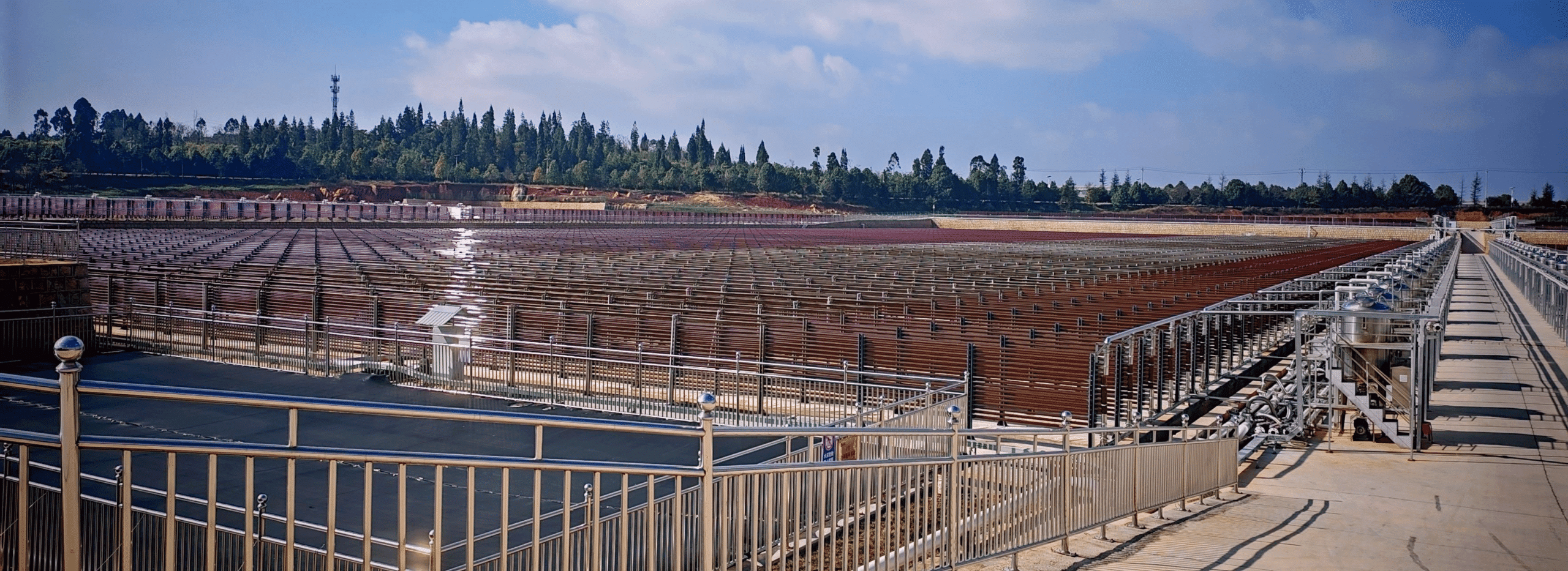
We have adopted a closed column photobioreactor system powered primarily by natural sunlight, designed to balance biological authenticity with industrial control.
(1) Why Natural Sunlight Matters?
Natural sunlight provides a dynamic full-spectrum irradiance profile (0–2000 μmol/m²/s) across the diurnal cycle.
This diel variation:
- Supports circadian metabolic regulation
- Enhances carotenogenic pathway activation
- Avoids spectral limitations of artificial light systems
Compared to fixed-spectrum LEDs, this enables more physiologically relevant stress responses.
(2) Engineering Design of Column PBR Systems
Our cultivation system is based on vertically arranged column photobioreactors designed for optimal light utilization and mass transfer.
Typical design considerations include:
| Parameter | Typical Range | Functional Role |
| Reactor diameter | 0.1 – 0.3 m | Light penetration control |
| Height-to-diameter ratio | 8:1 – 15:1 | Vertical light distribution |
| Light path | < 10 cm | Minimize self-shading |
| Gas flow rate | 0.2 – 0.5 vvm | CO₂ supply and mixing |
| Temperature | 20–30°C | Phase-specific optimization |
Mixing is typically achieved through airlift-driven circulation, which ensures:
- Low shear stress (<1 Pa estimated)
- Uniform exposure to light/dark cycles
- Efficient CO₂/O₂ mass transfer
(3) Photobioreactor Light Regime Modeling
Light attenuation in the reactor follows the Lambert–Beer law:
I(z) = I₀ · exp(-ε·C·z)
Where:
- I₀ = incident light intensity
- ε = biomass-specific absorption coefficient
- C = biomass concentration
- z = optical path
System design maintains:
- Adequate average irradiance throughout the culture
- Minimal photoinhibition zones under peak sunlight
- Controlled light gradients for efficient photosynthesis
(4) Two-Stage Cultivation Control Strategy
Phase Transition Criteria
The shift from growth to induction is triggered based on:
- Biomass density threshold
- Nutrient depletion (especially nitrogen)
- Cell morphology consistency
- Optical density monitoring
Induction Parameters
Typical controlled adjustments include:
- Increased light exposure (full sunlight conditions)
- Nitrogen limitation
- Moderate temperature elevation
- Optional osmotic stress
Induction duration typically ranges from 7–14 days, depending on environmental conditions and system design.
Performance Metrics (Industrial Observations + Literature Context)
Under optimized closed-system conditions, reported values typically fall within:
| Metric | Closed PBR Systems | Open Pond Systems | Notes |
| Astaxanthin content | 4–6% DW | 1–2% DW | (Boussiba, 2000; Ambati et al., 2014) |
| Biomass productivity | 0.5–1.5 g/L | Lower variability | System-dependent |
| Process consistency | High | Variable | Environmental sensitivity |
| Contamination risk | Low | Higher | Open exposure |
These values represent industry-aligned ranges, with performance dependent on site-specific conditions.
Comparison of Cultivation Systems
Understanding the differences between cultivation systems is critical for evaluating ingredient quality.
Open Raceway Ponds
- Low cost
- High variability
- Contamination exposure
Artificial Light Systems
- High controllability
- High energy consumption
- Limited spectral range
Natural Sunlight Column PBR (Our Approach)
- Controlled environment + natural energy input
- Balanced performance in yield, cost, and sustainability
- Suitable for high-quality astaxanthin production
From Cultivation to Extraction: Process-Oriented Quality Control
Astaxanthin is sensitive to:
- Heat
- Oxygen
- Light
Therefore, upstream biomass quality directly affects:
- Extraction efficiency
- Stability during storage
- Final product performance
Our process design emphasizes: Controlled cultivation → Protected extraction → Application-ready ingredients
Extraction Strategy and Application Alignment
Different applications require different extraction approaches.
Key Principles:
- Low-temperature(<50°C)processing to minimize degradation
- Controlled exposure to oxygen and light
- Optional use of supercritical CO₂ extraction, depending on product requirements
This ensures:
- Stable pigment profile
- Reduced oxidation risk
- Compatibility with food, supplement, and cosmetic applications
| Application Goal | Recommended Approach | Key Consideration |
| High-purity oil | Supercritical CO₂ | Solvent-free, controlled temperature |
| Cost-efficient bulk | Food-grade solvent extraction | Requires further refinement |
| Water-dispersible systems | Emulsification + drying | Improved bioaccessibility |
| Cosmetic applications | Deodorized fractions | Sensory optimization |
Natural vs. Synthetic Astaxanthin: Scientific Perspective
Natural astaxanthin differs structurally from synthetic forms.
Key Differences:
Structural Differences:
Natural: predominantly 3S,3’S stereoisomer (>90%)
Synthetic: mixture of stereoisomers composition
Chemical Form:
Natural: mainly esterified forms (mono- and di-esters)
Synthetic: free form
Functional Implications:
Esterified forms contribute to greater oxidative stability
Several studies suggest differences in bioavailability and biological activity
(e.g., Tominaga et al., 2012; Ambati et al., 2019)
Stability and Formulation Considerations
Astaxanthin performance depends heavily on formulation context.
General Stability Observations
- Stable under controlled temperature and low oxygen exposure
- Sensitive to high heat and prolonged UV exposure
Formulation Compatibility
| System | Compatibility | Notes |
| Fish oil | Excellent | Synergistic antioxidant effect |
| MCT oil | Excellent | Clear solutions |
| Powder systems | Moderate | Requires encapsulation |
| Emulsions | Good | pH-sensitive (optimal ~5–7) |
Sustainability Considerations
Natural sunlight-based systems offer several potential environmental advantages:
- Reduced reliance on artificial lighting → lower energy demand
- Closed-loop water management → minimized water loss
- Vertical reactor design → improved land-use efficiency
It should be noted that sustainability performance depends on:
- Geographic conditions
- Operational scale
- System optimization
Quality Assurance and Compliance
To support global market access, production systems are aligned with international standards:
- cGMP (current Good Manufacturing Practices)
- ISO 22000 / HACCP
- Halal and Kosher certifications
Quality control includes:
- Heavy metals within regulatory limits
- Microbiological testing (TPC, yeast & mold, pathogens)
- Residual solvent analysis
Each batch is supported by a Certificate of Analysis (COA), traceable production records and third-party testing when required.
Technical Challenges and Process Optimization
Natural cultivation systems present operational challenges that require active management.
Key Challenges & Solutions:
Light fluctuation
Managed through culture density control and system design
Temperature variation
Controlled via circulation systems and passive cooling strategies
Photo-inhibition under high irradiance
Mitigated by optimizing light path and mixing efficiency
These controls are essential to maintain process stability and consistent yield.
Designed for End-Product Performance
Our approach is not limited to raw material production.
We work backwards from the final application:
For Dietary Supplements Brands:
Focus on stability and bioavailability
Compatible with softgels and oil suspensions
For Functional Food Developers:
Emphasis on dispersibility and color consistency
For Cosmetic Formulators:
Stability under formulation conditions (Sensory neutrality)
Controlled oxidation profile
Integrated Capability and Partnership Approach
We provide a vertically integrated system:
- Strain selection and preservation
- Controlled cultivation base
- Industrial-scale production
- Extraction and formulation support
This enables:
- Batch consistency
- Scalable supply
- Reduced development risk for customers
We support different stages of customer development:
Standard Supply
- Ready-to-use materials
- Defined specifications
Custom Development
- Tailored concentrations and carriers
- Application testing support
Strategic Collaboration
- Long-term supply planning
- Co-development of formulations
Conclusion
In the astaxanthin value chain, cultivation is not just the first step—it is the most critical step.
Astaxanthin quality is not defined by a single process step.
It is the result of:
- Controlled biological cultivation
- Engineered production systems
- Application-oriented processing
We deliver an ingredient designed not only for purity—but for real-world performance in finished products.
Work With Us
If you are developing:
- Premium dietary supplements
- Functional beverages or foods
- Advanced cosmetic formulations
Our team can support you from raw material selection to formulation strategy.
Contact us to discuss your project requirements and technical specifications.
References
- Boussiba, S. (2000).
Carotenogenesis in Haematococcus pluvialis: Cellular physiology and stress response.
Physiologia Plantarum, 108(2), 111–117.
https://onlinelibrary.wiley.com/doi/10.1034/j.1399-3054.2000.108002111.x - Lorenz, R. T., & Cysewski, G. R. (2000).
Commercial potential for Haematococcusmicroalgae as a natural source of astaxanthin.
Trends in Biotechnology, 18(4), 160–167.
https://linkinghub.elsevier.com/retrieve/pii/S0167779900014335 - Shah, M. M. R., Liang, Y., Cheng, J. J., & Daroch, M. (2016).
Astaxanthin-producing green microalga Haematococcus pluvialis: From single cell to high value commercial products.
https://www.frontiersin.org/journals/plant-science/articles/10.3389/fpls.2016.00531/full - Ambati, R. R., Phang, S. M., Ravi, S., & Aswathanarayana, R. G. (2014).
Astaxanthin: Sources, extraction, stability, biological activities and its commercial applications.
Marine Drugs, 12(1), 128–152.
https://doi.org/10.3390/md12010128 - Panis, G., & Carreon, J. R. (2016).
Commercial astaxanthin production derived by Haematococcus pluvialis: Process model and techno-economic assessment.
Algal Research, 18, 175–190.
https://doi.org/10.1016/j.algal.2016.06.007 - Mota, G. C. P., et al. (2022).
Astaxanthin from Haematococcus pluvialis: Processes, applications, and market.
https://www.tandfonline.com/doi/abs/10.1080/10826068.2021.1966802 - Mularczyk, M., Michalak, I., & Marycz, K. (2020).
Astaxanthin and other nutrients from Haematococcus pluvialis—Multifunctional applications.
https://pmc.ncbi.nlm.nih.gov/articles/PMC7551667/ - Régnier, P., et al. (2015).
Astaxanthin from Haematococcus pluvialisprevents oxidative stress on human endothelial cells without toxicity.
https://pmc.ncbi.nlm.nih.gov/articles/PMC4446609/